
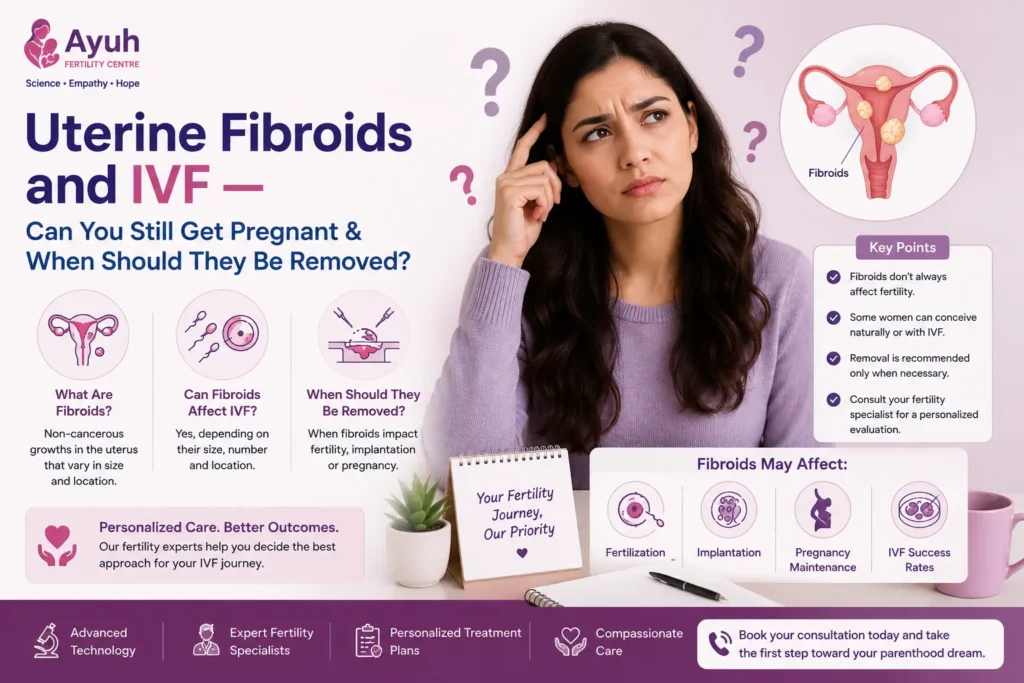
Uterine fibroids and IVF treatment Ahmedabad is one of the most common concerns women search for the moment fibroids are found while they’re planning a pregnancy — and Priya’s story is a familiar one. She was 32, six months into planning her first pregnancy, when a routine ultrasound showed something she hadn’t expected — three small fibroids in her uterus. She left the scan room in tears, convinced her chances of ever becoming a mother had just disappeared.
If you’ve recently been told you have fibroids, that same wave of fear and confusion is completely understandable. The words “you have fibroids” can feel overwhelming, especially when pregnancy is already on your mind.
Here is what’s genuinely reassuring: fibroids are extremely common, and a large number of women with fibroids go on to conceive successfully — either naturally or with the support of IVF. Dr. Krupa M. Shah, a fertility specialist in Ahmedabad, sees this exact situation regularly at Ayuh Fertility Centre, and the first thing she tells patients is this: not every fibroid needs surgery, and not every fibroid stands between you and a healthy pregnancy.
This guide explains, calmly and clearly, how fibroids relate to fertility and IVF — and how a fertility specialist actually decides what your specific case needs.
Author Bio
Dr. Krupa A. Shah MBBS · MS (Obstetrics & Gynaecology) · Infertility Specialist Founder, Ayuh Fertility Centre, Ahmedabad
19+ Years of Experience in reproductive medicine, obstetrics, and gynaecology.
Dr. Krupa Shah completed her MBBS from Baroda Medical College (2006) and her MS in Obstetrics & Gynaecology from B.J. Medical College, Ahmedabad (2010). After 12 years of experience at leading clinics in Chennai — including Apollo Hospital and Iswarya Fertility Centre — she completed an Advanced IVF Fellowship at Ludwig Maximilians University, Munich, Germany, one of Europe’s most prestigious reproductive medicine institutions.
She is a member of the Ahmedabad Obstetrics and Gynaecology Society (AOGS), the Indian Society of Assisted Reproduction (ISAR), and the Federation of Obstetric and Gynaecological Societies of India (FOGSI).
IVF laboratory is ART National Board Certified.
🩺 Medically Reviewed By
This article is medically reviewed by Dr. Krupa M. Shah, ensuring accurate and reliable fertility information.
What Are Uterine Fibroids?
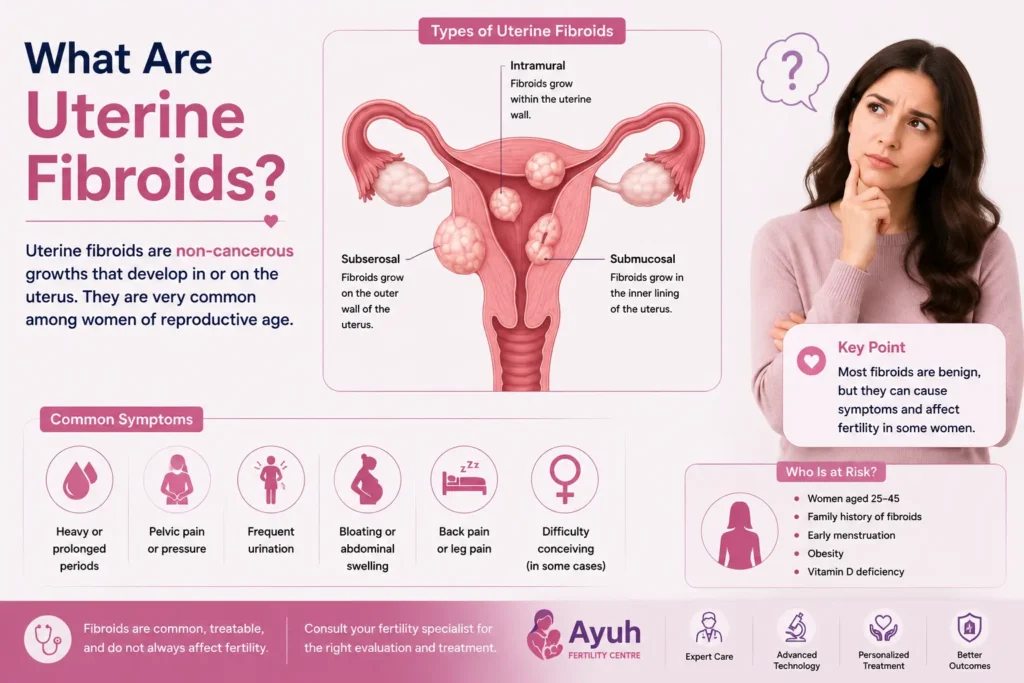
Uterine fibroids (also called myomas or leiomyomas) are non-cancerous growths that develop in or around the wall of the uterus. They are made of muscle and fibrous tissue, and they can range from as small as a pea to as large as a grapefruit.
A few important facts to start with:
- Fibroids are very common. Many women develop at least one fibroid at some point in their reproductive years, often without ever knowing it.
- They are not cancer. Fibroids are benign growths, and the vast majority never turn into anything malignant.
- Why they develop isn’t fully understood, but hormones — particularly oestrogen and progesterone — appear to influence their growth, which is why fibroids can shrink after menopause.
- Sizes vary enormously. Some fibroids stay tiny and are found only by accident during a scan. Others grow large enough to change the shape of the uterus.
The presence of a fibroid, on its own, does not tell you whether it will affect your fertility. What matters far more is where the fibroid is located, how large it is, and whether it distorts the uterine cavity — the space where an embryo needs to implant.
Types of Fibroids and Their Impact on Fertility
Not all fibroids behave the same way. Understanding the type helps explain why your fertility specialist may recommend very different plans for two women who both have “fibroids.”
Submucosal Fibroids
Location: Just under the lining of the uterus, bulging into the uterine cavity. Symptoms: Heavy periods, prolonged bleeding, cramping. Fertility impact: These have the greatest impact on fertility and IVF success, because they directly distort the space where the embryo implants. Pregnancy impact: Linked to higher rates of implantation failure and miscarriage when left untreated.
Intramural Fibroids
Location: Within the muscular wall of the uterus itself. Symptoms: Can be silent, or cause heaviness, pressure, or heavier periods depending on size. Fertility impact: Impact depends heavily on size and whether they push into the cavity. Small ones often cause no issue at all. Pregnancy impact: Larger intramural fibroids may affect blood flow to the uterine lining, which can influence implantation.
Subserosal Fibroids
Location: On the outer surface of the uterus. Symptoms: Often none, unless very large — may cause pressure on the bladder or bowel. Fertility impact: Generally the least likely to affect fertility, since they don’t touch the uterine cavity. Pregnancy impact: Rarely a direct concern unless size is significant.
Pedunculated Fibroids
Location: Attached to the uterus by a thin stalk, can be inside or outside the uterus. Symptoms: Depends on location — can cause pain if the stalk twists. Fertility impact: Usually low, unless the stalk connects to a submucosal position inside the cavity. Pregnancy impact: Case-dependent; your specialist will assess the exact position.
Fibroid Type vs Fertility Impact vs Need for Surgery
| Fibroid Type | Typical Fertility Impact | Surgery Usually Needed? |
|---|---|---|
| Submucosal | High — distorts uterine cavity | Often yes, before IVF |
| Intramural (large or cavity-distorting) | Moderate to high | Sometimes, case-dependent |
| Intramural (small, not touching cavity) | Low | Usually not |
| Subserosal | Low | Rarely |
| Pedunculated | Low to moderate, depends on position | Rarely, unless symptomatic |
Can Fibroids Affect IVF Success?
This is the question most women searching for can fibroids affect IVF success India actually want answered — and the honest response is: it depends on the fibroid, not on the diagnosis itself.
Fibroids can potentially affect IVF outcomes through a few mechanisms:
- Uterine cavity distortion — Submucosal or cavity-distorting intramural fibroids can physically interfere with where an embryo would implant.
- Blood supply to the uterus — Larger fibroids may alter blood flow to the endometrial lining, which can affect how receptive the lining is to an embryo.
- Implantation — A distorted or inflamed cavity lining can make it harder for an embryo to attach successfully.
- Embryo development — Fibroids do not affect the embryo itself, but they can affect the environment the embryo is placed into.
- Miscarriage risk — Some studies associate submucosal and larger intramural fibroids with a modestly increased miscarriage risk, particularly when the cavity is distorted.
What’s important to understand is this: not all fibroids reduce IVF success. Small, non-cavity-distorting fibroids — particularly subserosal ones — often have little to no measurable effect on IVF outcomes. This is exactly why a blanket answer (“fibroids are bad for IVF”) isn’t medically accurate, and why individual evaluation matters so much.
Uterine Fibroids and IVF Treatment in Ahmedabad — What Fertility Specialists Evaluate
When a patient comes in for uterine fibroids and IVF treatment in Ahmedabad, Dr. Krupa Shah doesn’t look at the fibroid diagnosis alone — she looks at the complete clinical picture. This evaluation typically includes a detailed ultrasound and diagnostic workup to assess:
- Fibroid size — Larger fibroids (generally above 4–5 cm) are watched more closely, though size alone isn’t the deciding factor.
- Number of fibroids — Multiple fibroids can have a cumulative effect even if each one is individually small.
- Location — This is often the single most important factor, since cavity-distorting fibroids carry the most fertility relevance.
- Symptoms — Heavy bleeding, pain, or pressure symptoms may independently justify treatment, separate from fertility concerns.
- Uterine cavity involvement — Assessed through ultrasound or, when needed, hysteroscopy, which allows direct visual examination of the cavity.
- Previous pregnancy history — Prior miscarriages or failed implantation can shift the recommendation toward treating a fibroid that might otherwise be left alone.
This is why treatment is always individualised rather than following a fixed rule. Two patients with a “3 cm fibroid” can receive completely different recommendations depending on exactly where that fibroid sits and what their reproductive history looks like.
When Should Fibroids Be Removed Before IVF?
Surgery before IVF is generally considered when the fibroid is genuinely likely to interfere with implantation or pregnancy. Situations where a fertility specialist commonly recommends myomectomy before IVF in Gujarat include:
- Submucosal fibroids — because these sit directly in the implantation zone, removal is usually advised regardless of size.
- Large intramural fibroids — especially those distorting or pressing into the uterine cavity.
- Distorted uterine cavity — confirmed on ultrasound, hysteroscopy, or other imaging.
- Recurrent implantation failure — when previous embryo transfers haven’t resulted in pregnancy despite good-quality embryos, fibroids are one of several factors evaluated.
- Recurrent miscarriage — where a cavity-affecting fibroid may be a contributing factor.
- Large, symptomatic fibroids — significant bleeding, pain, or rapid growth may justify surgery for the patient’s overall health, separate from fertility planning.
In these situations, addressing the fibroid first is generally recommended because it gives the embryo the best possible uterine environment to implant into.
When Surgery May NOT Be Necessary
This section matters just as much as the one above — because plenty of women are told they need surgery when, medically, they may not.
Surgery is often not required when:
- The fibroid is small and subserosal, sitting outside the uterine cavity entirely.
- The fibroid is not affecting the uterine cavity on ultrasound or hysteroscopy.
- The patient has no symptoms — no heavy bleeding, pain, or pressure.
- The fibroid has shown a stable size on repeat scans over time.
In these cases, many fertility specialists will proceed directly with IVF while simply monitoring the fibroid, rather than putting the patient through unnecessary surgery, recovery time, and delay. If this describes your situation, it’s entirely reasonable to feel reassured rather than alarmed.
What Is Myomectomy?
Myomectomy is the surgical removal of fibroids while preserving the uterus — unlike a hysterectomy, which removes the uterus entirely. For women planning pregnancy, myomectomy is the standard fibroid-removal procedure.
There are three main approaches:
- Hysteroscopic myomectomy — Used for submucosal fibroids inside the uterine cavity. Performed through the cervix with no external incision, using a hysteroscope. Generally the least invasive option, with a shorter recovery.
- Laparoscopic myomectomy — Used for intramural or subserosal fibroids. Performed through small incisions using a laparoscope, offering a quicker recovery than open surgery.
- Open (abdominal) myomectomy — Reserved for very large fibroids, multiple fibroids, or complex cases where minimally invasive approaches aren’t suitable. Involves a longer recovery period.
The right approach depends entirely on the fibroid’s size, number, and location — your fertility specialist will recommend the least invasive option that safely and completely addresses your specific fibroids.
How Long Should You Wait for IVF After Myomectomy?
This is one of the most common practical questions patients ask, and the honest answer is: it varies by individual and by surgery type.
General guidance your specialist will personalise:
- Hysteroscopic myomectomy typically allows a shorter waiting period, often around 1–3 months, since the uterine wall itself isn’t cut.
- Laparoscopic or open myomectomy usually requires a longer healing window — commonly 3–6 months — to allow the uterine muscle to heal fully and regain strength before pregnancy.
- Uterine recovery is confirmed through follow-up scans, not just by how you feel. A healed-looking scar on imaging is what your doctor is watching for.
- Individual variation matters — the number and depth of fibroids removed, your healing response, and any complications during surgery can all shift this timeline.
Your fertility team will confirm you’re ready with imaging and a clinical review before starting your IVF cycle — this isn’t a step to rush, even when you’re eager to begin.
IVF Success After Fibroid Removal
For women whose fibroids were distorting the uterine cavity, myomectomy can meaningfully improve the uterine environment for implantation. Patients and their specialists commonly see:
- Improved implantation conditions — once the cavity is no longer distorted, embryos have a more normal space to implant into.
- Better pregnancy chances in appropriate cases — particularly where the fibroid was clearly cavity-involving or symptomatic.
- A more favourable uterine environment overall — reduced abnormal bleeding and improved blood flow to the lining in many cases.
It’s important to be honest here: myomectomy is not a guarantee of IVF success. Pregnancy depends on many factors beyond the uterus — egg quality, sperm quality, embryo genetics, and overall reproductive health all still play their part. What removing a problematic fibroid does is take one identifiable obstacle out of the way, giving your embryo the best possible starting environment.
Pregnancy Risks With Fibroids
If you become pregnant with fibroids still present — whether naturally or through IVF — your care team will monitor for certain risks a little more closely:
- Miscarriage — particularly with cavity-distorting fibroids.
- Bleeding — some women experience spotting or bleeding during pregnancy, especially in the first trimester.
- Preterm birth — large fibroids are associated with a modestly increased risk in some studies.
- Placental problems — fibroids located near the placental attachment site can occasionally affect placental positioning or function.
- Delivery considerations — very large fibroids may influence the delivery plan, including the likelihood of a caesarean section.
This is why pregnancies in women with known fibroids are usually classified for closer monitoring under high-risk pregnancy care — not because complications are certain, but because early detection makes any issue far easier to manage. The large majority of women with fibroids carry perfectly healthy pregnancies to term.
Lifestyle Tips for Women With Fibroids Planning IVF
While no lifestyle change can eliminate fibroids, a few evidence-based habits support your overall reproductive health during this process:
- Maintain a healthy weight — since fat tissue produces oestrogen, which can influence fibroid growth.
- Eat a balanced diet — rich in vegetables, fruits, and whole grains supports overall hormonal and metabolic health.
- Stay physically active — regular moderate exercise supports circulation and general wellbeing.
- Manage stress — through rest, mindfulness, or activities that help you feel grounded during a demanding time.
- Keep up with medical follow-up — regular scans let your specialist track fibroid size and catch any changes early.
Be cautious of unverified “natural fibroid shrinking” remedies promoted online. There is no strong evidence that supplements, detoxes, or alternative therapies shrink fibroids, and relying on them can delay appropriate medical evaluation.
Common Myths About Fibroids and IVF
| Myth | Fact |
|---|---|
| Every fibroid causes infertility | Most fibroids, especially small subserosal ones, have little to no impact on fertility. |
| All fibroids require surgery | Many fibroids are simply monitored, particularly when they don’t affect the uterine cavity. |
| IVF never works with fibroids | Many women with fibroids conceive successfully through IVF, especially once cavity-relevant fibroids are addressed. |
| Fibroids always come back after surgery | Recurrence is possible but not universal — it depends on the number, type, and underlying cause. |
| Pregnancy is impossible with fibroids | The majority of women with fibroids can and do carry healthy pregnancies. |
Key Takeaways
- Fibroids are common, non-cancerous, and don’t automatically threaten your fertility.
- Location matters more than diagnosis alone — submucosal and cavity-distorting fibroids carry the most fertility relevance.
- Not every fibroid needs surgery before IVF; many can simply be monitored.
- When myomectomy is recommended, the approach (hysteroscopic, laparoscopic, or open) depends on your specific fibroids.
- Healing time before IVF varies — typically 1–3 months after hysteroscopic surgery, and 3–6 months after laparoscopic or open surgery.
- Myomectomy can improve implantation conditions, but it does not guarantee IVF success on its own.
- A personalised evaluation with a fertility specialist in Ahmedabad is the only reliable way to know what your specific case needs.
Checklist: Questions to Ask Your Fertility Specialist Before IVF
- What type of fibroid(s) do I have, and where exactly are they located?
- Is my uterine cavity affected?
- Do my fibroids need to be removed before starting IVF?
- If surgery is recommended, which type is best for my case?
- How long should I wait after surgery before starting IVF?
- Will my fibroids affect embryo transfer or increase pregnancy risk?
- How will my pregnancy be monitored if I conceive with fibroids still present?
- What are the realistic expectations for my specific situation?
FAQs-
Q1: Can I get pregnant with fibroids?
Yes, many women with fibroids conceive successfully, either naturally or with IVF support. Whether fibroids affect your specific chances depends largely on their size, number, and — most importantly — their location relative to the uterine cavity. Small fibroids that don’t distort the cavity often have no meaningful impact on pregnancy. A personalised evaluation with a fertility specialist is the best way to understand your individual outlook.
Q2: Do fibroids reduce IVF success?
Not all fibroids reduce IVF success. Submucosal and larger cavity-distorting intramural fibroids are the ones most associated with lower implantation rates, since they physically interfere with the space an embryo needs. Small subserosal or non-cavity-touching fibroids generally have little effect. This is why individualised assessment — rather than a blanket rule — determines your specific IVF plan.
Q3: Should all fibroids be removed before IVF?
No. Surgery is generally recommended for submucosal fibroids, large cavity-distorting intramural fibroids, or fibroids linked to recurrent implantation failure or miscarriage. Small, symptom-free, non-cavity-affecting fibroids are often simply monitored rather than surgically removed, since surgery carries its own recovery time and, in some cases, unnecessary risk.
Q4: What size fibroid affects fertility?
Size alone isn’t the deciding factor — location matters more. A small submucosal fibroid inside the uterine cavity can affect fertility more than a much larger subserosal fibroid on the outer uterine wall. As a general reference point, intramural fibroids above roughly 4–5 cm are watched more closely, but your specialist will always assess your case individually rather than relying on size alone.
Q5: How long after myomectomy can IVF begin?
This depends on the type of surgery performed. After hysteroscopic myomectomy, IVF can often begin within 1–3 months. After laparoscopic or open myomectomy, most specialists recommend waiting 3–6 months to allow the uterine wall to heal fully. Your doctor will confirm readiness through follow-up imaging rather than a fixed calendar date alone.
Q6: Are fibroids dangerous during pregnancy?
Fibroids can be associated with a modestly increased risk of certain complications, such as bleeding, preterm birth, or delivery considerations, particularly with larger or cavity-affecting fibroids. However, the majority of women with fibroids carry healthy pregnancies to term. Pregnancies with known fibroids are usually monitored a little more closely, which allows any issue to be identified and managed early.
Conclusion: Fibroids Don’t Have to Stand Between You and Motherhood
Being diagnosed with fibroids while planning uterine fibroids and IVF treatment in Ahmedabad can feel frightening at first — but a diagnosis is not a sentence. The location, size, and behaviour of your specific fibroids determine what — if anything — needs to be done before your IVF journey continues.
Dr. Krupa M. Shah and the team at Ayuh Fertility Centre believe every patient deserves an honest, individualised evaluation — not a fear-based assumption that fibroids mean the end of your fertility hopes. With the right assessment, the right timing, and the right treatment plan when needed, most women with fibroids go on to build the families they’ve been hoping for.
If you’ve recently been diagnosed with fibroids and are planning IVF, the most reassuring next step is a personalised consultation — where your specific case, not a generic worry, guides the conversation.
👉 Book your consultation with Ayuh Fertility Centre today
👉 Get expert guidance for PCOS and fertility treatment
👉 Start your journey toward a healthy and successful pregnancy
📍 Visit us in Ahmedabad
📞 Call now to schedule your appointment