
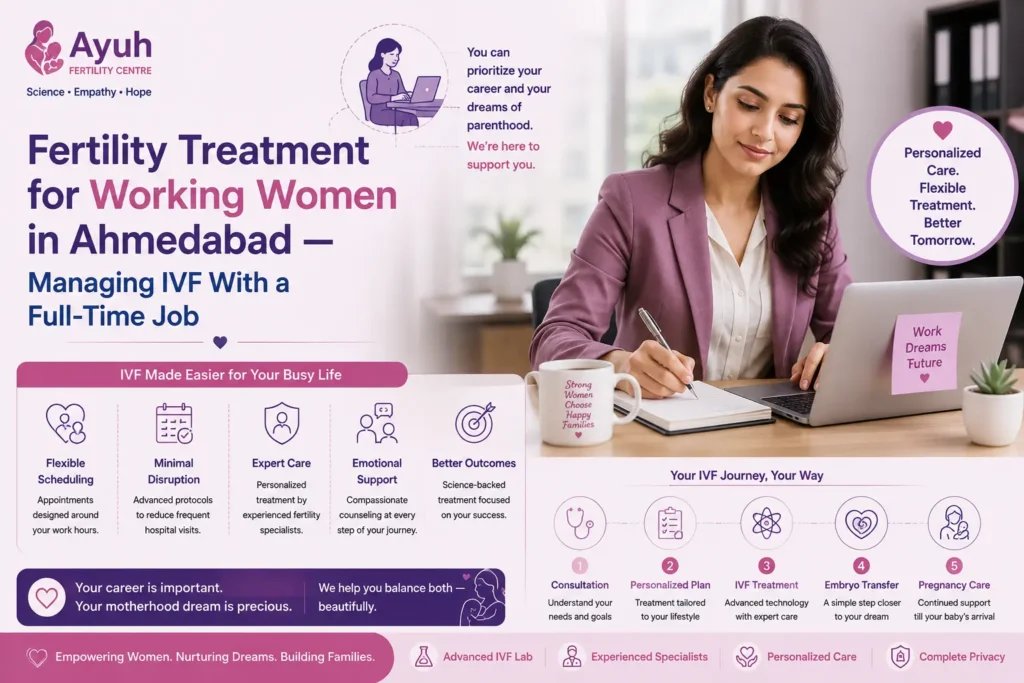
IVF treatment working women India is a topic more couples are searching for today than ever before — and for good reason. More Indian women are building strong careers while also planning families later in life, and the two goals often collide on the calendar. Between deadlines, meetings, and appointments, the question “can I really do IVF while working full-time?” comes up again and again.
The honest answer is yes, with the right planning. Dr. Krupa M. Shah, a fertility specialist in Ahmedabad at Ayuh Fertility Centre, works with corporate professionals, business owners, and healthcare staff every week who continue their jobs through treatment. This guide walks you through what that balance actually looks like — practically, medically, and emotionally.
Author Bio
Dr. Krupa A. Shah MBBS · MS (Obstetrics & Gynaecology) · Infertility Specialist Founder, Ayuh Fertility Centre, Ahmedabad
19+ Years of Experience in reproductive medicine, obstetrics, and gynaecology.
Dr. Krupa Shah completed her MBBS from Baroda Medical College (2006) and her MS in Obstetrics & Gynaecology from B.J. Medical College, Ahmedabad (2010). After 12 years of experience at leading clinics in Chennai — including Apollo Hospital and Iswarya Fertility Centre — she completed an Advanced IVF Fellowship at Ludwig Maximilians University, Munich, Germany, one of Europe’s most prestigious reproductive medicine institutions.
She is a member of the Ahmedabad Obstetrics and Gynaecology Society (AOGS), the Indian Society of Assisted Reproduction (ISAR), and the Federation of Obstetric and Gynaecological Societies of India (FOGSI).
IVF laboratory is ART National Board Certified.
🩺 Medically Reviewed By
This article is medically reviewed by Dr. Krupa M. Shah, ensuring accurate and reliable fertility information.
Can You Continue Working During IVF Treatment?
This is usually the first worry women bring up at their initial fertility consultation at Ayuh Fertility Centre. The good news: most women do not need complete bed rest or extended leave for the entire IVF process.
A few things to understand:
- Most IVF appointments — scans, bloodwork, injections — take 20 to 40 minutes.
- Only two days genuinely need dedicated time off: egg retrieval and embryo transfer.
- The rest of the cycle can often be worked around office hours with some planning.
That said, every body responds differently to stimulation medication. Some women feel completely normal; others feel bloated or tired during certain phases. This is exactly why personalised advice from your fertility specialist matters more than generic timelines you read online. Don’t plan your work calendar on assumptions — plan it after your first consultation, once your protocol is clear.
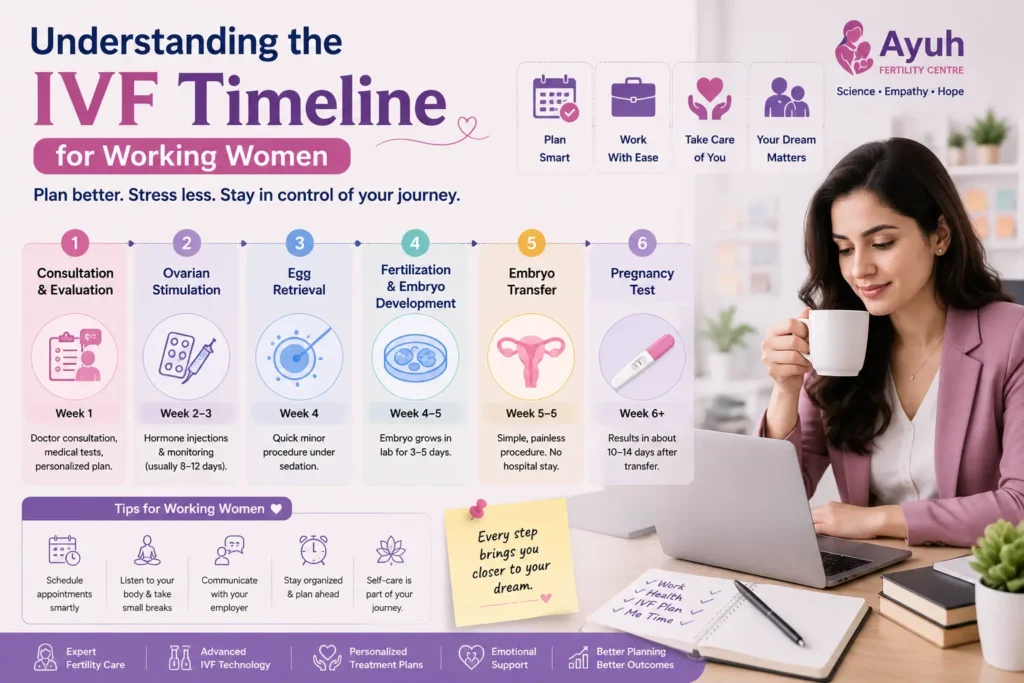
Understanding the IVF Timeline for Working Women
Knowing the stages ahead of time removes a lot of the anxiety. Here’s a simplified breakdown of what the IVF timeline typically looks like at Ayuh Fertility Centre:
- Initial Consultation — history review, discussion, and planning. Can usually be scheduled outside work hours.
- Fertility Testing — bloodwork and scans, typically quick, morning-friendly appointments.
- Ovarian Stimulation Phase — daily injections at home for about 10–14 days. No time off needed for this alone.
- Monitoring Scans — done every 2–3 days during stimulation using sonography. Short visits, can be scheduled early morning.
- Egg Retrieval — an ultrasound-guided egg pickup procedure under light sedation. You will need the day off, plus rest.
- Embryo Transfer — a short, precise embryo transfer procedure. Most women take that day off, sometimes the next day too.
- Pregnancy Test Waiting Period (Two-Week Wait) — normal activity is generally fine unless your doctor advises otherwise.
The stages that truly need flexibility are retrieval and transfer. Everything else can typically be managed around a working schedule.
How to Manage IVF and Work at the Same Time
Learning how to manage IVF and work at the same time comes down to preparation, not perfection. Some practical, realistic tips:
- Schedule early morning appointments. Ayuh Fertility Centre, like most fertility clinics, opens early specifically to accommodate monitoring scans for working patients.
- Mark your key dates first. Once your stimulation start date is known, block your calendar for retrieval and transfer before anything else gets scheduled.
- Communicate carefully at work. You don’t need to share full details — even a simple “I have a medical procedure that week” is enough for most managers.
- Manage your workload in advance. Try to clear major deadlines before your retrieval week so you’re not juggling both.
- Avoid unnecessary stress triggers. Say no to extra projects during your treatment month if you can.
- Rest when your body asks for it. Pushing through fatigue rarely helps — a slower week is not a setback.
Treat your IVF calendar the way you’d treat any important work project — with a plan, not last-minute scrambling.
How Many Leaves Are Needed During IVF?
There’s no single number that applies to everyone, but here’s a general guide based on typical patient experience:
| Stage | Typical Time Needed |
|---|---|
| Consultation visits | A few hours, 1–2 times |
| Monitoring scans | Short visits, several times over 10–14 days |
| Egg retrieval day | Full day off + light rest the next day |
| Embryo transfer day | Full day off, some prefer 1–2 days rest |
| Recovery time | Varies by individual response |
Some women manage the entire cycle with under a week of actual leave, spread out. Others, especially those with demanding travel-heavy jobs, prefer to take a short block of leave around retrieval and transfer. Both approaches are completely normal — this is a personal decision, best made after discussing your protocol with your doctor at Ayuh Fertility Centre.
IVF Leave Policy India — What Working Women Should Know
Understanding the IVF leave policy India maternity fertility landscape is important, but it’s equally important to know that there is currently no single, uniform national law guaranteeing paid fertility leave to every working woman in India. Policies vary significantly by:
- Company HR policy
- Whether your leave is categorised as medical leave, casual leave, or a special provision
- Sector (some larger corporates and MNCs have started introducing fertility-specific leave)
- State and organisation size
Some companies now offer defined fertility or IVF leave as part of progressive HR policies, while many others expect employees to use existing medical or casual leave. Before assuming what’s available to you, it’s worth checking directly with your HR department — policies differ enough between companies that generic information online should not be relied on for planning. Your team at Ayuh Fertility Centre can provide medical documentation to support whatever leave category your company requires.
Should You Tell Your Employer About IVF?
There is no universally “right” answer here — it depends on your workplace, your comfort level, and your role.
Reasons some women choose to share:
- Easier to request flexible timing without over-explaining
- Managers can plan around your appointment days
- Less pressure to hide fatigue or mood changes
Reasons some women choose to keep it private:
- Personal comfort and boundaries
- Concerns about workplace bias, fair or not
- Preferring to process the journey privately with close family only
Both choices are valid. Some women tell only their direct manager, others tell HR only for documentation purposes, and some keep it entirely confidential. Whatever you choose, it should be based on what makes you feel safest and most supported — not what anyone else’s journey looked like.
Managing IVF Injections With a Busy Work Schedule
Daily injections can feel intimidating at first, especially for women managing back-to-back meetings. A few things that help:
- Set a fixed time daily — most injections are timed for evening, which works well around office hours.
- Use phone reminders, not memory alone — cycles are already mentally demanding.
- Ask your clinic about storage instructions — some medications need refrigeration, which matters if you travel for work.
- Keep a small travel kit if you have client visits or outstation work during stimulation.
- Stay organised with a simple checklist — tick off each dose so nothing gets missed during a hectic week.
Your clinical team at Ayuh Fertility Centre will walk you through the exact technique and timing at your consultation, so this becomes routine within a few days.
Stress Management During IVF and Work
Balancing deadlines with daily injections and monitoring scans is genuinely demanding — acknowledging that is important, not weakness.
Helpful, realistic approaches:
- Mindfulness or short breathing breaks between meetings
- Protecting your sleep, especially during stimulation and the two-week wait
- Leaning on a support system — partner, close friend, or family member who knows what you’re going through
- Considering counselling support, which Ayuh Fertility Centre offers alongside medical treatment
It’s worth being clear: stress alone does not determine whether IVF succeeds or fails. Managing stress is about protecting your wellbeing through a demanding period — not about achieving a “perfect” emotional state for treatment to work.
IVF for Women With High-Pressure Careers
Corporate professionals, business owners, healthcare workers, teachers, and entrepreneurs all bring different scheduling challenges to IVF:
- Corporate professionals often manage back-to-back meetings — early morning scan slots work well here.
- Business owners and entrepreneurs have flexible but unpredictable hours — planning key dates around known busy periods helps.
- Healthcare workers deal with shift schedules — coordinating with your fertility clinic on rotating monitoring days is essential.
- Teachers work around fixed school hours — school holidays or lighter weeks can be ideal for scheduling retrieval or transfer.
Whatever your profession, the underlying principle is the same: plan your treatment timeline early, and build your work calendar around the two or three days that truly need flexibility. If male-factor infertility is also part of your case, treatments like ICSI can be planned into the same timeline without adding extra time off beyond the standard retrieval and transfer days.
Does Taking Rest Improve IVF Success?
There’s a common myth that strict, prolonged bed rest after embryo transfer improves outcomes. This isn’t well supported — normal, gentle daily activity after transfer is generally considered fine, unless your doctor advises otherwise for your specific case.
What actually matters more:
- Following your doctor’s specific instructions for your case
- Avoiding heavy lifting or intense exercise, rather than avoiding all movement
- Getting adequate sleep and reducing unnecessary physical strain
- Not confusing “resting” with “avoiding every normal activity”
Every patient’s situation is different, so always follow the guidance given directly by your fertility specialist rather than general internet advice.
Tips Before Starting IVF as a Working Woman
A simple checklist to prepare before your first cycle:
- ✔ Plan your calendar around your expected treatment timeline
- ✔ Understand each stage of the IVF timeline in advance
- ✔ Prepare emotionally — talk to your partner or support system early
- ✔ Discuss finances and understand treatment costs upfront with your clinic
- ✔ Ask about options like embryo freezing if you want flexibility on transfer timing around work commitments
- ✔ Prioritise your health over your usual pace of work during key weeks
- ✔ Build a support system — even one person who understands helps enormously
Common Myths About IVF and Working Women
Myth: You must quit your job during IVF. Not true for most women. Only retrieval and transfer typically require dedicated time off.
Myth: Working reduces IVF success. There’s no solid evidence that a normal work routine lowers IVF success rates on its own — a question Ayuh Fertility Centre patients often ask at their first consultation.
Myth: Complete bed rest is compulsory. Gentle, normal activity is usually fine unless your doctor says otherwise for your case.
Myth: IVF cannot fit into a busy lifestyle. With early planning around key dates, many working women complete full cycles without major career disruption.
Frequently Asked Questions
Q1: Can I work during IVF treatment?
Yes, most women continue working through the majority of an IVF cycle. Daily injections and most monitoring scans can be scheduled around office hours. The main exceptions are egg retrieval day and embryo transfer day, which usually require dedicated rest. Always confirm your personal plan with your fertility specialist, as responses to stimulation medication vary from person to person.
Q2: How many days leave is required for IVF?
This varies by individual, but most women need a full day off for egg retrieval, a full day off for embryo transfer, and possibly a day of rest after each. Monitoring scans are usually short enough to fit around a workday. Some women use under a week of total leave across the whole cycle, spread out over several weeks.
Q3: Does office stress affect IVF success?
There’s no strong evidence that ordinary work-related stress alone determines IVF outcomes. That said, managing stress is still important for your overall wellbeing during treatment. Focus on realistic stress management — sleep, support, and pacing your workload — rather than worrying that stress alone will affect your results.
Q4: Should I tell my company about IVF?
This is a personal choice with no universally right answer. Some women share with their manager or HR for scheduling flexibility, while others prefer to keep it private. Consider what makes you most comfortable, and remember you can choose to share only what’s necessary for practical planning.
Q5: Can I travel during IVF?
Travel is often possible during parts of the cycle, particularly before stimulation begins, but timing matters. Medication storage, monitoring scan schedules, and clinic availability all need to be factored in. Always discuss any planned travel with your fertility clinic before booking, so your treatment plan isn’t disrupted.
Q6: Is bed rest needed after embryo transfer?
Strict, prolonged bed rest is generally not required after embryo transfer for most patients. Gentle daily activity is usually fine. However, your doctor may give specific instructions based on your individual case, and those personalised instructions should always take priority over general guidance.
Conclusion:
IVF treatment working women India is no longer a contradiction — it’s simply a journey that needs the right planning, the right support, and the right medical guidance. Career and fertility treatment are not mutually exclusive; with a clear understanding of your treatment timeline, honest conversations with your workplace on your own terms, and realistic expectations around rest and recovery, working women across India are completing IVF cycles successfully every day.
Dr. Krupa M. Shah and her team at Ayuh Fertility Centre encourage every patient to make informed, personalised decisions rather than following generic advice — because your job, your body, and your journey to parenthood all deserve a plan built specifically around you.
👉 Book your consultation with Ayuh Fertility Centre today
👉 Get expert guidance for PCOS and fertility treatment
👉 Start your journey toward a healthy and successful pregnancy
📍 Visit us in Ahmedabad
📞 Call now to schedule your appointment