
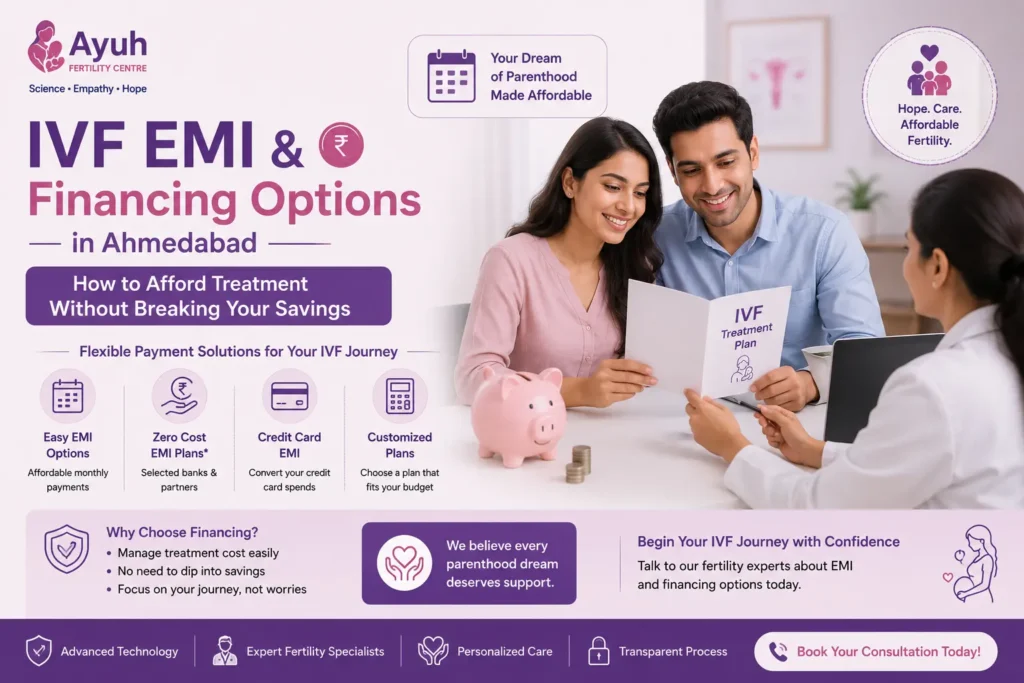
IVF EMI plan Ahmedabad options are something more couples are researching today, often quietly, late at night, after another difficult conversation about whether they can really afford to start treatment. Infertility already carries an emotional weight of its own — the waiting, the hoping, the disappointment that comes with every unsuccessful month. For many couples, the fear of cost adds a second, heavier layer on top of that.
Here’s something important to understand: many couples delay IVF not because of medical reasons, but because of financial uncertainty. They assume they need the full amount saved before they can even begin, and that assumption alone pushes treatment back by months or years — time that matters, especially for women whose fertility window is a genuine clinical factor.
IVF is best understood as an investment in parenthood, and like most significant investments, it can often be planned for financially rather than paid for all at once. Dr. Krupa M. Shah, a fertility specialist in Ahmedabad, encourages every couple at Ayuh Fertility Centre to have an open conversation about both their treatment plan and their financial plan — because neither should be a barrier to starting when you’re ready.
This guide walks through EMI options, financing routes, and practical budgeting so you can make an informed decision without feeling overwhelmed.
Author Bio
Dr. Krupa A. Shah MBBS · MS (Obstetrics & Gynaecology) · Infertility Specialist Founder, Ayuh Fertility Centre, Ahmedabad
19+ Years of Experience in reproductive medicine, obstetrics, and gynaecology.
Dr. Krupa Shah completed her MBBS from Baroda Medical College (2006) and her MS in Obstetrics & Gynaecology from B.J. Medical College, Ahmedabad (2010). After 12 years of experience at leading clinics in Chennai — including Apollo Hospital and Iswarya Fertility Centre — she completed an Advanced IVF Fellowship at Ludwig Maximilians University, Munich, Germany, one of Europe’s most prestigious reproductive medicine institutions.
She is a member of the Ahmedabad Obstetrics and Gynaecology Society (AOGS), the Indian Society of Assisted Reproduction (ISAR), and the Federation of Obstetric and Gynaecological Societies of India (FOGSI).
IVF laboratory is ART National Board Certified.
🩺 Medically Reviewed By
This article is medically reviewed by Dr. Krupa M. Shah, ensuring accurate and reliable fertility information.
📌 Quick Answer: Can IVF Be Paid in EMIs?
Yes. Many fertility clinics and third-party healthcare finance providers now offer IVF EMI plans, allowing couples to split treatment costs into monthly installments instead of paying the full amount upfront. This makes an IVF EMI plan in Ahmedabad a practical way to start treatment sooner while managing cash flow — though terms, eligibility, and interest vary by provider, so it’s worth reviewing details carefully before committing.
Why IVF Can Feel Financially Overwhelming
IVF isn’t a single expense — it’s a series of stages, each with its own cost, spread across several weeks. That structure alone can make the total feel harder to plan for than a one-time bill.
A few reasons couples find it overwhelming:
- Multiple stages, multiple costs — consultation, diagnostics, stimulation, retrieval, lab work, and transfer all carry separate cost components.
- Medicines add up — fertility medications are often priced separately from the procedure fee, and doses vary by patient.
- Investigations aren’t always one-time — some tests may need to be repeated depending on your protocol.
- The emotional weight compounds the financial one — every cost decision feels tied to your chances of becoming parents, which makes it emotionally heavier than an ordinary expense.
This is exactly why transparent cost planning matters so much. When a clinic lays out costs clearly from day one, couples can make decisions from a place of clarity — not anxiety.
What Is an IVF EMI Plan?
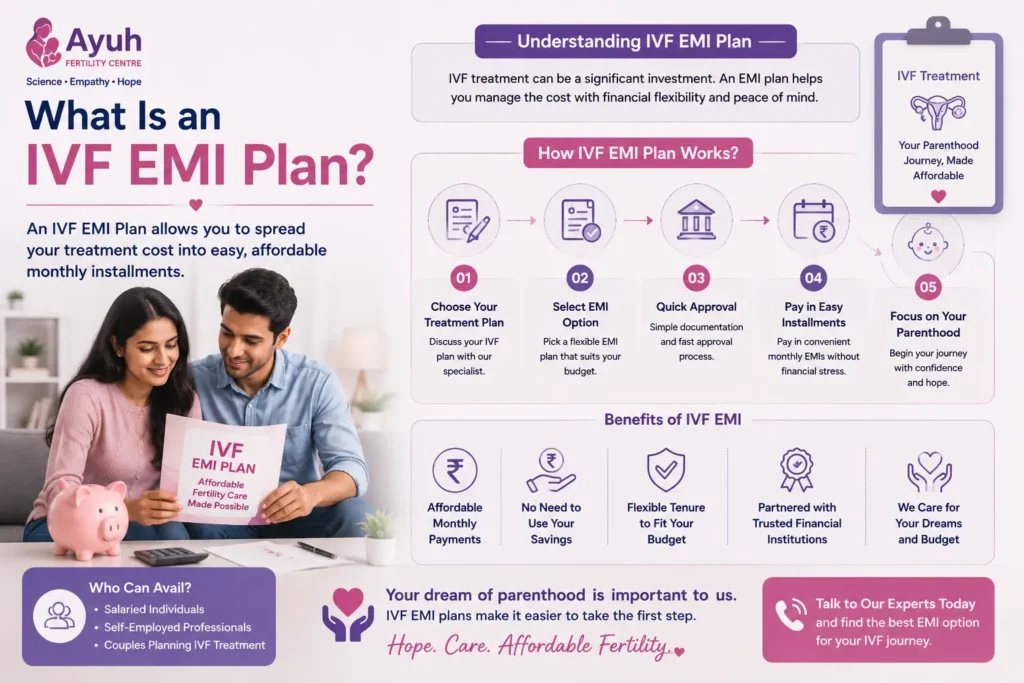
An IVF EMI plan in Ahmedabad simply means splitting the total cost of your treatment into smaller, fixed monthly installments instead of paying the full amount as a single lump sum.
Here’s the basic concept:
- EMI stands for Equated Monthly Instalment — a fixed amount paid each month over an agreed period.
- Medical EMI works similarly to EMIs for other big purchases — a lender (bank, NBFC, or sometimes a clinic-partnered finance provider) pays the treatment cost upfront, and you repay it in monthly parts, usually with interest.
- Benefit of paying gradually — instead of needing the entire treatment cost available immediately, you spread the financial impact across several months, which many families find far more manageable.
An EMI plan doesn’t change your treatment in any way — it only changes how the cost is paid. Your protocol, monitoring, and care remain exactly the same regardless of how the bill is settled.
Benefits of Choosing an IVF EMI Plan
- Better financial planning — a fixed monthly amount is easier to budget around than one large payment.
- Reduced financial stress — knowing your monthly commitment in advance removes a lot of the uncertainty.
- Ability to begin treatment sooner — instead of waiting months or years to save the full amount, EMI options can let you start once you’re medically ready.
- Preserve emergency savings — you’re not forced to drain your entire safety net for one expense.
- Easier budgeting for families — particularly useful for dual-income households planning around existing monthly commitments like rent, EMIs on other loans, or family expenses.
IVF Loan & Finance Options in India (2026)
Understanding IVF loan finance options in India for 2026 helps couples see the full picture before choosing a path. Broadly, the options available in the Indian healthcare finance space include:
| Option | How It Generally Works |
|---|---|
| Bank medical loans | Personal or medical loans offered by banks, often requiring standard income and credit checks. |
| NBFC healthcare loans | Non-banking financial companies specialising in medical financing, sometimes with faster approval processes than traditional banks. |
| Clinic-supported EMI programs | Some fertility clinics partner with third-party finance companies to offer EMI options directly at the point of billing, where available. |
| Credit card EMI conversion | Some banks allow large medical bills paid via credit card to be converted into EMIs after the transaction, subject to your card’s terms. |
A few important clarifications:
- Eligibility and interest rates vary by lender, your income profile, and credit history — there is no universal rate or guaranteed approval.
- We do not endorse or guarantee any specific lender. The options above are described generally so you understand the landscape, not as a recommendation for one provider over another.
- Always read the terms carefully — processing fees, interest rates, and prepayment conditions differ significantly between providers.
How to Afford IVF Treatment Without Breaking Your Savings
Learning how to afford IVF treatment in Gujarat without depleting your entire savings comes down to planning ahead rather than reacting under pressure. Practical steps that help:
- Start financial planning early — as soon as IVF becomes a possibility, begin researching costs rather than waiting until treatment is imminent.
- Ask for transparent package pricing — a written breakdown helps you understand exactly what’s included and what isn’t. Review our detailed IVF cost breakdown as a starting reference point.
- Build a treatment budget — separate your budget into procedure cost, medication cost, and a buffer for the unexpected.
- Understand medicine costs — these vary by protocol and by how your body responds, so ask for a realistic estimate range rather than a single fixed number.
- Discuss payment schedules directly with your clinic — many clinics allow staged payments tied to treatment milestones rather than one upfront sum.
- Avoid unnecessary repeat investigations — bring previous test reports to your consultation so tests aren’t duplicated unnecessarily.
- Check employer health benefits — some corporate policies offer partial reimbursement or wellness benefits that may apply, though this varies significantly by employer.
- Consider frozen embryo transfer planning — if multiple embryos are created, freezing surplus embryos for a future transfer can sometimes be more cost-effective than starting an entirely new stimulation cycle later.
What Expenses Should Couples Plan For?
Understanding each stage helps you build a realistic, complete budget rather than being surprised later.
Initial Consultation Your first visit with the fertility specialist, where your history is reviewed and an initial plan is discussed.
Diagnostic Tests Bloodwork, hormonal panels, and scans that assess ovarian reserve and overall reproductive health before treatment begins.
IVF Medicines Stimulation medications, trigger shots, and luteal support — typically the most variable cost, depending on your protocol and response.
Egg Retrieval The procedure where mature eggs are collected under light sedation, usually billed as part of the core treatment package.
Embryology Laboratory Fertilisation, culture, and monitoring of embryos in the lab — a core component of every IVF cycle.
Embryo Transfer The procedure placing the selected embryo into the uterus, usually included in the standard package.
Embryo Freezing If surplus healthy embryos remain, freezing them for future use is usually billed separately from the core cycle.
Frozen Embryo Transfer (FET) A separate procedure and cost if you use a frozen embryo in a future cycle rather than a fresh transfer.
Follow-up Care Post-transfer monitoring and the pregnancy test appointment, generally included in the treatment package.
Hidden Costs Couples Often Forget
Even with careful planning, a few costs are easy to overlook:
- Extra medicines — if your body needs a higher dose or a longer stimulation phase than initially estimated.
- Additional scans — if your monitoring schedule needs to be adjusted based on your response.
- Embryo storage fees — an ongoing annual cost if you choose to freeze embryos for future use.
- A repeat IVF cycle — not every first cycle results in pregnancy, and couples should financially prepare for this possibility rather than assuming a single cycle covers everything.
- Genetic testing (PGT) — if recommended for your specific case, this is typically a separate, additional cost.
- Surgical sperm retrieval — procedures like TESA/PESA are billed separately when medically indicated for male infertility.
The best protection against hidden costs is simple: ask for a written estimate before treatment begins, and ask specifically what is and isn’t included.
Questions to Ask Before Choosing an IVF EMI Plan
Use this checklist before signing any financing agreement:
- ✔ Are fertility medicines included in the EMI amount, or billed separately?
- ✔ Are diagnostic investigations included in the package?
- ✔ What happens financially if another IVF cycle is required?
- ✔ Are there processing charges or documentation fees?
- ✔ Can the loan be prepaid or closed early without penalty?
- ✔ Are there any hidden fees not mentioned in the initial quote?
- ✔ What is the total repayment amount, including interest, over the full term?
- ✔ Is the EMI provider directly affiliated with the clinic, or an independent third party?
Is Taking a Loan for IVF a Good Decision?
This is a genuinely personal financial decision, and a balanced view helps more than a one-sided answer.
Potential advantages:
- Allows you to start treatment sooner rather than waiting years to save the full amount
- Preserves your existing savings and emergency fund
- Offers more flexibility in managing monthly cash flow
Things to consider carefully:
- Whether the monthly instalment is genuinely affordable within your existing budget
- The total interest cost over the repayment period, not just the monthly figure
- How this fits into your family’s broader financial priorities and other commitments
- Your comfort level with taking on debt for a medical treatment with a possible but not guaranteed outcome
There’s no universally “right” answer here. Some couples prefer to preserve savings and take on manageable EMIs; others prefer to save and pay in full. Both are reasonable approaches — what matters is that the decision is made with full information, not urgency or pressure.
Emotional Benefits of Financial Planning Before IVF
Financial clarity doesn’t just help your bank balance — it genuinely supports your emotional experience of treatment too.
- Less anxiety — knowing your costs and payment plan in advance removes one major source of stress during an already demanding process.
- Better treatment focus — when finances are settled, couples can focus their energy on the medical and emotional aspects of the journey instead.
- Stronger relationship communication — discussing finances openly as a couple, before treatment begins, often strengthens how you navigate the process together.
- Reduced financial stress during treatment — avoiding last-minute money decisions during an emotionally intense period protects your overall wellbeing.
How to Choose an Affordable IVF Clinic
Affordability isn’t only about the lowest number on a price list — it’s about value, transparency, and trust. Look for:
- Transparent pricing — a clinic that gives you a clear written breakdown before treatment begins.
- Honest communication — a fertility specialist who explains why a test or procedure is recommended, not just that it’s required.
- No hidden charges — costs disclosed upfront, with any changes explained clearly as they arise.
- Experienced fertility specialist — expertise directly affects the number of cycles you may need, which affects your total cost.
- In-house embryology lab — reduces third-party referral costs and keeps your treatment timeline predictable.
- Success rate transparency — a clinic willing to share realistic, honestly reported outcomes rather than only headline numbers.
- Personalised treatment — protocols tailored to your specific diagnosis, rather than a one-size-fits-all approach that can lead to unnecessary added costs.
Choosing the “cheapest” clinic isn’t the same as choosing the most affordable one. The real measure of affordability is cost per successful outcome, not just cost per cycle.
Common Myths About IVF Financing
| Myth | Fact |
|---|---|
| IVF is only for wealthy families | With EMI options, staged payments, and financial planning, IVF is increasingly accessible to a wider range of families. |
| EMI always means huge interest | Interest rates vary significantly by provider and your credit profile — it’s not a fixed or universally high cost. |
| Cheapest IVF is always best | The lowest price doesn’t guarantee the best care or outcome; value and transparency matter more than price alone. |
| Loans reduce treatment quality | Financing only affects how you pay — it has no bearing on the medical protocol or quality of care you receive. |
| You must pay everything before treatment begins | Many clinics offer staged payment schedules tied to treatment milestones, not one upfront lump sum. |
FAQs
Q1: Can IVF be paid in EMI?
Yes, many fertility clinics and third-party healthcare finance providers offer EMI options for IVF treatment, allowing the total cost to be split into monthly instalments. This makes it easier for couples to start treatment without paying the full amount upfront. Terms, interest rates, and eligibility vary by provider, so it’s important to review the details carefully before choosing a plan.
Q2: Is IVF covered by insurance in India?
Most standard health insurance policies in India do not cover IVF treatment, though some corporate or specialised policies may offer partial coverage. It’s worth checking your specific policy documents or speaking with your insurer directly to understand what, if anything, applies to fertility treatment. Many couples rely on EMI plans or personal savings instead, given the limited insurance coverage currently available.
Q3: What is the best IVF EMI plan in Ahmedabad?
There isn’t a single “best” plan that suits everyone — the right choice depends on your monthly budget, the total loan amount, interest rate, and repayment period that works for your family. It’s best to compare a few options directly, ask detailed questions about what’s included, and discuss your specific case with your fertility clinic’s billing team before deciding.
Q4: Can I get a medical loan for IVF?
Yes, medical loans for fertility treatment are available through various banks and NBFCs in India, generally subject to standard income and credit eligibility checks. Approval and interest rates depend on the specific lender’s criteria and your financial profile. There is no guaranteed approval, so it’s worth checking eligibility directly with the lender before assuming a loan will be available.
Q5: Is financing IVF a good idea?
It can be a good option for couples who want to start treatment sooner without depleting their entire savings, provided the monthly instalment is genuinely affordable within their budget. It’s a personal financial decision that depends on your family’s overall financial situation, comfort with debt, and priorities. Discussing this openly as a couple, and reviewing the full repayment terms, helps you make a confident, informed choice.
Q6: How much should I save before starting IVF?
This depends on your specific treatment plan, but a helpful approach is to request a written cost estimate — covering the core cycle, medicines, and a buffer for possible additional costs — before starting. Some couples save the full estimated amount in advance; others use a combination of savings and an EMI plan for part of the cost. Speaking with your clinic’s billing team helps you build a realistic, personalised savings target.
Conclusion: Don’t Let Cost Concerns Delay Your Fertility Journey
Exploring an IVF EMI plan in Ahmedabad is ultimately about making sure that financial concerns don’t become the reason you delay a treatment you’re medically ready for. IVF is a significant investment — emotionally and financially — but with transparent pricing, thoughtful budgeting, and the right financing option for your family, it becomes far more manageable than it first appears.
Dr. Krupa M. Shah and the team at Ayuh Fertility Centre encourage every couple to have an open conversation about both their treatment plan and their financial plan at the very first consultation — because you deserve clarity on both fronts before you begin.
If financial worry has been holding you back, let a conversation with your fertility team be the first step, not the obstacle. Parenthood planning and money planning can move forward together.