
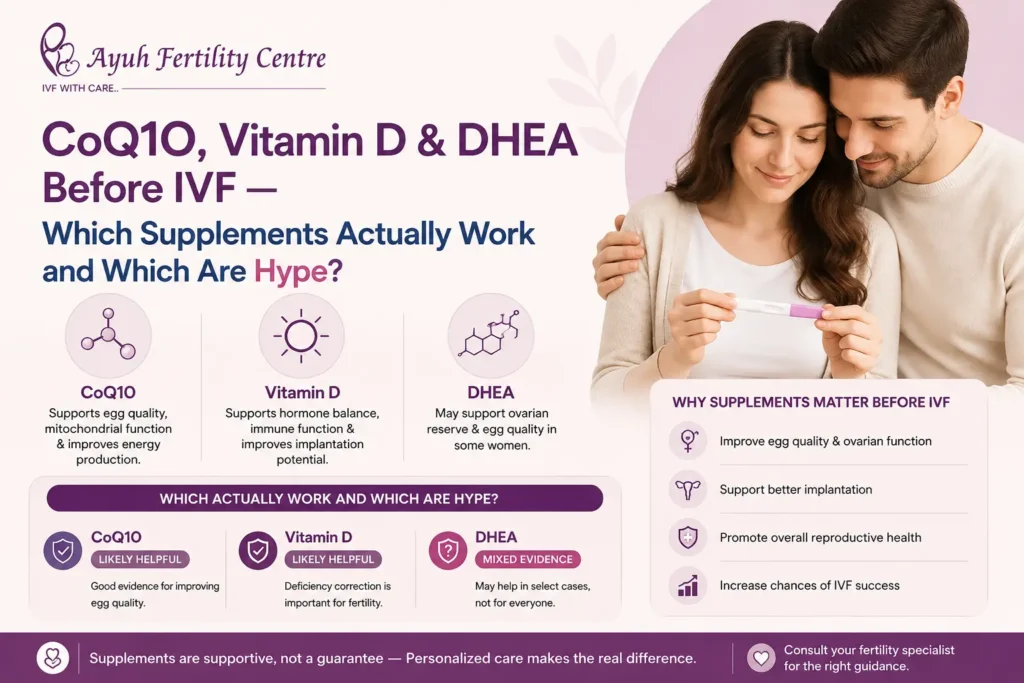
Supplements to take before IVF treatment in India is one of the most searched topics among couples preparing for fertility treatment — and one of the most confusing. Spend twenty minutes online and you will find confident recommendations for CoQ10, DHEA, myo-inositol, vitamin D, omega-3, melatonin, and dozens more — sometimes from reputable sources, sometimes from supplement companies with an obvious financial interest in your purchase.
The result is a familiar situation in fertility clinics: couples arriving at their first appointment carrying a bag full of supplements they have started based on Instagram posts, YouTube videos, and fertility forums — some helpful, some unnecessary, and some potentially counterproductive when combined with IVF medications.
The honest truth is that some supplements have genuine, evidence-supported roles in IVF preparation for specific patients with specific needs. Others have promising early research that has not yet translated into clinical certainty. And others are mostly hype.
At Ayuh Fertility Centre in Ahmedabad, Dr. Krupa M. Shah believes that every supplement decision should be driven by your personal diagnosis, your test results, and your fertility specialist’s recommendation — not by what is trending online.
This guide separates the science from the marketing — clearly, honestly, and without exaggeration.
Author Bio
Dr. Krupa A. Shah MBBS · MS (Obstetrics & Gynaecology) · Infertility Specialist Founder, Ayuh Fertility Centre, Ahmedabad
19+ Years of Experience in reproductive medicine, obstetrics, and gynaecology.
Dr. Krupa Shah completed her MBBS from Baroda Medical College (2006) and her MS in Obstetrics & Gynaecology from B.J. Medical College, Ahmedabad (2010). After 12 years of experience at leading clinics in Chennai — including Apollo Hospital and Iswarya Fertility Centre — she completed an Advanced IVF Fellowship at Ludwig Maximilians University, Munich, Germany, one of Europe’s most prestigious reproductive medicine institutions.
She is a member of the Ahmedabad Obstetrics and Gynaecology Society (AOGS), the Indian Society of Assisted Reproduction (ISAR), and the Federation of Obstetric and Gynaecological Societies of India (FOGSI).
IVF laboratory is ART National Board Certified.
🩺 Medically Reviewed By
This article is medically reviewed by Dr. Krupa M. Shah, ensuring accurate and reliable fertility information.
Do Supplements Really Improve IVF Success?
The short answer is: some supplements, for some patients, in the right context, may provide meaningful support. But none of them guarantee pregnancy — and that distinction matters enormously.
Here is what supplements can realistically do:
- Support the nutritional environment in which eggs and sperm mature over 2–3 months before an IVF cycle
- Correct specific deficiencies (vitamin D, folate, iron) that may otherwise impair hormonal function or embryo development
- Reduce oxidative stress in the follicular fluid and semen — the environment in which eggs and sperm mature
- Support mitochondrial energy production within eggs, which powers fertilisation and early embryo division
Here is what supplements cannot do:
- Reverse age-related egg quality decline
- Correct chromosomal abnormalities in eggs or sperm
- Replace the clinical management that IVF treatment provides
- Guarantee implantation or pregnancy
- Make up for poor diet, smoking, high alcohol intake, or other lifestyle factors that significantly impair fertility
The most important principle in the entire supplement conversation: individual diagnosis drives the decision. A supplement that is clinically appropriate for a 39-year-old woman with low ovarian reserve may be entirely unnecessary for a 28-year-old with normal AMH. What your fertility specialist recommends based on your specific test results is always more relevant than what you read worked for someone else online.
Why IVF Preparation Before Treatment Matters
Most IVF cycles begin with stimulation injections — but the preparation that matters most starts long before the first injection.
Eggs take approximately 90 days to mature inside the ovary before they are ready for retrieval. The nutritional and hormonal environment during those 90 days directly influences egg quality — the cellular energy capacity of the egg, the integrity of its DNA, and its chromosomal stability.
Sperm take approximately 74 days to complete their maturation cycle. Lifestyle changes and nutritional support made today will be reflected in sperm quality roughly 2–3 months from now.
This biology explains why the precautions before IVF treatment that your fertility specialist recommends typically begin 2–3 months before your planned cycle — not the week before injections start.
What matters during this preparation window:
- Egg quality — influenced by nutrition, oxidative stress, hormonal balance, and age
- Sperm quality — influenced by diet, lifestyle, heat exposure, and oxidative stress
- Hormonal balance — affected by weight, sleep, stress levels, and nutritional status
- Nutritional status — specific deficiencies (folate, vitamin D, iron, B12) can impair fertility and are correctable with appropriate supplementation
- Lifestyle factors — smoking, alcohol, excessive caffeine, poor sleep, and obesity all independently reduce fertility outcomes and interact with how well the body responds to IVF stimulation
Supplements are one layer of preparation — and potentially a valuable one — but they sit within this broader preparation context. They are not a shortcut around it.
Supplements to Take Before IVF Treatment India — Evidence-Based Overview
When evaluating supplements to take before IVF treatment in India, it helps to think in categories: those with reasonably good evidence for specific populations, those with promising but inconclusive evidence, and those where the claims significantly outpace the science.
Here is an honest, evidence-grounded overview of the most commonly discussed supplements:
| Supplement | Best Evidence For | Evidence Strength |
|---|---|---|
| Folic acid / Methylfolate | All women before IVF | Strong — widely recommended |
| Vitamin D | Women with confirmed deficiency | Good — test before supplementing |
| CoQ10 (Ubiquinol) | Women over 35, low ovarian reserve | Moderate — promising, not definitive |
| Omega-3 (DHA/EPA) | Both partners | Moderate — cell membrane support |
| Prenatal multivitamin | All women before IVF | Good — covers baseline needs |
| DHEA | Low AMH, poor ovarian responders | Moderate — medical supervision essential |
| Myo-inositol | Women with PCOS | Moderate — insulin sensitivity support |
| Melatonin | Specific clinical cases | Early/limited — not routine |
| Vitamin E | Antioxidant support | Moderate — typically covered by prenatal MV |
These are discussed in more detail in the sections that follow. The consistent message throughout: discuss with your fertility specialist before starting any supplement, because the appropriate supplement is the one that matches your diagnosis.
CoQ10 for IVF Egg Quality India — Does It Actually Work?
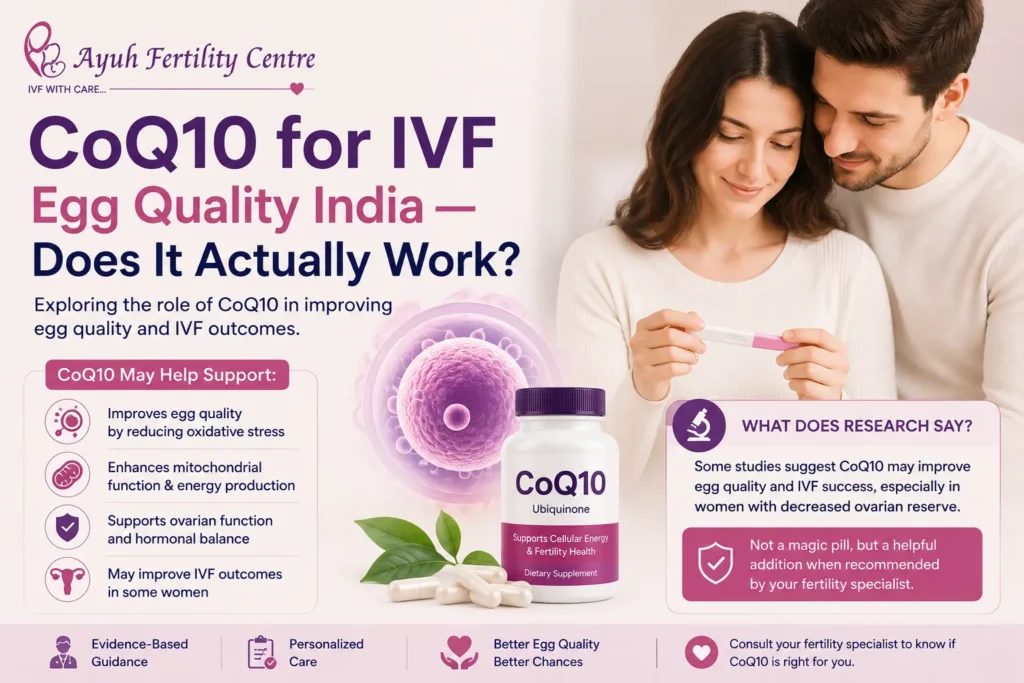
CoQ10 (Coenzyme Q10) is probably the most discussed fertility supplement in the world right now — and for understandable reasons. The science behind it is biologically plausible, the research is more substantial than for most fertility supplements, and it has one of the better safety profiles.
What CoQ10 Is
CoQ10 is a naturally occurring compound found in every cell of the body. Its primary role is supporting the mitochondria — the energy-producing structures inside cells. Mitochondria generate ATP (adenosine triphosphate), the fuel that powers cellular processes.
In eggs, mitochondrial function is critically important. The energy required for fertilisation, the first cell divisions of the embryo, and the complex process of early embryo development all depend on mitochondrial ATP production within the egg.
Why It Is Discussed for IVF Egg Quality
Mitochondrial function in eggs declines naturally with age. This is one of the primary reasons why egg quality — and therefore IVF success rates — declines as women get older. The hypothesis behind CoQ10 for IVF egg quality is straightforward: supplementing with CoQ10 supports mitochondrial energy production, which may improve the cellular environment within maturing eggs.
What the research shows: Several clinical studies — including a well-cited trial published in reproductive medicine journals — have shown that CoQ10 supplementation before IVF cycles may improve ovarian response, egg quality markers, and embryo development parameters in women with diminished ovarian reserve or older age. These findings are genuinely encouraging.
What the research does not show: A guaranteed improvement in live birth rates across all patient populations. The studies are mostly smaller-scale, and the magnitude of benefit varies between individuals. CoQ10 does not reverse age-related chromosomal decline in eggs — it supports energy production, which is one factor among many in egg quality.
The preferred form: Ubiquinol (the reduced, active form) is more bioavailable than ubiquinone (the oxidised form) and is generally preferred when supplementing for fertility purposes.
The practical recommendation: CoQ10 supplementation is most commonly recommended for women over 35, those with low AMH or diminished ovarian reserve, or those who have had poor ovarian response or poor embryo quality in previous IVF cycles. It is not universally necessary for all women before IVF. Dose and duration should be discussed with your fertility specialist — not self-prescribed based on what worked for someone in a fertility forum.
Vitamin D Before IVF — Why It Matters
Vitamin D is unique among fertility supplements because the evidence for its importance in reproductive health is genuinely strong — and because deficiency is extremely common in India.
Vitamin D and Reproductive Health
Vitamin D receptors are found in ovarian tissue, the endometrium, and the testes. This biological presence is consistent with the growing body of research showing associations between vitamin D levels and:
- Ovarian reserve markers
- Follicular fluid quality
- Endometrial receptivity — the ability of the uterine lining to receive and support an implanting embryo
- IVF clinical pregnancy rates — several studies have found lower pregnancy rates in vitamin D-deficient women undergoing IVF compared to sufficient women
Why Deficiency Is So Common in India
Despite India’s abundant sunshine, vitamin D deficiency is paradoxically common — particularly among urban women. Cultural practices of sun avoidance (use of sunscreen, full-coverage clothing, indoor working environments) significantly limit natural vitamin D synthesis. Studies suggest deficiency rates of 50–90% in various Indian urban populations.
The Practical Recommendation
Test before supplementing. A simple blood test measures your 25-hydroxyvitamin D level. Your fertility specialist will advise the appropriate supplement dose based on your result — not a generic dose from a pharmacy shelf.
Vitamin D toxicity is real with excessive supplementation — which is why testing is genuinely important rather than simply starting a supplement because it is “probably low.” The goal is correction of confirmed deficiency, not supplementation without a baseline measurement.
DHEA Supplement for IVF and Low Ovarian Reserve — Who Actually Needs It?
DHEA (dehydroepiandrosterone) is a naturally occurring hormone produced primarily by the adrenal glands. It is a precursor to both androgens (testosterone) and oestrogen — and its role in ovarian function has generated significant research interest in the fertility field.
Why DHEA Is Discussed for Low AMH
In the ovary, androgens — including those derived from DHEA — play a role in early follicle development. The hypothesis is that in women with diminished ovarian reserve or poor ovarian response to IVF stimulation, DHEA supplementation may support the androgen-dependent early stages of follicle growth, potentially improving ovarian response.
Several studies — primarily from specialist fertility centres — have suggested that DHEA supplementation in carefully selected women with low AMH or poor ovarian reserve may be associated with:
- Modestly improved ovarian response to stimulation
- Higher number of eggs retrieved in some patients
- Potentially improved embryo quality in specific populations
These findings have made DHEA one of the more widely discussed supplements for poor ovarian responders preparing for IVF treatment.
The Critical Caveat — Medical Supervision Is Non-Negotiable
DHEA is a hormone precursor. It has real physiological effects — including on androgen levels — and taking it without medical supervision can cause hormonal imbalances, acne, hair changes, and interactions with other medications or hormonal conditions.
DHEA is not appropriate for all women. It is particularly not recommended for women with conditions where androgen excess is already a concern — including PCOS.
Do not self-start DHEA. This is one supplement where the instruction to consult your fertility specialist is not a cautious disclaimer — it is a genuine clinical necessity. If DHEA is appropriate for your situation, your fertility specialist in Ahmedabad will recommend it based on your AMH, AFC, previous cycle history, and hormonal profile.
Supplements for Male Fertility Before IVF
A complete IVF preparation supplement conversation must include both partners equally. Male fertility contributes to approximately 40–50% of infertility cases, and sperm quality directly affects fertilisation rates and embryo development.
The most evidence-supported nutritional supports for male fertility before IVF include:
Antioxidants — the most important category Oxidative stress is one of the primary causes of sperm DNA damage. Antioxidant supplementation — particularly vitamins C and E, selenium, and zinc — directly targets this mechanism. Multiple studies have shown improvements in sperm parameters with antioxidant supplementation in men with elevated oxidative stress.
Zinc Critical for sperm production, maturation, and testosterone synthesis. Zinc deficiency is associated with reduced sperm count and poor morphology. Found naturally in pumpkin seeds, legumes, and meat — and available as a targeted supplement where dietary intake is insufficient.
CoQ10 Just as CoQ10 supports mitochondrial function in eggs, it supports mitochondrial function in sperm — providing the energy needed for motility. Several studies have shown improvements in sperm motility with CoQ10 supplementation.
Omega-3 fatty acids (DHA) DHA is a major structural component of the sperm tail. Low DHA is associated with poor sperm motility. Fish oil or algae-based DHA supplements are commonly recommended for men preparing for ICSI.
L-carnitine Supports sperm energy metabolism and motility. Most relevant for men with poor sperm motility as a primary finding.
Lifestyle foundation: No supplement replaces the impact of stopping smoking, eliminating alcohol, achieving a healthy BMI, and avoiding heat exposure on sperm quality. These lifestyle factors are the highest-impact interventions for male fertility — supplements work best when built on this foundation.
Supplements That Are Mostly Hype or Need Caution
The fertility supplement market in India — as globally — contains products and claims that are well ahead of the science. Here is an honest evaluation of some common situations:
Viral fertility supplements with celebrity endorsement The fertility supplement market is particularly vulnerable to influencer-driven recommendations. A supplement that worked for one person — or appears to have worked in their telling of the story — is not clinical evidence. Fertility outcomes are influenced by dozens of factors, and attributing a pregnancy to a specific supplement taken alongside IVF treatment is almost never scientifically justifiable.
Excessive supplement combinations More supplements do not mean better fertility. The body has metabolic capacity for processing nutrients, and excessive supplementation with fat-soluble vitamins (A, D, E, K) can reach harmful levels. Some supplements compete for absorption or interact with IVF medications. A carefully chosen 4–5 supplements recommended by your doctor is more appropriate and safer than 15 products bought from a health store.
Unverified “fertility cleanse” products Products marketed as “detoxifying” the reproductive system or “cleansing” the uterus have no meaningful clinical evidence supporting their use. The liver and kidneys manage the body’s detoxification processes; herbal “cleanses” targeted at fertility are not scientifically supported and some contain compounds that interact with hormonal medications.
Herbal supplements without medical clearance Many commonly used Indian herbal supplements — including ashwagandha, shatavari, and various Ayurvedic preparations — have not been adequately studied in the context of IVF. Some contain phytoestrogens or other bioactive compounds that could affect hormonal balance or interact with stimulation medications. They should not be started during IVF preparation without explicit clearance from your fertility specialist.
How Long Before IVF Should Supplements Be Started?
The biology of egg and sperm maturation provides a clear answer to this question:
- Eggs actively maturing to be retrieved in an upcoming IVF cycle begin this maturation process approximately 90 days before retrieval
- Sperm complete their full maturation cycle in approximately 74 days
This means that supplements intended to support egg quality or sperm quality need to be started at least 2–3 months before the planned egg retrieval date to influence the eggs and sperm that will actually be used in the cycle.
Starting supplements the week before stimulation injections begin has minimal impact on the eggs that will be retrieved — those eggs were already well into their maturation process before the supplements were started.
Practical guidance:
- Folic acid: start at least 3 months before IVF (or as soon as fertility treatment is planned)
- CoQ10: typically started 2–3 months before planned retrieval
- Vitamin D: correct deficiency as soon as identified — timing depends on severity
- DHEA: protocols vary — this is particularly important to discuss with your fertility specialist, as DHEA protocols are highly individualised
Consistency over 2–3 months is more important than the specific brand or dose — within the ranges recommended by your doctor.
Lifestyle Factors That Work Alongside Supplements
Supplements are most effective when they work alongside — not instead of — meaningful lifestyle changes. For Indian couples preparing for IVF, these lifestyle factors are particularly important:
Diet — the foundation A Mediterranean-style dietary pattern rich in antioxidants, lean proteins, healthy fats, and whole grains is the dietary framework with the strongest fertility evidence. For Indian women, this translates naturally to dals, seasonal vegetables, millets, healthy fats (ghee in moderation, walnuts, flaxseeds), and protein-rich foods like paneer and eggs. See the complete IVF diet and lifestyle guide for a detailed food-by-food breakdown.
Sleep — underrated and essential 7–9 hours of consistent sleep regulates melatonin and reproductive hormones. Poor sleep elevates cortisol and disrupts the hormonal signalling that governs follicle development.
Weight management Both significantly elevated and low BMI impair hormonal balance and IVF outcomes. Modest, sustainable weight change in the 2–3 months before IVF — not crash dieting — is what matters.
Exercise — moderate is optimal Gentle walking, yoga, and swimming support circulation, stress management, and healthy weight. High-intensity training during the stimulation phase should be avoided.
Stop smoking and reduce alcohol Smoking directly damages egg and sperm DNA. Alcohol disrupts hormonal balance. These are the highest-impact lifestyle changes available — more impactful than any supplement.
Stress management Chronic stress elevates cortisol, which suppresses reproductive hormones. Yoga, pranayama, mindfulness, and counselling all have evidence-supported effects on stress hormone regulation.
Common Mistakes Couples Make With IVF Supplements
Starting supplements without baseline testing Taking vitamin D without knowing your baseline level, or starting CoQ10 based on a forum recommendation rather than a clinical assessment, is taking a supplement in the dark. Test first; supplement based on results.
Replacing medical treatment with supplements Supplements prepare the body for IVF. They do not replace it. CoQ10 and DHEA, however evidence-supported in their respective populations, cannot open blocked fallopian tubes, treat severe male infertility, or correct chromosomal abnormalities. If IVF is recommended, pursue it — with supplements as preparation, not as an alternative.
Taking excessive doses More is not better. Fat-soluble vitamins accumulate. Some antioxidants at very high doses can actually have pro-oxidant effects. Stick to doses recommended by your fertility specialist.
Following online advice over doctor guidance The fertility supplement space online is dominated by anecdote, influencer promotion, and commercial interest. A fertility specialist who has reviewed your actual test results and history is always a more reliable guide than anonymous internet recommendations.
Ignoring the male partner Male factor infertility is involved in half of all infertile couples. Focusing entirely on female supplements while ignoring the male partner’s sperm health is a significant and common oversight.
Starting too late Beginning supplements 2 weeks before IVF stimulation is not the same as starting 3 months before. The biology of egg and sperm maturation means the preparation window that matters started months ago.
Questions to Ask Your Fertility Specialist Before Taking Supplements
Before adding any supplement to your pre-IVF routine, bring these questions to your consultation with your fertility specialist:
- “Do I actually need this supplement based on my test results?” — A deficiency or specific clinical need should justify any supplement, not a general recommendation.
- “Is my deficiency confirmed, or are we guessing?” — Vitamin D, iron, B12, and folate levels can all be measured. Test before supplementing.
- “Will this supplement interact with my IVF medications?” — Some supplements can affect hormone levels or medication metabolism.
- “What dose do you recommend for my specific situation?” — Doses vary significantly between general health use and fertility-specific applications.
- “How long should I take it before my cycle starts?” — The preparation window matters; timing is clinically relevant.
- “Is this supplement safe to continue during stimulation and after embryo transfer?” — Some supplements are appropriate before IVF but not during active treatment.
Common Myths About IVF Supplements
Myth: Supplements guarantee IVF success. Reality: No supplement guarantees IVF success. They may support the fertility preparation process for specific patients, but IVF outcomes depend on age, egg quality, sperm quality, embryo genetics, uterine health, and clinical management — none of which are controlled by supplements. Any product claiming to guarantee pregnancy is making a false claim.
Myth: Everyone needs DHEA before IVF. Reality: DHEA is a hormone precursor with specific indications — primarily women with confirmed diminished ovarian reserve or poor ovarian response to stimulation in previous cycles. For women with normal ovarian reserve, DHEA has no established benefit and, given its hormonal activity, should not be taken without a specific clinical indication and medical supervision.
Myth: More vitamins mean better fertility. Reality: More is not better — and in some cases, more is harmful. Fat-soluble vitamins accumulate in the body. Antioxidants at very high doses can have paradoxical pro-oxidant effects. Excessive supplementation creates an unnecessarily complex medication burden and potential interactions with IVF drugs. A small, targeted supplement regimen recommended by your doctor is preferable to a large stack of self-prescribed products.
Myth: Natural products are always safe. Reality: Natural does not mean harmless, particularly in the context of IVF. Many herbal products contain phytoestrogens, adaptogens, or other bioactive compounds that interact with reproductive hormones or IVF medications. “Natural” is a marketing description, not a clinical safety guarantee. Always disclose all supplements — including herbal and Ayurvedic — to your fertility specialist.
Frequently Asked Questions
Q1: Does CoQ10 improve IVF success?
CoQ10 may support egg quality by improving mitochondrial energy production — particularly relevant for women over 35 or those with diminished ovarian reserve. Several studies have shown improvements in ovarian response and embryo quality parameters with CoQ10 supplementation in these populations. However, CoQ10 does not guarantee better embryos or higher IVF success rates, and the evidence varies across studies. It is most appropriately used in women with a specific clinical indication — not universally by all IVF patients. Discuss whether it is relevant for your situation with your fertility specialist before starting.
Q2: Should everyone take supplements before IVF?
Not the same supplements — no. All women planning IVF should take folic acid (or methylfolate) at least 3 months before their cycle. Beyond that, supplements should be guided by individual test results and clinical needs. Vitamin D only if deficiency is confirmed. CoQ10 if there is a specific indication such as age or low ovarian reserve. DHEA only under medical supervision for appropriate candidates. A prenatal multivitamin as a baseline. The supplement plan that is right for someone else — however confident their recommendation — may not be right for you.
Q3: Is DHEA good for low AMH?
DHEA may be beneficial for carefully selected women with confirmed low AMH or poor ovarian response to stimulation — but only under medical supervision. It is not appropriate for all women with low AMH, is contraindicated in certain hormonal conditions including PCOS, and has real hormonal effects that require clinical management. If you have a low AMH result, discuss DHEA with your fertility specialist — they will assess whether it is appropriate based on your complete hormonal and clinical profile, not just your AMH number.
Q4: Can Vitamin D improve fertility?
Vitamin D deficiency is strongly associated with poorer IVF outcomes, reduced endometrial receptivity, and lower clinical pregnancy rates in multiple studies. Correcting a confirmed deficiency before IVF is a well-supported clinical recommendation. However, supplementing without testing — and potentially over-supplementing — is not advisable. Have your vitamin D level tested, and supplement based on the result under your doctor’s guidance. For Indian women, where deficiency is very common, this is one of the most consistently useful and straightforward pre-IVF supplement interventions available.
Q5: How long before IVF should supplements start?
Ideally, supplements that target egg or sperm quality should begin at least 3 months (90 days) before planned egg retrieval — because that is when the eggs being retrieved are actively maturing. Folic acid should ideally be started even earlier — at least 3 months before any attempt at conception. Vitamin D correction may begin as soon as deficiency is confirmed. DHEA protocols vary by individual and are specified by your fertility specialist. Starting any supplement the week before stimulation injections begin is too late to influence the eggs being retrieved in that cycle.
Q6: Can supplements improve egg quality after 40?
Supplements can support the mitochondrial function and oxidative stress environment in which eggs mature — which matters at every age but becomes increasingly relevant after 40, when mitochondrial function in eggs declines more significantly. CoQ10 and antioxidant supplementation are most commonly discussed for older women in IVF. However, supplements cannot reverse the chromosomal ageing that is the primary reason egg quality declines after 40. They support the best possible quality from the eggs available — they cannot create eggs that are chromosomally younger than they are. Honest expectations and personalised guidance from your fertility specialist are essential at this stage.
Conclusion: Supplements Support Fertility
Understanding the supplements to take before IVF treatment in India — what is evidence-supported, what is condition-specific, and what is marketing hype — is one of the most practically useful things a couple can do in their fertility preparation.
The evidence-based supplements — folic acid, vitamin D (when deficient), CoQ10 (for appropriate candidates), omega-3, and a prenatal multivitamin — provide a meaningful foundation for pre-IVF preparation. DHEA, in the right clinical situation under medical supervision, may offer additional support. Beyond this carefully chosen core, the supplement landscape is more marketing than medicine.
Dr. Krupa M. Shah at Ayuh Fertility Centre approaches every pre-IVF consultation with the same principle: test first, supplement based on results, and build a preparation plan around your individual diagnosis — not around what is trending. Because the supplement that genuinely matters is the one that is right for you, at the right dose, for the right duration, alongside the right medical care.
Supplements are support, not solutions. The solution is expert, personalised IVF care — with supplements making the preparation as thorough as possible.
👉 Book your consultation with Ayuh Fertility Centre today
👉 Get expert guidance for PCOS and fertility treatment
👉 Start your journey toward a healthy and successful pregnancy
📍 Visit us in Ahmedabad
📞 Call now to schedule your appointment