
Mild stimulation IVF India has become an increasingly important conversation in fertility medicine — particularly for couples who approach IVF with genuine concern about the injection burden, medication side effects, and physical demands of a conventional stimulation cycle. You have heard about the daily injections. You have read about bloating, mood swings, and the clinical intensity of a full IVF protocol. And part of you wonders: is there a gentler way?
For some couples, the answer is yes. Mild stimulation IVF — also called Mini IVF — uses lower doses of stimulation medications over a shorter period, with the goal of retrieving fewer, higher-quality eggs rather than maximising egg numbers through aggressive ovarian stimulation. The philosophy is quality over quantity.
But — and this is important — mild stimulation IVF is not the right approach for every patient. For some women, retrieving fewer eggs per cycle meaningfully reduces the overall success of the treatment. For others, it is exactly the protocol their physiology and personal circumstances call for.
Dr. Krupa A. Shah, founder of Ayuh Fertility Centre in Ahmedabad, offers both mild stimulation and conventional IVF protocols — and the recommendation between them is always made based on your individual clinical picture, not a standard template.
This blog explains everything you need to know to understand which approach might suit you best.
Author Bio
Dr. Krupa A. Shah MBBS · MS (Obstetrics & Gynaecology) · Infertility Specialist Founder, Ayuh Fertility Centre, Ahmedabad
19+ Years of Experience in reproductive medicine, obstetrics, and gynaecology.
Dr. Krupa Shah completed her MBBS from Baroda Medical College (2006) and her MS in Obstetrics & Gynaecology from B.J. Medical College, Ahmedabad (2010). After 12 years of experience at leading clinics in Chennai — including Apollo Hospital and Iswarya Fertility Centre — she completed an Advanced IVF Fellowship at Ludwig Maximilians University, Munich, Germany, one of Europe’s most prestigious reproductive medicine institutions.
She is a member of the Ahmedabad Obstetrics and Gynaecology Society (AOGS), the Indian Society of Assisted Reproduction (ISAR), and the Federation of Obstetric and Gynaecological Societies of India (FOGSI).
IVF laboratory is ART National Board Certified.
🩺 Medically Reviewed By
This article is medically reviewed by Dr. Krupa M. Shah, ensuring accurate and reliable fertility information.9+ years of experience — ensuring accurate, balanced, and patient-friendly information on mild stimulation IVF protocols and treatment planning.
What Is Mild Stimulation IVF?
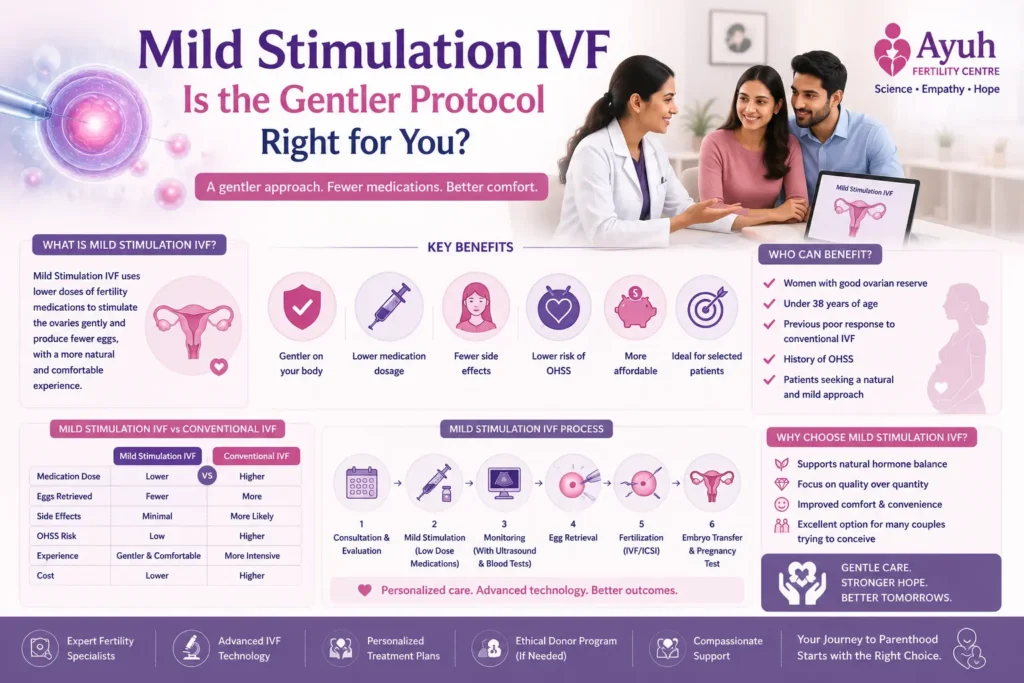
Mild stimulation IVF — also called Mini IVF, low-dose IVF, or minimal stimulation IVF — is an IVF protocol that uses significantly lower doses of stimulation medications than conventional IVF, over a shorter period, with the aim of retrieving a smaller number of high-quality eggs.
The core philosophy is straightforward: rather than maximising the number of eggs retrieved per cycle (the goal of conventional IVF), mild stimulation IVF prioritises the quality of each egg retrieved — reasoning that 3–5 genuinely high-quality eggs may offer better real-world outcomes than 12–15 eggs of more variable quality.
How it works: In conventional IVF, daily gonadotropin injections over 10–14 days drive the ovaries to produce as many mature follicles as possible. In mild stimulation IVF, either a significantly lower dose of gonadotropins is used, or oral medications (typically Clomiphene Citrate or Letrozole) are used instead of or alongside very low-dose injectable gonadotropins — producing 2–6 follicles rather than 8–15.
Difference from natural cycle IVF: Natural cycle IVF involves no stimulation at all — retrieving the single egg that develops in a natural, un-stimulated menstrual cycle. Mild stimulation IVF sits between these extremes: it uses some stimulation medication to produce a small number of follicles, rather than relying on a single natural egg or maximising follicle production through full stimulation.
The quality-over-quantity argument: In women where all eggs would be expected to be high quality regardless of stimulation level — particularly younger women with good ovarian reserve — collecting more eggs gives more embryos to work with and potentially more frozen embryos for future cycles. In women where egg quality concerns are the dominant factor, or in those who respond excessively to full stimulation, a lower-dose approach may actually produce better-quality individual eggs even if fewer in number.
How Does Mild Stimulation IVF Work? Step by Step
Understanding the process removes much of the uncertainty around what to expect.
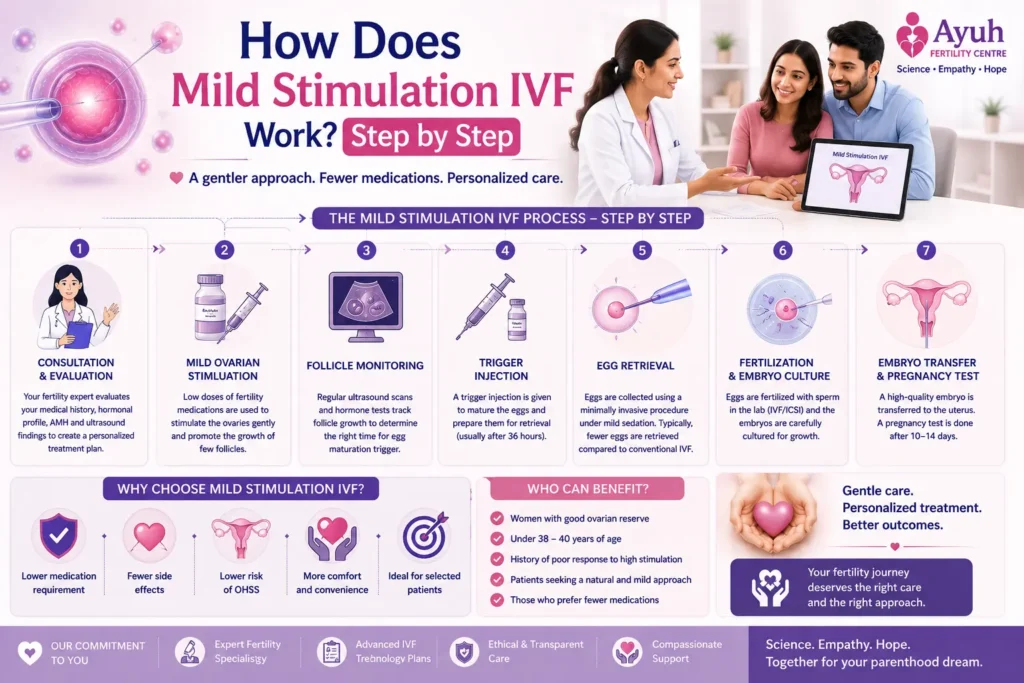
Step 1 — Fertility Evaluation Before any protocol is recommended, a complete fertility evaluation is performed at Ayuh — including AMH, antral follicle count, FSH, LH, thyroid panel, and semen analysis. This data determines whether mild stimulation is clinically appropriate for your specific ovarian profile.
Step 2 — Low-Dose Medication Stimulation Stimulation begins on Day 2–3 of the menstrual cycle. Instead of full-dose gonadotropin injections, mild stimulation protocols use:
- Low-dose gonadotropin injections (significantly lower than conventional IVF doses), and/or
- Oral medications (Clomiphene or Letrozole) to support natural follicle recruitment
- Antagonist suppression injections (where needed) to prevent premature ovulation
The stimulation period is typically 7–10 days — somewhat shorter than conventional IVF.
Step 3 — Follicle Monitoring Serial ultrasound monitoring — typically 2–3 scans across the stimulation period — tracks follicle growth. Because fewer follicles develop, monitoring is generally less intensive than conventional IVF. Follicular monitoring at Ayuh includes endometrial assessment alongside follicle measurement.
Step 4 — Egg Retrieval When 2–5 follicles reach target size (typically 17–22mm), a trigger injection is given and egg retrieval (OPU) is performed 34–36 hours later under light sedation. The procedure is identical to conventional IVF egg retrieval — just typically shorter due to fewer follicles.
Step 5 — Fertilisation Retrieved eggs are fertilised in Ayuh’s ART National Board Certified, ISO-certified embryology laboratory using ICSI where male factor infertility is present, or conventional IVF fertilisation. Fertilisation rates per mature egg are typically comparable between mild and conventional stimulation cycles.
Step 6 — Embryo Development and Transfer Fertilised embryos are cultured to the optimal stage (Day 3 cleavage or Day 5 blastocyst) and the best-quality embryo is transferred into the uterus — the same procedure as any other embryo transfer. Surplus embryos, if any, are frozen in Ayuh’s ART Bank for future FET cycles.
Mini IVF vs Conventional IVF Ahmedabad — Complete Comparison
This is the comparison most couples considering mild stimulation actually need to see clearly. Here is an honest, balanced breakdown of mini IVF vs conventional IVF Ahmedabad:
| Factor | Mild Stimulation IVF | Conventional IVF |
|---|---|---|
| Daily Injection Dose | Significantly lower — or replaced partly by oral tablets | Full-dose gonadotropins daily |
| Number of Injection Days | 7–10 days | 10–14 days |
| Eggs Typically Retrieved | 2–6 eggs | 8–15+ eggs |
| Embryos Available | Fewer — less material for selection or freezing | More — greater selection and frozen embryo reserve |
| Physical Discomfort | Less bloating, less medication burden | More bloating, more physical intensity |
| OHSS Risk | Significantly lower | Higher — particularly in PCOS or high AMH patients |
| Procedure Cost (Ayuh) | ₹80,000–₹1,10,000 per cycle | ₹1,20,000–₹1,40,000 per cycle |
| Medication Cost | Lower — reduced medication volume | Higher |
| Total Estimated Cycle Cost (with meds) | ₹1,00,000–₹1,40,000 | ₹1,60,000–₹2,20,000 |
| Per-Transfer Success Rate | Comparable per transferred embryo | Comparable per transferred embryo |
| Cumulative Success Potential | May require more cycles due to fewer embryos per cycle | Higher cumulative potential per stimulation cycle |
| Best Suited For | PCOS, hormone-sensitive patients, high responders, patients preferring fewer medications | Most IVF patients — particularly those needing multiple embryos for testing or frozen reserve |
The essential honest comparison: Per embryo transferred, mild stimulation IVF does not consistently underperform conventional IVF. The difference is in the number of embryos available from each stimulation cycle. For couples who need or want multiple embryos — for PGT-A testing, for frozen embryo banking, or for multiple transfer attempts without another stimulation cycle — conventional IVF typically offers a more efficient single-cycle investment. For couples where OHSS risk is high, or where fewer medications are a genuine priority, mild stimulation is a clinically reasonable alternative.
Benefits of Mild Stimulation IVF
Fewer Injections and Lower Medication Burden This is the most consistently valued benefit for patients who choose mild stimulation. Fewer daily injections, lower total medication volumes, and a shorter stimulation period all reduce the physical and logistical demands of the cycle.
Significantly Reduced OHSS Risk Because the ovaries are stimulated to a lower level, the risk of Ovarian Hyperstimulation Syndrome is meaningfully reduced. This is particularly significant for PCOS patients and women with high AMH, whose ovaries are inherently more responsive to stimulation.
Lower Physical Discomfort Bloating, pelvic pressure, and the general physical weight of a conventional stimulation cycle are typically reduced in a mild stimulation protocol. Most patients describe mild IVF as a noticeably more comfortable physical experience.
More Emotionally Manageable The reduced injection burden and shorter stimulation period can make the cycle feel less overwhelming — particularly for patients who feel anxious about the intensity of full IVF treatment.
Lower Medication Cost Component Because significantly less medication is used, the medication portion of the overall cycle cost is reduced — contributing to a lower total investment per cycle compared to conventional IVF.
Environmentally Kinder Approach Some patients value the reduced hormonal load on their body as a clinical principle. While there is no evidence that conventional IVF medication doses cause long-term harm, the ability to achieve IVF with a lower hormonal intervention is genuinely appealing to many patients.
Limitations of Mild Stimulation IVF
Honesty here is as important as the benefits — because choosing a mild stimulation protocol without understanding its limitations can lead to a cycle that does not meet your expectations.
Fewer Eggs Retrieved The most significant limitation: a mild stimulation cycle typically yields 2–6 eggs rather than 8–15. Fewer eggs means fewer fertilised embryos, fewer blastocysts for selection, and fewer surplus embryos to freeze. For couples who need multiple embryos for PGT-A testing or want a frozen embryo bank for future cycles, this can be a meaningful disadvantage.
May Require More Cycles to Achieve Pregnancy If each mild stimulation cycle produces only 1–2 transferable embryos, more stimulation cycles may be needed over the full treatment course to achieve the same cumulative success probability as a single conventional IVF cycle that produced 4–5 high-quality blastocysts.
Not Suitable for Every Patient Women who need a larger number of eggs — due to expected poor egg quality (as in women above 38), for PGT-A testing of multiple embryos, or to build a frozen embryo reserve before surgery or other treatment — are often better served by conventional stimulation.
Reduced Blastocyst Development Opportunity With fewer eggs and fewer fertilised embryos, the probability of at least one reaching the blastocyst stage is lower than in a conventional cycle. This can limit the embryo selection process.
Who Is the Right Candidate for Mild Stimulation IVF?
Dr. Krupa Shah recommends mild stimulation IVF in specific clinical circumstances where the benefit profile genuinely outweighs the limitations:
PCOS Patients at High OHSS Risk For women with PCOS and very high AMH (above 5–6 ng/mL), conventional stimulation carries a significant OHSS risk even with careful low-dose protocols. Mild stimulation reduces this risk substantially, while still retrieving a small number of eggs — which in PCOS patients are often of good quality.
Women Sensitive to Hormones Some women experience significant adverse reactions to conventional IVF medications — severe mood changes, physical discomfort beyond typical levels, or previous overstimulation even at moderate doses. Mild stimulation offers a more tolerable alternative for these patients.
Patients with Moderate-to-Good Ovarian Reserve Who Prefer Fewer Medications For younger women with good ovarian reserve who have an informed preference for a lower-medication approach — and who understand that this may mean fewer embryos per cycle — mild stimulation is a clinically reasonable option.
Previous High Responders Women who have experienced moderate or severe OHSS in a previous conventional IVF cycle may benefit significantly from a mild stimulation approach in their next cycle — reducing the recurrence risk substantially.
What mild stimulation is generally NOT the right choice for:
- Women above 37–38 who need to maximise egg numbers from a declining reserve
- Women who need multiple embryos for PGT-A testing
- Women who have previously produced few eggs even on full stimulation protocols
- Couples whose timeline makes multiple mild cycles less feasible than a single conventional cycle
The appropriate protocol is always determined individually by Dr. Krupa Shah after reviewing your complete fertility evaluation — never assumed based on a category.
Low Dose IVF Protocol Cost India — What Affects Pricing?
Understanding the low dose IVF protocol cost India requires looking at the complete cycle investment rather than just the headline procedure price.
At Ayuh Fertility Centre, verified costs:
| Treatment | Cost Per Cycle |
|---|---|
| Mild / Mini IVF | ₹80,000 – ₹1,10,000 (procedure) |
| Standard IVF | ₹1,20,000 – ₹1,40,000 (procedure) |
| Mini IVF — Estimated Total with Medications | ₹1,00,000 – ₹1,40,000 |
| Standard IVF — Estimated Total with Medications | ₹1,60,000 – ₹2,20,000 |
What makes mild stimulation less expensive per cycle:
Reduced medication volume The most significant cost difference. Full-dose gonadotropin protocols typically cost ₹25,000–₹60,000 in medications per cycle. Mild stimulation, using lower doses with partial or full oral medication substitution, typically reduces medication costs to ₹8,000–₹25,000.
Fewer monitoring appointments Fewer follicles developing means fewer monitoring scans may be needed, potentially reducing associated scan costs.
Shorter stimulation period 7–10 days versus 10–14 days represents fewer doses of injectable medication and fewer clinic visits.
Important nuance on cumulative cost: If mild stimulation requires two cycles where conventional IVF would have achieved the same result in one — the cumulative cost advantage narrows or may reverse. The cost-effectiveness of mild versus conventional IVF depends entirely on how many cycles are needed to achieve a successful pregnancy.
Dr. Krupa Shah discusses this calculation transparently at every pre-treatment consultation — including the full IVF cost breakdown for both protocol options.
Mild IVF Success Rate — What Patients Should Know
This section requires clarity and honesty over reassurance.
Per embryo transferred, mild stimulation IVF does not consistently show lower success rates than conventional IVF. The quality of each individual embryo transferred is what determines implantation success — and mild stimulation embryos are not inherently of lower quality than conventional stimulation embryos.
What mild stimulation does affect:
- The number of embryos available for transfer or freezing per cycle
- The opportunity for blastocyst-stage selection (with fewer embryos reaching Day 5)
- The efficiency of PGT-A testing, which benefits from multiple embryos being available for biopsy
What determines success in any IVF cycle:
- Female age — the most consistent predictor of per-embryo success
- Egg quality — related to age, ovarian health, and lifestyle
- Sperm quality — including DNA fragmentation not visible on basic semen analysis
- Embryo development quality — assessed by embryologist grading and, where used, PGT-A
- Uterine receptivity — endometrial health and preparation
- Laboratory quality — Ayuh’s ART National Board Certified, ISO-certified lab maintains the highest standards for embryo culture
Realistic expectation: Mild stimulation IVF can produce successful pregnancies. It may require more treatment cycles in some patients to achieve the same cumulative outcome as a single conventional cycle. This is a genuine limitation, and it should be part of every informed consent conversation before choosing a mild stimulation protocol.
Mild IVF for PCOS Patients
PCOS is one of the clinical situations where mild stimulation IVF makes the most compelling case for itself.
Women with PCOS characteristically have high antral follicle counts and high AMH — meaning their ovaries respond powerfully to even moderate stimulation. Full-dose conventional IVF in these patients carries a meaningful risk of OHSS, which at its most severe requires hospitalisation, a freeze-all strategy, and delayed transfer.
Why mild stimulation makes sense for selected PCOS patients:
- Lower starting doses reduce the risk of recruiting an excessive number of follicles simultaneously
- OHSS risk is substantially reduced while still retrieving several eggs
- The eggs produced are often of excellent quality — PCOS primarily affects ovulation timing, not inherent egg chromosomal quality, particularly in younger women
- The reduced physical burden of the cycle may be genuinely welcomed by patients for whom conventional stimulation has been physically taxing
The important PCOS IVF nuance: Not all PCOS patients automatically suit mild stimulation. Women with PCOS who also have reduced ovarian reserve (an unusual combination, but it occurs), or women above 37 where maximising egg numbers is important, may still be better served by a carefully managed conventional protocol with a low starting dose.
Dr. Krupa Shah evaluates this individually for every PCOS patient — because PCOS is not one uniform clinical picture, and no protocol decision should be made on a diagnosis label alone.
Mild IVF for Low AMH Patients
This is an area where careful individual evaluation is especially important — because the argument for mild stimulation in low AMH patients is more nuanced than it might initially appear.
The case for mild stimulation in low AMH: Some practitioners argue that in women with low AMH, the remaining follicles may respond better to gentle stimulation than to aggressive high-dose protocols. The theory is that in a woman with a small follicle pool, high doses may not recruit significantly more follicles but may increase the hormonal environment that influences follicle maturation quality.
The counter-argument: For women with very low ovarian reserve, every stimulation cycle is an opportunity that should be maximised. Retrieving 1–2 eggs on a mild protocol versus 3–4 eggs on a carefully titrated conventional protocol could mean the difference between having one transferable embryo and having two — with meaningful implications for cumulative success.
The honest clinical position: In low AMH patients, the decision between mild and conventional stimulation is genuinely individualised and data-dependent. It is not a decision that should be made on protocol preference alone. Dr. Krupa Shah reviews prior stimulation response data (if available), current AMH and AFC, age, and fertility goals before making a protocol recommendation for low AMH patients.
Conventional IVF vs Mini IVF — How Doctors Decide
The protocol recommendation is always based on your specific clinical picture — never on general preference or category-based assumptions.
Here is how Dr. Krupa Shah evaluates the decision:
Female Age Under 35 with good reserve: either protocol may be appropriate — mild stimulation is a genuine option with informed consent. Above 37: conventional stimulation generally preferred to maximise egg numbers from declining reserve.
AMH and Antral Follicle Count High AMH / high AFC (PCOS pattern): mild stimulation is preferred to manage OHSS risk. Low AMH / low AFC: protocol choice depends on prior stimulation response and fertility goals. Moderate AMH: either approach may be appropriate.
Previous IVF Response Prior severe OHSS: strongly indicates mild or low-dose stimulation for next cycle. Prior poor response despite high doses: mild stimulation unlikely to improve outcomes further — protocol modification in a different direction is more likely to be recommended.
Fertility Diagnosis Tubal factor with good ovarian reserve and normal embryo quality: either protocol. Male factor requiring ICSI: protocol choice driven by egg reserve and age factors. Endometriosis: individual assessment needed.
Couple Goals Couples wanting to bank embryos for multiple future transfers, or for PGT-A testing: conventional stimulation more efficient. Couples prioritising treatment comfort and willing to consider multiple cycles: mild stimulation is a reasonable alternative.
Common Myths About Mild Stimulation IVF
Myth 1: Mini IVF always has lower success rates. False. Per embryo transferred, mild stimulation IVF does not consistently show lower success rates. The difference is in the number of embryos produced per cycle — not inherently in the quality of each individual embryo.
Myth 2: More injections always mean better IVF results. False. The relationship between medication dose and outcome is not linear. Beyond a certain threshold, more stimulation does not produce proportionally more or better embryos — and can increase OHSS risk and patient discomfort without commensurate benefit. Individualised dosing consistently outperforms generic high-dose approaches.
Myth 3: Mild IVF is suitable for everyone who wants fewer injections. False. Mild stimulation is appropriate for selected patients based on clinical factors — not simply patient preference. For women who need to maximise egg numbers from limited reserve, or who need multiple embryos for PGT-A testing, conventional stimulation may be the more clinically appropriate choice regardless of injection preferences.
Myth 4: IVF medications permanently harm the body. False. There is no credible evidence that gonadotropin medications used in IVF stimulation — whether at conventional or mild doses — cause permanent harm to the ovaries or long-term fertility. The medications stimulate eggs that were already in the development pipeline — they do not deplete the ovarian reserve beyond what would have been lost naturally in that cycle.
FAQs — Mild Stimulation IVF in Ahmedabad
1. Is mild stimulation IVF successful?
Yes — mild stimulation IVF can be successful and has resulted in healthy pregnancies for many patients, particularly those who are good candidates for the protocol. Per embryo transferred, success rates are generally comparable to conventional IVF. The key difference is the number of embryos available from each cycle — which is typically fewer in a mild stimulation cycle. Whether this affects cumulative success depends on how many cycles are needed to achieve a successful pregnancy. Dr. Krupa Shah discusses realistic per-cycle and cumulative success expectations individually for every patient.
2. Is Mini IVF always better than regular IVF?
No — and this is an important nuance. Mild stimulation IVF offers genuine advantages for specific patients, particularly those at high OHSS risk or who strongly prefer fewer medications. However, for patients who need to maximise egg numbers from limited reserve, need multiple embryos for PGT-A testing, or want a larger frozen embryo bank from a single stimulation cycle, conventional IVF typically offers better cumulative efficiency. The “better” protocol is always the one that matches your individual clinical needs — not the one with fewer injections or lower per-cycle cost.
3. Who should choose mild IVF?
Mild stimulation IVF is most appropriate for PCOS patients at significant OHSS risk, women with high AMH who respond strongly to conventional stimulation, patients who have experienced OHSS in a prior IVF cycle, or couples with an informed preference for fewer medications who understand the potential implications for embryo numbers per cycle. It is not the default recommendation for every patient — it requires individual clinical evaluation based on AMH, antral follicle count, age, prior cycle history, and fertility goals.
4. Does mild IVF cost less than conventional IVF?
Per cycle, yes — mild stimulation IVF at Ayuh Fertility Centre costs ₹80,000–₹1,10,000 per cycle (procedure) compared to ₹1,20,000–₹1,40,000 for standard IVF. Medication costs are also lower. However, if mild stimulation requires more cycles to achieve pregnancy, the cumulative cost advantage may narrow or reverse. See the full IVF cost guide for complete pricing transparency, and discuss the cumulative cost picture with Dr. Krupa Shah at your consultation.
5. Can low AMH patients choose mild stimulation IVF?
It depends — and this is genuinely a case-by-case decision. Some low AMH patients may respond similarly to mild and conventional protocols, making the gentler approach clinically reasonable. Others may benefit more from conventional stimulation that maximises every available follicle’s development from an already-limited reserve. Dr. Krupa Shah evaluates low AMH patients individually — reviewing prior stimulation history (if available), current AFC, age, and fertility goals before recommending whether mild or conventional stimulation gives the best opportunity for that specific patient.
Conclusion
Mild stimulation IVF India is a genuine and medically valid IVF option — not a compromise, but a deliberately chosen protocol with specific clinical benefits for specific patients. Fewer medications. Less OHSS risk. Reduced physical burden. A more manageable treatment experience.
But it is not the right choice for every couple. The number of embryos produced per cycle matters — for selection, for genetic testing, and for building a frozen embryo reserve. For patients where maximising those numbers is the clinical priority, conventional stimulation remains the more efficient approach.
The most honest answer to “is mild stimulation IVF right for me?” is: it depends entirely on your individual clinical picture. Your AMH, your antral follicle count, your age, your prior cycle response, your fertility diagnosis, and your personal priorities all shape that answer.
Dr. Krupa A. Shah evaluates every one of these factors at the first consultation at Ayuh Fertility Centre — and makes a protocol recommendation grounded in evidence, experience, and your specific biology. Her Advanced IVF Diploma from the International School of Medicine, Kiel–Goettingen–Munich, Germany, her ART National Board Certified and ISO-Certified laboratory, and her commitment to personalised, transparent care ensure that whichever protocol is right for you, the decision is made with complete information and genuine clinical rationale.
👉 Book your consultation with Ayuh Fertility Centre today
👉 Get expert guidance for PCOS and fertility treatment
👉 Start your journey toward a healthy and successful pregnancy
📍 Visit us in Ahmedabad
📞 Call now to schedule your appointment