
OHSS — three letters that, for many couples preparing for IVF, arrive somewhere in their online research and immediately raise alarm. You have already made the emotional decision to begin treatment. Now you are reading about a complication, and the fear sets in: are these injections actually safe? What happens to my body during stimulation? What if something goes wrong?
These are completely reasonable questions — and they deserve honest, calm, evidence-based answers, not vague reassurance and not exaggerated fear.
OHSS — Ovarian Hyperstimulation Syndrome — is a real, recognised potential complication of fertility medications used during IVF stimulation. It occurs when the ovaries respond more strongly than expected to stimulation, becoming enlarged and, in some cases, causing fluid shifts within the body. The vast majority of cases are mild and resolve on their own. Severe OHSS is uncommon — and modern fertility protocols, careful monitoring, and individualised dosing have dramatically reduced its occurrence over the past two decades.
Dr. Krupa A. Shah, founder of Ayuh Fertility Centre in Ahmedabad, has managed thousands of IVF stimulation cycles over 19+ years — and prevention of OHSS through careful, personalised protocol design is a core part of how every cycle is planned.
This blog gives you the complete, honest picture — what OHSS is, who is at risk, how it is prevented, and why you can approach IVF stimulation with informed confidence rather than fear.
Author Bio
Dr. Krupa A. Shah MBBS · MS (Obstetrics & Gynaecology) · Infertility Specialist Founder, Ayuh Fertility Centre, Ahmedabad
19+ Years of Experience in reproductive medicine, obstetrics, and gynaecology.
Dr. Krupa Shah completed her MBBS from Baroda Medical College (2006) and her MS in Obstetrics & Gynaecology from B.J. Medical College, Ahmedabad (2010). After 12 years of experience at leading clinics in Chennai — including Apollo Hospital and Iswarya Fertility Centre — she completed an Advanced IVF Fellowship at Ludwig Maximilians University, Munich, Germany, one of Europe’s most prestigious reproductive medicine institutions.
She is a member of the Ahmedabad Obstetrics and Gynaecology Society (AOGS), the Indian Society of Assisted Reproduction (ISAR), and the Federation of Obstetric and Gynaecological Societies of India (FOGSI).
IVF laboratory is ART National Board Certified.
🩺 Medically Reviewed By
This article is medically reviewed by Dr. Krupa M. Shah, ensuring accurate and reliable fertility information.
What Is OHSS (Ovarian Hyperstimulation Syndrome)?
OHSS — Ovarian Hyperstimulation Syndrome — is a condition that can occur when the ovaries respond more strongly than intended to the hormonal medications used during IVF stimulation.
Understanding what happens normally: During a natural menstrual cycle, the body produces enough FSH (Follicle Stimulating Hormone) to mature a single egg. During IVF stimulation, higher doses of FSH and LH are given through daily injections to encourage multiple follicles to develop simultaneously — giving the embryologist more eggs to work with and improving the chances of a successful cycle.
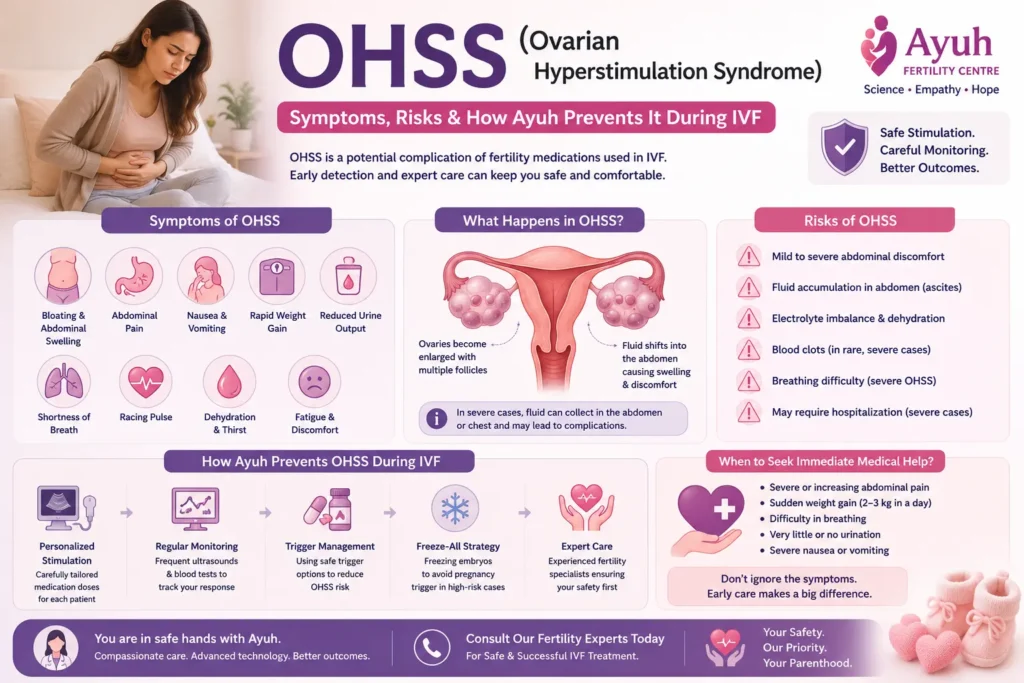
What happens in OHSS: In some women, the ovaries respond to this stimulation more vigorously than expected — developing a larger number of follicles than anticipated. The ovaries become enlarged, and substances released by the growing follicles (particularly VEGF — vascular endothelial growth factor) increase the permeability of blood vessels throughout the body. This allows fluid to leak from the bloodstream into surrounding body spaces — particularly the abdominal cavity — causing bloating, discomfort, and in more significant cases, fluid accumulation that requires medical attention.
The relationship between fertility injections and the ovaries: It is important to understand that OHSS is a response to the medication’s intended effect — stimulating follicle development — taken further than the optimal target range. It is not an allergic reaction or a sign that something is fundamentally wrong with the medication itself. It reflects individual variation in how strongly a person’s ovaries respond to a given dose.
The reassuring reality: The overwhelming majority of OHSS cases — approximately 90% — are mild, causing temporary bloating and discomfort that resolve within a week to ten days without any specific medical intervention beyond rest and hydration. Moderate and severe OHSS are far less common, and with modern preventive protocols, severe OHSS requiring hospitalisation occurs in less than 1–2% of IVF cycles at experienced centres.
Why Does OHSS Happen During IVF?
Understanding the mechanism helps replace fear with informed awareness.
Hormonal Stimulation Medications Gonadotropin injections (FSH and LH-containing medications) directly stimulate the ovaries to develop multiple follicles. The dose is calculated based on individual factors — but the body’s actual response can sometimes exceed what was anticipated, even with careful initial dosing.
Follicle Growth and Hormone Production As follicles grow, they produce increasing amounts of estradiol. Very high estradiol levels — often seen when a large number of follicles develop simultaneously — are one of the strongest predictors of OHSS risk. Dr. Krupa Shah monitors estradiol levels closely throughout every stimulation cycle precisely because of this relationship.
Increased Ovarian Response Some women’s ovaries are simply more sensitive to stimulation medication than others — producing many more follicles from the same dose that would produce a moderate response in another patient. This sensitivity is largely determined by AMH level, antral follicle count, and underlying conditions like PCOS.
Fluid Shifts Inside the Body The trigger injection — given to finalise egg maturation before retrieval — can intensify the VEGF-driven vascular permeability described above, particularly in women who already have a strong stimulation response. This is why trigger injection choice is one of the most important OHSS prevention decisions in high-risk patients.
Why some women respond more strongly than others: Younger age, higher AMH, higher antral follicle count, lower body weight, and PCOS are all associated with a stronger-than-average ovarian response to the same medication dose. This is precisely why individualised stimulation protocols — rather than a one-size-fits-all approach — are central to both IVF success and OHSS prevention.
Who Is at Higher Risk of Developing OHSS?
Women with PCOS PCOS is the single strongest risk factor for OHSS. The polycystic ovaries characteristic of this condition contain a very high number of small antral follicles — meaning even moderate stimulation doses can recruit a large number of developing follicles simultaneously.
Young Women with High Ovarian Reserve Women under 30 generally have higher ovarian reserve and more robust ovarian response to stimulation than older women — placing them at higher OHSS risk even without a PCOS diagnosis.
High AMH Levels AMH (Anti-Müllerian Hormone) directly correlates with the number of follicles likely to respond to stimulation. AMH above 4.0–5.0 ng/mL is associated with significantly elevated OHSS risk and prompts specific protocol modifications at Ayuh.
Previous OHSS History Women who have experienced OHSS in a prior IVF cycle — even mild OHSS — are at increased risk of recurrence in subsequent cycles, making careful protocol adjustment essential.
Large Number of Developing Follicles Regardless of the underlying cause, any cycle where follicle monitoring reveals an unusually large number of developing follicles (typically more than 15–20) signals elevated OHSS risk, prompting closer monitoring and potential dose or trigger modifications.
Symptoms of OHSS
Understanding the symptom spectrum — from mild to severe — helps patients know what to expect and when to seek immediate attention.
Mild Symptoms (most common — approximately 90% of cases):
- Abdominal bloating and a feeling of fullness
- Mild abdominal discomfort or tenderness
- Slight weight gain (1–2 kg)
- Mild nausea
- These symptoms typically appear a few days after egg retrieval and resolve within 7–10 days with rest, hydration, and monitoring at home
Moderate Symptoms (less common):
- More significant abdominal swelling and visible distension
- Vomiting
- Reduced urine output
- Noticeable weight gain (3–5 kg) over a few days
- Shortness of breath with exertion
- These symptoms warrant closer medical follow-up — typically with additional ultrasound and blood test monitoring
Severe Symptoms (rare — less than 1–2% of cycles at experienced centres):
- Severe, persistent abdominal pain
- Significant abdominal distension with visible fluid accumulation
- Rapid, significant weight gain
- Severe shortness of breath, even at rest
- Very reduced or absent urine output
- Signs of blood clot formation (calf pain, swelling, chest pain)
- Severe dehydration despite fluid intake
When to seek immediate medical attention: Any of the severe symptoms listed above warrant immediate contact with your fertility clinic — at Ayuh, patients are given direct contact information for exactly this purpose during their stimulation cycle. Severe OHSS requires hospital-based monitoring and treatment, and early intervention significantly improves outcomes.
Is IVF Stimulation Safe?
This is the question at the heart of every couple’s concern — and the honest answer requires both reassurance and appropriate medical nuance.
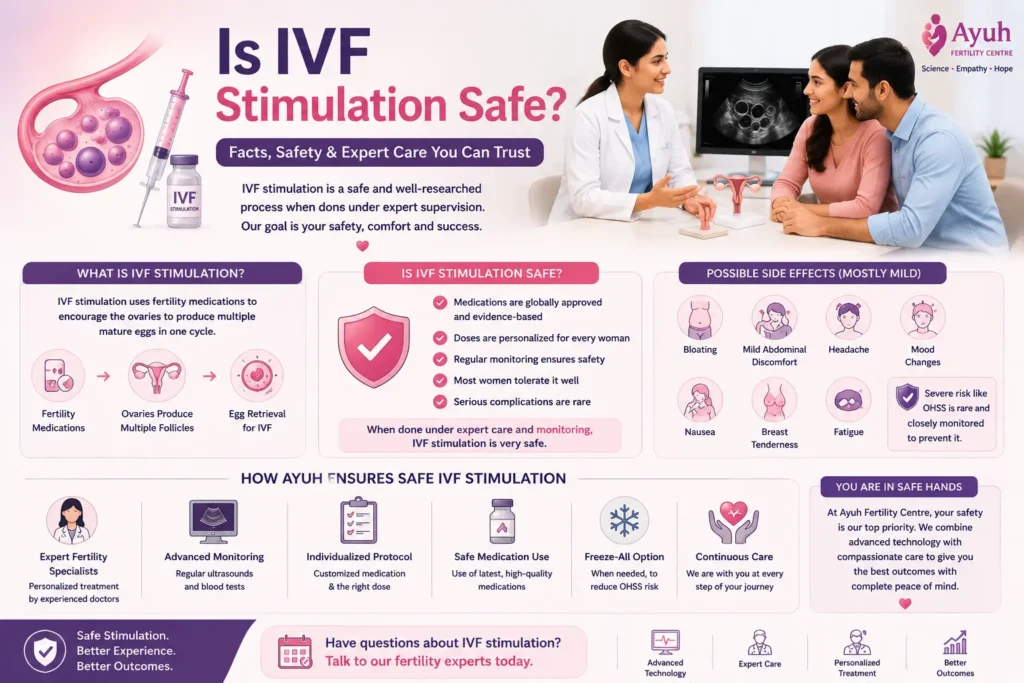
Is IVF stimulation safe Ahmedabad patients can expect at an experienced, well-equipped centre? Generally, yes — with important context.
Modern stimulation protocols: IVF stimulation protocols have evolved significantly over the past two decades, with a much stronger emphasis on individualisation and OHSS prevention built into routine practice — not added as an afterthought.
Individualised medication dosing: Rather than a fixed starting dose for every patient, Dr. Krupa Shah calculates starting doses based on each patient’s AMH, antral follicle count, age, and BMI — significantly reducing the likelihood of excessive response from the outset.
Regular ultrasound monitoring: Follicle monitoring scans every 1–2 days during stimulation track exactly how many follicles are developing and how quickly — allowing real-time dose adjustments before excessive response occurs.
Blood hormone monitoring: Estradiol levels are checked alongside ultrasound monitoring. Rapidly rising estradiol — even before follicle numbers look excessive on ultrasound — can signal the need for dose reduction.
Safer trigger injection choices: For patients identified as high-risk during monitoring, a GnRH agonist trigger (rather than the traditional hCG trigger) is used. This significantly reduces OHSS risk because it does not have the same prolonged, intensifying effect on vascular permeability as hCG.
Freeze-all strategies when necessary: When a patient’s response indicates significant OHSS risk, Dr. Krupa Shah may recommend freezing all embryos rather than proceeding with a fresh transfer — because pregnancy itself (through hCG production) can prolong and worsen OHSS. A subsequent frozen embryo transfer (FET) is performed once the patient has fully recovered, with no compromise to embryo quality or future success rates.
Important honest note: No medical procedure — including IVF stimulation — can be described as carrying zero risk. What can be said accurately is that with experienced specialist oversight, individualised protocols, and rigorous monitoring, the risk of serious complications is low and is actively, continuously managed throughout your cycle.
How Experienced Fertility Specialists Prevent OHSS
OHSS prevention is not a single decision — it is a continuous process woven through every stage of an IVF stimulation cycle.
Personalised Stimulation Protocols The starting medication dose, protocol type (antagonist vs agonist), and overall stimulation approach are determined individually based on each patient’s hormonal profile — never applied as a generic template.
AMH Testing Before Treatment Begins AMH level is one of the strongest predictors of ovarian response. Testing this before the first injection allows Dr. Krupa Shah to anticipate high-risk patients and design a cautious starting protocol from Day 1.
Antral Follicle Count Assessment A baseline ultrasound counting the small follicles visible at the start of the cycle provides additional predictive information about how the ovaries are likely to respond, complementing the AMH result.
Frequent Monitoring Throughout Stimulation Regular ultrasound and blood test monitoring — more frequent for higher-risk patients — allows real-time tracking of the ovarian response, rather than waiting until the end of stimulation to assess the outcome.
Adjusting Medication Doses Mid-Cycle If monitoring shows a stronger-than-expected response, the daily medication dose can be reduced immediately — a flexibility that is central to modern OHSS-prevention practice.
Choosing Safer Trigger Injections As discussed, the GnRH agonist trigger is used preferentially in high-risk patients, significantly reducing the intensity and duration of OHSS symptoms even if some response does occur.
Delaying Embryo Transfer If Necessary Rather than proceeding with a fresh embryo transfer that could be complicated by — or worsen — OHSS symptoms, a freeze-all approach protects both the patient’s safety and the embryos’ future potential.
The Freeze-All Approach This strategy has transformed OHSS prevention in modern IVF. By separating the stimulation cycle from the embryo transfer cycle, the body has time to fully recover before any pregnancy-related hormonal changes occur — eliminating the prolonged OHSS risk that pregnancy itself can create.
How Ayuh Fertility Centre Helps Reduce OHSS Risk
At Ayuh Fertility Centre, OHSS risk minimisation is built into the clinical philosophy — not treated as an exception to standard practice.
Individual Treatment Planning Every stimulation protocol at Ayuh begins with a complete hormonal and ultrasound evaluation — AMH, antral follicle count, BMI, and prior cycle history (if any) — before a single medication dose is prescribed.
Careful Ovarian Monitoring Dr. Krupa Shah personally reviews monitoring scans and hormone results throughout each stimulation cycle — ensuring that dose adjustments, when needed, happen promptly rather than being delayed.
Modern IVF Protocols Ayuh’s ART National Board Certified, ISO-certified facility uses current, evidence-based stimulation protocols — including antagonist protocols with GnRH agonist trigger options for high-risk patients — reflecting international best practice rather than outdated approaches.
Personalised Medication Adjustments No two patients at Ayuh receive an identical stimulation plan. Doses are recalculated based on real-time response throughout the cycle — not fixed at the outset and left unchanged regardless of how the ovaries respond.
Evidence-Based Decision Making Every decision — from initial dose to trigger choice to fresh versus freeze-all transfer planning — is grounded in current clinical evidence and Dr. Krupa Shah’s 19+ years of direct clinical experience managing thousands of stimulation cycles.
Important honest acknowledgment: While these measures significantly reduce OHSS risk, no fertility centre — however experienced — can promise that OHSS will never occur. What Ayuh can promise is vigilant monitoring, rapid response to early signs, and a clinical team that takes your safety as seriously as your success.
Ovarian Hyperstimulation Syndrome Treatment India
Ovarian Hyperstimulation Syndrome treatment India approaches mirror international best practice, tailored by severity:
Mild OHSS Treatment:
- Rest at home, avoiding strenuous activity
- Increased fluid intake (electrolyte-containing fluids are often recommended)
- Over-the-counter pain relief for discomfort (under specialist guidance)
- Monitoring of symptoms with clear instructions on when to call the clinic
- Most mild OHSS resolves completely within 7–10 days without further intervention
Moderate OHSS Treatment:
- Closer medical supervision with scheduled follow-up visits
- Ultrasound follow-up to monitor ovarian size and any fluid accumulation
- Blood tests to monitor kidney function, electrolyte balance, and blood concentration (haematocrit)
- Dietary guidance — typically a high-protein, adequate-salt diet to help maintain fluid balance
- Close monitoring of urine output and weight
Severe OHSS Treatment:
- Hospital admission for close monitoring
- Intravenous fluid administration to correct dehydration and electrolyte imbalance
- Drainage of accumulated abdominal fluid (paracentesis) if causing significant discomfort or breathing difficulty
- Blood thinning medication if clot risk is elevated
- Continuous monitoring of vital signs, kidney function, and fluid balance until symptoms resolve
- In rare, very severe cases, intensive care support may be required
The reassuring clinical reality: with prompt recognition and appropriate management at each stage, the overwhelming majority of OHSS cases — including moderate and severe cases — resolve completely without long-term health consequences.
Can Women Still Have Successful IVF After OHSS?
Yes — and this is one of the most important reassurances to offer couples who have experienced OHSS or are worried about it affecting their future fertility journey.
Recovery is generally complete OHSS, even in moderate or severe form, typically resolves fully within 1–2 weeks with appropriate management. There is no evidence that having experienced OHSS reduces a woman’s underlying fertility potential or damages the ovaries long-term.
Freeze-all cycles preserve the opportunity When OHSS risk leads to a freeze-all approach, the embryos created during that stimulation cycle remain fully viable in cryopreservation — with vitrification survival rates above 95% at Ayuh’s certified laboratory. There is no compromise to embryo quality or future implantation potential from being frozen rather than transferred fresh.
Future embryo transfer proceeds normally Once a woman has fully recovered from OHSS — typically within a few weeks — a frozen embryo transfer (FET) can proceed with the same expectation of success as any other FET cycle. In fact, some research suggests FET cycles may have implantation advantages over fresh transfers, as the endometrium has time to recover from the stimulation hormones before the embryo is introduced.
Long-term fertility is not affected There is no evidence that a history of OHSS affects future natural fertility or the success of subsequent IVF cycles, provided the stimulation protocol is appropriately modified based on the lessons learned from the prior response.
Emotional reassurance Experiencing OHSS — even mild symptoms — can be frightening, particularly during a cycle already filled with anxiety and hope. Dr. Krupa Shah ensures every patient who experiences any degree of OHSS receives clear explanation, close follow-up, and a revised plan for future cycles that directly addresses what was learned.
Common Myths About OHSS
Myth 1: IVF always causes OHSS. False. The majority of IVF cycles — particularly with modern individualised protocols — do not result in any OHSS symptoms at all. Even when mild symptoms occur, they affect a minority of patients and resolve without complication.
Myth 2: OHSS is extremely common. False. Mild OHSS symptoms occur in a meaningful minority of cycles, particularly in higher-risk patients like those with PCOS. Severe OHSS requiring hospitalisation occurs in less than 1–2% of cycles at experienced, well-monitored centres like Ayuh.
Myth 3: IVF injections are unsafe. False. Fertility medications used in IVF stimulation have been used safely in millions of cycles worldwide for over four decades. Like all medications, they carry potential side effects — but when prescribed and monitored by an experienced fertility specialist, they are administered within a carefully managed safety framework.
Myth 4: OHSS permanently damages fertility. False. There is no evidence that experiencing OHSS — even moderate or severe — causes lasting damage to ovarian function or future fertility potential. Recovery is typically complete, and subsequent cycles proceed with appropriately modified protocols.
Myth 5: Every woman with PCOS develops OHSS. False. While PCOS significantly increases OHSS risk, the majority of women with PCOS complete IVF stimulation cycles without developing OHSS — particularly when their specialist applies PCOS-specific protocol modifications, such as lower starting doses and GnRH agonist trigger use, from the outset.
Questions to Ask Your Fertility Specialist Before IVF
Before beginning your stimulation cycle, these questions ensure you feel fully informed:
- Based on my AMH and antral follicle count, am I at higher risk for OHSS?
- How will you monitor me during stimulation, and how often?
- What happens if my ovaries respond more strongly than expected?
- Can my medication dose be adjusted mid-cycle if needed?
- Under what circumstances would you recommend a freeze-all approach for me?
- What type of trigger injection do you plan to use, and why?
- What symptoms should prompt me to contact the clinic immediately?
Dr. Krupa Shah welcomes and directly answers each of these questions at every pre-stimulation consultation at Ayuh — because an informed patient is a calmer, safer patient.
Emotional Support During IVF Treatment
The fear of complications during IVF stimulation is real, valid, and deserves acknowledgment alongside the clinical information.
Fear of Complications Reading about OHSS — or any IVF risk — before beginning treatment can understandably increase anxiety. This fear does not mean you are not ready for treatment. It means you are taking this decision seriously.
Anxiety Before Injections The daily ritual of self-administered injections is, for many patients, one of the most anxiety-provoking aspects of IVF — independent of any complication risk. This is normal, and the Ayuh nursing team provides hands-on injection training and ongoing support throughout your stimulation cycle.
The Importance of Communication Patients who communicate openly with their clinical team about symptoms, concerns, and fears receive better, more responsive care. Dr. Krupa Shah actively invites this communication — no symptom or worry is “too small” to mention during monitoring visits.
Patient Education Understanding what is happening in your body at each stage — why monitoring is being done, what the results mean — genuinely reduces anxiety. This is why detailed explanation, not just instruction, is part of every consultation at Ayuh.
Partner Support Having your partner present at monitoring appointments where possible, and involved in understanding the process, distributes the emotional weight of the cycle and provides practical support during the physically demanding stimulation period.
FAQs
1. What is OHSS?
OHSS (Ovarian Hyperstimulation Syndrome) is a condition that can occur when the ovaries respond more strongly than expected to the hormonal medications used during IVF stimulation. The ovaries become enlarged, and substances released by developing follicles increase blood vessel permeability — allowing fluid to shift from the bloodstream into surrounding body spaces, causing bloating and discomfort. The vast majority of OHSS cases are mild and resolve within 7–10 days. Severe OHSS requiring hospitalisation is uncommon at experienced, well-monitored fertility centres like Ayuh.
2. Is OHSS dangerous?
Mild OHSS, which accounts for approximately 90% of cases, is not dangerous — it causes temporary discomfort that resolves on its own with rest and hydration. Moderate OHSS requires closer monitoring but is generally manageable on an outpatient basis. Severe OHSS, while rare (less than 1–2% of cycles at experienced centres), can involve significant fluid accumulation, breathing difficulty, and blood clot risk — requiring hospital-based care. With prompt recognition and appropriate treatment at each stage, the overwhelming majority of even severe cases resolve completely without long-term health consequences.
3. Can OHSS be prevented?
OHSS risk can be significantly reduced — though not entirely eliminated — through individualised stimulation protocols, careful AMH and antral follicle count assessment before treatment, frequent monitoring during stimulation, real-time medication dose adjustments, safer trigger injection choices (GnRH agonist trigger for high-risk patients), and freeze-all embryo strategies when indicated. Dr. Krupa Shah applies all of these preventive measures at Ayuh Fertility Centre, particularly for patients identified as higher risk based on PCOS, high AMH, or young age.
4. Is IVF stimulation safe?
IVF stimulation is generally safe when managed by an experienced fertility specialist with individualised protocols and regular monitoring. Fertility medications have been used safely in millions of cycles globally for over four decades. While no medical procedure carries zero risk, modern stimulation approaches — including personalised dosing based on AMH and antral follicle count, frequent ultrasound and blood monitoring, and flexible dose adjustment — have significantly reduced complication rates including OHSS. At Ayuh Fertility Centre, safety monitoring is built into every stage of the stimulation cycle.
5. Can I still get pregnant after experiencing OHSS?
Yes. There is no evidence that experiencing OHSS — even moderate or severe cases — causes lasting damage to fertility potential. When a freeze-all approach is used due to OHSS risk, the resulting embryos remain fully viable for future frozen embryo transfer, with no compromise to success rates. Once fully recovered — typically within a few weeks — patients proceed with FET or future stimulation cycles using a protocol specifically adjusted based on what was learned from the prior response, often resulting in a smoother subsequent cycle.
Conclusion
OHSS is a real, recognised potential complication of IVF stimulation — and it deserves honest acknowledgment, not dismissal. But it is equally important to understand what the evidence actually shows: the overwhelming majority of OHSS cases are mild, modern protocols have dramatically reduced severe OHSS occurrence, and even when it does happen, recovery is typically complete with no lasting impact on fertility.
The goal of experienced fertility care is never to promise zero risk — that would not be honest. The goal is vigilant, individualised, evidence-based management that catches early warning signs before they become serious, and that prioritises your safety as seriously as your chance of success.
Dr. Krupa A. Shah has managed thousands of stimulation cycles over 19+ years at Ayuh Fertility Centre, with OHSS prevention woven into every protocol from the very first consultation. Her Advanced IVF Diploma from the International School of Medicine, Kiel–Goettingen–Munich, Germany, her ART National Board Certified and ISO-Certified laboratory, and her commitment to individualised, carefully monitored care mean that when you begin IVF stimulation at Ayuh, your safety is never an afterthought.
If you have concerns about OHSS or IVF safety, the most important step is an open conversation with your specialist — before treatment begins, not after questions have already created unnecessary anxiety.
Discuss your IVF stimulation plan with Dr. Krupa Shah at Ayuh Fertility Centre.
👉 Book your consultation with Ayuh Fertility Centre today
👉 Get expert guidance for PCOS and fertility treatment
👉 Start your journey toward a healthy and successful pregnancy
📍 Visit us in Ahmedabad
📞 Call now to schedule your appointment