
IVF Success Rate in Ahmedabad by Age: What Should You Really Expect?
If you are considering IVF treatment in Ahmedabad, one of the first questions you may have is:
“What is my chance of getting pregnant with IVF?”
It is completely understandable to look for a percentage. IVF is an emotional, physical, and financial commitment, and knowing what to expect can make the treatment journey easier to plan.
However, there is no single IVF success rate in Ahmedabad that applies to every woman.
Age, egg quality, ovarian reserve, sperm health, embryo quality, uterine health, the cause of infertility, previous IVF history, and the type of treatment can all influence the outcome.
Most importantly, a clinic’s overall success percentage cannot predict an individual’s exact chance of pregnancy or live birth.
Large ART datasets also emphasize that average outcomes do not necessarily apply to a particular patient or couple.
At Ayuh Fertility Centre Ahmedabad, the goal is not simply to quote a number. The more useful question is:
“Based on my age, fertility tests, diagnosis and treatment history, what is a realistic chance for me?”
What Does IVF Success Rate Actually Mean?
Before comparing IVF clinics, it is important to understand what they mean by “success.”
A clinic may refer to:
- Positive pregnancy test
- Clinical pregnancy
- Implantation rate
- Ongoing pregnancy
- Live birth
- Success per embryo transfer
- Success per IVF cycle
- Cumulative success over multiple transfers
These are not interchangeable measurements.
For someone trying to have a baby, live birth is ultimately the most meaningful outcome, but the way statistics are calculated can differ between clinics and studies.
For example, one clinic might report pregnancy after embryo transfer, while another may report live births per cycle started.
That is why you should always ask:
“Is this percentage a pregnancy rate, clinical pregnancy rate, or live birth rate—and is it calculated per transfer or per cycle?”
This distinction matters when comparing IVF success rates in Ahmedabad.
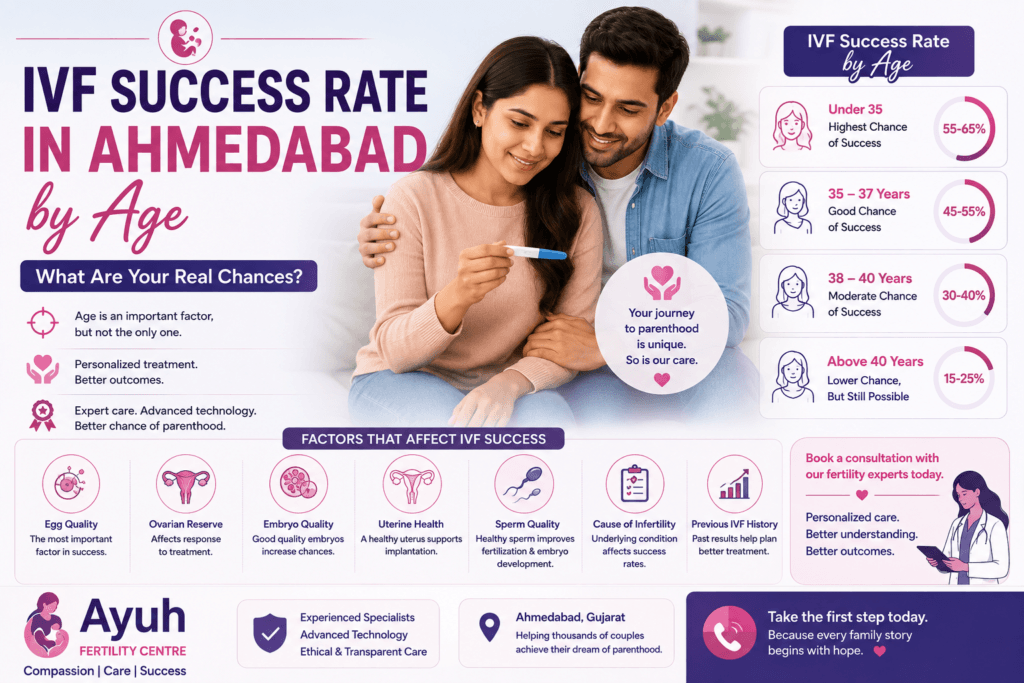
IVF Success Rate by Age
Age is one of the strongest factors associated with IVF outcomes, particularly when using a woman’s own eggs.
As women age, fertility naturally declines, and egg quality becomes an increasingly important factor. The risk of chromosomal abnormalities and miscarriage also increases with age.
But age does not determine your outcome by itself.
Two women of the same age can have very different IVF outcomes because their ovarian reserve, embryo development, uterine health, sperm parameters, and medical history may be different.
IVF Success Under 35
Women under 35 generally have more favorable IVF outcomes when using their own eggs compared with older age groups.
This is largely related to egg quality and the probability of obtaining embryos with good developmental potential.
However, being younger does not guarantee IVF success.
Factors such as:
- Low ovarian reserve
- Endometriosis
- Tubal factors
- Male infertility
- Uterine abnormalities
- Previous failed IVF
- Other medical conditions
can still affect the outcome.
IVF Success Rate Between 35 and 37
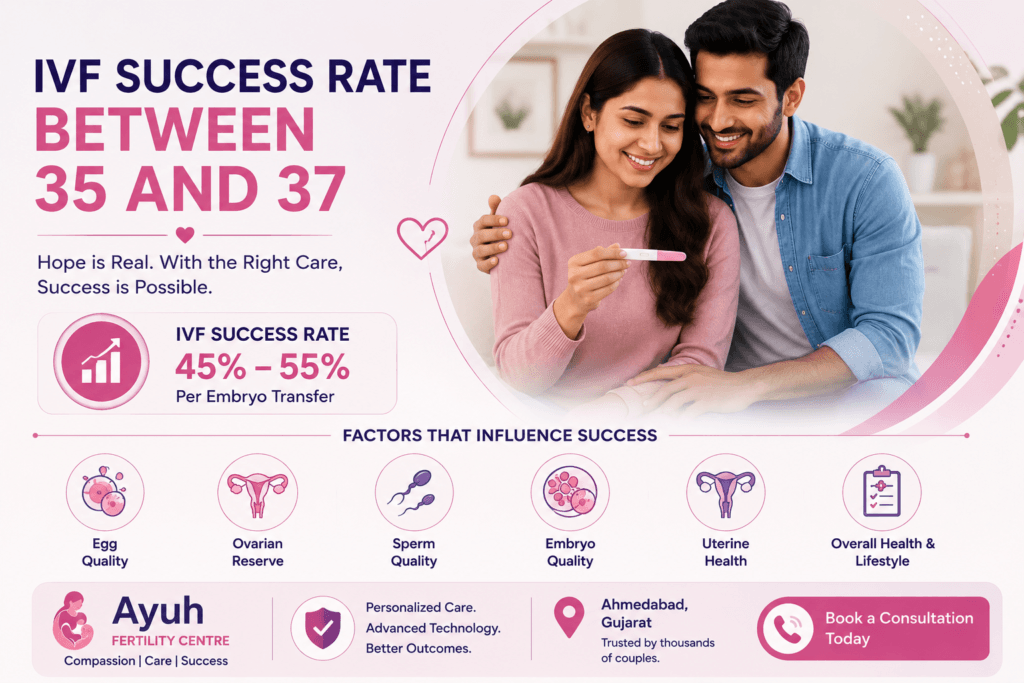
The period after 35 is an important stage in fertility treatment.
Pregnancy through IVF is still very possible, but the chances may gradually decrease compared with younger age groups.
The main concern is not simply the number of eggs retrieved.
Egg quality becomes increasingly important.
As egg age increases, the likelihood of chromosomal abnormalities in embryos also increases. This can affect embryo development, implantation and miscarriage risk.
Ayuh has previously discussed realistic IVF expectations after 35 in detail, emphasizing individualized assessment rather than one universal success number.
IVF Success Rate Between 38 and 40
Between 38 and 40, fertility specialists generally pay closer attention to:
- AMH
- Antral follicle count
- Previous IVF response
- Number of eggs retrieved
- Fertilization
- Embryo development
- Embryo quality
- Uterine condition
- Sperm quality
At this stage, time can become an important consideration.
This does not mean IVF cannot work.
It means that your fertility specialist may recommend a more individualized strategy after reviewing your complete fertility profile.
IVF Success After 40
Many women wonder:
“Can IVF work after 40?”
Yes, pregnancy with IVF after 40 is possible.
However, when using a woman’s own eggs, age-related changes in egg quality can make treatment more challenging.
The chances of obtaining chromosomally normal embryos generally decrease with increasing maternal age, while miscarriage risk increases.
For this reason, women over 40 may require more individualized counselling and treatment planning.
Depending on the circumstances, a fertility specialist may discuss:
- Ovarian reserve testing
- Embryo development
- Blastocyst culture
- Genetic testing options
- Frozen embryo transfer
- Repeated IVF attempts
- Donor egg IVF
The appropriate option depends on the individual patient—not age alone.
Why Does IVF Success Decline With Age?
One of the most important factors is egg quality.
A woman may still have eggs available at 40, but the probability that an egg will produce a chromosomally normal embryo generally decreases with age.
This can influence:
Egg → Fertilization → Embryo development → Implantation → Pregnancy → Live birth
Therefore, ovarian reserve tests such as AMH and AFC can provide useful information about egg quantity, but they do not perfectly measure egg quality.
This is one reason why a younger woman with a low AMH may still have a different IVF prognosis from an older woman with a higher AMH.
7 Factors That Affect IVF Success Besides Age
Age is important, but it is not the only factor.
1. Egg Quality
Egg quality has a major influence on embryo development.
Age is closely associated with egg quality, although individual variation exists.
2. Ovarian Reserve
Tests such as:
- AMH
- AFC
- FSH
- Estradiol
may help your fertility specialist understand ovarian reserve and plan stimulation.
But these tests should be interpreted alongside your age and complete medical history.
3. Embryo Quality
An embryo needs to develop appropriately before it can be transferred.
Embryologists assess embryo development and morphology to help determine which embryos may have better potential.
However, a good-looking embryo does not guarantee pregnancy.
4. Uterine and Endometrial Health
The uterus and endometrium also matter.
Conditions such as:
- Fibroids
- Polyps
- Adenomyosis
- Endometriosis
- Uterine adhesions
- Abnormal endometrial development
may require evaluation before or during fertility treatment.
5. Sperm Quality
IVF is not only about female fertility.
Sperm concentration, motility, morphology and other sperm-related factors may influence fertilization and embryo development.
In selected cases, advanced male infertility testing may be considered.
6. Cause of Infertility
The reason for infertility can influence treatment planning.
For example, treatment may differ for:
- PCOS
- Low ovarian reserve
- Tubal blockage
- Endometriosis
- Male infertility
- Unexplained infertility
- Previous IVF failure
A personalized approach is therefore more useful than relying only on an age-based percentage.
7. Previous IVF History
If you have already undergone IVF, your previous cycle can provide valuable information.
Your doctor may review:
- How you responded to stimulation
- Number of eggs retrieved
- Fertilization rate
- Embryo development
- Blastocyst formation
- Embryo quality
- Endometrial thickness
- Transfer details
- Pregnancy outcome
A failed IVF cycle does not automatically mean that the next cycle will fail.
Instead, the previous cycle can provide information that helps refine the next treatment strategy.
Does IVF Success Mean Pregnancy or a Baby?
This is an important question that many couples don’t ask.
A positive pregnancy test is not the same as a live birth.
There can be differences between:
Positive pregnancy → Clinical pregnancy → Ongoing pregnancy → Live birth
Therefore, when researching the best IVF centre in Ahmedabad, don’t simply ask:
“What is your success percentage?”
Instead ask:
“What outcome does your success rate represent?”
“Is it calculated per cycle or embryo transfer?”
“Is it age-specific?”
“Does it include all patients or selected patients?”
“Is it pregnancy rate or live birth rate?”
These questions can help you make a more informed decision.
Can You Improve Your IVF Success Chances?
There is no guaranteed method to make IVF successful.
However, appropriate medical evaluation and individualized treatment can help identify factors that may be addressed before or during IVF.
Your fertility specialist may consider:
Before IVF
- Ovarian reserve assessment
- Semen analysis
- Uterine evaluation
- Hormonal testing
- Review of medical history
- Lifestyle assessment
- Previous treatment history
During IVF
- Individualized stimulation protocol
- Follicle monitoring
- Appropriate timing of egg retrieval
- Laboratory fertilization
- Embryo culture
- Embryo assessment
- Appropriate embryo transfer planning
The aim is to choose a treatment strategy that fits your specific fertility profile, rather than following the exact same protocol for every patient.
Is IVF Successful in the First Attempt?
It can be, but first-cycle success is not guaranteed.
Some couples conceive during their first IVF cycle, while others may require additional cycles or frozen embryo transfers.
A failed first cycle should not automatically be viewed as the end of the journey.
The next step is often to understand why the cycle did not result in pregnancy.
Your fertility specialist may review the entire cycle before deciding whether to repeat, modify or change the treatment strategy.
What If IVF Fails?
An unsuccessful IVF attempt can be emotionally difficult.
But one failed cycle does not necessarily mean that IVF will never work.
Depending on the circumstances, your doctor may review:
- Egg yield
- Fertilization
- Embryo development
- Blastocyst formation
- Embryo quality
- Uterine factors
- Endometrial preparation
- Sperm factors
- Age-related factors
The next treatment should be based on what was learned from the previous attempt.
In some cases, the next step may simply involve another individualized IVF cycle. In other cases, additional testing or a different approach may be appropriate.
IVF Success Rate in Ahmedabad: Don’t Compare Clinics Only by Percentage
When searching Google for the best IVF specialist in Ahmedabad, you may see clinics advertising different success percentages.
Be careful about comparing numbers without understanding how they were calculated.
A higher percentage does not automatically mean that one clinic is better for your individual situation.
Look at:
- Doctor’s experience
- Embryology laboratory quality
- Individualized treatment planning
- Transparency in reporting outcomes
- Patient selection
- Available fertility treatments
- Male infertility evaluation
- Embryology expertise
- Follow-up care
- Communication and counselling
Most importantly, ask whether the clinic can explain your individual expected outcome rather than simply giving you a general percentage.
Why Personalized IVF Treatment Matters at Ayuh Fertility Centre
At Ayuh Fertility Centre Ahmedabad, IVF treatment is approached as an individualized fertility journey.
Dr. Krupa A. Shah, Founder of Ayuh Fertility Centre, is an infertility specialist with experience in IVF, IUI, PCOS, reproductive medicine and related fertility care. Ayuh’s published information emphasizes personalized protocols and realistic counselling rather than making blanket promises about IVF success.
Your age is an important part of the picture—but it is only one part.
A meaningful assessment may consider your:
Age + ovarian reserve + egg quality + sperm parameters + embryo development + uterine health + infertility diagnosis + previous treatment history
Together, these factors can help your fertility specialist provide a more realistic understanding of your treatment options.
FAQ | IVF Success Rate in Ahmedabad by Age
1. What is the IVF success rate in Ahmedabad?
There is no single success rate that applies to every IVF patient in Ahmedabad. Outcomes vary according to age, egg and sperm factors, embryo quality, uterine health, diagnosis, treatment protocol and other individual factors.
2. Does IVF success decrease after 35?
Generally, IVF outcomes using a woman’s own eggs tend to decline with increasing age, particularly because egg quality and chromosomal normality change with age.
3. Can IVF work after 40?
Yes. IVF can result in pregnancy after 40, but success using one’s own eggs may be lower than at younger ages. Individual assessment is important.
4. Does AMH determine IVF success?
No. AMH primarily provides information about ovarian reserve and expected response to stimulation. It does not independently predict whether an individual will have a live birth.
5. Does a good embryo guarantee IVF success?
No. Embryo quality is important, but implantation and pregnancy also depend on several other factors.
6. How many IVF cycles are needed to get pregnant?
There is no fixed number. Some couples conceive during their first cycle, while others may require additional cycles or frozen embryo transfers. The appropriate plan depends on individual circumstances.
7. What should I ask an IVF clinic about its success rate?
Ask whether the reported figure refers to pregnancy or live birth, whether it is calculated per cycle or transfer, and whether the results are broken down by age and relevant patient characteristics.
Final Takeaway
If you’re searching for the IVF success rate in Ahmedabad, don’t focus on finding one perfect percentage.
The more useful question is:
“What is my realistic chance of having a baby with IVF?”
Age is one of the strongest factors, but it is not the only one. Egg quality, ovarian reserve, sperm health, embryo development, uterine health, infertility diagnosis and previous IVF history can all influence your outcome.
The best way to understand your chances is through a personalized fertility assessment with an experienced fertility specialist.
Thinking about IVF in Ahmedabad? A consultation can help you understand your fertility profile, available treatment options and realistic expectations before you begin.
Medical Disclaimer
This article is intended for general educational purposes and does not replace medical consultation, diagnosis or individualized treatment advice. IVF outcomes vary significantly between individuals. Your fertility specialist can assess your medical history and investigations to provide advice appropriate to your situation.
Medically Reviewed / Author:
Dr. Krupa A. Shah
MBBS, MS (Obstetrics & Gynaecology)
Infertility Specialist & Founder, Ayuh Fertility Centre, Ahmedabad