
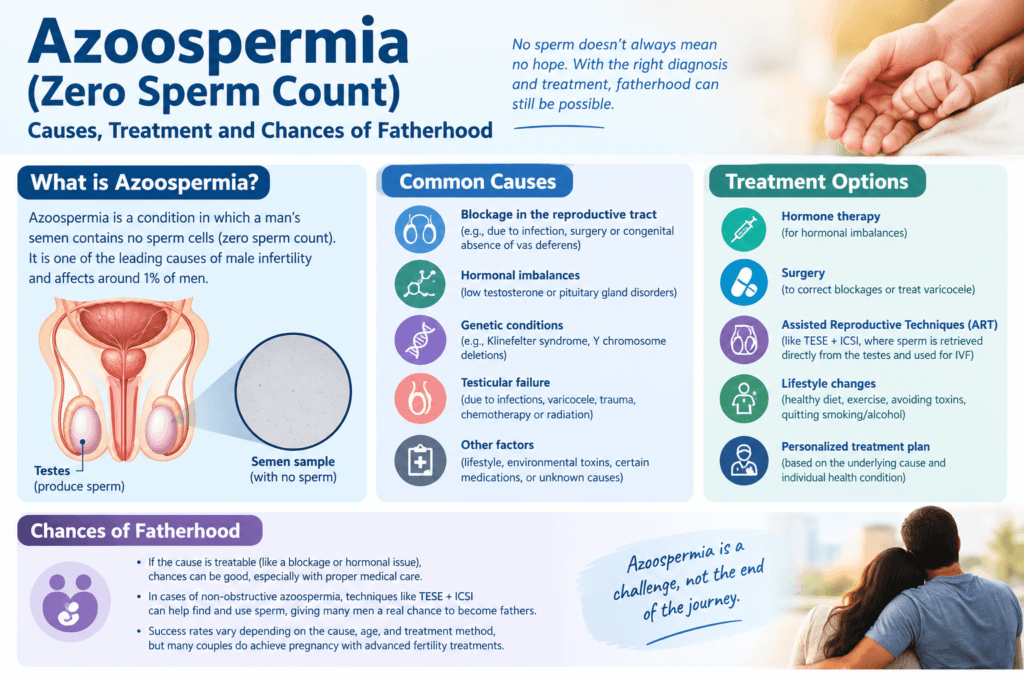
What Is Azoospermia?
Azoospermia means no sperm are present in the ejaculated semen. It is found in roughly 1% of all men and in about 10 to 15% of men being evaluated for infertility. Before a diagnosis is confirmed, the semen sample is usually spun in a centrifuge and checked again, and the test is repeated on a second occasion.
The Two Types of Azoospermia
| Obstructive azoospermia (OA) | Non-obstructive azoospermia (NOA) | |
|---|---|---|
| What happens | Sperm are made, but a blockage stops them reaching the semen | The testes make very few or no sperm |
| Common causes | Past infection, vasectomy, injury, absent vas deferens from birth | Hormonal problems, genetic causes, undescended testes, mumps, chemotherapy |
| Hormone levels | Usually normal | FSH often high |
| Chance of finding sperm by retrieval | Very high | Lower, but sperm are still found in many men |
Tests Your Doctor May Advise
- Repeat semen analysis with centrifugation
- Hormone tests: FSH, LH, testosterone, prolactin
- Scrotal ultrasound to check testis size, varicocele and blockages
- Genetic tests: karyotype and Y-chromosome microdeletion, especially in non-obstructive cases
- Physical examination to check the vas deferens
These results tell the doctor which type you have, and therefore which treatment is most likely to work.
Treatment Options
1. Treating the cause
Some causes can be corrected. Hormonal problems may respond to medication. Certain blockages can be surgically opened, and a varicocele can be repaired. These approaches may restore sperm in the semen for some men.
2. Surgical sperm retrieval
When sperm cannot reach the semen, they can be collected directly:
- PESA (Percutaneous Epididymal Sperm Aspiration): A fine needle draws sperm from the epididymis. Used mainly for obstructive azoospermia.
- TESA (Testicular Sperm Aspiration): A needle takes sperm from the testis itself.
- TESE / Micro-TESE: A small surgical biopsy, sometimes under a microscope, to find sperm in non-obstructive cases.
These are day-care procedures done under local or short general anaesthesia. Most men return to normal activity within a day or two.
3. IVF with ICSI
Retrieved sperm are few in number, so they are used with ICSI. An embryologist injects a single sperm into each mature egg. Retrieved sperm can also be frozen for future cycles, so the procedure need not be repeated.
4. Donor sperm
If no sperm are found, donor sperm from an ICMR-registered ART bank is an option that some couples choose after counselling.
Can Azoospermia Be Cured?
It depends on the cause. Obstructive azoospermia and hormone-related azoospermia can sometimes be reversed. For many other men, a permanent “cure” is not possible, but becoming a father with their own sperm through retrieval and ICSI often is.
Azoospermia Treatment at Ayuh Fertility Centre
Ayuh Fertility Centre in Ranip, Ahmedabad, offers the full pathway under one roof: evaluation, TESA/PESA, ICSI in an ISO-certified embryology lab, and sperm freezing in our ART bank. Dr. Krupa Shah counsels both partners about realistic chances before any procedure, in complete privacy.
Diagnosed with zero sperm count? Don’t lose hope before a proper evaluation. Call or WhatsApp +91 94260 28483.
Frequently Asked Questions
Can a man with zero sperm count become a father?
Often, yes. Sperm can frequently be retrieved directly from the testis or epididymis and used with ICSI.
Is TESA painful?
It is done under anaesthesia. Mild soreness for one or two days is common.
Can medicines increase sperm count from zero?
Only in specific hormonal causes. Supplements do not reverse a blockage or genetic cause.
Does azoospermia affect sexual performance?
Usually not. Most men with azoospermia have normal erections and ejaculation.
Will my child inherit the problem?
Some genetic causes can pass to a son. Genetic testing and counselling before ICSI help you understand this.