
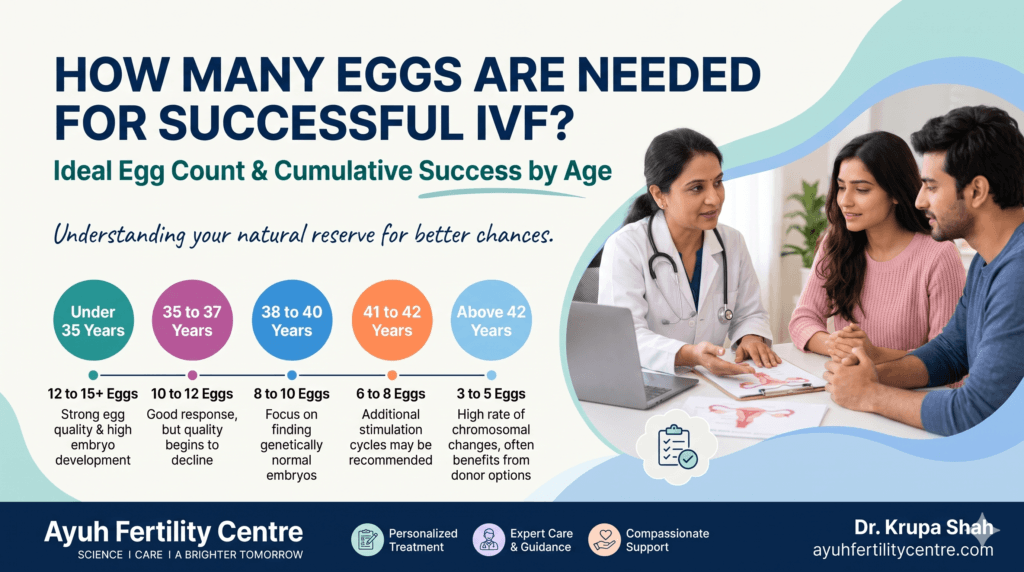
Quick Answer: There is no fixed number of eggs required for successful IVF. However, retrieving around 8–15 eggs is often considered a useful treatment response in many IVF cycles. The number of mature eggs, egg quality, fertilisation rate, embryo development and the woman’s age all influence the chances of success. Even a few good-quality eggs can result in a healthy pregnancy.
How Many Eggs Are Needed For Successful IVF?
One of the most common questions couples ask before starting IVF treatment is, “How many eggs are needed for successful IVF?”
During an IVF cycle, fertility specialists use hormonal medications to stimulate the ovaries to develop multiple follicles. These follicles may contain eggs, which are collected through a procedure called egg retrieval.
While retrieving more eggs can provide additional opportunities for fertilisation and embryo development, a higher egg count does not automatically guarantee pregnancy.
For many women, retrieving approximately 8–15 eggs can be a reasonable response to ovarian stimulation. However, the ideal number varies depending on age, ovarian reserve, medical history and individual treatment response.
The primary goal is not simply to collect more eggs but to obtain mature, good-quality eggs that can develop into healthy embryos.
Does the Number of Eggs Affect IVF Success Rates?
Yes, the number of eggs retrieved can influence IVF outcomes because having more eggs may provide more opportunities for fertilisation and embryo development.
However, not every retrieved egg is mature, and not every mature egg successfully fertilises or develops into a transferable embryo.
For example, an IVF cycle may follow this general process:
| IVF Stage | What Happens |
|---|---|
| Egg retrieval | Eggs are collected from the ovaries |
| Maturity assessment | Mature and immature eggs are identified |
| Fertilisation | Mature eggs are fertilised using IVF or ICSI |
| Embryo development | Fertilised eggs are monitored for development |
| Blastocyst formation | Some embryos develop to the blastocyst stage |
| Embryo transfer | A suitable embryo is transferred into the uterus |
This explains why the initial egg count is only one part of the IVF journey.
A woman with fewer eggs may still have a successful IVF outcome if suitable embryos develop.
How Many Eggs Are Needed for Successful IVF by Age?
Age is one of the important factors affecting egg quality and reproductive potential. As women grow older, the proportion of eggs with chromosomal abnormalities generally increases.
The expected egg retrieval response also varies depending on ovarian reserve.
The following table provides a general educational overview, not a guaranteed egg target or a personalised success prediction.
| Age Group | Important Fertility Considerations |
|---|---|
| Below 30 years | Egg quality is generally more favourable, although individual ovarian response varies |
| 30–34 years | Egg quality and ovarian reserve should be assessed before treatment |
| 35–37 years | Age-related changes in egg quality become increasingly relevant |
| 38–40 years | Fewer eggs may result in fewer chromosomally suitable embryos |
| Above 40 years | Individualised treatment planning and realistic counselling become especially important |
Important: There is no scientifically established universal egg number for each age group that guarantees IVF success. Your fertility specialist will assess your ovarian reserve, previous treatment response and other medical factors before recommending an appropriate stimulation protocol.
What Is the Difference Between Retrieved Eggs and Mature Eggs?
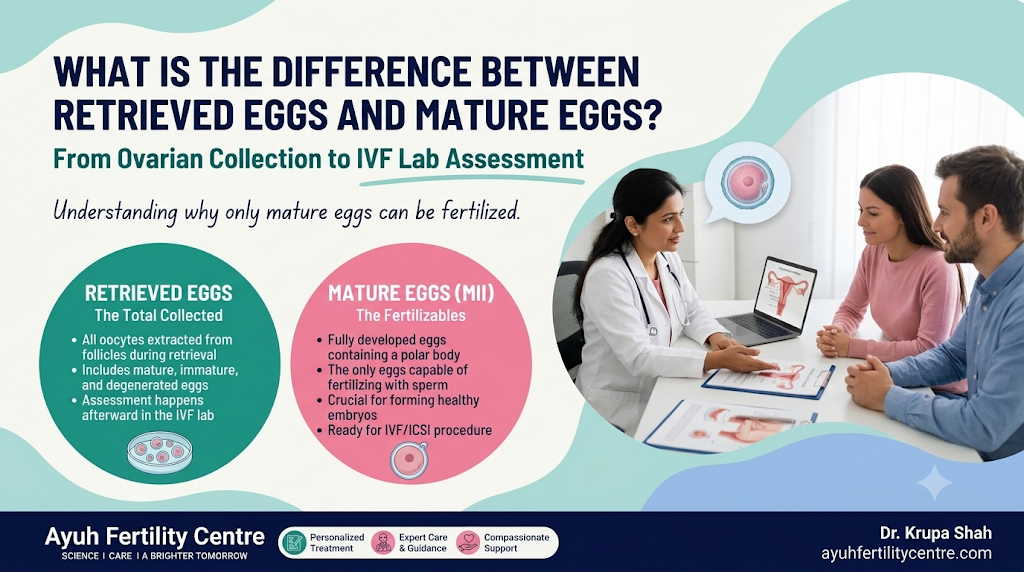
Not all eggs collected during IVF are ready for fertilisation.
After egg retrieval, embryologists examine the collected eggs to determine their maturity.
There are three commonly discussed maturity stages:
- GV (Germinal Vesicle): An immature egg that has not completed the first stage of nuclear maturation.
- MI (Metaphase I): An egg that is still undergoing maturation.
- MII (Metaphase II): A mature egg that is generally suitable for fertilisation.
Mature MII eggs are typically used for fertilisation through conventional IVF or Intracytoplasmic Sperm Injection (ICSI), depending on the treatment plan.
This is why the number of mature eggs is often more informative than the total number retrieved.
5 Factors That Affect the Number of Eggs Retrieved During IVF
Several factors influence how many eggs a woman may produce during an IVF cycle.
1. Woman’s Age
Age affects both egg quantity and quality. Younger women generally have a higher proportion of chromosomally normal eggs, while the proportion tends to decline with increasing age.
2. Ovarian Reserve (AMH Levels)
Anti-Müllerian Hormone (AMH) is a blood marker used to estimate ovarian reserve.
It helps fertility specialists understand how the ovaries may respond to stimulation medications.
However, AMH does not directly measure egg quality or guarantee pregnancy.
3. Antral Follicle Count (AFC)
Antral Follicle Count is measured through an ultrasound examination.
It helps estimate the number of small follicles present in the ovaries and provides information about the expected response to ovarian stimulation.
4. PCOS and Hormonal Conditions
Women with Polycystic Ovary Syndrome (PCOS) may have a higher number of small follicles and can sometimes produce a larger number of eggs during IVF stimulation.
However, a higher egg count does not necessarily mean better egg quality or improved pregnancy outcomes. Careful monitoring is also important to reduce the risk of ovarian hyperstimulation syndrome (OHSS).
5. Previous IVF Response
A woman’s response to previous IVF stimulation cycles can help specialists plan future treatment.
If a previous cycle resulted in fewer eggs than expected, the fertility specialist may review the medication protocol, ovarian reserve and other relevant factors.
Can IVF Be Successful with Only 2–3 Eggs?
Yes, IVF can sometimes be successful even when only two or three eggs are retrieved.
Although fewer eggs may reduce the number of opportunities for fertilisation and embryo development, a smaller number does not mean pregnancy is impossible.
The outcome depends on several factors, including:
- The maturity of the retrieved eggs
- Egg quality and age-related factors
- Sperm quality
- Successful fertilisation
- Embryo development
- Uterine and endometrial health
For example, even if only two mature eggs are available, one may successfully fertilise and develop into an embryo suitable for transfer.
Therefore, couples should not assume that a low egg count automatically means IVF failure.
Does More Eggs Mean Higher IVF Success?
Not necessarily.
A higher number of retrieved eggs may increase the potential number of embryos available for transfer or freezing. However, egg quantity and egg quality are two different things.
The European Society of Human Reproduction and Embryology (ESHRE) highlights the importance of individualised ovarian stimulation and monitoring. A high response also requires careful medical management because excessive ovarian stimulation can increase the risk of OHSS.
The goal of IVF treatment is to achieve an appropriate and safe ovarian response rather than simply maximise the number of eggs collected.
How Can You Improve Your Egg Quality Before IVF?
Egg quality is influenced by factors such as age, genetics and overall reproductive health. No supplement, diet or lifestyle change can guarantee improved egg quality.
However, maintaining good general health before IVF may support reproductive health.
Some helpful measures include:
- Maintain a balanced diet containing vegetables, fruits, whole grains and adequate protein.
- Maintain a healthy body weight.
- Avoid smoking and tobacco products.
- Limit alcohol consumption.
- Follow a regular sleep schedule.
- Discuss folic acid and other supplements with your fertility specialist.
- Manage conditions such as PCOS, thyroid disorders and diabetes with appropriate medical guidance.
- Attend recommended fertility assessments before starting treatment.
Always consult your doctor before taking fertility supplements or making changes to prescribed medications.
Which Tests Help Predict How Many Eggs You May Produce During IVF?
Before starting IVF, fertility specialists may recommend certain tests to estimate ovarian response.
| Fertility Test | Purpose |
|---|---|
| AMH blood test | Estimates ovarian reserve |
| Antral Follicle Count (AFC) | Counts small follicles through ultrasound |
| FSH test | Provides additional information about ovarian function |
| Pelvic ultrasound | Assesses ovarian and uterine health |
AMH and AFC are particularly useful for predicting whether a woman may have a low or high response to ovarian stimulation.
However, these tests cannot independently predict whether IVF will result in a pregnancy or live birth.
When Should You Consult an IVF Specialist in Ahmedabad?
If you are planning IVF treatment, have experienced repeated unsuccessful IVF cycles or have concerns about low ovarian reserve, consulting a fertility specialist can help you understand your treatment options.
At Ayuh Fertility Centre, Ahmedabad, couples can discuss their fertility concerns, undergo recommended investigations and receive an individualised treatment plan based on their medical history and reproductive goals.
Dr. Krupa Shah can help patients understand important fertility factors such as AMH levels, egg maturity, ovarian response and embryo development when planning IVF treatment.
An early fertility evaluation can help couples make informed decisions about their next steps.
Frequently Asked Questions (FAQs)
1. How many eggs are considered good for IVF?
Around 8–15 retrieved eggs may represent a useful ovarian response in many IVF cycles. However, there is no universal ideal number. Age, mature egg count, egg quality and individual medical factors influence the outcome.
2. Can IVF succeed with only 3 eggs?
Yes. IVF can succeed with three eggs if one or more develop into suitable embryos. A lower egg count may reduce the number of available embryos but does not rule out pregnancy.
3. Is 10 eggs enough for successful IVF?
Ten eggs can be a reasonable number for an IVF cycle. However, the final outcome depends on how many are mature, how many fertilise and how many develop into suitable embryos.
4. Does egg quality matter more than egg quantity in IVF?
Both matter. Egg quantity determines how many opportunities are available for fertilisation, while egg quality influences fertilisation and embryo development. Age is an important factor associated with egg quality.
5. Does low AMH mean fewer eggs during IVF?
Low AMH may indicate a lower ovarian reserve and a potentially reduced response to stimulation. However, it does not mean that pregnancy through IVF is impossible.
6. Can a woman above 40 have successful IVF with fewer eggs?
Yes, pregnancy may still be possible. However, age-related changes in egg quality and chromosomal normality can affect the chances of success. Treatment expectations should be discussed individually with a fertility specialist.
7. How long does it take to collect eggs during IVF?
Ovarian stimulation usually takes around 8–14 days, depending on the treatment response. Egg retrieval is then performed as a short procedure under appropriate sedation or anaesthesia.
Conclusion
The number of eggs needed for successful IVF varies from woman to woman. Although retrieving around 8–15 eggs may be a useful response in many treatment cycles, egg maturity, quality, age and embryo development are equally important considerations.
Even women with a low egg count can sometimes achieve pregnancy through IVF with an appropriately planned treatment approach.
If you are considering IVF treatment, consult a fertility specialist to understand your ovarian reserve and the most suitable treatment options.