
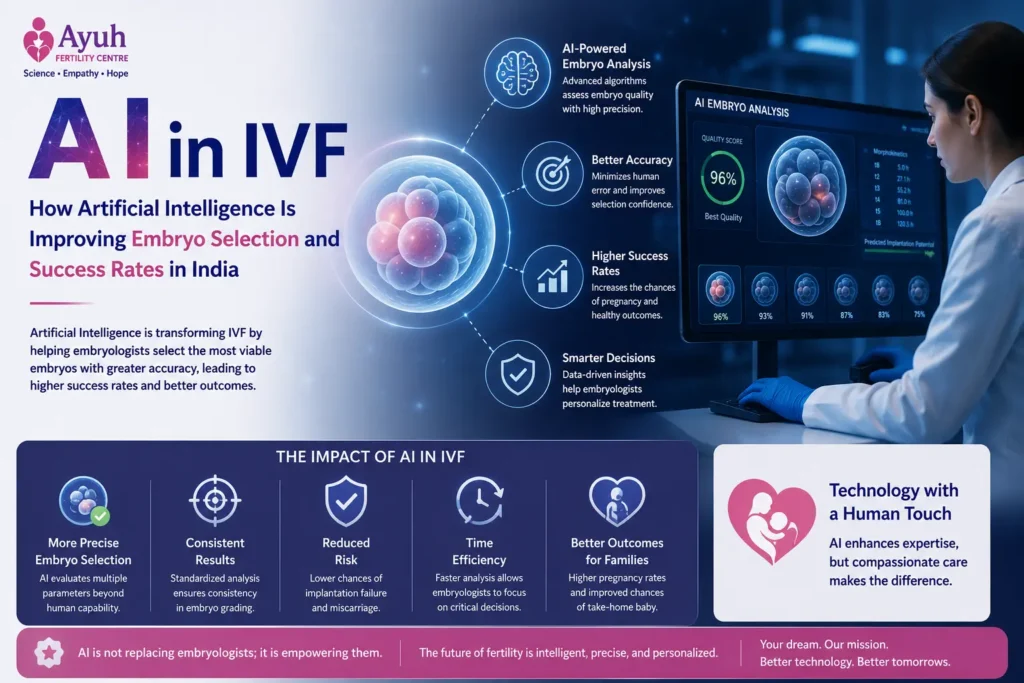
AI embryo selection in IVF India is a topic generating genuine curiosity among couples preparing for fertility treatment — and for good reason. IVF has evolved enormously since the first successful cycle in 1978, and the integration of artificial intelligence into embryology laboratories represents one of the most significant shifts in reproductive technology in recent years.
Couples today are asking informed questions: What does AI actually do in IVF? Can it really improve our chances? Does it replace the embryologist? These are exactly the right questions to ask — and they deserve honest, medically responsible answers.
The straightforward truth is this: AI in IVF is a supportive tool. It helps embryologists analyse more data, observe embryo development more consistently, and make more informed selection decisions. It does not guarantee pregnancy. It does not replace the expertise of a trained fertility specialist or embryologist. And it is not a technology that every patient automatically needs.
At Ayuh Fertility Centre in Ahmedabad, Dr. Krupa M. Shah believes that patients deserve a clear, realistic understanding of what technology can and cannot do — so they can make informed decisions without either dismissing important advances or placing unrealistic expectations on them.
This guide explains AI in IVF honestly, practically, and in language that makes the science accessible.
Author Bio
Dr. Krupa A. Shah MBBS · MS (Obstetrics & Gynaecology) · Infertility Specialist Founder, Ayuh Fertility Centre, Ahmedabad
19+ Years of Experience in reproductive medicine, obstetrics, and gynaecology.
Dr. Krupa Shah completed her MBBS from Baroda Medical College (2006) and her MS in Obstetrics & Gynaecology from B.J. Medical College, Ahmedabad (2010). After 12 years of experience at leading clinics in Chennai — including Apollo Hospital and Iswarya Fertility Centre — she completed an Advanced IVF Fellowship at Ludwig Maximilians University, Munich, Germany, one of Europe’s most prestigious reproductive medicine institutions.
She is a member of the Ahmedabad Obstetrics and Gynaecology Society (AOGS), the Indian Society of Assisted Reproduction (ISAR), and the Federation of Obstetric and Gynaecological Societies of India (FOGSI).
IVF laboratory is ART National Board Certified.
🩺 Medically Reviewed By
This article is medically reviewed by Dr. Krupa M. Shah, ensuring accurate and reliable fertility information.
What Is Artificial Intelligence in IVF?
Artificial intelligence, in the context of IVF, refers to computer systems trained to analyse large amounts of embryological data — particularly images of developing embryos — and identify patterns that may be relevant to embryo assessment.
To understand how this works, it helps to understand what AI actually does. An AI system in an IVF laboratory is trained on thousands or hundreds of thousands of images of embryos at different developmental stages — from fertilised egg through to blastocyst. By analysing these images, the system learns to recognise patterns associated with different developmental outcomes.
When a new cycle produces embryos, the AI can analyse images of those embryos and provide the embryologist with additional data points — flagging developmental characteristics that the algorithm has associated with favourable or less favourable outcomes in its training data.
What AI in IVF does not do:
- It does not guarantee which embryo will implant
- It does not replace the clinical judgement of an experienced embryologist or fertility specialist
- It does not make independent treatment decisions
- It cannot correct poor egg quality, sperm DNA damage, or uterine problems
- It cannot account for the full biological complexity of implantation
AI in IVF is best understood as a sophisticated second opinion — an additional source of information that the clinical team can consider alongside their own expertise and assessment. The final decision always remains with the medical team.
Understanding AI Embryo Selection in IVF
Traditional embryo selection has always been one of the most critical — and genuinely difficult — decisions in the IVF laboratory. When a cycle produces several embryos, choosing which one to transfer first requires careful evaluation. More embryos mean more choices, but not necessarily more clarity.
AI embryo selection in IVF India is changing how that evaluation is supported — though not replacing the humans who make the final call.
What Traditional Embryo Grading Involves
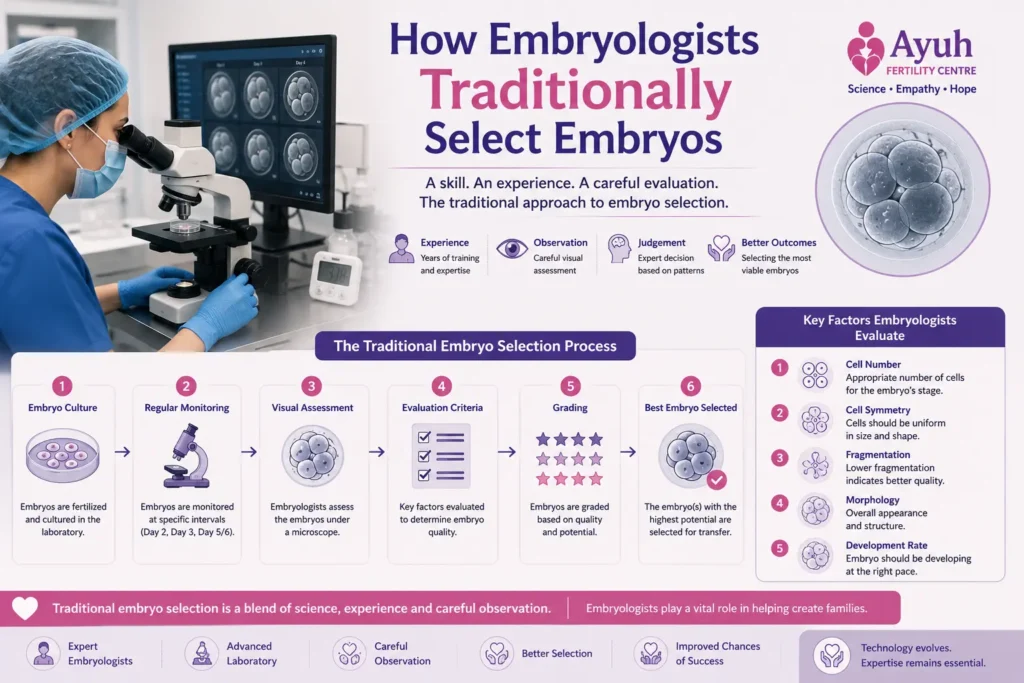
Embryologists traditionally assess embryos by observing them under a microscope at set time points — typically day 3 and day 5 of development. They evaluate:
- Cell number — how many cells the embryo has divided into
- Cell symmetry — whether the cells are roughly equal in size
- Fragmentation — the presence and amount of cellular debris
- Blastocyst quality — the expansion and appearance of the blastocyst’s inner cell mass and outer trophectoderm layer
This is a skilled, experience-dependent process. Two expert embryologists examining the same embryo at the same time point may reach similar conclusions — but they are working from a single snapshot at a discrete moment.
How AI-Assisted Assessment Differs
AI-assisted assessment — particularly when combined with time-lapse imaging — works from a continuous record of embryo development rather than discrete snapshots. The algorithm can analyse hundreds of images captured automatically every 10–20 minutes and identify developmental timing events that may be clinically relevant.
Specific developmental milestones — when cells first divided, how long each division took, whether divisions were synchronous — are captured and analysed without the embryologist needing to open the incubator. The AI presents this developmental data in a structured way that supports, rather than replaces, the embryologist’s assessment.
The result is more information, not a guaranteed answer. Whether that additional information improves outcomes in any given case depends on many factors well beyond what the algorithm can assess — including egg quality, sperm DNA integrity, uterine receptivity, and the patient’s age and ovarian reserve.
How Embryologists Traditionally Select Embryos
Before exploring what AI adds, it is important to understand and appreciate what experienced embryologists already bring — because the human expertise in this field is genuinely remarkable and irreplaceable.
An experienced embryologist working in a well-equipped IVF laboratory evaluates embryos across multiple dimensions:
Fertilisation confirmation After ICSI or standard IVF insemination, the embryologist checks each egg for normal fertilisation signs — specifically, the presence of two pronuclei, confirming that one nucleus from the egg and one from the sperm have formed correctly.
Day 3 cleavage assessment The embryo is examined for cell number (ideally 6–8 cells by day 3), cell symmetry, and fragmentation. These characteristics have well-established correlations with developmental potential.
Blastocyst grading (Day 5–6) Embryos that continue developing are assessed as blastocysts using standardised grading systems (such as the Gardner grading system) that evaluate the degree of expansion, inner cell mass quality, and trophectoderm quality.
Cumulative assessment The embryologist considers the full developmental history of each embryo — not just its appearance at a single moment — and uses this, combined with knowledge of the patient’s clinical history, to inform which embryo is recommended for transfer.
This process is highly skilled, clinically contextualised, and informed by years of laboratory experience. AI provides additional data to support this process — it does not replicate or replace the expertise behind it.
Time-Lapse Embryo Monitoring IVF — How It Works
Time-lapse embryo monitoring in IVF is the technology most commonly associated with AI-assisted assessment — and understanding it helps explain why the combination of the two is clinically interesting.
In a traditional IVF laboratory, embryos are kept in an incubator and periodically removed for examination under a microscope. Each removal briefly disrupts the controlled temperature, gas, and humidity environment the embryo is developing in.
Time-lapse systems change this fundamentally. The embryos remain inside a specialised incubator that contains a built-in camera — images are captured automatically every 10–20 minutes, 24 hours a day, without any need to remove the embryo from its environment.
This provides several practical benefits:
- Undisturbed embryo development — The embryo remains in its optimal environment continuously, without the micro-disruptions of traditional monitoring
- Complete developmental record — Every division event is captured on camera, creating a full developmental timeline rather than isolated snapshots
- Retrospective analysis — Embryologists can review the complete developmental history of each embryo at any point
- AI integration — The continuous image stream is the raw material that AI algorithms analyse, looking for developmental timing patterns associated with different outcome profiles
Time-lapse embryo monitoring in IVF in Ahmedabad is available at well-equipped specialist fertility centres. Availability varies, and whether it is recommended for a specific patient depends on clinical factors and the fertility team’s assessment.
AI and Time-Lapse Technology — How They Work Together
The combination of time-lapse imaging and AI analysis creates a more comprehensive embryo assessment framework than either technology provides alone.
Here is how the two technologies interact in practice:
- Continuous imaging — The time-lapse system photographs embryos every 10–20 minutes throughout their development in the incubator
- Automated milestone detection — The AI component identifies key developmental events in the image sequence — the precise timing of each cell division, the moment of compaction, blastulation timing, and other morphokinetic parameters
- Pattern comparison — The algorithm compares these developmental timing patterns against its training data to generate an assessment of each embryo’s developmental profile
- Data presentation — This information is presented to the embryologist in a structured format — typically as a ranking or annotation — that they can consider alongside their own visual assessment
- Clinical integration — The embryologist and fertility specialist incorporate this data into the overall embryo selection discussion, alongside the patient’s clinical history, age, previous cycle history, and other relevant factors
The key principle throughout: the AI provides data. The clinical team makes decisions. This distinction is not a limitation of the technology — it is the correct and ethical way to apply it in patient care.
Does AI Improve IVF Success Rates?
This is the question patients most want answered — and it requires the most careful, honest response.
The honest scientific position: Research into AI’s impact on IVF success rates is ongoing and, so far, shows promise in some areas while remaining inconclusive in others.
Several published studies have suggested that AI-assisted embryo assessment and time-lapse monitoring may be associated with improved embryo selection accuracy and, in some cases, modestly improved clinical pregnancy rates compared to conventional methods. These findings are encouraging — but they come with important caveats:
- Study quality and design vary considerably
- Outcomes differ between patient populations, clinics, and AI systems used
- AI performance depends heavily on the quality and diversity of the training data
- The benefit — where demonstrated — appears most in situations where multiple good-quality embryos are available and selection between them is genuinely difficult
What is clearly established: AI does not, and cannot, correct the fundamental biological factors that most strongly determine IVF success:
- Female age — The most powerful predictor of IVF outcome. AI cannot reverse age-related egg quality decline.
- Egg quality — Poor egg quality produces compromised embryos regardless of how accurately they are assessed.
- Sperm DNA integrity — Embryos from sperm with high DNA fragmentation have impaired developmental potential that AI cannot correct.
- Uterine receptivity — The best embryo cannot implant in an unfavourable uterine environment.
- Embryo genetics — AI image analysis does not assess chromosomal status. Only preimplantation genetic testing (PGT) can confirm chromosomal normality.
AI in IVF is a potentially valuable tool for making better-informed selection decisions. It is not a factor that independently drives success in the way that age, egg quality, and uterine health do.
Advanced IVF Technology in Gujarat 2026 — What Patients Should Know
Advanced IVF technology in Gujarat in 2026 encompasses a range of laboratory and clinical innovations beyond AI — and understanding the full picture helps patients evaluate what a well-equipped fertility centre offers.
Blastocyst Culture
Extending embryo culture to day 5–6 (blastocyst stage) allows only the most developmentally capable embryos to reach the transfer stage naturally — a form of selection by survival that improves the quality of embryos available for transfer.
Advanced Incubation Systems
Modern incubators maintain extraordinarily precise control of temperature, CO₂, O₂, and humidity — creating optimal developmental conditions. Time-lapse-integrated incubators combine this precision with continuous imaging.
Embryo Vitrification (Flash Freezing)
Advanced embryo freezing technology allows surplus embryos to be stored at very high survival rates — giving couples the opportunity for future frozen embryo transfer cycles without repeating the full stimulation process.
Preimplantation Genetic Testing (PGT)
Where medically indicated — particularly for recurrent IVF failure, recurrent miscarriage, or advanced maternal age — PGT allows embryos to be tested for chromosomal abnormalities before transfer, enabling the selection of chromosomally normal embryos.
ICSI and Advanced Sperm Selection
ICSI allows a single healthy sperm to be selected and injected directly into each egg. Advanced sperm selection techniques — including PICSI (physiological ICSI) — use biological binding properties to select sperm with more intact DNA.
Reproductive Genetics Integration
Genetic counselling and testing — including karyotyping, Y-chromosome analysis, and carrier screening — are increasingly integrated into advanced fertility care in Ahmedabad, allowing couples to make more informed decisions before and during IVF.
Benefits of AI-Assisted IVF Technology
When understood and applied realistically, AI-assisted embryo assessment offers several potential clinical benefits:
More comprehensive data for embryo assessment AI can process and quantify developmental information from hundreds of images per embryo — far more than a human observer can assess in periodic examinations. This additional data may support more informed selection when multiple embryos of apparently similar quality are available.
Consistency of analysis AI algorithms apply the same analytical criteria to every embryo in every cycle — without the variability that naturally exists between human observers on different days or in different conditions. This consistency is clinically valuable.
Better embryo monitoring without disturbance Time-lapse-integrated AI means embryos can be monitored continuously without the micro-environmental disruptions of traditional examination — potentially supporting better developmental conditions.
Research advancement AI systems accumulate data across thousands of cycles, contributing to the growing body of knowledge about embryo development patterns and their clinical correlations. This research benefit extends to all future patients.
Improved laboratory workflow Automated image capture and AI-assisted annotation reduce the manual workload on embryologists — allowing them to focus their expertise on the decisions rather than the data collection process.
Limitations of AI in IVF
A genuinely trustworthy account of AI in IVF must address its limitations as clearly as its potential — because patients deserve the complete picture.
AI cannot predict implantation Even the most sophisticated AI system cannot reliably predict whether a specific embryo will implant in a specific uterus. Implantation depends on a complex biological dialogue between the embryo and the endometrium that imaging-based AI analysis cannot assess.
AI cannot correct poor egg quality The genetic and mitochondrial limitations of an egg determine the developmental ceiling of the resulting embryo. AI can assess an embryo more comprehensively — it cannot improve what the egg provided.
AI cannot replace medical expertise The interpretation of AI output, integration with clinical history, consideration of patient-specific factors, and communication with the patient all require experienced medical professionals. AI is a tool used by experts — not a replacement for them.
Not suitable or necessary for all patients For couples with straightforward fertility profiles, a single high-quality embryo, or specific clinical circumstances, advanced AI-assisted assessment may add cost without meaningful additional benefit. Whether it is appropriate is a clinical decision made individually.
The technology is still evolving AI systems in IVF are trained on existing datasets and validated against historical outcomes. As embryology practices, laboratory conditions, and patient populations evolve, these systems require ongoing validation and updating. The field is advancing rapidly — which means today’s AI tools will likely be surpassed by tomorrow’s — and current evidence should be interpreted with appropriate scientific caution.
Who May Benefit From Advanced Embryo Monitoring?
Advanced embryo monitoring — including time-lapse and AI-assisted assessment — is most clinically relevant in situations where additional data is most likely to meaningfully support embryo selection decisions. These typically include:
- Couples with multiple good-quality embryos — When selection between several apparently similar embryos is genuinely difficult, additional developmental data may support a more informed choice
- Previous IVF failures with good-quality embryos — Where implantation has failed despite apparently well-developed embryos, the additional data from time-lapse monitoring may reveal developmental characteristics not visible through conventional assessment
- Advanced maternal age — Older women typically have a higher proportion of chromosomally abnormal embryos. Additional morphokinetic data may provide supplementary information alongside visual grading.
- Complex fertility histories — Patients with recurrent miscarriage, previous poor embryo development, or other complicating factors may benefit from the most comprehensive assessment available
Important: Whether advanced monitoring is appropriate for your specific situation is a decision for you and your fertility specialist in Ahmedabad to make together — based on your clinical history, the number and quality of embryos produced, and the overall treatment plan.
Common Myths About AI in IVF
Myth: AI guarantees IVF pregnancy. Reality: AI is a data analysis tool that supports embryo assessment. It does not guarantee implantation, pregnancy, or live birth. Outcomes depend on biological factors — age, egg quality, sperm quality, uterine health, embryo genetics — that AI cannot control or correct.
Myth: AI replaces fertility doctors and embryologists. Reality: AI provides additional information for clinical teams to consider. The interpretation, integration with patient history, and final decision always remain with the medical team. Experienced fertility specialists and embryologists are more important than ever — because understanding and contextualising AI output requires genuine expertise.
Myth: AI creates perfect embryos. Reality: AI assesses embryos — it does not create, modify, or improve them. Embryo quality is determined by the egg, sperm, and fertilisation process. AI analyses what exists; it cannot generate something better.
Myth: Everyone needs AI IVF. Reality: AI-assisted assessment is one tool among many in a well-equipped IVF laboratory. It is not universally necessary. Whether it adds meaningful value for a specific patient depends on clinical circumstances — and this is a decision made with your fertility team.
Myth: If a clinic doesn’t use AI, their IVF is inferior. Reality: The most important factors in IVF success are the expertise of the fertility specialist and embryology team, the quality of the laboratory environment, and the appropriateness of the treatment protocol for the individual patient. Technology supports expertise; it does not replace it.
The Future of AI in Fertility Treatment
The integration of AI into fertility care is genuinely at an early stage — and the next decade will likely see significant advances in how this technology is applied.
Personalised fertility care AI systems are being developed to integrate data not just from embryo images but from patient-specific factors — hormonal profiles, genetic data, endometrial assessment, and cycle history — to support more personalised treatment planning.
Improved decision-support tools Rather than simply ranking embryos, next-generation AI tools may provide fertility teams with more nuanced decision support — contextualising embryo assessment within the full clinical picture of each patient.
Sperm selection AI is being applied to sperm analysis and selection — potentially improving the identification of sperm with higher DNA integrity for use in ICSI beyond what the human eye can assess.
Endometrial assessment Research is underway into AI tools that can assess uterine receptivity — potentially helping to identify the optimal timing for embryo transfer in cases where this has been a clinical challenge.
The core principle remains constant: As AI in reproductive medicine advances, it will continue to be most valuable when it amplifies human expertise rather than attempting to replace it. The combination of exceptional clinical judgment and thoughtfully applied technology is what serves patients best.
FAQ-
Q1: Is AI embryo selection better than traditional IVF embryo assessment?
AI embryo selection is not a replacement for traditional assessment — it is a supplement to it. Traditional embryo grading by experienced embryologists remains the foundation of embryo selection. AI provides additional developmental data, particularly from time-lapse imaging, that can support and potentially refine that assessment in certain clinical situations. Whether AI-assisted assessment produces meaningfully better outcomes depends on the specific patient situation, the quality of the AI system, and the expertise of the team interpreting the results. It is best understood as an additional tool in a skilled team’s hands.
Q2: Can AI guarantee IVF success?
No — and any claim suggesting otherwise is medically irresponsible. IVF success depends on age, egg quality, sperm quality, embryo genetics, uterine receptivity, and clinical management — factors that AI cannot control or correct. AI may support more informed embryo selection decisions in certain situations. It may provide additional data that helps embryologists choose between apparently similar embryos. But it cannot guarantee implantation, pregnancy, or live birth. Patients should be cautious of any clinic or technology that makes such claims.
Q3: Does AI replace embryologists in IVF?
No — absolutely not. Embryologists remain essential in IVF. They perform fertilisation, manage embryo culture, interpret developmental findings, integrate clinical context, and make selection recommendations. AI provides additional data for embryologists to consider — it does not perform these functions, cannot exercise clinical judgement, and cannot communicate with or care for patients. In fact, integrating AI output meaningfully into clinical decisions requires more embryological expertise, not less. The combination of skilled embryologists and good decision-support tools is what advances patient care.
Q4: What is time-lapse embryo monitoring and how does it help?
Time-lapse embryo monitoring uses a specialised incubator with a built-in camera to photograph developing embryos every 10–20 minutes — creating a complete visual record of embryo development without removing embryos from their controlled environment. This provides embryologists with a full developmental timeline rather than periodic snapshots and allows AI algorithms to analyse timing patterns across the development sequence. The potential benefits include undisturbed embryo development, more comprehensive developmental data, and support for embryo assessment. Time-lapse monitoring in Ahmedabad is available at specialist fertility centres and its use is guided by clinical recommendation.
Q5: Is AI used in IVF treatment in India?
Yes — AI-assisted embryo assessment and time-lapse monitoring systems are available at a growing number of specialist fertility centres across India, including in major cities such as Mumbai, Delhi, Bangalore, Hyderabad, and Ahmedabad. Availability varies between clinics, and its use is guided by clinical recommendation rather than being standard practice across all centres. As with any medical technology, what matters most is how it is used — by whom, in what clinical context, and with what level of expertise — rather than its mere presence.
Q6: Who should consider advanced IVF technology with AI?
Advanced embryo monitoring including AI-assisted assessment may be most relevant for couples with multiple good-quality embryos where selection between them is clinically challenging, patients with previous failed IVF cycles despite good embryo quality, women of advanced maternal age where comprehensive assessment is most valuable, and couples with complex fertility histories where every additional data point matters. Whether it is appropriate in your specific situation is a decision to make with your fertility specialist — based on your clinical profile and the embryos your cycle produces.
Conclusion: Technology at the Service of Expertise
AI embryo selection in IVF India represents a genuinely promising area of reproductive technology — one that is expanding the data available to embryologists and supporting more informed assessment decisions in clinical settings equipped to use it well.
But it is technology at the service of expertise, not a replacement for it. The most important factors in any IVF cycle remain the quality of the clinical team, the experience of the embryologists, the appropriateness of the treatment protocol for the individual patient, and the biological realities of age, egg quality, and uterine health that no algorithm can override.
Dr. Krupa M. Shah and the team at Ayuh Fertility Centre approach every aspect of fertility treatment — including technology adoption — with the same principle: what serves this patient best, applied with transparency, expertise, and genuine care.
If you have questions about the technologies used in your IVF treatment, what they mean clinically, and whether advanced assessment is relevant for your situation, that conversation belongs in a consultation — where your complete picture can be considered honestly and individually.
👉 Book your consultation with Ayuh Fertility Centre today
👉 Get expert guidance for PCOS and fertility treatment
👉 Start your journey toward a healthy and successful pregnancy
📍 Visit us in Ahmedabad
📞 Call now to schedule your appointment