
IVF cycles — how many will it take? It is one of the first questions couples ask when they begin this journey, and one of the hardest to answer simply. Because the honest answer is: it depends. And that uncertainty, sitting alongside so much hope, can feel overwhelming.
Many couples walk into their first IVF consultation believing — and sometimes being told — that one cycle will be enough. When it does not work, the disappointment is not just emotional. It is the collision of expectation with a biological reality nobody fully prepared them for.
The truth is that IVF, even at the best fertility centres in the world, does not guarantee success in a single attempt. Per-cycle success rates — even for younger women with good ovarian reserve — typically range between 40–60%. That means even under ideal conditions, a meaningful proportion of first cycles do not result in a baby. This is not failure. It is biology.
Dr. Krupa A. Shah, founder of Ayuh Fertility Centre in Ahmedabad, sets these expectations honestly at every first consultation — because couples who understand the realistic picture from the beginning make better decisions, experience less trauma when a cycle does not succeed, and are better prepared to continue effectively.
This blog gives you exactly that realistic picture — with compassion, clinical accuracy, and genuine hope.
Author Bio
Dr. Krupa A. Shah MBBS · MS (Obstetrics & Gynaecology) · Infertility Specialist Founder, Ayuh Fertility Centre, Ahmedabad
19+ Years of Experience in reproductive medicine, obstetrics, and gynaecology.
Dr. Krupa Shah completed her MBBS from Baroda Medical College (2006) and her MS in Obstetrics & Gynaecology from B.J. Medical College, Ahmedabad (2010). After 12 years of experience at leading clinics in Chennai — including Apollo Hospital and Iswarya Fertility Centre — she completed an Advanced IVF Fellowship at Ludwig Maximilians University, Munich, Germany, one of Europe’s most prestigious reproductive medicine institutions.
She is a member of the Ahmedabad Obstetrics and Gynaecology Society (AOGS), the Indian Society of Assisted Reproduction (ISAR), and the Federation of Obstetric and Gynaecological Societies of India (FOGSI).
IVF laboratory is ART National Board Certified.
🩺 Medically Reviewed By
This article is medically reviewed by Dr. Krupa M. Shah, ensuring accurate and reliable fertility information.
Does IVF Always Work on the First Attempt?
No — and understanding why is the single most important thing a couple can do before starting treatment.
IVF is the most advanced fertility treatment available. It gives couples their best possible chance of conception in a controlled, medically optimised environment. But it is not a guarantee. It is not a machine that produces a baby every time it runs. It is a process that works with human biology — and human biology is complex, variable, and sometimes unpredictable even with the best clinical inputs.
Why IVF success varies so much between couples:
- Age is the most consistent predictor of success. Egg quality declines with age, which directly affects fertilisation, embryo development, and implantation. A 28-year-old and a 39-year-old undergoing IVF in the same clinic, with the same doctor, will have meaningfully different per-cycle success rates — not because of the clinic, but because of biology.
- Ovarian reserve determines how many eggs can be retrieved. Lower AMH means fewer eggs, fewer embryos, and fewer chances per cycle.
- Embryo quality is the single biggest factor in implantation. Even visually graded embryos can carry chromosomal abnormalities invisible to the eye — and these often prevent implantation or cause early pregnancy loss.
- Uterine receptivity affects whether the embryo can successfully implant in the endometrial lining — and this can vary between cycles and between patients.
- Sperm quality — including DNA fragmentation not visible on a standard semen analysis — affects fertilisation rates and embryo development directly.
None of these factors can be fully predicted before the first cycle begins. The first cycle, in many cases, is as much a diagnostic opportunity as a treatment attempt — it shows exactly how your ovaries respond, how your embryos develop, and where any gaps in the process exist.
How Many IVF Cycles Are Usually Needed to Get Pregnant?
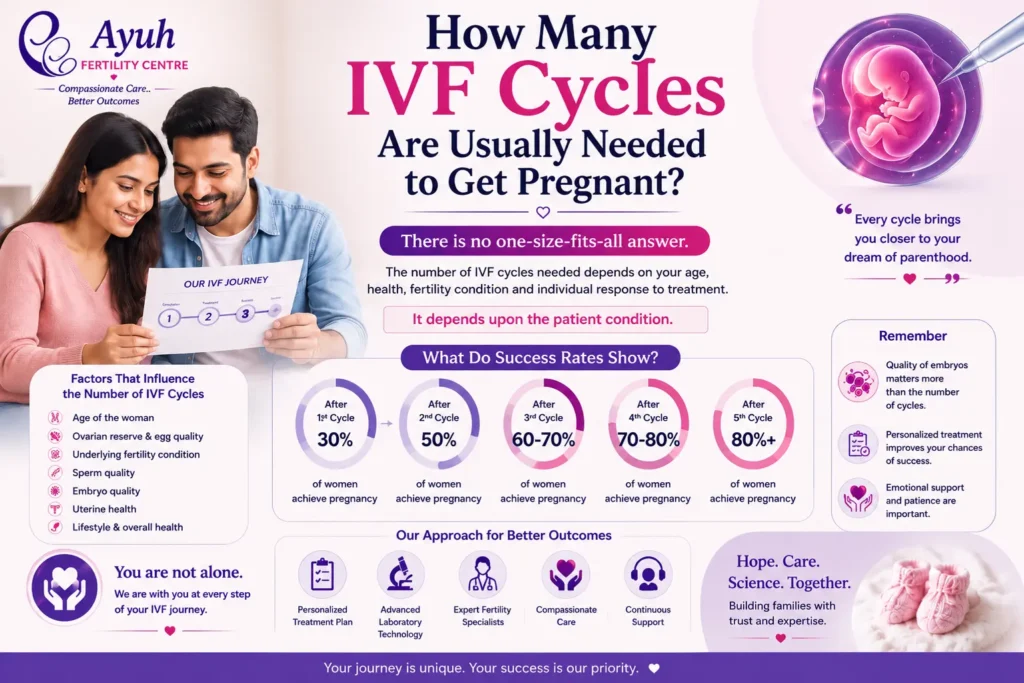
The most clinically honest answer: most couples who achieve a successful IVF pregnancy do so within 2–3 cycles.
Here is what the data generally shows:
After 1 IVF cycle: Success rates per single cycle range from approximately 40–55% for women under 35 at an experienced, well-equipped centre. This means that while many couples do conceive on their first attempt, a significant proportion — close to half — do not.
After 2 IVF cycles: Cumulative success rates rise substantially. For women under 35, cumulative live birth rates after two full cycles typically reach 60–70%.
After 3 IVF cycles: Cumulative success rates reach 70–80%+ for women under 35 over three complete cycles. This is the range most fertility specialists use when counselling couples about realistic overall success expectations.
After 4–6 IVF cycles: Some couples — particularly those with complex diagnoses, lower ovarian reserve, or age above 38 — need more cycles. Cumulative success continues to build with each additional attempt, though at a slower rate as complicating factors become more significant.
Important note on “cumulative” success: A single per-cycle success rate of 45% does not mean the chances of success are 45% total. Cumulative success — the probability of achieving pregnancy across multiple cycles — is meaningfully higher. Think of it like rolling a dice: each roll has its own independent probability, but the more rolls you take, the higher the cumulative chance of the outcome you are hoping for.
Google Featured Snippet Answer:
Most couples need 2–3 IVF cycles to achieve a successful pregnancy. Per-cycle success rates range from 40–55% for women under 35 at experienced fertility centres. Cumulative success rates over 3 cycles reach 70–80%+, rising further with additional attempts. The number of cycles needed depends on age, ovarian reserve, embryo quality, and individual fertility factors.
Why Some Couples Need Multiple IVF Cycles
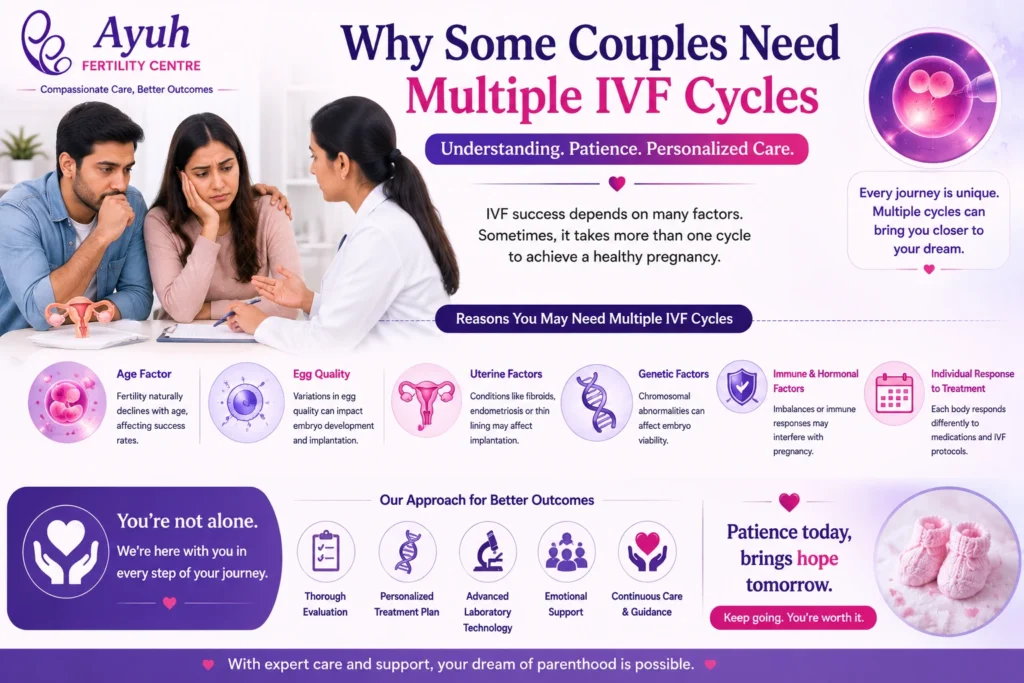
Repeated IVF is not a sign of medical failure — it is often a sign that the biology is complex and needs more attempts to find the right combination of factors that leads to successful implantation.
Here are the most common reasons multiple cycles are needed:
1. Age-Related Egg Quality Decline After 35, the proportion of chromosomally abnormal eggs increases significantly. More cycles may be needed because a higher percentage of embryos carry chromosomal errors that prevent successful implantation — even when they look normal on grading.
2. Low Ovarian Reserve (Low AMH) Women with low AMH may retrieve fewer eggs per cycle. Fewer eggs mean fewer embryos, which means fewer chances per cycle. Multiple cycles — or a modified stimulation approach — may be needed to accumulate enough good-quality embryos.
3. Sperm DNA Fragmentation High sperm DNA fragmentation affects fertilisation rates and embryo quality even when the basic semen analysis appears normal. This is frequently identified only after a first cycle produces unexpectedly poor embryo development. ICSI with physiological sperm selection in subsequent cycles can improve outcomes.
4. Implantation Failure Some women conceive embryos that develop well in the laboratory but consistently fail to implant. This may be related to endometrial receptivity, immune factors, or a shifted implantation window identifiable through ERA (Endometrial Receptivity Analysis). These causes are often only identified after one or more failed transfers.
5. Embryo Quality Issues Not every retrieved egg fertilises. Not every fertilised egg develops into a viable blastocyst. The proportion of eggs that become high-quality Day 5 embryos varies significantly between patients — and cannot be fully predicted before the first cycle.
6. Endometriosis Endometriosis creates a toxic pelvic environment that affects egg quality, fertilisation, and implantation. Women with moderate-to-severe endometriosis often need more cycles — or surgical optimisation between cycles — to achieve success.
7. PCOS with Complex Stimulation PCOS patients may produce many eggs but not all of high quality. Protocol refinement over cycles — adjusting stimulation doses, trigger timing, and freeze-all strategies — often produces progressively better outcomes.
8. Uterine Factors Unidentified polyps, fibroids, adhesions, or a uterine septum can prevent implantation even with excellent embryos. Hysteroscopy between cycles identifies and corrects these — often transforming outcomes on the next attempt.
Are Failed IVF Cycles Common?
Yes — and this is one of the most important truths about IVF that is not communicated clearly enough before couples begin treatment.
Failed IVF cycles are a statistically normal part of the IVF journey for a significant proportion of couples. This does not reflect poorly on the doctor, the laboratory, or the patient. It reflects the biological reality that even chromosomally normal, well-developed embryos only implant successfully a portion of the time — just as natural conception has a per-cycle success rate of only 20–25% in healthy young couples.
What a failed cycle is not:
- It is not evidence that IVF will never work for you
- It is not a reflection of anything you did wrong
- It is not a sign that you should abandon treatment
- It is not the same result you will necessarily get next time
What a failed cycle actually is: It is clinical data. It tells Dr. Krupa Shah exactly how your ovaries responded to stimulation, how many eggs matured, how many fertilised, how embryos developed, and whether implantation was attempted and failed or whether it simply did not occur. Every one of these data points informs a better protocol for the next cycle.
Many couples who achieve successful pregnancies at Ayuh Fertility Centre did not succeed on the first attempt. Some came to Ayuh after failing elsewhere. What changed was not luck — it was a more thorough evaluation, a revised protocol, and in some cases, an investigation that identified something that had been missed.
What Doctors Review After a Failed IVF Cycle
A thorough post-cycle clinical review is one of the most valuable — and most often skipped — steps in the IVF journey. At Ayuh Fertility Centre, every failed cycle triggers a complete debrief with Dr. Krupa Shah.
Here is what is reviewed:
Stimulation Response How many follicles developed? Was the dose appropriate for your AMH and AFC? Did the ovaries over- or under-respond? Protocol adjustments for the next cycle begin here.
Egg Maturity and Quality What proportion of retrieved eggs were mature (MII stage)? Immature eggs indicate either a trigger timing issue or an underlying egg quality problem requiring protocol adjustment.
Fertilisation Rate What percentage of mature eggs fertilised normally? A low rate — especially with normal sperm — suggests the need to switch to or optimise ICSI, or investigate sperm DNA fragmentation.
Embryo Development Pattern Did embryos develop normally to Day 3 and Day 5? Did any arrest before transfer? Arrest patterns tell the embryologist whether the issue lies with egg quality, sperm quality, or culture conditions.
Endometrial Assessment What was the endometrial thickness and pattern on transfer day? A trilaminar pattern above 7–8mm is optimal. Below this, endometrial preparation modifications are needed for the next cycle.
Hormonal Data Were progesterone levels elevated on trigger day? A premature progesterone rise impairs endometrial receptivity and is a modifiable factor for the next cycle.
Additional Investigations Depending on cycle findings, Dr. Krupa Shah may recommend hysteroscopy, sperm DNA fragmentation testing, genetic testing, ERA, or immunological panels before the next cycle. These investigations — done after a failed cycle — often identify the precise barrier that was preventing success.
Does Success Increase With Additional IVF Cycles?
Generally yes — particularly when the protocol is revised based on learning from previous cycles. Here is why:
Learning Curve Advantage Each completed IVF cycle provides information about your individual response that no blood test or scan can fully predict in advance. By cycle two or three, the doctor knows exactly how your ovaries respond, what stimulation dose works best, what your embryo development typically looks like, and what your endometrium needs. This knowledge directly improves outcomes.
Protocol Modifications Changes between cycles — adjusting stimulation doses, switching from antagonist to agonist protocol (or vice versa), modifying trigger timing, adding endometrial preparation measures, or changing progesterone support — can produce dramatically different results in the same patient.
Frozen Embryo Transfer (FET) Cycles If embryos were frozen from a previous stimulation cycle, FET cycles — which are significantly less physically demanding and less expensive (₹25,000–₹50,000) — give those embryos another chance without the physical stress of full ovarian stimulation.
PGT Testing of Embryos For couples with repeated implantation failure despite good-quality embryos, Pre-Implantation Genetic Testing (PGT) in a subsequent cycle screens embryos for chromosomal normality. Transferring only chromosomally normal embryos significantly reduces both miscarriage risk and failed implantation.
The cumulative picture: the more carefully revised and individually designed each subsequent cycle is, the better the outcomes tend to be. This is why the relationship between patient and specialist — built over multiple consultations — is itself a clinical advantage.
When Should You Consider a Second IVF Cycle?
The decision to begin a second cycle is not just medical — it is emotional, physical, and financial. Here is a practical guide to thinking through it:
Physical Recovery Most fertility specialists recommend waiting at least one full menstrual cycle — ideally two — before beginning a second stimulated cycle. This allows the ovaries and uterine lining to recover fully and ensures hormonal levels have returned to baseline.
For Frozen Embryo Transfer (FET) cycles where frozen embryos from the first stimulation are available, the interval can be shorter — often 4–6 weeks — as no ovarian stimulation is required.
Emotional Readiness There is no clinical formula for this. Grief after a failed cycle is real and needs time. Some couples are ready to start again within weeks. Others need months. Both are completely valid. What matters is that the decision to continue is made from a place of informed choice — not panic or pressure.
Medical Evaluation First Before beginning a second cycle, a complete review of the first cycle data is essential. Dr. Krupa Shah conducts this review personally — identifying what can be improved, what tests should be added, and how the next protocol should differ. Rushing into a second cycle with the same protocol that did not work is not good clinical practice.
Financial Planning Understanding the full cost of a second cycle — including medications, any additional investigations, and the FET option if frozen embryos exist — before starting allows couples to make decisions calmly rather than under financial stress mid-treatment. Flexible EMI options are available at Ayuh.
When Might Doctors Recommend Alternative Options?
After multiple cycles, Dr. Krupa Shah may discuss alternatives — sensitively, honestly, and without pressure. These conversations happen when:
Donor Egg IVF When multiple cycles consistently produce no or very poor-quality embryos — particularly in women above 42–43 — donor egg IVF offers success rates of 50–65% per cycle, regardless of recipient age. All donors at Ayuh are screened under strict ICMR guidelines. This option is always discussed with full medical and emotional counselling — never as a quick alternative to trying harder.
Donor Sperm When male factor infertility is severe and sperm retrieval via TESA/PESA has not produced viable sperm, donor sperm from the ART Bank — screened per ICMR standards — may be discussed as an option.
Embryo Donation In rare cases where both partners have fertility challenges, donated embryos from ICMR-approved sources offer another path.
Fertility Preservation For couples who need to pause treatment — due to medical, financial, or personal reasons — embryo freezing ensures that embryos created during productive cycles are safely preserved for future use.
None of these conversations happen before they are appropriate — and none are presented as the end of one path, but as the beginning of another.
The Emotional Impact of Repeated IVF Attempts
This needs to be said plainly: going through multiple IVF cycles is one of the most emotionally demanding experiences a couple can face. And it deserves to be acknowledged — not minimised.
The Hope-Disappointment Cycle Each cycle begins with hope that builds through stimulation, peaks at retrieval, and either sustains through the two-week wait or collapses at a negative result. Repeating this emotional arc multiple times compounds the impact in ways that are hard to explain to anyone who has not lived it.
Anxiety and Hypervigilance After one or more failed cycles, it becomes very difficult to simply experience a new cycle without analysing every symptom, every blood result, every embryo grade. The anxiety of knowing what loss feels like — and facing the possibility again — is genuinely exhausting.
Relationship Stress Partners often cope differently. One may want to discuss every detail; the other may need to compartmentalise. One may want to try again immediately; the other needs time. These differences are normal — but without communication and mutual acknowledgment, they can quietly strain even strong relationships.
Social Pressure The questions from family. The pregnancy announcements from friends. The well-intentioned advice that lands like small punctures. All of it accumulates.
What Helps At Ayuh Fertility Centre, emotional support is built into the care model — not added as an afterthought. Dr. Krupa Shah takes time with every couple after a failed cycle. She does not rush. She does not minimise. She acknowledges what was lost and then — when the couple is ready — focuses on what comes next. This combination of emotional presence and clinical precision is, for many couples, the most important thing their fertility care team provides.
How to Improve Your Chances in Future IVF Cycles
These are evidence-based, clinically grounded suggestions — not miracle claims.
1. Maintain a Healthy BMI Both obesity and underweight affect hormonal balance, ovarian response, and endometrial receptivity. A BMI between 18.5 and 24.9 is consistently associated with better IVF outcomes.
2. Optimise Sleep Poor sleep disrupts cortisol and melatonin — both of which affect reproductive hormone balance. 7–9 hours of consistent, quality sleep is a clinical priority during IVF preparation.
3. Manage Stress Actively Chronic stress elevates cortisol, which disrupts the hormonal cascade needed for successful stimulation and implantation. Yoga, mindfulness, therapy, and adequate social support are all genuinely relevant — not just lifestyle suggestions.
4. Nutrition An anti-inflammatory, antioxidant-rich diet — vegetables, whole grains, healthy fats, lean protein — supports both egg and sperm quality. Avoid ultra-processed food, refined sugar, and alcohol during treatment cycles.
5. Male Partner Involvement Sperm DNA quality improves within 90 days of lifestyle changes — smoking cessation, alcohol reduction, heat avoidance, antioxidant supplementation. The male partner’s preparation matters as much as the female partner’s.
6. Follow Medical Guidance Precisely Injection timing, medication doses, and monitoring appointments during an IVF cycle are not suggestions — they are clinical requirements. Missing or adjusting these affects outcomes. Dr. Krupa Shah’s team at Ayuh provides detailed, clear guidance at every stage to ensure this is as manageable as possible.
7. Ask for a Complete Protocol Review Before the Next Cycle This is perhaps the most important suggestion on this list. A second cycle run with the same protocol as a failed first cycle is not a second chance — it is a repetition. A revised, individually adjusted protocol — informed by everything learned in the previous cycle — is what genuinely improves outcomes.
Common Myths About IVF Cycles
Myth 1: IVF always works on the first attempt. False. Per-cycle success rates at even the best fertility centres globally range from 40–55% for women under 35. A proportion of first cycles do not result in pregnancy — this is statistically normal, not a sign of poor care.
Myth 2: Failed IVF means pregnancy is impossible. False. A failed cycle is clinical data — not a verdict. Many couples who did not succeed on cycles one or two went on to have successful pregnancies at Ayuh Fertility Centre after a revised approach.
Myth 3: More cycles automatically guarantee success. False. More cycles improve cumulative chances — but only when each cycle is individually designed based on learning from previous attempts. Repeating the same protocol repeatedly without adjustment does not improve outcomes. Protocol refinement between cycles is what drives success rates upward.
Myth 4: IVF success depends only on age. False. Age is the most consistent predictor — but it is not the only one. Ovarian reserve, embryo quality, uterine receptivity, sperm DNA integrity, endometriosis, and the quality of the laboratory and specialist all affect outcomes independently of age.
Myth 5: Once you stop IVF, pregnancy becomes impossible. False. Some couples achieve natural conception after pausing IVF. Others successfully conceive with frozen embryos years after their original stimulation cycle. The fertility journey does not have a single fixed timeline.
FAQs
1. How many IVF cycles are considered normal?
There is no single “normal” number — it varies by individual biology. However, most fertility specialists consider 2–3 IVF cycles a reasonable treatment course before reassessing the approach. Many couples conceive on cycles one or two. Others need three or more. The key is that each cycle should be individually designed and revised based on the previous cycle’s data — not repeated identically. At Ayuh Fertility Centre, Dr. Krupa Shah conducts a complete cycle review after every attempt and adjusts the next protocol accordingly.
2. Is it common for the first IVF cycle to fail?
Yes — significantly more common than most couples expect. Even at experienced, well-equipped centres, per-cycle success rates are typically 40–55% for women under 35. This means close to half of first cycles do not result in pregnancy. This is a statistical reality, not a clinical failure. Dr. Krupa Shah prepares every couple for this possibility before treatment begins — because realistic expectations lead to better emotional outcomes and better clinical decisions when the result comes.
3. Do IVF success rates improve with additional cycles?
Generally yes — when each cycle is revised based on learning from the previous one. Cumulative success rates increase meaningfully with each additional attempt. For women under 35, cumulative live birth rates reach 60–70% after two cycles and 70–80%+ after three. Protocol adjustments, PGT genetic testing, hysteroscopy, and frozen embryo transfers between full stimulation cycles all contribute to improving outcomes in subsequent attempts.
4. How long should I wait between IVF cycles?
Most fertility specialists recommend waiting at least one to two full menstrual cycles before beginning a second stimulated IVF cycle. This allows the ovaries and uterine lining to recover fully. For FET (Frozen Embryo Transfer) cycles using frozen embryos from a previous retrieval, the interval can be shorter — typically 4–6 weeks — as no ovarian stimulation is required. Dr. Krupa Shah also uses this interval to conduct any additional investigations needed before the next cycle.
5. When should I consider stopping IVF treatment?
This is one of the most personal decisions in the fertility journey — and there is no single clinical answer. Most specialists discuss reassessment after 3–4 unsuccessful cycles, particularly when the cause has been thoroughly investigated and protocols have been appropriately revised. At this point, Dr. Krupa Shah honestly discusses alternative options — including donor egg IVF, embryo donation, or a modified approach. The decision should be made calmly, with full information, and never under pressure — from the clinic or from family.
Conclusion
The question of how many IVF cycles are needed has no single right answer — because every couple’s biology, diagnosis, and circumstances are different. What is consistent is this: most couples who achieve successful IVF pregnancies do not do so on the first attempt. They do it through a combination of clinical persistence, revised protocols, honest evaluation, and a specialist who treats each cycle as an opportunity to learn and improve.
A failed cycle is not a full stop. It is a comma — a pause before the next, better-informed attempt.
Dr. Krupa A. Shah has guided thousands of couples through this process over 19+ years of clinical practice in Ahmedabad. Her Advanced IVF Diploma from the International School of Medicine, Kiel–Goettingen–Munich, Germany, combined with Ayuh Fertility Centre’s ART National Board Certified, ISO-Certified, ICMR-compliant laboratory, means every cycle — first, second, or third — is approached with the same individual precision and care.
You are not running out of chances. You are building toward the right one.
👉 Book your consultation with Ayuh Fertility Centre today
👉 Get expert guidance for PCOS and fertility treatment
👉 Start your journey toward a healthy and successful pregnancy
📍 Visit us in Ahmedabad
📞 Call now to schedule your appointment