
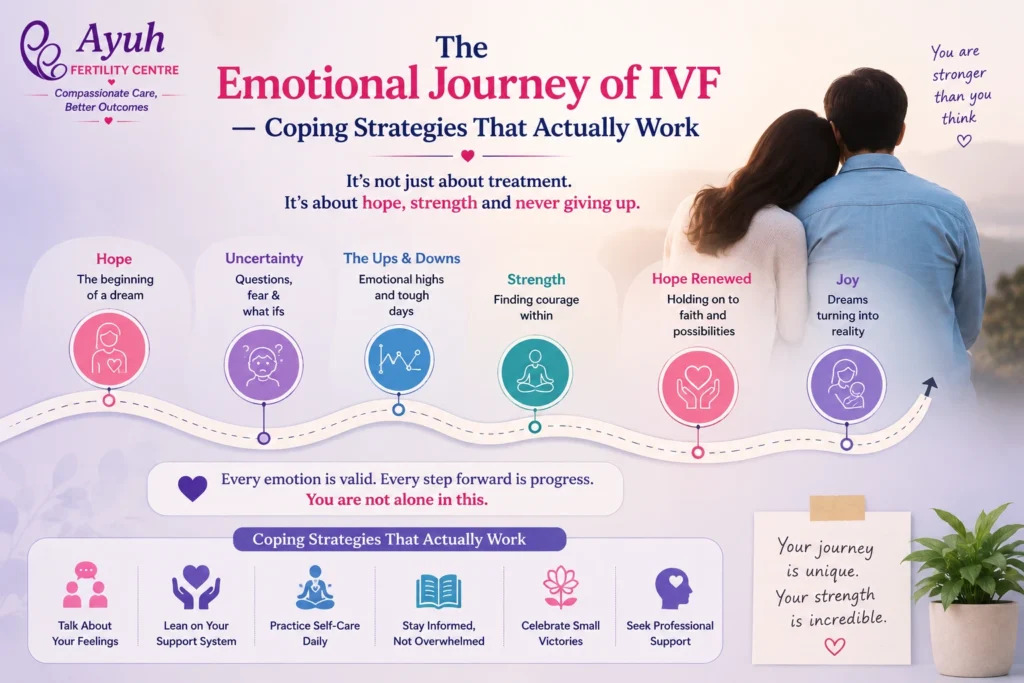
The emotional journey of IVF begins long before the first injection — and it does not end at the pregnancy test. It lives in the quiet moments: the drive home after a scan that showed fewer follicles than expected. The forced smile at a colleague’s baby shower when you are mid-cycle and barely holding it together. The 2am scrolling through forums, looking for someone whose story ends the way you want yours to.
If any of that sounds familiar, you are not alone. And you are not weak. You are a human being navigating one of the most emotionally demanding medical experiences that exists — one that touches hope, identity, relationships, finances, and biology all at once.
IVF is not just a treatment. It is a way of living for however long it takes. And the emotional dimension of that experience deserves as much care and attention as the medical one.
Dr. Krupa A. Shah, founder of Ayuh Fertility Centre in Ahmedabad, has sat with hundreds of couples through this journey. She knows that the emotional reality of IVF is not separate from clinical outcomes — it is deeply intertwined with them. Which is why emotional support at Ayuh is not an afterthought. It is part of the care.
This blog is written for you — wherever you are in this journey right now.
Author Bio
Dr. Krupa A. Shah MBBS · MS (Obstetrics & Gynaecology) · Infertility Specialist Founder, Ayuh Fertility Centre, Ahmedabad
19+ Years of Experience in reproductive medicine, obstetrics, and gynaecology.
Dr. Krupa Shah completed her MBBS from Baroda Medical College (2006) and her MS in Obstetrics & Gynaecology from B.J. Medical College, Ahmedabad (2010). After 12 years of experience at leading clinics in Chennai — including Apollo Hospital and Iswarya Fertility Centre — she completed an Advanced IVF Fellowship at Ludwig Maximilians University, Munich, Germany, one of Europe’s most prestigious reproductive medicine institutions.
She is a member of the Ahmedabad Obstetrics and Gynaecology Society (AOGS), the Indian Society of Assisted Reproduction (ISAR), and the Federation of Obstetric and Gynaecological Societies of India (FOGSI).
IVF laboratory is ART National Board Certified.
🩺 Medically Reviewed By
This article is medically reviewed by Dr. Krupa M. Shah, ensuring accurate and reliable fertility information.
Why IVF Is Emotionally Challenging
IVF is not simply a medical procedure. It is a sustained emotional experience — and the emotional challenges during IVF are as real and significant as the physical ones.
Here is why IVF is uniquely emotionally demanding:
Uncertainty at every stage Unlike most medical treatments where the outcome is reasonably predictable, IVF outcomes remain uncertain until the very end. How many eggs will be retrieved? How many will fertilise? How many embryos will develop? Will this one implant? Every stage has its own unpredictable answer — and couples live in that uncertainty for weeks at a time.
Repeated waiting IVF is a series of waiting rooms — literal and metaphorical. Waiting for the stimulation to work. Waiting for retrieval. Waiting for fertilisation reports. Waiting through the two-week wait. Each wait carries its own anxiety load.
Financial pressure IVF treatment costs are real and significant. For many couples, each cycle represents a substantial financial investment — which adds a layer of pressure to every decision and every result.
Social expectations Questions from family. The cultural weight of parenthood in Indian society. The sense of being watched, hoped for, pitied — all of it compounds the private pressure couples already carry.
Fear of failure After one failed cycle, the fear of another — and another — begins to accumulate. Each subsequent attempt carries more history, more scar tissue, more qualified hope.
Relationship stress IVF happens to a couple, but it often does not happen with them in the same emotional way. Partners grieve differently, cope differently, and sometimes reach their limits at different times. Without active, deliberate communication, this can quietly create distance.
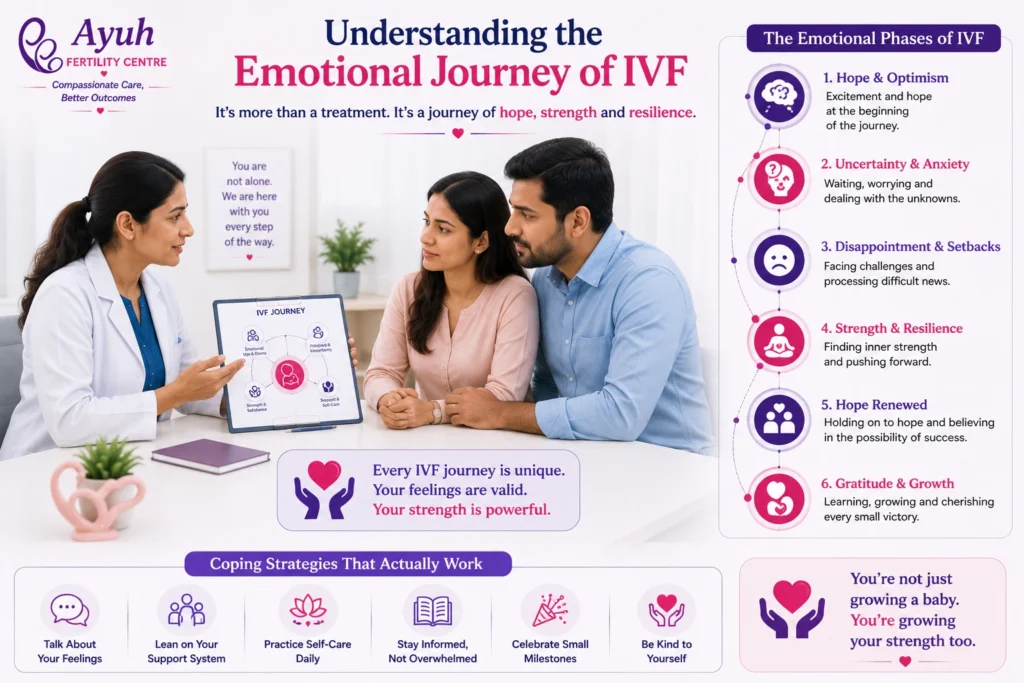
Understanding the Emotional Journey of IVF
The emotional journey of IVF is not a straight line. It has its own landscape — with valleys and peaks that most patients are not warned about before they begin.
Here is what each phase typically feels like — and why knowing this in advance genuinely helps:
Before Starting IVF A complicated mix of relief (finally, a plan), fear (what if it doesn’t work?), hope (maybe this is it), and guilt (what did I do wrong to need this?). Many people describe this phase as strangely calm — the anxiety has not fully arrived yet because the cycle has not begun.
During Hormone Injections (Days 1–12) The physical reality of daily injections brings the experience into sharp focus. Bloating, mood fluctuations from hormonal surges, and the vigilance of monitoring appointments — every scan a moment of holding your breath. Many women describe feeling surprisingly functional during this phase, with the routine of injections and scans providing a sense of control.
Egg Retrieval Day Anticipation mixed with vulnerability. The number of eggs retrieved — whatever it is — carries enormous emotional weight. Couples often feel relief that the retrieval is done, anxiety about fertilisation, and a strange tenderness toward the tiny possibility now sitting in a laboratory incubator.
The Fertilisation Call One of the hardest phone calls in any IVF cycle. The number of fertilised eggs — however it arrives — often triggers a release of emotion that has been building for weeks. Grief if the number is low. Cautious relief if it is reasonable. A complex mix of both.
Embryo Transfer Day Many couples describe this as one of the most emotionally tender moments of the entire journey. The feeling of having done everything possible — of having given your best — sits alongside the awareness that what happens next is beyond your control.
The Two-Week Wait Universally described as the hardest period. No scans, no data, no certainty. Every physical sensation is analysed for meaning. Time slows to a crawl. The mind runs through every possible outcome simultaneously. Managing this period well — without obsessive symptom-checking or total emotional shutdown — is one of the most important emotional skills in IVF.
Pregnancy Test Day A positive: profound relief, cautious joy, the beginning of a new kind of waiting. A negative: a grief that can feel physical in its weight. Both outcomes bring their own emotional complexity.
After a Failed Cycle The days immediately following a negative test are often the most raw. Give yourself time before making any decisions. Rest, process, and wait before re-engaging with planning.
After Success Many couples are surprised to find that a positive pregnancy test does not bring uncomplicated happiness — particularly after prior losses or failed cycles. Anxiety in early pregnancy after IVF is extremely common. This is normal, and it too deserves acknowledgment and support.
IVF Anxiety and Depression — More Common Than People Realise
IVF anxiety and depression are not signs of weakness or inadequacy. They are the natural psychological response to an extraordinarily stressful situation — and they are significantly more prevalent than most people realise.
Research consistently shows that:
- Approximately 40% of women undergoing IVF experience clinically significant anxiety
- Approximately 30% experience clinically significant depression
- These rates are comparable to — or higher than — rates in women diagnosed with serious chronic illnesses
Why does this happen?
The hormonal fluctuations of IVF directly affect mood — estrogen and progesterone levels rise and fall sharply in ways that can trigger anxiety, irritability, and low mood even in women with no history of mental health challenges.
The existential uncertainty of the process — will I ever be a parent? — taps into something deep and primal that very few other life experiences touch.
And the isolation of carrying a private grief — unable to fully explain it to colleagues, reluctant to burden family, afraid to acknowledge it even to your partner — creates a loneliness that compounds everything else.
Signs that anxiety or depression may need professional support:
- Sleep disrupted for more than two weeks
- Persistent feelings of hopelessness that are not improving
- Inability to function at work or in daily life
- Withdrawal from relationships and activities that previously brought comfort
- Panic attacks or persistent physical anxiety symptoms
- Thoughts of self-harm (seek help immediately)
These signs are not weakness. They are information — signals that you need and deserve more support than you are currently receiving.
Coping With IVF Stress — Strategies That Actually Work
Coping with IVF stress does not require a complete personality overhaul or a daily three-hour wellness routine. It requires a handful of genuinely useful strategies, applied consistently and with self-compassion.
Here is what actually helps:
1. Accept Your Emotions — All of Them The pressure to “stay positive” during IVF is one of the most harmful pieces of advice couples receive. You do not need to feel positive. You need to feel what you actually feel — and allow it to move through you rather than suppressing it. Suppressed grief and fear do not disappear. They compound.
2. Focus on One Step at a Time IVF has a lot of stages. Thinking about all of them simultaneously — “what if the embryo doesn’t implant, what if we need a third cycle, what if we never have a baby” — is cognitively and emotionally exhausting. Focus only on the step directly in front of you. Today, the goal is to take today’s injection. Not more than that.
3. Limit Online Research The internet contains every IVF outcome that has ever occurred — including the very rare bad ones. Searching for your specific situation online at midnight almost always increases anxiety rather than reducing it. Set specific boundaries around research. Use only sources you and your doctor have identified as reliable.
4. Maintain Your Daily Routines IVF already disrupts enough. Protecting the rhythms of your ordinary life — working, exercising moderately, seeing friends, doing things you enjoy — creates a sense of normalcy and control that counterbalances the unpredictability of the treatment.
5. Have a Two-Week Wait Plan The waiting period needs its own strategy. Plan activities that are absorbing but not demanding. Avoid isolation. Do not take a pregnancy test early — it serves no clinical purpose and adds emotional risk. Decide in advance how you will receive the result, and who will be with you or available to you.
6. Know When to Ask for Professional Support Seeing a therapist or fertility counsellor during IVF is not a last resort. It is a sensible clinical strategy — comparable to taking prenatal vitamins. You do not need to be in crisis to benefit from professional emotional support. You just need to be human, going through something hard.
Stress Management During IVF Treatment
Stress management during IVF treatment is not about eliminating stress — it is about building resilience and recovery capacity so that the inevitable moments of high stress do not overwhelm you.
These approaches are grounded in evidence:
Deep Breathing and Breathwork Diaphragmatic breathing activates the parasympathetic nervous system — shifting the body out of fight-or-flight. Even five minutes of slow, deliberate breathing (in for 4 counts, hold for 4, out for 6) measurably reduces cortisol levels. This is not alternative medicine. It is physiology.
Meditation Regular mindfulness meditation — even 10–15 minutes daily — reduces anxiety, improves sleep, and reduces rumination. Apps such as Calm, Headspace, and Insight Timer offer guided sessions specifically for infertility and medical stress.
Yoga Gentle yoga — particularly restorative and yin styles — reduces cortisol, improves sleep quality, and creates a deliberate relationship between breath and body that is valuable during IVF. Avoid hot yoga and very intense forms during stimulation and the two-week wait.
Journaling Writing down what you are feeling — without editing it for an audience — externalises internal emotional weight. Many IVF patients describe journaling as one of the most consistently useful practices during treatment.
Walking A 20–30 minute daily walk in natural light reduces cortisol, improves mood, and supports sleep quality. It is accessible, free, and evidence-based. Light walking is appropriate at every stage of IVF including the two-week wait.
Sleep Hygiene IVF disrupts sleep in multiple ways — early monitoring appointments, hormone-related insomnia, anxiety. Protecting sleep with consistent bedtimes, limited screen exposure after 9pm, and a cool, dark sleeping environment is one of the highest-leverage things you can do for both emotional and physical wellbeing during treatment.
How IVF Affects Relationships
IVF does not happen to an individual. It happens to a couple — and it tests that couple in ways that are both predictable and deeply personal.
Different coping styles Partners almost never cope identically. One may want to talk through every scan result and every fear. The other may need to compartmentalise — process privately and then move forward. Neither approach is wrong. But without mutual acknowledgment of these differences, both partners can feel misunderstood and alone in the same experience.
Communication challenges Under sustained stress, even communicative couples can find themselves retreating into silence or conflict. The key is to maintain the intention to communicate — not necessarily the execution of it every day, but the agreement that you are on the same side, navigating the same challenge together.
Intimacy IVF changes the relationship with the body and with intimacy in ways that deserve acknowledgment. Timed intercourse, procedures, and hormonal changes can reduce intimacy to something that feels clinical and pressured. Rebuilding non-reproductive intimacy — physical affection that is not goal-directed — is important for the relationship during a long treatment journey.
Financial conversations Money is one of the most relationship-stressful dimensions of IVF. Having honest, calm conversations about budget, what you are both willing to invest, and what your individual limits are — before you are mid-cycle and emotionally compromised — protects the relationship significantly.
The Role of Family and Friends During IVF
Loved ones want to help during IVF. Most of the time, they do not know how. And sometimes, in trying to help, they say things that land like small injuries.
Unhelpful comments couples commonly hear:
- “Just relax and it will happen”
- “Have you tried [supplement/diet/prayer]?”
- “At least you know you can get pregnant” (after a miscarriage)
- “Why don’t you just adopt?”
- “Maybe it’s God’s plan”
These are not said with malice. They are said with love by people who are uncomfortable with uncertainty and reach for resolution. But they can sting deeply when you are mid-cycle and vulnerable.
Setting boundaries — practically: You are under no obligation to share details of your treatment with anyone. It is completely reasonable to say: “We’re going through something medical and we’d really appreciate support without questions or advice. We’ll share updates when we’re ready.” Most people, told this clearly, will respect it.
How to ask for help without feeling vulnerable: Specific requests are easier than general ones. “Can you bring dinner on Wednesday?” is easier to ask and easier to receive than “I need more support.” Make your needs specific, and accept help when it is offered.
IVF Emotional Support — You Do Not Have to Do This Alone
IVF emotional support — in a structured, professional form — is one of the most underused resources in fertility treatment. Many couples do not access it because they feel they should be coping on their own, or because they are not yet in crisis.
But you do not need to be in crisis to benefit from support.
Fertility counselling: A fertility counsellor specialises in the specific emotional landscape of infertility and assisted reproduction. They understand the two-week wait, the grief of a failed cycle, the complex feelings around donor eggs, and the relational stress of sustained treatment. This is not general therapy — it is specific, practical, and often transformative.
Support groups: Connecting with others going through the same experience reduces isolation dramatically. Online fertility support communities — and in-person groups where available — provide the particular comfort of being genuinely understood by people who know exactly what you mean.
Couple counselling: If IVF is creating significant tension in the relationship — which it does in a substantial proportion of couples — couple counselling during treatment is a proactive, protective investment in the relationship. It does not mean the relationship is failing. It means you are taking care of it.
Clinic counselling: At Ayuh Fertility Centre, emotional support is integrated into the clinical care model. Dr. Krupa Shah takes time in every consultation to address not just the medical but the emotional dimension of each couple’s journey. If additional professional support is needed, appropriate referrals are made.
When Emotional Stress Becomes Too Much
There is a difference between the difficult, heavy emotions that are a normal part of IVF — and a level of distress that requires immediate professional attention.
Seek professional help urgently if you are experiencing:
- Thoughts of harming yourself or feeling that life is not worth living
- Complete inability to function at work or in daily life for more than one week
- Panic attacks that are frequent and unmanageable
- A complete withdrawal from relationships and daily life
- Persistent, severe sleep disturbance that is not improving
These are not signs of weakness. They are signals from your mind and body that you need more support than any wellness app or coping strategy can provide.
If you are in crisis, contact a mental health professional immediately. If you are outside a crisis but struggling significantly, tell your fertility doctor. Dr. Krupa Shah and her team at Ayuh will ensure you have access to the right support — without judgment, and without it affecting your fertility care.
What Ahmedabad Fertility Specialists Often Recommend
Dr. Krupa Shah has observed, across thousands of patient journeys, that the couples who navigate IVF most effectively share several common approaches:
They set realistic expectations from the beginning Couples who enter IVF with an accurate understanding of per-cycle success rates — and the possibility that more than one cycle may be needed — experience significantly less trauma when a first cycle does not succeed. Realistic expectations are not pessimism. They are preparation.
They plan for the emotional journey, not just the medical one Emotionally prepared couples — those who have discussed how they will handle different outcomes, who they will tell, how they will support each other — consistently report better emotional experiences during treatment.
They stay connected to life outside the treatment IVF can become all-consuming if allowed to be. Couples who protect activities, relationships, and routines outside of treatment — work, hobbies, friendships — report better overall emotional wellbeing and, interestingly, often better clinical compliance too.
They communicate with their clinical team At Ayuh Fertility Centre, patients who voice their anxieties and questions — rather than suppressing them — receive better care. Dr. Krupa Shah actively invites questions, concerns, and emotional check-ins as part of every consultation. Silence is never required or expected.
They ask for help when they need it The most resilient couples are not the ones who never struggle. They are the ones who recognise when they need support and reach for it — from each other, from family, from the clinical team, or from a professional.
Common Myths About Emotional Health During IVF
Myth 1: Stress alone causes IVF failure. Partially false. Extreme, prolonged chronic stress can affect hormonal balance — but the evidence does not support the idea that normal IVF anxiety causes cycle failure. Couples should not blame themselves for feeling stressed. The stress does not cause the failure. The failure causes the stress.
Myth 2: Emotionally strong people don’t struggle during IVF. False. Emotional strength is not the absence of struggle. It is the capacity to continue despite it. The most resilient IVF patients are not the ones who feel nothing — they are the ones who feel everything and keep going.
Myth 3: IVF anxiety means you’re not ready for treatment. False. Anxiety is a normal, expected response to an uncertain, high-stakes medical process. It does not mean you are psychologically unfit for IVF. It means you are human and you care deeply about the outcome.
Myth 4: Therapy is only for people with serious mental illness. False. Fertility counselling and therapy are practical, proactive tools for anyone navigating the sustained stress of infertility treatment — regardless of prior mental health history. You do not need a diagnosis to benefit from professional support.
Myth 5: You must stay positive all the time. False — and this myth is genuinely harmful. Toxic positivity — the pressure to suppress negative emotions in favour of relentless optimism — causes harm by preventing people from processing real feelings. You are allowed to have bad days. You are allowed to grieve. You are allowed to be scared. These feelings do not undermine your chances. They are part of the honest human experience of this journey.
Practical Daily Self-Care Checklist During IVF
This checklist is designed to be genuinely achievable — not an aspirational list of things you are already too tired to do.
Morning:
- ☐ Drink a full glass of water before anything else
- ☐ Take prescribed medications and supplements at their correct times
- ☐ Eat a nourishing breakfast — protein and healthy fat support hormonal stability
- ☐ Five minutes of slow breathing before checking your phone
During the day:
- ☐ Move your body — even a 20-minute walk counts
- ☐ Limit research and fertility forum reading to 15 minutes or less
- ☐ Do at least one thing that is completely unrelated to IVF
- ☐ Check in with your partner — not necessarily about IVF, but genuinely
Evening:
- ☐ Eat dinner without screens where possible
- ☐ Limit alcohol entirely during treatment cycles
- ☐ Write three sentences in a journal — whatever is on your mind
- ☐ Begin reducing screen brightness and stimulation by 9pm
- ☐ Be in bed by a consistent time that allows 7–9 hours of sleep
Weekly:
- ☐ Do something that brings genuine joy — not fertility-related
- ☐ Connect with a friend you trust
- ☐ Assess honestly: do you need more support this week?
FAQs
1. Is anxiety normal during IVF?
Yes — completely and measurably normal. Research shows that approximately 40% of women undergoing IVF treatment experience clinically significant anxiety during at least one phase of the process. The uncertainty of outcomes, the physical demands of treatment, and the emotional weight of infertility all contribute. Anxiety during IVF does not mean you are not coping — it means you are human, going through something genuinely difficult. What matters is not the absence of anxiety but the presence of strategies to manage it. Dr. Krupa Shah discusses emotional readiness and coping strategies at every IVF consultation at Ayuh Fertility Centre.
2. Can stress affect IVF success?
The relationship between stress and IVF outcomes is more nuanced than many people are told. Extreme, chronic, physiological stress can affect hormonal balance — but normal IVF anxiety has not been shown in robust clinical evidence to directly cause cycle failure. More importantly: couples should never blame themselves for feeling stressed during IVF. The anxiety is a response to the situation, not a cause of poor outcomes. What does affect outcomes is untreated clinical depression or anxiety that prevents medical compliance or disrupts sleep and basic self-care. Managing stress is valuable — but not because stress is “causing” failure. It is valuable because your wellbeing matters.
3. How do couples cope with IVF together when they grieve differently?
The most consistently helpful strategy is establishing a shared agreement about how you will navigate the treatment together — before you are in the middle of it. Agree that both coping styles are valid. Agree that you will check in regularly, even if briefly. Agree that protecting the relationship is as important as protecting the cycle. When one partner needs to process verbally and the other needs quiet, find a middle ground — a structured “IVF conversation window” rather than the topic dominating every moment. If the strain becomes significant, couple counselling during IVF is a proactive, protective investment — not a sign of failure.
4. Should I see a therapist or counsellor during IVF?
You do not need to be in crisis to benefit from professional emotional support during IVF. Fertility counsellors specialise in exactly the emotional landscape you are navigating — the two-week wait, the grief of a failed cycle, the relational stress of sustained treatment. Even a small number of sessions during the most intense periods of treatment can significantly improve emotional resilience and clarity. At Ayuh Fertility Centre, the care model includes emotional support as part of comprehensive fertility care. If you would benefit from a referral to additional professional support, Dr. Krupa Shah will say so directly.
5. What actually helps during the two-week wait?
The two-week wait — the period between embryo transfer and the pregnancy blood test — is universally described as the hardest phase of IVF. What genuinely helps: maintaining your normal routine as much as possible, planning absorbing activities that do not require heavy physical exertion, limiting symptom-checking online (it almost always increases anxiety, not clarity), staying connected to people who give energy rather than drain it, and deciding in advance who will be with you when you receive the result. Avoid taking a home pregnancy test early — the result can be misleading at this stage and the emotional cost of a false result is very high.
Conclusion
The emotional journey of IVF is real, it is demanding, and it is a legitimate and important part of the treatment experience — not a side effect to be endured silently while the real work happens in the laboratory.
Feeling anxious does not mean you are doing it wrong. Grieving a failed cycle does not mean you have given up. Struggling in your relationship does not mean your partnership is broken. These are normal, human responses to one of life’s most demanding experiences — and they deserve acknowledgment, support, and care.
Dr. Krupa A. Shah has accompanied thousands of couples through this journey at Ayuh Fertility Centre — not just as a medical specialist, but as a doctor who understands that behind every AMH report, every embryo count, every transfer day, is a person who is hoping with everything they have.
You do not have to carry this alone. The science is here. The care is here. And when you are ready to take the next step — whether that is a first consultation, a second opinion, or simply a conversation — Ayuh Fertility Centre is here.
👉 Book a consultation with Dr. Krupa Shah at Ayuh Fertility Centre today — and take your next step with clarity and confidence.
👉 Book your consultation with Ayuh Fertility Centre today
👉 Get expert guidance for PCOS and fertility treatment
👉 Start your journey toward a healthy and successful pregnancy
📍 Visit us in Ahmedabad
📞 Call now to schedule your appointment