
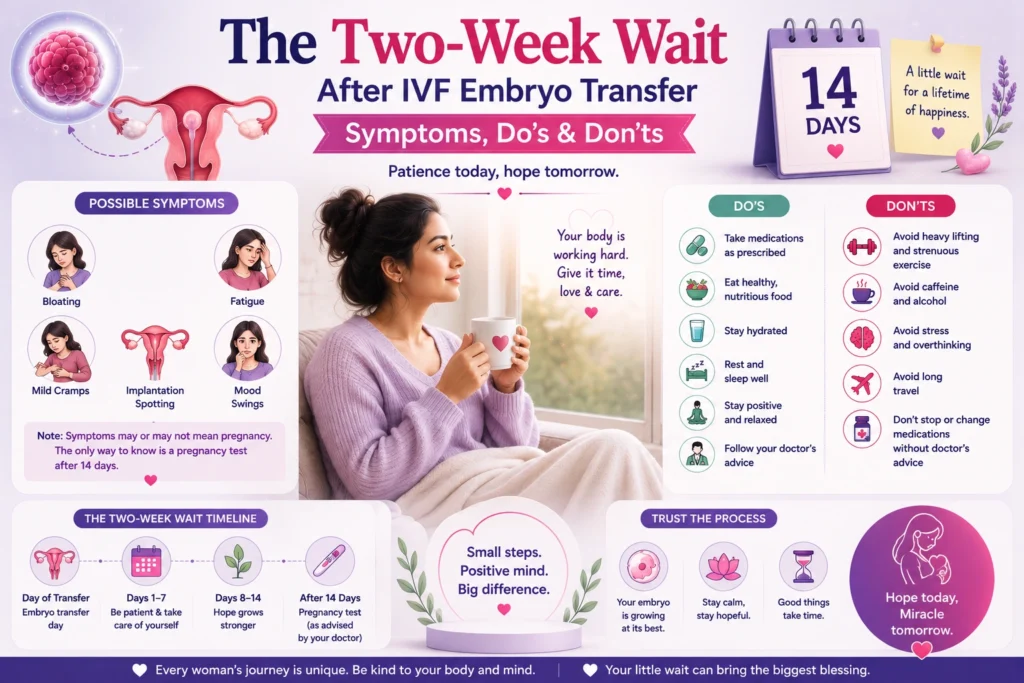
The two-week wait after IVF embryo transfer is, for many couples, the most emotionally demanding stretch of the entire fertility journey. The injections are done. The egg retrieval is behind you. The embryo has been carefully transferred. And now — you wait.
Fourteen days. Roughly 336 hours. And in each of those hours, the mind does what anxious minds do best: it searches for signs, replays symptoms, scrolls through forums, and alternates between cautious hope and quiet dread.
Many couples say these two weeks feel harder than any needle, any procedure, or any medical appointment. And that is completely understandable. This is not just a medical waiting period — it is an emotional one, and it deserves to be acknowledged as such.
At Ayuh Fertility Centre in Ahmedabad, Dr. Krupa M. Shah has guided thousands of couples through this exact experience. Her most consistent message: what you feel during these two weeks — or don’t feel — tells you very little about what is actually happening inside. What matters most is following your care plan, protecting your emotional wellbeing, and giving yourself the patience this process genuinely requires.
This guide is here to help you do exactly that.
Author Bio
Dr. Krupa A. Shah MBBS · MS (Obstetrics & Gynaecology) · Infertility Specialist Founder, Ayuh Fertility Centre, Ahmedabad
19+ Years of Experience in reproductive medicine, obstetrics, and gynaecology.
Dr. Krupa Shah completed her MBBS from Baroda Medical College (2006) and her MS in Obstetrics & Gynaecology from B.J. Medical College, Ahmedabad (2010). After 12 years of experience at leading clinics in Chennai — including Apollo Hospital and Iswarya Fertility Centre — she completed an Advanced IVF Fellowship at Ludwig Maximilians University, Munich, Germany, one of Europe’s most prestigious reproductive medicine institutions.
She is a member of the Ahmedabad Obstetrics and Gynaecology Society (AOGS), the Indian Society of Assisted Reproduction (ISAR), and the Federation of Obstetric and Gynaecological Societies of India (FOGSI).
IVF laboratory is ART National Board Certified.
🩺 Medically Reviewed By
This article is medically reviewed by Dr. Krupa M. Shah, ensuring accurate and reliable fertility information.
What Is the Two-Week Wait After IVF Embryo Transfer?
The two-week wait (TWW) refers to the approximately 10–14 day period between embryo transfer and the recommended date for a pregnancy blood test. It is called this because it takes roughly two weeks after transfer for hCG — the hormone produced by a successfully implanting embryo — to rise to levels that can be reliably detected and measured.
During this window, your body is doing something remarkable and entirely invisible: the transferred embryo is either implanting into the uterine lining or it is not. There is nothing you can do to force this process, speed it up, or slow it down. It happens — or it doesn’t — based on the quality of the embryo, the receptivity of the uterine lining, and a complex interaction of biological signals that even the best fertility medicine cannot fully control.
What happens biologically during the TWW:
- The embryo begins to “hatch” out of its outer shell (zona pellucida) — this usually occurs within 1–3 days of transfer
- It then begins to attach to the endometrial lining — a process called implantation
- Once attached, specialised cells called trophoblasts begin to invade the lining and establish the early placenta
- As implantation progresses, hCG begins to be produced and gradually rises
- By approximately day 10–14 after a day-5 (blastocyst) transfer, hCG levels are typically high enough for accurate blood testing
Understanding this biology helps explain why testing earlier than recommended gives unreliable results — and why symptoms during this period are so difficult to interpret.
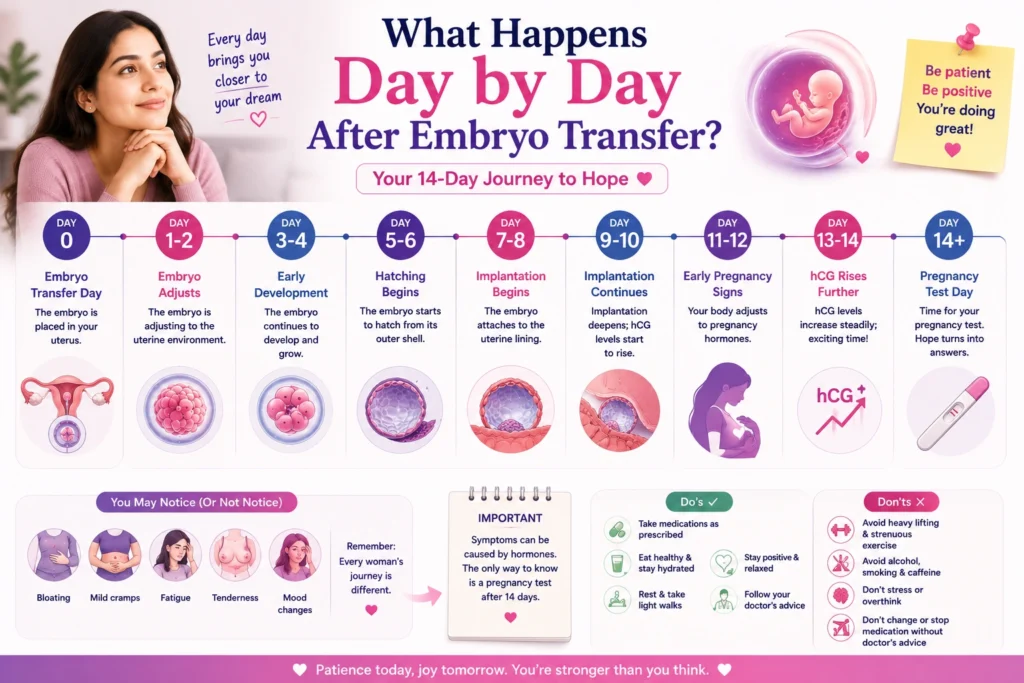
What Happens Day by Day After Embryo Transfer?
This timeline applies to a day-5 blastocyst transfer, which is the most common type in modern IVF treatment. Day-3 embryo transfers follow a slightly different timeline.
Days 1–3 After Transfer
The blastocyst continues to develop and begins hatching from its zona pellucida. It floats freely in the uterine cavity during this period. Most women feel very little — perhaps some mild pelvic heaviness from the transfer itself or from ongoing progesterone medication. No implantation has occurred yet at this stage.
Days 4–6 After Transfer
This is the typical implantation window. The embryo begins to attach to the uterine lining. Some women experience very mild cramping or a fleeting sense of pressure at this stage — but many feel nothing at all. Some women notice a small amount of light spotting around day 5–6, which may be implantation bleeding — though this is not universal or reliable as a sign.
Days 7–9 After Transfer
If implantation has occurred, hCG begins to be produced and enters the bloodstream. Hormone-related symptoms — breast tenderness, fatigue, bloating — may become more noticeable at this stage, though these are also caused by the progesterone and oestrogen medications most IVF patients are taking. The two sensations are genuinely indistinguishable.
Days 10–14 After Transfer
hCG is rising (if implantation has occurred). A blood hCG test at this stage gives the most reliable result. Some women will experience stronger symptoms; others will feel completely normal. Neither pattern reliably predicts the outcome. This is the stage where emotional intensity peaks for most couples — and where the temptation to test early becomes hardest to resist.
Common Symptoms During the Two-Week Wait
Understanding symptoms after embryo transfer is one of the most important things you can read during this period — because misinterpreting them causes enormous unnecessary distress.
The critical point, which cannot be repeated often enough: progesterone and oestrogen medications cause the same symptoms as early pregnancy. This is not a coincidence — it is biology. The hormones used to support implantation are the same hormones that cause pregnancy symptoms. There is genuinely no way to distinguish medication side effects from pregnancy signs during the TWW.
With that context in mind, here are the symptoms commonly experienced:
Mild Cramping Lower abdominal cramping or a dull ache is common and can result from the transfer procedure, progesterone pessaries, or early implantation. It does not confirm or rule out pregnancy.
Breast Tenderness Sore, heavy, or sensitive breasts are a very common side effect of progesterone supplementation. Almost all women on progesterone experience this to some degree. It is not a reliable indicator of pregnancy.
Fatigue Feeling unusually tired or needing more rest is extremely common after embryo transfer — both from the physical demands of the IVF cycle and from progesterone, which has a sedating effect on many women.
Bloating Abdominal bloating and fullness can persist from the stimulation phase, particularly if mild OHSS occurred, and can also be a progesterone side effect. It is very common and rarely concerning.
Increased Vaginal Discharge Milky or clear discharge is common during the TWW — often related to the progesterone pessaries being used. If discharge is accompanied by itching, unusual colour, or odour, contact your clinic.
Mood Changes Emotional sensitivity, irritability, tearfulness, and anxiety are all extremely common. These are partly hormonal and partly the entirely understandable emotional response to one of the most stressful waiting periods of a person’s life.
Light Spotting (Possible Implantation Bleeding) Some women notice a small amount of light pink or brown spotting around days 5–7 after transfer. This may represent implantation bleeding — but it can also be caused by the progesterone pessaries irritating the cervix. It is generally not cause for concern unless it becomes heavy.
Symptoms That Do NOT Necessarily Mean Pregnancy
This section exists because the internet — and well-meaning friends — are full of symptom lists that create false certainty in both directions. Let’s be clear:
No symptoms at all does not mean the cycle has failed. Many women with completely uneventful, symptom-free two-week waits go on to have positive pregnancy tests. The absence of symptoms is not a bad sign.
Cramping does not mean miscarriage or failure. Mild cramping is normal throughout the TWW.
Spotting does not mean the period has arrived. Light spotting during the TWW is common and can coexist with successful implantation.
Breast soreness fading does not mean pregnancy hormones have dropped. Sensitivity varies day to day and is heavily influenced by medication dosing.
Fatigue improving does not mean anything clinically significant. Energy levels fluctuate throughout the TWW for multiple reasons.
The honest, medically accurate truth is this: symptoms during the two-week wait after IVF embryo transfer cannot predict whether a cycle has succeeded. Only a blood hCG test at the recommended time can do that.
Symptoms That Require Immediate Medical Attention
While most symptoms during the TWW are normal and manageable, some require prompt contact with your fertility clinic:
- Severe or worsening abdominal pain — particularly if sudden and one-sided (possible ectopic pregnancy concern)
- Heavy bleeding — more than a light period, with or without clots
- Fever above 38°C — may indicate infection
- Significant abdominal swelling with difficulty breathing — possible signs of worsening OHSS
- Inability to keep fluids down — combined with swelling may indicate OHSS
- Severe shoulder tip pain — can indicate fluid irritating the diaphragm in OHSS
When in doubt, call your clinic. No symptom concern is too small to raise during the TWW. Your fertility team would always rather hear from you than have you suffer in worried silence.
What to Do After IVF Transfer — Doctor-Recommended Advice
Knowing what to do after IVF transfer in Ahmedabad — or anywhere — comes down to a small number of consistent, well-supported principles. There is no magic ritual that improves implantation chances. But there are several genuinely helpful things you can do.
Take your medications exactly as prescribed This is the single most important thing on this list. Progesterone and oestrogen support the uterine lining for implantation. Missing doses, changing doses, or stopping early can have real consequences. Set phone reminders. Keep your medication schedule visible. Do not miss a dose.
Stay well hydrated Drinking 8–10 glasses of water daily supports blood flow to the uterus, helps process medications, and reduces bloating. Coconut water is an excellent additional option, particularly in Indian summer conditions.
Eat a balanced, nourishing diet No specific food will cause or prevent implantation. But a diet rich in whole foods, lean protein, healthy fats, and fresh vegetables supports your overall health and energy during a demanding period. Indian meals built around dals, vegetables, whole grains, and dairy are naturally well-suited to fertility nutrition.
Get adequate rest and sleep Your body has been through a significant medical process. Resting well — 7–9 hours of sleep per night — supports hormonal regulation and emotional resilience.
Attend all follow-up appointments Do not skip your follow-up scans or blood tests, even if you feel fine or feel like avoiding difficult news. These appointments exist to support you — not to judge the outcome.
Do something meaningful with your time This sounds simple, but it matters. Gentle activities you enjoy — reading, cooking, spending time with people you trust, gentle walks — genuinely help manage the mental load of waiting. The two weeks pass faster when filled with quiet purpose rather than anxious symptom-watching.
What NOT to Do During the Two-Week Wait
Avoid heavy exercise Intense physical activity — HIIT, heavy lifting, running — should be avoided during the TWW. Light walking is fine and beneficial. The concern with vigorous exercise is not that it causes implantation failure (the evidence for this is limited) but that enlarged ovaries from stimulation remain slightly vulnerable for the first week, and physical exertion can worsen discomfort.
Avoid smoking Smoking impairs blood flow, disrupts hormonal signalling, and is associated with poorer IVF success rates. Avoid completely during the TWW and ideally throughout the entire treatment cycle.
Avoid alcohol Alcohol disrupts hormonal balance and is best avoided entirely during the two-week wait after IVF embryo transfer. This is a temporary sacrifice that is well worth making.
Avoid self-medicating Do not take any new medications, supplements, herbal remedies, or Ayurvedic preparations during the TWW without first checking with your fertility doctor. Some substances interact with progesterone or affect uterine blood flow.
Avoid excessive internet symptom-searching This is one of the most consistent pieces of advice from fertility specialists — and one of the hardest to follow. Symptom lists online are almost universally unhelpful during the TWW because they confirm whatever you are already hoping or fearing. Limit forum browsing. Trust your care team instead.
Avoid repeated home pregnancy tests before the recommended date Testing too early gives unreliable results — both false positives (from the hCG trigger injection still being detectable) and false negatives (hCG not yet high enough). Each early negative test causes unnecessary grief during a period already full of emotional strain. Wait for the blood test. It is worth it.
Diet During the Two-Week Wait
There is no scientifically proven “implantation diet.” But eating well during the TWW supports your physical health and emotional stability — both of which matter.
Foods to include:
- Protein-rich foods — eggs, dals, paneer, fish, chicken — support cellular repair and hormone production
- Iron-rich foods — palak, rajma, masoor dal — particularly important if light spotting occurs
- Antioxidant-rich fruits and vegetables — pomegranate, amla, berries, tomatoes, carrots — reduce oxidative stress
- Warm, easily digestible foods — in traditional Indian medicine and in general comfort terms, warm cooked foods are easier on a sensitive digestive system
- Healthy fats — ghee (in moderation), walnuts, almonds, flaxseeds — support hormonal health
- Prenatal vitamins — continue exactly as prescribed; do not stop or add supplements without guidance
Foods and habits to limit:
- Excess sugar and refined carbohydrates (maida, packaged snacks)
- Very spicy or oily foods if they cause digestive discomfort
- Raw papaya, pineapple in very large amounts — cultural myths exist around both; moderate consumption is fine, but excess is unnecessary
- Alcohol and caffeine — reduce or eliminate
Can You Travel, Work, or Exercise?
These are among the most common practical questions couples ask about the TWW.
Office work: Yes — returning to desk work within 1–2 days of transfer is generally fine for most women. Physical rest is helpful immediately after transfer but prolonged bed rest has not been shown to improve IVF outcomes. A normal work routine provides helpful distraction.
Travel: Short local travel is generally fine. Long-distance travel — particularly flights — during the first few days after transfer is best avoided if possible, simply to reduce physical stress and ensure you are close to your clinic if any concerns arise. Discuss specific travel plans with your fertility specialist.
Walking: Yes — gentle walking is safe, beneficial, and encouraged throughout the TWW. A 20–30 minute walk daily supports blood circulation, helps manage stress, and maintains a sense of normalcy.
Light exercise: Gentle yoga (not hot yoga), stretching, and light household activity are all fine. Avoid vigorous or high-impact activities.
Household activities: Normal, light household tasks are fine. Avoid heavy lifting, bending repeatedly, or activities that cause significant physical exertion.
Emotional Challenges During the Two-Week Wait
If there is one thing that almost every couple going through IVF agrees on, it is this: the TWW is not a medical challenge — it is a psychological one.
The two-week wait after IVF embryo transfer is a uniquely suspended state. You cannot do more. You cannot know yet. You can only wait — and waiting, when something this important is at stake, is genuinely hard.
Common emotional experiences during the TWW:
- Obsessing over symptoms — analysing every twinge, every feeling, every bodily sensation for meaning it may not have
- Anxiety and intrusive thoughts — particularly at night, when there are no distractions
- Relationship strain — partners often cope differently; one may want to talk, the other may go quiet. Both responses are normal.
- Fear of failure — particularly for couples who have experienced previous failed cycles or losses
- Mood swings — partly hormonal, partly the natural response to an emotionally loaded situation
- Isolation — many couples keep IVF private, which means carrying this weight without the support structures that surround other major life events
What helps:
- Talk to your partner honestly — about fears, not just hopes. Shared vulnerability builds resilience.
- Maintain a gentle routine — structure reduces the mental space available for anxiety to fill
- Limit symptom-searching — set a daily limit if needed; use a timer if that helps
- Consider counselling — a therapist familiar with fertility treatment can provide tools that are specifically useful for this kind of waiting
- Be kind to yourself — this is genuinely one of the hardest things couples do. Treating yourself with the same compassion you would extend to a close friend is not indulgent — it is necessary.
When Should You Take a Pregnancy Test?
The recommended timeframe for a blood hCG pregnancy test after a day-5 blastocyst transfer is approximately 10–14 days after transfer — as advised by your specific clinic protocol.
Why waiting matters:
- The hCG trigger injection used before egg retrieval can remain detectable in the blood for up to 10 days. Testing before this clears can produce a false positive.
- If hCG from a successfully implanting embryo is tested too early, levels may be below the detection threshold — producing a false negative that causes devastating unnecessary grief.
- Blood hCG tests are far more sensitive and accurate than home urine tests. A quantitative blood hCG level also tells your doctor more than a simple positive or negative.
About home pregnancy tests: Most fertility specialists recommend avoiding home tests before the blood test date, or — if you absolutely cannot wait — not before day 10 post-transfer, and only with the understanding that results at that stage are still not fully reliable.
Trust your clinic’s specific guidance on timing. It exists for good reason.
What Happens If the Pregnancy Test Is Positive?
A positive blood hCG result is the beginning of the next stage of your journey — not the final confirmation. Here is what typically follows:
- A repeat hCG blood test 48 hours later to confirm that levels are rising appropriately (doubling every 48–72 hours is a healthy sign)
- An early ultrasound at approximately 6–7 weeks of pregnancy to confirm a gestational sac and, later, a fetal heartbeat
- Continued progesterone and oestrogen support — do not stop medications when you see a positive result. Your doctor will guide you on when to taper these safely.
- Ongoing monitoring through the first trimester, particularly for high-risk pregnancies or women with previous complications
A positive test is wonderful news — but the journey continues, and your care team remains alongside you.
What If the IVF Cycle Doesn’t Work?
A negative result after an IVF cycle is one of the most painful experiences a couple can face. There are no words that make it easier — and this guide will not pretend otherwise.
What is genuinely true is this: a failed cycle is not a failed person, and it is not the end of the road.
What follows a negative result:
- A follow-up consultation with your fertility specialist — not to rush into the next cycle, but to review what the cycle showed, what the embryo quality was, and what, if anything, would be adjusted in a future protocol
- Time to grieve, rest, and recover — emotionally as much as physically. This is not a detour from the process; it is part of it.
- A clearer picture — each cycle provides information. A failed cycle with good-quality embryos may prompt investigation into uterine receptivity. A cycle with poor fertilisation may prompt a change in protocol. The data matters.
- Hope that is realistic — many couples who do not succeed on their first cycle go on to have children through subsequent attempts. The first cycle is rarely the last word.
Speak to Dr. Krupa M. Shah about what your specific cycle results mean and what the most informed next step looks like for you.
Common Myths About the Two-Week Wait
Myth: Complete bed rest after embryo transfer improves success. Reality: There is no clinical evidence that bed rest — whether for hours, days, or the full two weeks — improves IVF outcomes. Gentle activity, including walking and light work, is safe and may actually be beneficial for circulation and emotional wellbeing.
Myth: Symptoms guarantee pregnancy. Reality: Progesterone and oestrogen medications cause identical symptoms to early pregnancy. There is genuinely no way to distinguish them during the TWW. Symptoms are not a reliable indicator of outcome.
Myth: No symptoms means the cycle has failed. Reality: Many successful pregnancies occur with minimal or no symptoms during the TWW. The absence of symptoms carries no negative clinical significance.
Myth: Stress automatically causes IVF failure. Reality: While chronic stress affects hormonal balance, everyday anxiety during the TWW has not been shown to cause implantation failure. Worrying that you are worrying too much adds unnecessary distress. Manage stress for your own wellbeing — not because it controls implantation.
Myth: An early home pregnancy test is reliable. Reality: Testing before the recommended date gives results that are frequently misleading — in both directions. The blood hCG test at the right time is the only reliable measurement.
Myth: A faint line on a home test means pregnancy has definitely occurred. Reality: Very faint lines at early testing may reflect residual trigger injection hCG rather than pregnancy hCG, or may represent a very early chemical pregnancy. Only a properly timed blood test with a rising hCG level provides meaningful confirmation.
Frequently Asked Questions
Q1: Is cramping normal after embryo transfer?
Yes — mild cramping during the two-week wait after IVF embryo transfer is very common and usually not a cause for concern. Cramping can result from the transfer procedure itself, from progesterone pessaries, from bloating related to the stimulation cycle, or from early implantation activity. Most cramping during the TWW is mild and intermittent. If cramping becomes severe, is one-sided, or is accompanied by heavy bleeding or fever, contact your fertility clinic immediately. Mild, on-and-off cramping in the absence of heavy bleeding is generally normal and does not predict a negative outcome.
Q2: Can I walk after IVF transfer?
Yes — gentle walking is safe and encouraged after embryo transfer. There is no clinical evidence that walking prevents implantation. In fact, light activity supports blood circulation, helps manage stress, and maintains a sense of routine — all of which are beneficial during the TWW. What should be avoided is vigorous or high-impact exercise, particularly in the first week when ovaries may still be slightly enlarged from the stimulation phase. A 20–30 minute daily walk is a healthy and appropriate activity for most women after embryo transfer.
Q3: Can I travel during the two-week wait?
Short local travel is generally fine from a few days after transfer. Long-distance travel — particularly flights of several hours — is best avoided in the first 3–5 days if possible, simply to minimise physical stress and ensure proximity to your clinic if concerns arise. After day 5–7, most fertility specialists consider moderate travel acceptable. Always discuss specific travel plans with your fertility doctor before the transfer so you can plan accordingly. Staying well hydrated and avoiding long periods of immobility are particularly important if travel is unavoidable.
Q4: When should I take a pregnancy test after embryo transfer?
Your fertility clinic will advise a specific test date — typically 10–14 days after a day-5 blastocyst transfer. This timing ensures that residual hCG from the trigger injection has cleared and that any pregnancy hCG has risen to reliably detectable levels. Testing earlier frequently produces misleading results — false negatives from low hCG or false positives from residual trigger. A blood hCG test (quantitative beta-hCG) is significantly more sensitive and informative than a home urine test. Follow your clinic’s recommended date, even when waiting feels impossible.
Q5: Is spotting normal after embryo transfer?
Light spotting — particularly pink or brown discharge — during the TWW is relatively common and does not necessarily indicate that the cycle has failed. It can represent implantation bleeding (a positive sign in some cases), irritation from progesterone pessaries, or simply normal hormonal fluctuation. Light spotting is generally not cause for alarm. Heavy bleeding — comparable to or heavier than a period — should always be reported to your clinic promptly. When in doubt, call your care team. They are there precisely for moments of uncertainty like this.
Conclusion:
The two-week wait after IVF embryo transfer is not something you can control your way through. You cannot symptom-check your way to certainty. You cannot rest your way to a positive result or worry your way to a negative one. What you can do — and what matters — is follow your medication schedule carefully, nourish your body gently, protect your emotional energy wisely, and allow the process the time it genuinely needs.
Every IVF journey is unique. Every body responds differently. Every couple carries their own history into those fourteen days. And in the middle of all that complexity and uncertainty, one thing remains simple: you have already done something extraordinarily brave by getting here.
Dr. Krupa M. Shah and the team at Ayuh Fertility Centre are with you through every stage of this journey — the procedures, the waiting, the results, and whatever comes next. If you have concerns at any point during your TWW, please reach out. You are never alone in this.
👉 Book your consultation with Ayuh Fertility Centre today
👉 Get expert guidance for PCOS and fertility treatment
👉 Start your journey toward a healthy and successful pregnancy
📍 Visit us in Ahmedabad
📞 Call now to schedule your appointment