
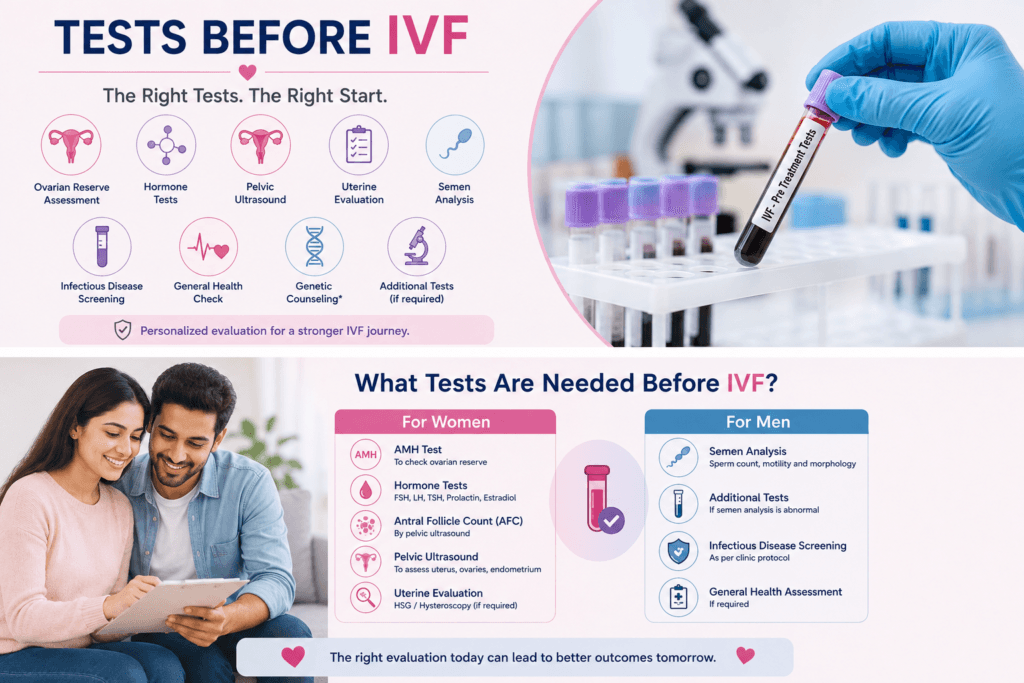
Tests Before IVF : Starting IVF is a major decision, and many couples wonder what happens before the actual treatment begins.
One of the most important steps is a fertility evaluation.
Before starting IVF, your fertility specialist may recommend different tests to understand your reproductive health, identify factors that could affect treatment, and select an appropriate IVF protocol.
But there is an important point to remember:
Not every patient needs every fertility test.
The tests recommended before IVF depend on your age, medical history, infertility diagnosis, previous treatment, previous IVF cycles and individual circumstances.
The purpose of pre-IVF testing is not simply to collect reports. It is to help your fertility team understand your situation and plan treatment appropriately.
Why Are Tests Done Before IVF?
IVF involves several stages, from ovarian stimulation to egg retrieval, fertilization, embryo development and embryo transfer.
Testing before treatment can help your doctor assess factors that may influence these stages.
A pre-IVF evaluation may help assess:
- Ovarian reserve
- Ovulation and reproductive hormones
- Uterine health
- Endometrial condition
- Sperm health
- Previous fertility problems
- General medical factors
- The likely response to ovarian stimulation
The results can help your fertility specialist decide how to approach your treatment.
What Tests Are Commonly Done Before IVF?
There is no single universal test list.
However, depending on your situation, your fertility specialist may consider several categories of evaluation.
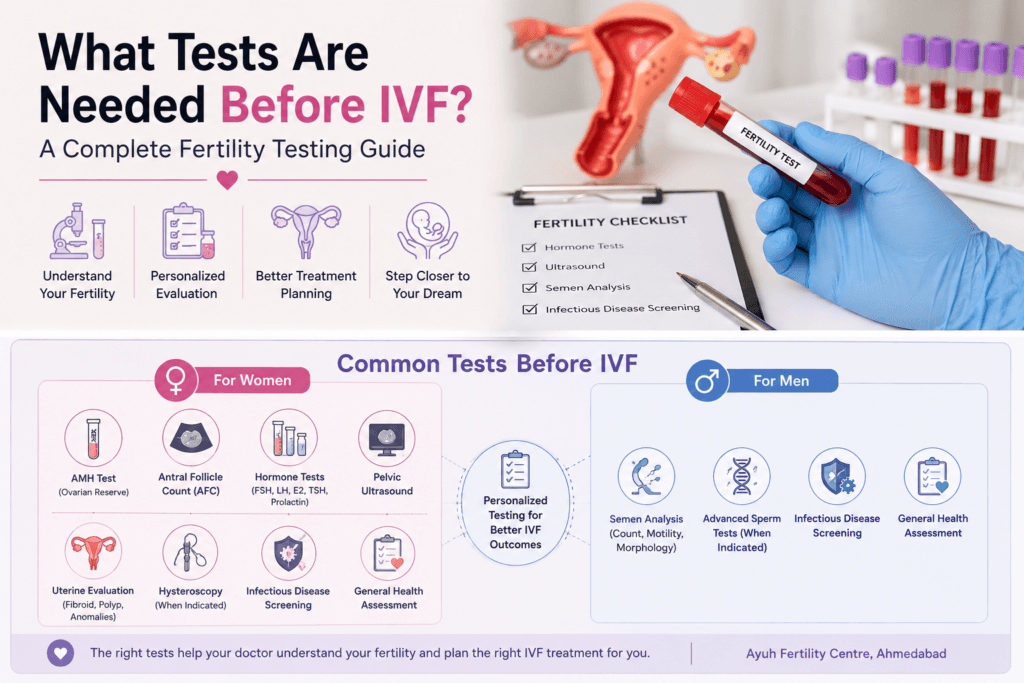
1. AMH Test
AMH (Anti-Müllerian Hormone) is commonly used to assess ovarian reserve.
It can provide information about the approximate number of recruitable follicles and may help predict how the ovaries could respond to stimulation.
However:
AMH does not directly measure egg quality.
A low AMH does not automatically mean that IVF cannot work, while a higher AMH does not guarantee pregnancy.
Your AMH result should be interpreted together with your age, ultrasound findings and overall fertility history.
2. Antral Follicle Count
An Antral Follicle Count (AFC) is performed using an ultrasound examination of the ovaries.
The fertility specialist looks at the small antral follicles visible in the ovaries.
AFC can help provide information about ovarian reserve and assist with IVF stimulation planning.
AMH and AFC are often considered together rather than relying on one result alone.
3. Hormone Tests
Depending on your history and treatment plan, your doctor may recommend blood tests to evaluate reproductive hormones.
These can include:
- FSH
- LH
- Estradiol
- TSH
- Prolactin
The exact tests and timing can vary.
For example, thyroid and prolactin abnormalities may need to be identified and appropriately managed when clinically relevant.
Your fertility specialist will determine which hormone tests are appropriate for you.
4. Pelvic Ultrasound
A pelvic ultrasound can provide information about the:
- Uterus
- Endometrium
- Ovaries
- Follicles
- Fibroids
- Ovarian cysts
- Other pelvic findings
Ultrasound is particularly useful because it can assess both ovarian reserve indicators and the reproductive anatomy.
Depending on your symptoms and history, your doctor may recommend additional imaging or evaluation.
5. Uterine Evaluation
Before embryo transfer, the uterus and endometrium are important considerations.
Your doctor may evaluate whether there are conditions such as:
- Endometrial polyps
- Fibroids
- Uterine adhesions
- Congenital uterine abnormalities
- Other structural problems
Not every woman requires an advanced uterine test.
If your history, ultrasound or previous IVF results suggest a possible uterine problem, your doctor may recommend additional evaluation.
6. Hysteroscopy When Indicated
Hysteroscopy allows a doctor to examine the inside of the uterus using a small camera.
It may be recommended when there is a clinical reason to investigate the uterine cavity, such as suspected polyps, adhesions or other abnormalities.
It is not necessary for every patient before IVF.
The decision should depend on your individual history and findings.
7. Semen Analysis
IVF evaluation should include the male partner too.
A semen analysis commonly assesses:
- Sperm concentration
- Sperm motility
- Sperm morphology
The results help the fertility team understand whether male-factor infertility may be contributing to the couple’s difficulty conceiving.
This information may also influence decisions regarding fertilization techniques.
8. Additional Male Fertility Testing
If the semen analysis shows abnormalities, or if there is a history of infertility or previous treatment difficulties, additional male fertility evaluation may be considered.
Depending on the clinical situation, this may include further assessment of sperm function or other male reproductive factors.
Advanced tests should not automatically be performed on every patient.
Your fertility specialist may recommend them when the results could meaningfully influence treatment planning.
9. Infectious Disease Screening
Certain infectious disease screening tests may be required as part of fertility treatment and IVF laboratory protocols.
The exact tests depend on the clinic, applicable regulations and individual circumstances.
Your fertility centre will provide the required list before treatment begins.
10. Blood Group and General Health Assessment
Depending on your medical history, your doctor may review:
- Blood group
- Complete blood count
- Blood sugar
- Blood pressure
- General medical history
Additional tests may be recommended if you have a known medical condition or symptoms that require evaluation before pregnancy.
Does Everyone Need the Same IVF Tests?
No.
This is one of the most important things couples should understand.
For example, a woman with regular cycles, normal ultrasound findings and no previous fertility treatment may require a different evaluation from someone with:
- Previous IVF failure
- Recurrent miscarriage
- Endometriosis
- PCOS
- Low ovarian reserve
- Uterine abnormalities
- Male-factor infertility
Testing should therefore be personalized.
More tests do not necessarily mean better IVF treatment.
What Tests Are Needed for Women Before IVF?
A typical female fertility evaluation may include:
Ovarian assessment
- AMH
- AFC
- Relevant hormone testing
Uterine assessment
- Pelvic ultrasound
- Endometrial evaluation
- Additional uterine testing when indicated
Medical assessment
- Relevant blood tests
- Review of medical history
- Assessment of conditions that may affect pregnancy
The exact combination depends on your individual circumstances.
What Tests Are Needed for Men Before IVF?
Male fertility evaluation commonly starts with:
Semen analysis
This may assess:
- Sperm count
- Motility
- Morphology
Additional testing may be considered when clinically appropriate.
This is important because infertility can involve male factors, female factors or a combination of both.
Are Tests Different for IVF After a Failed Cycle?
They can be.
If you have already undergone IVF, your previous cycle provides useful information.
Your fertility specialist may review:
- Number of eggs retrieved
- Egg maturity
- Fertilization rate
- Embryo development
- Blastocyst formation
- Embryo quality
- Endometrial preparation
- Embryo transfer
- Pregnancy outcome
Depending on what happened, additional evaluation may or may not be appropriate.
A failed IVF cycle does not automatically mean that you need every available fertility test.
Do You Need Genetic Testing Before IVF?
Genetic testing is not automatically required for every IVF patient.
Depending on your personal or family history, your doctor may discuss:
- Carrier screening
- Genetic counselling
- Embryo genetic testing options
The appropriate approach depends on your circumstances.
If embryo genetic testing is being considered, your fertility specialist can explain what the test is designed to detect, its limitations and whether it is relevant to your treatment.
Do You Need HSG Before IVF?
An HSG (hysterosalpingogram) evaluates the uterus and whether the fallopian tubes are open.
Whether an HSG is necessary before IVF depends on the individual situation.
Because IVF generally bypasses the fallopian tubes for fertilization, an HSG may not be required in every IVF patient.
Your doctor may recommend it when the result could provide useful information for diagnosis or treatment planning.
How Long Do Pre-IVF Tests Take?
The testing stage can range from several days to a few weeks depending on:
- Which tests are required
- Timing of hormone tests
- Ultrasound findings
- Need for additional investigations
- Existing medical conditions
- Previous fertility treatment
Some tests can be completed quickly, while others may require a particular menstrual-cycle day or additional consultation.
This is why the overall IVF journey may begin before ovarian stimulation actually starts.
What Happens After Your IVF Tests?
Once the required evaluation is complete, your fertility specialist can review the results with you.
The discussion may include:
Your ovarian reserve
How many follicles might be expected to respond to stimulation?
Your reproductive health
Are there any uterine or hormonal factors that should be addressed?
Male fertility
Are there sperm-related factors that could influence fertilization?
Your infertility diagnosis
What is the most likely reason for difficulty conceiving?
Treatment plan
Is IVF appropriate, and what protocol may be suitable?
The aim is to turn the test results into a personalized treatment plan.
Can Abnormal Test Results Stop You From Having IVF?
Not necessarily.
Finding an abnormal result does not automatically mean IVF cannot be performed.
Instead, it may help your doctor identify something that should be addressed first.
For example:
- A thyroid abnormality may need appropriate management.
- A uterine polyp may need evaluation.
- An ovarian cyst may require assessment.
- Abnormal semen parameters may influence the fertilization strategy.
- Low ovarian reserve may influence stimulation planning.
The correct response depends on the specific finding.
Why You Shouldn’t Compare Your IVF Test List With Someone Else’s
It is common for couples to compare fertility reports online or with friends.
But two patients may have completely different testing requirements.
For example:
Patient A:
Regular cycles + normal ultrasound + no previous IVF
Patient B:
Previous IVF failure + endometriosis + abnormal ultrasound
Their pre-IVF evaluation is unlikely to be identical.
Therefore, don’t worry if another patient has fewer or more tests than you.
Your evaluation should be based on your fertility history and medical needs.
What Should You Ask Your Fertility Specialist Before Doing a Test?
Before undergoing an additional test, ask:
“Why do I need this test?”
“What problem are we looking for?”
“If the result is abnormal, will it change my treatment?”
“Is this test recommended for my particular situation?”
“What are the limitations of the test?”
These questions can help you understand the purpose of your fertility evaluation.
Pre-IVF Testing at Ayuh Fertility Centre Ahmedabad
At Ayuh Fertility Centre Ahmedabad, fertility testing should be approached as part of individualized IVF planning.
Your fertility specialist can review your:
- Age
- Medical history
- Menstrual history
- Previous pregnancies
- Previous IUI or IVF treatment
- Ovarian reserve
- Ultrasound findings
- Male fertility factors
- Uterine health
Based on this assessment, appropriate investigations can be recommended before treatment.
The goal is not to order the maximum number of tests.
The goal is to identify the information needed to make a better treatment decision.
Frequently Asked Questions
What tests are needed before IVF?
Common Tests Before IVF may include ovarian reserve assessment, pelvic ultrasound, relevant hormone testing, semen analysis and uterine evaluation when indicated. The exact tests depend on your age, fertility history, medical conditions, previous treatment and the reason for infertility. Your fertility specialist will recommend only the investigations that are relevant to your situation.
Is AMH mandatory before IVF?
AMH is commonly used as part of Tests Before IVF to assess ovarian reserve. However, AMH alone does not determine your chances of pregnancy or egg quality. Your fertility specialist may interpret AMH along with your age, ultrasound findings, medical history and other fertility investigations before planning IVF.
Is semen analysis required before IVF?
Male fertility evaluation is an important part of Tests Before IVF. A semen analysis commonly evaluates sperm concentration, motility and morphology. Depending on the results and the couple’s fertility history, your doctor may recommend additional male fertility evaluation when clinically indicated.
Do I need HSG before IVF?
Not necessarily. HSG may be recommended as part of Tests Before IVF when your doctor believes information about the uterus or fallopian tubes could be useful for diagnosis or treatment planning. Since IVF bypasses the fallopian tubes for fertilization, an HSG is not automatically required for every IVF patient.
Is hysteroscopy required before every IVF?
No. Hysteroscopy is not routinely required for every patient as part of Tests Before IVF. It may be recommended when there is a clinical reason to examine the uterine cavity, such as suspected polyps, adhesions or other abnormalities identified through your history or previous investigations.
How many days before IVF should tests be done?
There is no single timeline for completing Tests Before IVF. Some blood tests can be performed at different times, while certain hormone tests and ultrasound assessments may need to be performed at a particular stage of the menstrual cycle. Your fertility clinic can provide a schedule based on your planned IVF treatment.
Can IVF start immediately after testing?
Sometimes, but not always. After completing Tests Before IVF, your fertility specialist will review the results and decide whether you are ready to begin treatment. If an underlying medical, hormonal or uterine issue needs attention, your doctor may recommend addressing it before starting IVF.
Are blood tests included in Tests Before IVF?
Blood investigations may be included in Tests Before IVF depending on your medical history and treatment requirements. These can include ovarian reserve testing and relevant hormone or general health assessments. The exact blood tests required vary from patient to patient.
Are ultrasound scans part of Tests Before IVF?
Yes, pelvic ultrasound is commonly used during Tests Before IVF. It can provide information about the ovaries, follicles, uterus and endometrium. It may also help identify findings such as ovarian cysts or fibroids that could require further evaluation.
What Tests Before IVF are done for women?
Depending on the individual case, Tests Before IVF for women may include AMH, antral follicle count, relevant hormone testing, pelvic ultrasound and uterine evaluation when indicated. Your fertility specialist will determine which investigations are appropriate based on your fertility history.
What Tests Before IVF are done for men?
For men, Tests Before IVF commonly begin with a semen analysis to assess sperm concentration, motility and morphology. Additional evaluation may be considered if the semen analysis is abnormal or if there is a relevant history of male-factor infertility or previous treatment difficulties.
Final Takeaway
Tests before IVF are an important part of personalized fertility treatment.
However, there is no universal checklist that every couple needs.
Depending on your circumstances, your fertility specialist may assess:
Ovarian reserve + hormones + uterus + endometrium + sperm + general medical factors
The purpose of testing is to understand your fertility profile and make informed treatment decisions—not simply to collect more reports.
If you are planning IVF in Ahmedabad, discussing your complete fertility history with a fertility specialist can help you understand which tests you actually need and why.
The right test at the right time can help build the right IVF treatment plan.
Medical Disclaimer
This article is intended for general educational purposes and does not replace medical diagnosis or individualized fertility advice. Fertility tests and IVF protocols vary between patients. Your fertility specialist should determine which investigations are appropriate based on your medical history, symptoms, previous treatment and clinical findings.
Author / Medical Reviewer:
Dr. Krupa A. Shah
Fertility Specialist & Founder
Ayuh Fertility Centre, Ahmedabad
Suggested CTA
Planning IVF in Ahmedabad?
Consult the fertility team at Ayuh Fertility Centre to understand your fertility evaluation, required tests and personalized IVF treatment pla