
If you are preparing for IVF, you may have heard people ask:
“How many eggs did you get?”
Egg retrieval is one of the major stages of IVF, so it is natural to wonder whether there is an ideal number of eggs needed for IVF success.
But the answer is not as simple as saying that a particular number of eggs guarantees pregnancy.
During IVF, several steps occur between egg retrieval and embryo transfer. Not every retrieved egg will be mature, not every mature egg will fertilize, and not every fertilized egg will develop into a blastocyst.
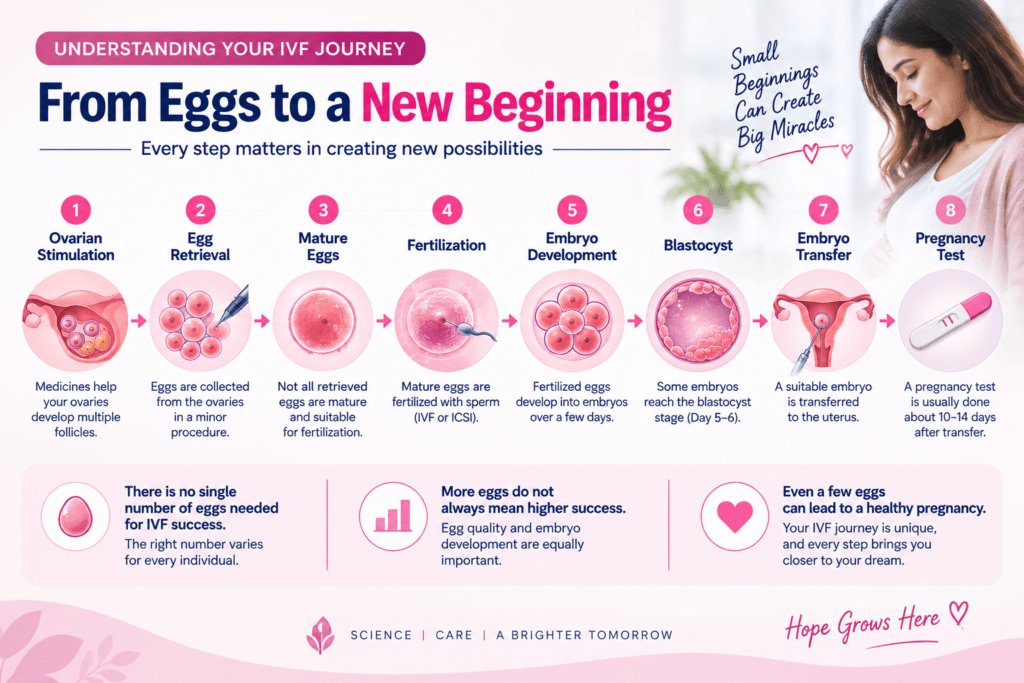
The IVF journey can therefore look like:
Eggs Retrieved → Mature Eggs → Fertilized Eggs → Developing Embryos → Blastocysts → Embryo Transfer → Pregnancy
This is why egg quality and embryo development are just as important as the number of eggs retrieved.
Is There an Ideal Number of Eggs for IVF?
There is no single egg number that guarantees IVF success.
Some women may produce several eggs during stimulation, while others may produce fewer because of age, ovarian reserve or other fertility factors.
A patient who retrieves fewer eggs can still have a successful IVF outcome if suitable embryos develop.
Similarly, retrieving a large number of eggs does not guarantee pregnancy.
The goal of IVF stimulation is therefore not simply to collect the maximum possible number of eggs.
The aim is to obtain an appropriate ovarian response while maintaining safety and giving the patient a reasonable opportunity to develop usable embryos.
What Happens After Egg Retrieval?
The number of eggs retrieved is only the beginning.
Let’s look at what happens next.
Step 1: Eggs Are Retrieved
During egg retrieval, the fertility specialist collects eggs from the developed ovarian follicles.
The number retrieved can vary significantly between patients.
Your doctor may have an estimated number based on ultrasound monitoring, but the final number is known only after retrieval
Step 2: Mature Eggs Are Identified
Not every retrieved egg is mature.
Only appropriately mature eggs are generally suitable for fertilization.
For example, a patient may have several eggs retrieved, but a smaller number may be mature.
This is why egg maturity is an important part of evaluating an IVF cycle.
Step 3: Fertilization
Mature eggs are then fertilized with sperm in the embryology laboratory.
Depending on the clinical situation, fertilization may involve conventional IVF or ICSI.
Not every mature egg will fertilize.
For example:
10 eggs retrieved
↓
8 mature eggs
↓
6 fertilized eggs
The exact numbers vary between patients.
This illustrates why the initial egg count alone cannot predict the final number of embryos.
Step 4: Embryo Development
After fertilization, embryos are monitored in the laboratory.
Some embryos continue developing normally, while others may stop developing.
The embryos may be cultured for several days, with blastocyst development typically assessed around Day 5–6 when appropriate.
The number of blastocysts may therefore be lower than the original number of eggs retrieved.
For example:
10 eggs → 8 mature → 6 fertilized → 2–4 blastocysts
This is only an illustrative example, not an expected result for every patient.
Step 5: Embryo Selection and Transfer
If suitable embryos develop, your fertility team will determine the appropriate transfer strategy.
Depending on your circumstances, an embryo may be:
- Transferred in the same cycle
- Frozen for a future transfer
- Considered for additional treatment or testing when clinically indicated
Therefore, the ultimate goal isn’t simply:
“How many eggs did we retrieve?”
It is:
“How many suitable embryos were successfully developed?”
Does More Eggs Mean Higher IVF Success?
Not necessarily.
Having an adequate number of eggs can provide more opportunities for fertilization and embryo development.
However, more eggs do not automatically mean a higher chance of having a baby.
The quality of the eggs matters.
A younger woman may produce fewer eggs but have good embryo development, while another patient may produce more eggs but have fewer embryos reaching the blastocyst stage.
This is why your fertility specialist considers the complete picture rather than focusing on egg count alone.
Egg Quantity vs Egg Quality
This distinction is extremely important.
Egg Quantity
Egg quantity refers broadly to the number of eggs available or retrieved.
Tests such as:
- AMH
- Antral follicle count
- FSH
can provide information about ovarian reserve and expected ovarian response.
Egg Quality
Egg quality refers to the biological potential of an egg to fertilize, develop into an embryo and ultimately contribute to a healthy pregnancy.
Age is an important factor associated with egg quality.
Therefore:
Good egg quantity ≠ guaranteed good egg quality
and
Low egg quantity ≠ impossible IVF success
Both need to be interpreted in context.
How Age Affects the Number and Quality of Eggs
Age can influence both ovarian reserve and egg quality, although individual experiences vary.
As reproductive age increases, there can be:
- Fewer available eggs
- Reduced ovarian response
- Changes in egg quality
- Increased likelihood of chromosomal abnormalities in embryos
This is why IVF treatment for a woman in her early 30s may be approached differently from treatment for someone in her early 40s.
However, age alone cannot tell you exactly how many eggs you will retrieve or whether IVF will succeed.
What Is Low Ovarian Reserve?
Low ovarian reserve means that the available pool of eggs is lower than expected for a particular age.
A fertility specialist may assess ovarian reserve using:
- AMH
- Antral follicle count
- FSH
- Medical and reproductive history
A low ovarian reserve may result in fewer eggs being retrieved during IVF stimulation.
But this does not automatically mean that IVF cannot work.
The treatment plan can be adjusted according to your individual response and circumstances.
What If Only a Few Eggs Are Retrieved?
This is a common concern.
Suppose your doctor expected more follicles but only a few eggs were retrieved.
That does not automatically mean that the cycle has failed.
Even a small number of eggs can potentially result in an embryo suitable for transfer.
Your fertility specialist will consider:
- Your age
- Ovarian reserve
- Egg maturity
- Fertilization
- Embryo development
- Previous IVF history
before deciding what to do next.
The focus should be on what happened to the eggs after retrieval, not only the initial number.
What If Many Eggs Are Retrieved?
A higher number of retrieved eggs can provide more opportunities for fertilization and embryo development.
However, a high egg count can also be associated with a strong ovarian response.
In some patients, excessive ovarian stimulation can increase the risk of ovarian hyperstimulation syndrome (OHSS).
For this reason, fertility specialists carefully monitor ovarian response during IVF.
If a patient is at increased risk of OHSS, the treatment plan may be modified to prioritize safety.
This is another reason why more eggs is not always better.
How Many Eggs Are Needed for One Embryo?
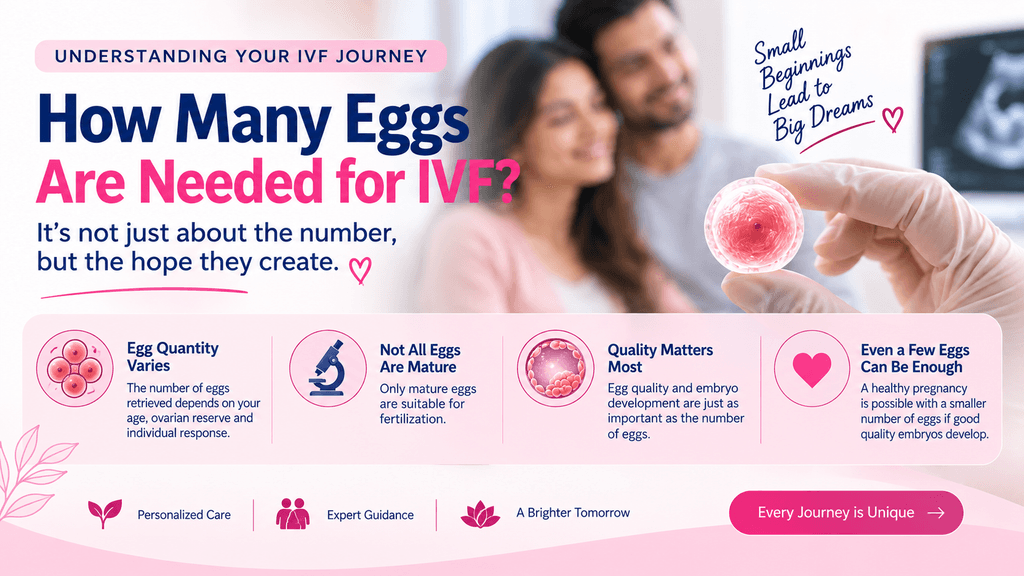
There is no fixed conversion rate.
You cannot accurately say:
“Five eggs always produce one embryo.”
The outcome varies according to:
- Age
- Egg maturity
- Egg quality
- Sperm quality
- Fertilization method
- Embryo development
- Laboratory factors
Some patients may obtain a transferable embryo from a small number of eggs, while others may have fewer usable embryos despite retrieving more eggs.
What Factors Affect Egg Retrieval Results?
Several factors can influence the number of eggs retrieved during IVF.
1. Age
Age can influence ovarian reserve and egg quality.
2. AMH Level
AMH can provide information about ovarian reserve and expected response to stimulation.
3. Antral Follicle Count
AFC provides an ultrasound-based estimate of the available antral follicles.
4. IVF Stimulation Protocol
Your fertility specialist selects medications and doses based on your individual characteristics.
5. Ovarian Response
Patients can respond differently to the same stimulation approach.
6. Previous IVF History
Your previous response to stimulation can help doctors plan future treatment.
7. Underlying Fertility Conditions
Conditions such as PCOS, endometriosis or diminished ovarian reserve may influence treatment planning.
What Is a Good Egg Retrieval Result?
A “good” result cannot be defined by one universal number.
Instead, your doctor may look at the entire sequence:
How many eggs were retrieved?
↓
How many were mature?
↓
How many fertilized?
↓
How many developed into embryos?
↓
How many reached the blastocyst stage?
↓
How many were suitable for transfer or freezing?
This gives a much more useful picture of the IVF cycle.
What If Eggs Do Not Fertilize?
Sometimes eggs are retrieved successfully but fertilization is unexpectedly low.
Your fertility specialist may review:
- Egg maturity
- Sperm parameters
- Previous fertilization results
- Fertilization method
- Other relevant laboratory findings
If fertilization problems occur repeatedly, your doctor may consider whether a change in treatment strategy or additional male/female fertility evaluation is appropriate.
What If No Embryos Develop?
This can be particularly difficult for couples.
If eggs are retrieved and fertilization occurs but no embryo reaches the stage suitable for transfer, your fertility team may review the entire cycle.
Possible factors may include:
- Egg-related factors
- Sperm-related factors
- Age
- Embryo development
- Underlying fertility conditions
A single cycle does not necessarily provide the complete answer.
Your doctor may use the results to guide future treatment decisions.
Can You Improve Egg Quality Before IVF?
There is no guaranteed method to dramatically change egg quality before IVF.
However, your fertility specialist can advise you about appropriate preparation based on your health and fertility profile.
General recommendations may include:
- Avoiding smoking
- Limiting alcohol
- Maintaining a healthy lifestyle
- Managing existing medical conditions
- Following prescribed medications
- Maintaining a balanced diet
- Getting adequate sleep
Do not start supplements simply because they are marketed as “egg-quality boosters.”
Discuss any supplement with your fertility specialist first.
Does AMH Tell You How Many Eggs You Will Get?
AMH can help provide an estimate of ovarian reserve and may help predict ovarian response to stimulation.
However, AMH does not guarantee the exact number of eggs that will be retrieved.
The final result depends on several factors, including:
- Age
- AFC
- Stimulation protocol
- Individual ovarian response
- Timing of retrieval
Your fertility specialist will interpret AMH alongside your other investigations.
Can IVF Work With Low Egg Count?
Yes, it can.
A lower egg count does not automatically mean that pregnancy through IVF is impossible.
The number of eggs is only one part of the process.
A small number of eggs can still potentially result in a suitable embryo.
Your doctor may therefore focus on optimizing the treatment strategy rather than simply trying to increase the egg number at any cost.
Should You Worry If Your Egg Count Is Lower Than Someone Else’s?
No two IVF cycles are exactly the same.
Comparing your egg retrieval number with a friend’s or someone else’s online IVF story can create unnecessary anxiety.
For example:
Patient A: 15 eggs retrieved but only a few embryos develop.
Patient B: 7 eggs retrieved and a good embryo develops.
The second patient can still achieve a successful pregnancy.
Your fertility journey should therefore be evaluated according to your own results.
What Questions Should You Ask After Egg Retrieval?
After your procedure, you can ask your fertility team:
- How many eggs were retrieved?
- How many were mature?
- How many fertilized?
- How are the embryos developing?
- How many reached the blastocyst stage?
- Will embryos be transferred fresh or frozen?
- Were there any unexpected findings?
- What does this result mean for my treatment?
- Does my previous cycle change the next treatment plan?
Understanding these numbers can help you see the entire IVF process rather than focusing on one figure.
Egg Retrieval at Ayuh Fertility Centre Ahmedabad
At Ayuh Fertility Centre Ahmedabad, IVF treatment involves monitoring the ovarian response and planning egg retrieval according to the patient’s individual treatment protocol.
The goal is not simply to obtain a large number of eggs.
The broader goal is to support:
Appropriate ovarian response → Mature eggs → Successful fertilization → Embryo development → Appropriate embryo transfer
Your age, ovarian reserve, medical history and previous fertility treatment can all influence the treatment plan.
If you are concerned about your egg count, discussing your individual results with your fertility specialist is more useful than comparing your numbers with general internet statistics.
Frequently Asked Questions
How many eggs are needed for IVF?
There is no fixed number of eggs required to guarantee IVF success. The outcome depends on egg maturity, egg quality, fertilization, embryo development, age and other individual factors.
How many eggs are good for IVF?
There is no universal number that can be called “good” for every patient. Your fertility specialist will assess your egg retrieval result together with maturity, fertilization and embryo development.
Is 5 eggs enough for IVF?
Five retrieved eggs may still provide an opportunity for IVF success, depending on maturity, fertilization and embryo development. Egg number alone cannot determine the outcome.
Is 10 eggs good for IVF?
Ten eggs can provide multiple opportunities for fertilization and embryo development, but the final outcome depends on what happens after retrieval.
Does more eggs mean better IVF success?
Not necessarily. A greater number of eggs may provide more opportunities, but egg quality, fertilization and embryo development are also important.
What happens if only 2 eggs are retrieved?
Two eggs can still potentially result in an embryo suitable for transfer. Your doctor will consider your age, ovarian reserve, egg maturity and subsequent fertilization and embryo development.
What happens if many eggs are retrieved?
A high number of eggs may provide more opportunities for embryo development, but excessive ovarian response can increase the risk of OHSS. Your fertility team will monitor you carefully.
Does AMH determine egg quality?
No. AMH primarily provides information about ovarian reserve. It does not directly measure egg quality.
Can IVF work with low ovarian reserve?
Yes. Low ovarian reserve does not automatically mean IVF cannot work. Your fertility specialist can assess your individual situation and discuss appropriate treatment options.
How many eggs are needed to get one embryo?
There is no fixed number. The proportion of eggs that become mature, fertilize and develop into embryos varies significantly between patients.
Final Takeaway
So, how many eggs are needed for IVF?
There is no magic number.
The most important thing is not simply the number of eggs retrieved. What happens after egg retrieval matters greatly.
The IVF journey can be summarized as:
Eggs Retrieved → Mature Eggs → Fertilization → Embryo Development → Blastocyst → Embryo Transfer → Pregnancy
Age, ovarian reserve, egg quality, sperm factors and embryo development can all influence the outcome.
If your egg retrieval number is lower or higher than expected, don’t judge your IVF chances based on that number alone.
Your fertility specialist can interpret the complete cycle and explain what your results mean for your next step.
Medical Disclaimer
This article is for general educational purposes and does not replace medical diagnosis or individualized fertility advice. IVF outcomes vary between individuals. Egg retrieval numbers, fertilization rates and embryo development differ from patient to patient. Treatment decisions should be made with a qualified fertility specialist after reviewing your medical history and investigations.
Author / Medical Reviewer:
Dr. Krupa A. Shah
Fertility Specialist & Founder
Ayuh Fertility Centre, Ahmedabad
Suggested CTA
Concerned about your egg count or IVF results?
Consult the fertility team at Ayuh Fertility Centre Ahmedabad to understand your ovarian reserve, egg retrieval results and personalized IVF treatment options.