
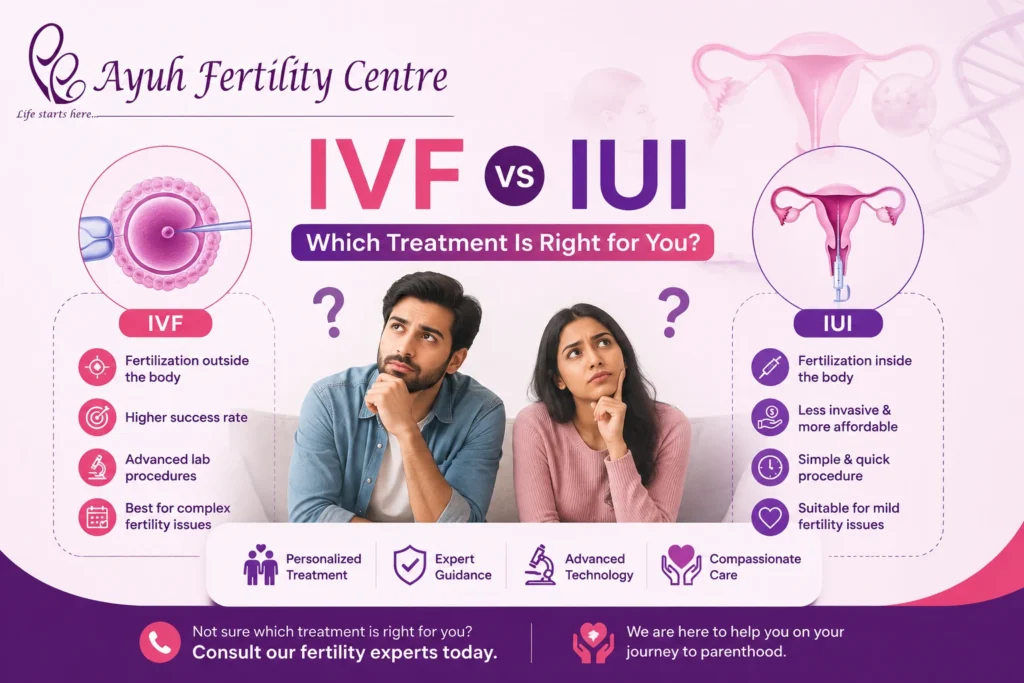
Every couple begins the fertility journey with hope. But somewhere between the first missed period and the third unanswered prayer, hope quietly turns into questions. Hard questions. And one of the most common ones we hear at Ayuh Fertility Centre is this: “Doctor, should we do IUI or IVF?”
If you have been searching for answers around IVF vs IUI Ahmedabad, you are not alone. Thousands of couples across Ahmedabad, Gandhinagar, Kadi, Kalol, Ranip, and nearby areas sit exactly where you are right now — confused, scared, and desperate to make the right decision.
The truth is, there is no universal answer. Every couple is different. Every diagnosis tells a different story. That is precisely why Dr. Krupa Shah takes time with every patient — not to sell a treatment, but to find the right one.
This guide will walk you through everything you need to understand about IUI and IVF — clearly, honestly, and without confusing medical language — so that when you walk into a consultation, you already feel informed and empowered.
About the Author
Dr. Krupa A. Shah MBBS · MS (Obstetrics & Gynaecology) · Infertility Specialist Founder, Ayuh Fertility Centre, Ahmedabad
19+ Years of Experience in reproductive medicine, obstetrics, and gynaecology.
Dr. Krupa Shah completed her MBBS from Baroda Medical College (2006) and her MS in Obstetrics & Gynaecology from B.J. Medical College, Ahmedabad (2010). After 12 years of experience at leading clinics in Chennai — including Apollo Hospital and Iswarya Fertility Centre — she completed an Advanced IVF Fellowship at Ludwig Maximilians University, Munich, Germany, one of Europe’s most prestigious reproductive medicine institutions.
She is a member of the Ahmedabad Obstetrics and Gynaecology Society (AOGS), the Indian Society of Assisted Reproduction (ISAR), and the Federation of Obstetric and Gynaecological Societies of India (FOGSI).
IVF laboratory is ART National Board Certified.
Medically Reviewed By
This article is medically reviewed by Dr. Krupa A. Shah, MD — ensuring accurate, evidence-based, and reliable fertility information for couples seeking guidance on infertility treatment options.
What Is IUI Treatment?
IUI stands for Intrauterine Insemination. It is one of the simpler, less invasive fertility treatments available — often recommended as the first step for couples who have been trying to conceive without success.
Here is how it works in plain language:
The male partner provides a semen sample. In the lab, the best-quality sperm are separated and prepared. Then, using a thin, flexible tube, that prepared sperm is gently placed directly into the woman’s uterus — right around the time she is ovulating. This way, the sperm has a shorter distance to travel and a better chance of meeting the egg naturally.
IUI is typically recommended for:
- Couples with unexplained infertility
- Mild male infertility (low sperm count or motility)
- Women with ovulation issues such as PCOS
- Cervical factor infertility
- Couples where the male partner has difficulty with ejaculation
IUI is often described as a “helping hand” — it does not take over fertilisation. The egg and sperm still have to find each other naturally, just with a shorter journey. Because of this, it is less invasive, less expensive, and requires fewer clinic visits. However, it also has lower success rates per cycle.
Most fertility specialists, including Dr. Krupa Shah, consider IUI a reasonable starting point — especially for younger patients with mild infertility issues and at least one open fallopian tube.
What Is IVF Treatment?
IVF stands for In Vitro Fertilisation — which literally means “fertilisation outside the body.” It is one of the most advanced assisted reproductive technologies (ART) available today.
Unlike IUI where fertilisation still happens inside the body, IVF takes the entire fertilisation process into a controlled laboratory environment. Here is a simplified step-by-step overview:
- Ovarian Stimulation — Hormone injections stimulate the ovaries to produce multiple eggs instead of one.
- Egg Retrieval (OPU) — Mature eggs are collected under light sedation using a needle guided by ultrasound.
- Sperm Collection — A semen sample is collected and prepared. If sperm retrieval from the testes is needed (TESA/PESA), that is done too.
- Fertilisation in the Lab — Eggs and sperm are combined in the ART National Board Certified laboratory. In cases of severe male infertility, a single sperm is injected directly into each egg (this is called ICSI).
- Embryo Culture — Fertilised embryos grow in the lab for 3–5 days under close monitoring.
- Embryo Transfer — The healthiest embryo is placed gently into the uterus using a thin catheter.
- Pregnancy Test — About 14 days later, a blood HCG test confirms whether the embryo has implanted successfully.
The key difference between IVF and IUI is that IVF bypasses the natural fertilisation process entirely. This gives the embryologist full control over fertilisation conditions — which is why IVF tends to have significantly higher success rates per cycle.
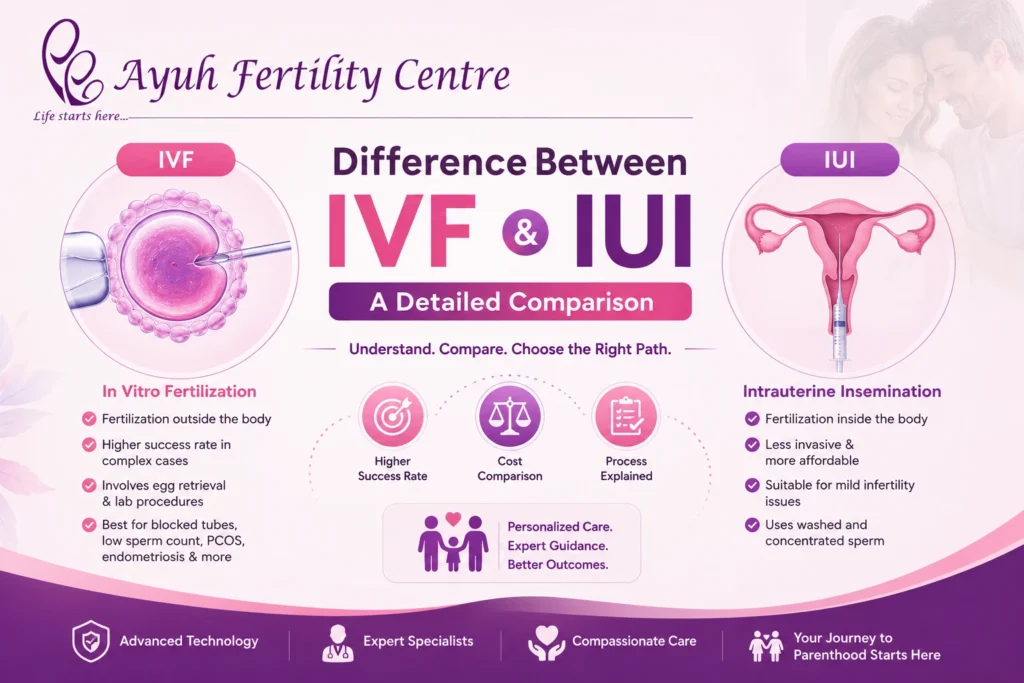
Difference Between IVF and IUI — A Detailed Comparison
Many couples ask: “Is the difference between IVF and IUI just about cost?” Not at all. They are very different procedures with different purposes, processes, and outcomes. Let us break it all down:
| Factor | IUI | IVF |
|---|---|---|
| Full Form | Intrauterine Insemination | In Vitro Fertilisation |
| Where Fertilisation Happens | Inside the woman’s body | Outside the body, in a certified ART lab |
| Invasiveness | Minimal — no egg retrieval | Moderate — egg retrieval under light sedation |
| Medications | Mild tablets or low-dose injections | Multiple hormone injections over 10–14 days |
| Number of Clinic Visits | 3–5 visits per cycle | 8–12 visits per cycle |
| Duration of Treatment | 2–3 weeks per cycle | 4–6 weeks per cycle |
| Suitable For | Mild infertility, PCOS, unexplained infertility | Blocked tubes, severe male infertility, failed IUI, low AMH |
| Success Rate Per Cycle | 10–20% (age and diagnosis dependent) | 40–60%+ (at a certified centre like Ayuh) |
| Cost Per Cycle at Ayuh | ₹6,000 per cycle | ₹1,20,000 – ₹1,40,000 per cycle |
| Emotional Load | Moderate | Higher — more steps, more monitoring |
| Sedation Required | No | Yes — for egg retrieval |
| Requires Open Fallopian Tubes | Yes — at least one tube must be open | No — tubes are bypassed entirely |
| Suitable for Male Factor | Mild cases only | Severe cases — ICSI available |
| Genetic Testing Option | Not available | PGT available before embryo transfer |
| Recovery Time | None — return to normal same day | Rest recommended 24–48 hours post transfer |
Think of IUI as giving the sperm a shortcut. IVF, on the other hand, handles the entire journey in a controlled environment — from egg to embryo — before placing it directly into the uterus. More steps, more control, and significantly higher success rates.
IUI vs IVF Success Rate — What Couples Should Know
The IUI vs IVF success rate is one of the most important comparisons couples want to understand. Here is what the data generally shows:
IUI success rates per cycle:
- Women under 35: approximately 15–20%
- Women aged 35–40: approximately 10–15%
- Women over 40: approximately 5–10%
IVF success rates per cycle (at Ayuh Fertility Centre):
- Women under 35: approximately 50–60%
- Women aged 35–40: approximately 35–45%
- Women over 40: approximately 20–30%
These are general ranges. Success depends on many individual factors including ovarian reserve, embryo quality, uterine health, sperm parameters, and the expertise of the fertility team.
For PCOS patients: IUI can be reasonably effective if the main issue is ovulation. But if ovulation induction alone does not work, IVF with a tailored antagonist protocol gives better results with controlled stimulation.
For male infertility cases: Mild sperm issues respond to IUI. But low sperm count, poor motility, or zero sperm count (azoospermia) requires ICSI within an IVF cycle — something IUI cannot offer.
For low AMH (low ovarian reserve): IUI is rarely effective when AMH is critically low. IVF with a personalised protocol at Ayuh gives a much better chance of collecting enough quality eggs.
No treatment — not even IVF — guarantees pregnancy. What IVF does is give your body the best possible conditions to succeed, cycle after cycle.
When to Choose IVF Over IUI
Understanding when to choose IVF over IUI can save couples both time and heartbreak. Here are the clinical situations where IVF becomes the clearly appropriate treatment:
1. Blocked or Damaged Fallopian Tubes IUI cannot work if the tubes are blocked — sperm cannot reach the egg. IVF completely bypasses the fallopian tubes, making tube status irrelevant to success.
2. Severe Male Infertility Very low sperm count, zero motility, or azoospermia requires ICSI — a procedure performed only within an IVF cycle at a certified ART lab.
3. Advanced Maternal Age (Above 37–38) Egg quality and quantity decline with age. IVF with an optimised stimulation protocol maximises the number of quality eggs collected in each cycle.
4. Endometriosis Moderate to severe endometriosis affects egg quality, tube function, and implantation conditions. IVF offers significantly better outcomes in such cases.
5. Low Ovarian Reserve (Low AMH) If AMH levels are very low, stimulating the ovaries mildly for IUI may not produce results. IVF with a tailored mini or full stimulation protocol can still retrieve usable eggs.
6. Multiple Failed IUI Cycles After 3–4 failed IUI attempts, the body’s response to the treatment has already been tested. Continuing IUI beyond this point is often not the most productive use of time or money.
7. Genetic Concerns If there is a family history of genetic disorders, IVF allows Pre-Implantation Genetic Testing (PGT) — identifying chromosomally healthy embryos before transfer.
IUI Failure — When Should You Switch to IVF?
This is one of the hardest conversations in a fertility clinic — and also one of the most important.
How many IUI attempts are reasonable?
Most fertility specialists recommend 3–4 IUI cycles before reconsidering the approach. Beyond that, continuing IUI without results is not just emotionally draining — it can also delay your IVF window, especially as age increases and ovarian reserve gradually declines.
Signs it may be time for the IUI failure to IVF transition:
- Three or more failed IUI cycles despite good follicle development
- Partner’s sperm parameters are declining over serial semen analyses
- AMH levels are low or dropping on repeat testing
- Age is 35 or above and time is a clinical factor
- A new finding — like a blocked tube or endometriosis — discovered during workup
- Emotional exhaustion from repeated cycles without results
Switching from IUI failure to IVF is not a defeat. It is wisdom. It means recognising that your body needs a more targeted clinical approach — and choosing to act on that knowledge before it is too late.
At Ayuh Fertility Centre, couples who come after multiple IUI failures are evaluated completely afresh. Sometimes new findings change the entire treatment plan. That fresh perspective — guided by 19+ years of experience — often makes all the difference.
IVF vs IUI Cost Difference in Ahmedabad
Cost is a real and valid concern. Here is the honest picture, based on actual pricing at Ayuh Fertility Centre:
| Treatment | Cost at Ayuh Fertility Centre | What Is Included |
|---|---|---|
| IUI | ₹6,000 per cycle | Pre-IUI workup, semen analysis, follicle monitoring, sperm washing, insemination, post-procedure consultation |
| Standard IVF | ₹1,20,000 – ₹1,40,000 per cycle | Stimulation monitoring, egg retrieval (OPU), lab fertilisation, embryo culture, embryo transfer, post-ET luteal support |
| ICSI (for male infertility) | ₹1,00,000 – ₹1,70,000 per cycle | Everything in IVF + single sperm microinjection, fertilisation rate monitoring, embryologist consultation |
| Mini IVF | ₹80,000 – ₹1,10,000 per cycle | Lower-dose stimulation, gentler on the body, suitable for good ovarian reserve patients |
| Frozen Embryo Transfer (FET) | ₹25,000 – ₹50,000 | Transfer of previously frozen embryo in a subsequent cycle |
Note: Fertility medication costs vary by protocol and are separate. Dr. Krupa Shah provides a personalised medication estimate at your first consultation based on your AMH and antral follicle count. All pricing at Ayuh is 100% transparent — no hidden charges, no surprise bills.
The real cost question is not “which treatment is cheaper per cycle?” — it is “which treatment is most likely to work for me, given my diagnosis?”
If a couple completes 4 IUI cycles at ₹6,000 each (₹24,000 total) and then needs IVF anyway, the cumulative spend is considerably higher than starting IVF earlier would have been. Dr. Krupa Shah helps every couple understand this upfront — honestly and without pressure.
Flexible EMI and payment plans are available at Ayuh Fertility Centre so that financial concerns never stand between you and the right treatment.
Which Fertility Treatment Is Right for You? The Scientific Reasoning
This is the question every couple deserves a clear answer to. And the honest answer involves both science and individual biology.
Here is how fertility specialists scientifically determine the right treatment:
1. Ovarian Reserve Testing
Your AMH (Anti-Müllerian Hormone) level and Antral Follicle Count (AFC) on ultrasound tell the doctor how many eggs your ovaries have in reserve. If AMH is very low, IUI is unlikely to generate a strong enough response. IVF with a tailored protocol gives a better opportunity to retrieve quality eggs while the reserve still exists.
2. Tubal Patency Assessment
A hysterosalpingography (HSG) or laparoscopy confirms whether your fallopian tubes are open. If both tubes are blocked or damaged, IUI has zero scientific basis — the sperm literally cannot reach the egg. IVF is the only viable option.
3. Semen Analysis Parameters
The WHO 2021 reference values classify sperm by concentration, motility (progressive movement), and morphology. If total motile sperm count (TMSC) is above 5–10 million, IUI is scientifically reasonable. Below that threshold, ICSI within an IVF cycle gives statistically superior fertilisation rates.
4. Age-Related Egg Quality
After the age of 35, chromosomal errors in eggs increase significantly. This is known as aneuploidy. IVF allows the embryologist to culture embryos to Day 5 (blastocyst stage) — where chromosomally abnormal embryos often self-arrest naturally. This built-in selection process does not exist in IUI.
5. Endometrial Receptivity
In IVF, the timing of embryo transfer can be optimised using ERA (Endometrial Receptivity Analysis) tests if needed. Implantation can be timed to the exact window of receptivity. IUI does not allow this level of precision.
6. Diagnosis-Specific Evidence
Published clinical data consistently shows that for moderate-to-severe endometriosis, blocked tubes, severe male factor, or low ovarian reserve, IVF delivers significantly higher cumulative pregnancy rates over 2–3 cycles compared to the same number of IUI attempts. For unexplained infertility in women under 35 with good ovarian reserve, the evidence supports starting with IUI — it is medically justified as a first-line approach.
The takeaway: the right treatment is determined by what your body’s biology — your specific diagnosis, your age, your hormonal profile, and your partner’s sperm data — tells a trained fertility specialist. There is no shortcut to this evaluation. It requires a proper consultation.
Common Myths About IVF and IUI
Let us clear up a few things that cause unnecessary fear or false hope:
Myth 1: IVF always guarantees pregnancy. No fertility treatment guarantees pregnancy. IVF offers significantly better odds per cycle — but every attempt is exactly that: an attempt. Success depends on multiple biological factors including age, embryo quality, and uterine receptivity.
Myth 2: IUI is always cheaper overall. If multiple IUI failures eventually lead to IVF anyway, the cumulative cost of IUI plus IVF is often higher than starting with IVF earlier. Dr. Krupa Shah discusses this clearly at every consultation.
Myth 3: IVF babies are “different” from naturally conceived babies. They are not. IVF babies are born healthy and develop exactly as naturally conceived children do. The only difference is how fertilisation happened — inside a certified ART lab rather than inside the fallopian tube.
Myth 4: Young couples never need IVF. Age is one factor — but not the only one. Blocked tubes, genetic disorders, and severe male infertility can affect couples of any age and may require IVF regardless of how young or healthy the woman appears.
Myth 5: If IUI failed, IVF will fail too. Not true. IUI and IVF work through completely different mechanisms. Many couples who experienced repeated IUI failures achieve successful pregnancies through IVF because the underlying issue — such as poor fertilisation — is only resolvable in the controlled environment of a certified embryology lab.
FAQs
1. Which is more successful — IVF or IUI?
IVF has significantly higher success rates per cycle compared to IUI. At Ayuh Fertility Centre, IVF success rates reach 90%+ per cycle under Dr. Krupa Shah’s personalised protocols, while IUI success rates typically range from 10–20% per attempt. However, IUI may be entirely appropriate for couples with mild infertility — which is why a thorough evaluation before choosing any treatment is essential. The most successful treatment is always the one that matches your specific diagnosis.
2. How many IUI attempts should I try before switching to IVF?
Most fertility specialists, including Dr. Krupa Shah, recommend 3–4 IUI cycles as a reasonable attempt before reconsidering the approach. Delaying the switch to IVF beyond this — especially after age 35 — can reduce your overall chances, as ovarian reserve and egg quality decline over time. Every failed IUI cycle is also an opportunity to re-evaluate the diagnosis and identify whether a different approach would be more effective.
3. Is IVF painful?
IVF is not as painful as many people fear. The daily hormone injections cause mild discomfort at the injection site. The egg retrieval (OPU) procedure is performed under light sedation, so you are not awake or in pain during it. Some women experience mild bloating or cramping after egg retrieval — similar to period pain. Overall, most patients find the process manageable, and Dr. Krupa Shah’s all-female care team at Ayuh supports you through every step.
4. Is IVF a better option for women with PCOS?
It depends on the severity. Many women with PCOS respond well to ovulation induction and IUI. However, if IUI does not produce results, IVF with a tailored antagonist protocol is scientifically better — it allows controlled stimulation, precise trigger timing, and a freeze-all strategy to prevent Ovarian Hyperstimulation Syndrome (OHSS). Dr. Krupa Shah specialises in PCOS management and evaluates each case individually before making this recommendation.
5. Can I get pregnant naturally after failed IUI cycles?
Yes, it is possible — particularly if the cause of infertility is mild or unexplained. Some couples do achieve natural conception after stopping treatment, possibly because reduced stress and lifestyle changes play a role. However, if there is a structural cause like blocked tubes or a significant sperm issue, natural conception remains unlikely without medical intervention. After failed IUI cycles, a thorough re-evaluation often reveals new clinical information that changes the treatment direction entirely.
Conclusion
Deciding between IVF and IUI is not just a medical decision — it is an emotional one. It involves your time, your hope, your finances, and the dream you have been carrying quietly inside you.
There is no shame in needing help. There is no weakness in asking the right questions. And there is no one “correct” path that works for every couple facing an IVF vs IUI decision in Ahmedabad.
What matters most is getting the right answer from the right doctor — one who takes the time to look at your unique biology, not just your test reports.
Dr. Krupa A. Shah has walked this journey with over 10,000 couples across Gujarat. Trained at Ludwig Maximilians University in Munich, Germany, and holding an ART National Board Certified laboratory that meets every ICMR and National Board standard — she understands that behind every AMH report and semen analysis is a real human being with real fears and real hopes.
At Ayuh Fertility Centre, no decision is rushed, no patient is pushed into a treatment they do not understand, and no couple leaves a consultation without complete clarity. Whether IUI or IVF is the right next step for you — that is a conversation worth having. One honest conversation can change everything.
👉 Book your consultation with Ayuh Fertility Centre today
👉 Get expert guidance for PCOS and fertility treatment
👉 Start your journey toward a healthy and successful pregnancy
📍 Visit us in Ahmedabad
📞 Call now to schedule your appointment