
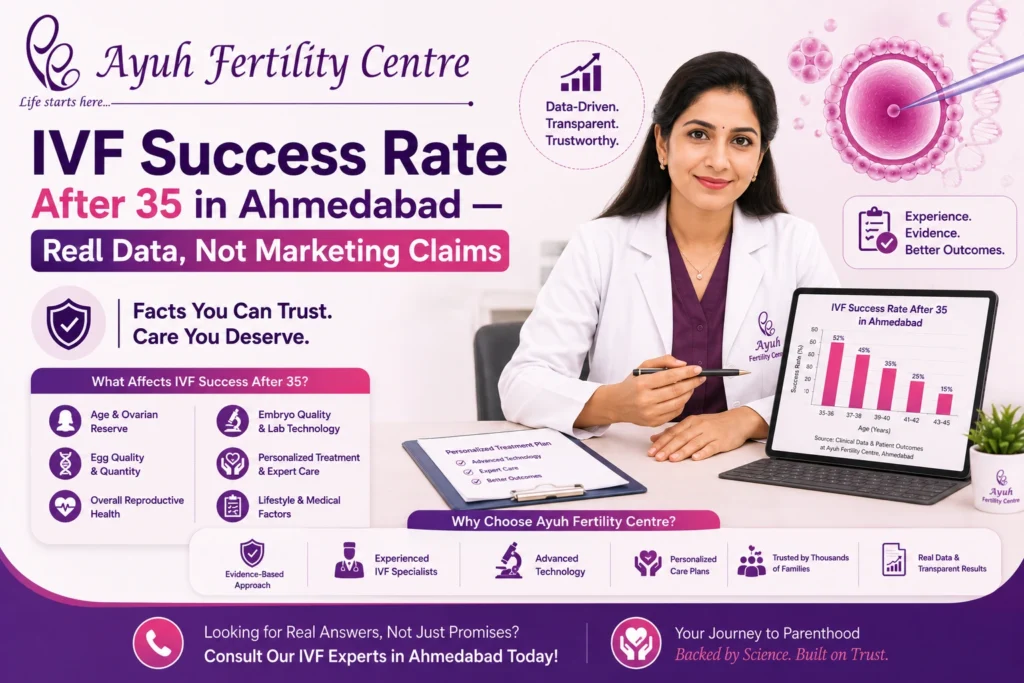
For women searching for the IVF success rate after 35 Ahmedabad, life does not always follow a plan. Many women reach their mid-thirties having focused on their career, their marriage, their health, or simply waiting for the right moment to start a family. And then, when that moment finally arrives, comes a question that no one warned them about: “Is it too late?”
If you have been searching for the IVF success rate after 35 Ahmedabad, chances are you are already carrying a weight that most people around you cannot fully see. The fear of time running out. The grief of months gone by without a positive test. The pressure from family. The confusing information online — some terrifying, some unrealistically hopeful.
You deserve something better than both extremes. You deserve honest, medically accurate information from a doctor who has actually sat with thousands of women in your exact position.
Dr. Krupa A. Shah, founder of Ayuh Fertility Centre in Ahmedabad, has helped women above 35 — and even above 40 — achieve successful pregnancies. Not by making promises. But by understanding each woman’s biology deeply and designing a treatment plan that gives her the best real chance.
This blog gives you the real picture. Not marketing. Not fear. Just facts, compassion, and clarity.
About the Author
Dr. Krupa A. Shah MBBS · MS (Obstetrics & Gynaecology) · Infertility Specialist Founder, Ayuh Fertility Centre, Nava Vadaj, Ahmedabad
19+ Years of Clinical Experience in reproductive medicine, IVF, IUI, PCOS, high-risk pregnancy, and gynaecological surgery.
Dr. Krupa Shah completed her MBBS from Baroda Medical College (2006) and MS in Obstetrics & Gynaecology from B.J. Medical College, Ahmedabad (2010). She gained 12 years of clinical experience at leading institutions including Apollo Hospital, Chennai and Iswarya Fertility Centre, Chennai, before completing her Advanced IVF Fellowship at Ludwig Maximilians University, Munich, Germany — one of Europe’s most respected reproductive medicine programmes.
She has also trained internationally in the USA and Singapore, bringing a globally informed perspective to every treatment decision.
Her professional memberships include the Ahmedabad Obstetrics and Gynaecology Society (AOGS), the Indian Society of Assisted Reproduction (ISAR), and the Federation of Obstetric and Gynaecological Societies of India (FOGSI).
Ayuh Fertility Centre holds an ART National Board Certified laboratory.
Medically Reviewed By
This article is medically reviewed by Dr. Krupa A. Shah — fertility specialist with 19+ years of experience — ensuring accurate, evidence-based, and compassionate fertility information for women above 35.
Does IVF Success Rate After 35 in Ahmedabad Drop Because Fertility Declines?
Yes — and being honest about this is the most respectful thing a fertility doctor can do.
Fertility after 35 does decline, but the story is more nuanced than most people realise. It is not a cliff. It is a gradual slope. And understanding what actually changes helps you make smarter decisions.
Here is what happens biologically:
Egg Quantity Declines Women are born with all the eggs they will ever have — approximately 1–2 million at birth. By the time a woman reaches 35, that number has naturally fallen to around 25,000–30,000. By 40, it may be just a few thousand. This is measured by AMH (Anti-Müllerian Hormone) and antral follicle count (AFC) on ultrasound.
Egg Quality Declines This is actually the more important issue in IVF. As women age, the chromosomal integrity of eggs decreases. By age 35, approximately 30–40% of eggs may have chromosomal abnormalities (aneuploidy). By age 40, that figure rises to 50–60% or more. These abnormal eggs either fail to fertilise, fail to develop into healthy embryos, or result in early miscarriage.
Hormonal Changes FSH (Follicle Stimulating Hormone) typically rises as ovarian reserve declines. Higher FSH levels mean the brain is working harder to stimulate the ovaries — a sign that they are responding less efficiently. AMH levels fall. This affects how the ovaries respond to stimulation during IVF.
Uterine Changes The uterine lining can also become less receptive with age. Conditions like fibroids, polyps, or thin endometrium become more common after 35, and these can affect implantation.
The Key Difference Between Natural Conception and IVF After 35
Natural conception relies on one egg each month — and that egg must be chromosomally normal. After 35, the odds of any single egg being normal are lower. IVF, however, collects multiple eggs in one cycle, allows them to be fertilised and developed in a certified lab, and gives the embryologist the ability to select the best-quality embryo for transfer. This is why IVF often gives women above 35 a meaningfully better chance than waiting for natural conception.
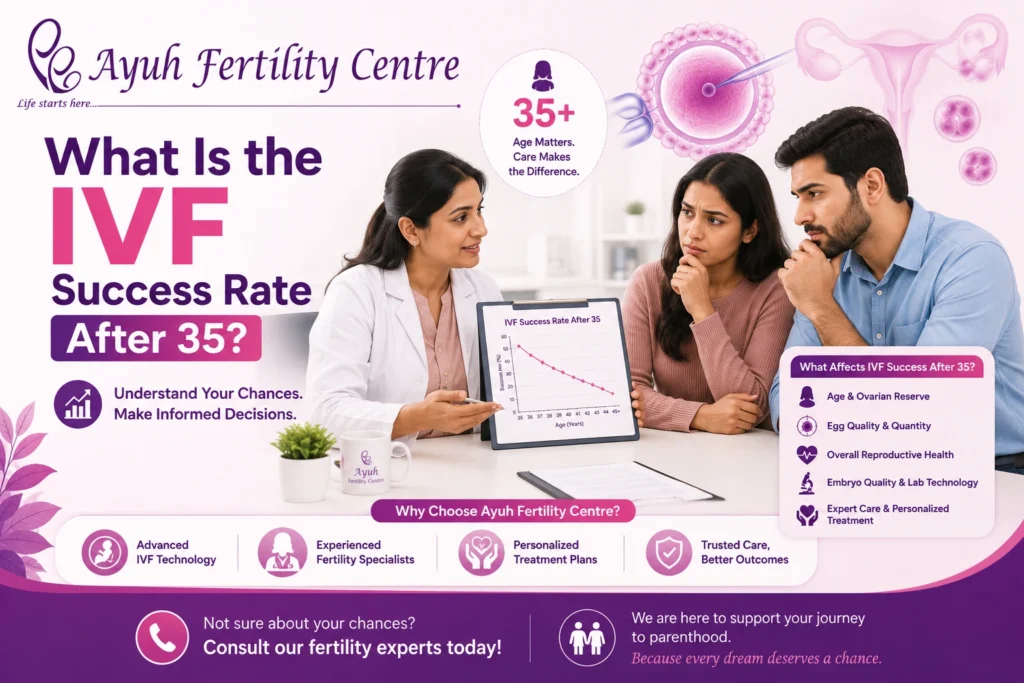
What Is the IVF Success Rate After 35?
This is the question everyone wants answered — and where most clinics either scare you or oversell you. Neither is helpful.
The IVF success rate after 35 Ahmedabad depends on several factors that vary between every woman and every cycle. There is no single universal number.
At a well-equipped, experienced centre like Ayuh Fertility Centre, women between 35 and 38 can realistically expect IVF success rates of 35–50% per cycle using their own eggs, with careful protocol design. Women above 38 may see rates of 20–35% per cycle. These are honest, clinically grounded figures — not inflated marketing claims.
Why do success rates vary so much?
- Ovarian reserve — AMH and AFC results directly influence how many eggs can be collected
- Embryo quality — the number of chromosomally normal, high-grade embryos developed
- Uterine receptivity — whether the endometrium is prepared to receive the embryo
- Sperm quality — male factor is responsible for 40–50% of infertility cases and affects fertilisation
- Protocol design — an experienced specialist like Dr. Krupa Shah tailors each stimulation protocol individually, which significantly affects outcomes
- Lab quality — an ART National Board Certified lab with strict environmental controls gives embryos the best possible conditions to develop
What a number on a webpage cannot tell you is what your success rate is. That requires a full fertility evaluation — AMH, AFC, hormonal panel, uterine assessment, and semen analysis — and a conversation with a doctor who has actually seen your reports.
IVF Success Rate by Age — A Realistic Breakdown
Understanding the IVF success rate by age helps women plan with clarity rather than anxiety. Here is what the data generally shows:
Age 35–37
This is often considered the “sweet spot” for women who have delayed fertility treatment. Ovarian reserve is usually still reasonable, egg quality — while declining — is often still workable, and the uterus typically has good receptivity.
- Average IVF success per cycle (own eggs): 40–55%
- Most women in this range respond well to stimulation
- Blastocyst-stage transfer (Day 5) is often possible, improving implantation rates
- Miscarriage risk is around 15–20% per clinical pregnancy
Key consideration: Do not wait too long once you know you want to conceive. Between 35 and 37, each passing year matters.
Age 38–40
Success rates begin to decline more noticeably in this range. Egg quality is the primary concern. Fewer eggs may be retrieved, and a smaller proportion may develop into high-quality blastocysts.
- Average IVF success per cycle (own eggs): 25–40%
- Multiple cycles may be needed to achieve a successful pregnancy
- Pre-Implantation Genetic Testing (PGT) can help identify chromosomally normal embryos, reducing miscarriage risk
- Miscarriage risk rises to approximately 25–30%
Key consideration: Personalised stimulation protocols — like those designed by Dr. Krupa Shah — become even more critical at this stage. A protocol that worked for another patient at a different clinic may not be optimal for you.
Age 40 and Above
This is where realistic expectations become especially important — and where compassionate honesty from your doctor matters most.
- Average IVF success per cycle (own eggs): 15–25%
- Egg quality issues are significant; many embryos may not progress to blastocyst
- Higher miscarriage rates — approximately 35–45% of clinical pregnancies
- Multiple cycles are often required
- PGT strongly recommended to select chromosomally normal embryos
Many women above 40 do achieve successful pregnancies with their own eggs at Ayuh Fertility Centre. It requires patience, a skilled specialist, and the right protocol. But it is possible — and it happens.
IVF with Donor Eggs (Any Age)
When ovarian reserve is severely depleted or egg quality is consistently poor after multiple cycles, donor egg IVF offers a significantly higher chance of success.
- Average IVF success with donor eggs: 50–65% per cycle, regardless of the recipient’s age
- Donor eggs come from young, screened women with good ovarian reserve
- All donors at Ayuh Fertility Centre are screened under strict ICMR guidelines
- This option allows women above 42–45 to carry and deliver their own pregnancy
Choosing donor egg IVF is a deeply personal decision. Dr. Krupa Shah provides complete counselling — emotionally and medically — before discussing this option with any patient.
IVF Over 35 Chances — What Genuinely Improves Success?
While age and ovarian reserve are factors you cannot change, there are several things that genuinely improve your IVF over 35 chances:
1. Healthy BMI Obesity and underweight both affect hormonal balance, ovarian response, and implantation. Achieving a BMI of 18.5–24.9 before starting IVF can meaningfully improve outcomes.
2. Quitting Smoking Completely Smoking directly damages egg DNA and reduces ovarian reserve. Studies show smokers need up to twice as many IVF cycles as non-smokers. This is one of the most impactful changes a woman can make.
3. Optimising Male Partner’s Sperm Sperm quality affects fertilisation rates and embryo development regardless of the woman’s age. A thorough semen analysis and, if needed, antioxidant supplements or lifestyle changes can significantly improve embryo quality.
4. Choosing an Experienced Fertility Specialist Protocol design is not formulaic — it requires interpreting your specific hormonal profile and adjusting in real time. Dr. Krupa Shah’s 19+ years of experience, combined with international training from Germany, USA, and Singapore, means your protocol is designed for you, not for an average patient.
5. ART National Board Certified Lab Quality Embryo quality depends heavily on the laboratory environment. Temperature, air quality, culture media, and incubator stability directly affect how embryos develop. Ayuh Fertility Centre’s ART National Board Certified, ICMR-compliant lab maintains the highest standards for embryo care.
6. Timing — Not Delaying Further This is perhaps the single most important factor. Every six months after 35 represents a measurable decline in ovarian reserve. If you are considering IVF, the best time to begin a proper evaluation is now — not after another year of trying naturally.
7. Emotional Wellbeing Chronic stress elevates cortisol, which can disrupt the hormonal environment needed for successful stimulation and implantation. Having proper emotional support, counselling, and a caring clinical team genuinely matters — not just emotionally, but physiologically.
Why Marketing Claims Around IVF Success Can Be Misleading
It is important to address something that many fertility clinics in India avoid discussing openly.
“Pregnancy rate” is not the same as “live birth rate.”
A clinic may claim a 70% success rate — but that figure might refer to the rate of a positive blood HCG test (biochemical pregnancy), not to actual clinical pregnancies confirmed by heartbeat, and certainly not to babies taken home.
Here is the hierarchy of outcomes:
- Biochemical pregnancy — a positive blood test at 14 days (can miscarry very early)
- Clinical pregnancy — confirmed heartbeat on ultrasound at 6–7 weeks
- Ongoing pregnancy — pregnancy continuing past 12 weeks
- Live birth rate — a healthy baby delivered at term
The number that actually matters to you is the live birth rate per cycle — broken down by your age group. Any clinic that cannot or will not give you age-specific live birth data is not giving you a complete picture.
At Ayuh Fertility Centre, Dr. Krupa Shah believes in transparent, age-specific reporting. She sets realistic expectations at your first consultation — because informed couples make better decisions, experience less emotional trauma from unexpected failure, and ultimately achieve better outcomes when they proceed with clear eyes.
Common Fertility Challenges After 35
Women above 35 face a specific set of challenges that a good fertility specialist evaluates carefully before designing any treatment plan:
Low AMH (Low Ovarian Reserve) AMH below 1.0 ng/mL indicates diminished ovarian reserve. It does not mean IVF is impossible — but it does mean stimulation needs to be carefully designed to maximise whatever reserve remains.
Poor Egg Quality Even with adequate numbers, egg quality — especially chromosomal integrity — declines with age. This is why blastocyst culture and PGT become more valuable after 35.
PCOS in Women Over 35 While PCOS is associated with excess eggs, the quality of those eggs can still be affected by age. Additionally, PCOS in older women is often accompanied by insulin resistance, which affects both stimulation and endometrial receptivity.
Endometriosis Endometriosis is progressive — it worsens over time if not treated. Women who had mild endometriosis at 28 may have moderate-to-severe disease by 36, significantly affecting egg quality and implantation.
Uterine Fibroids and Polyps These become more common after 35. Submucosal fibroids and endometrial polyps can directly interfere with implantation. Dr. Krupa Shah performs hysteroscopic assessment and, where needed, operative hysteroscopy before IVF to ensure the uterine cavity is clear.
Male Infertility Factors Male partners above 40 also experience declining sperm DNA integrity (DNA fragmentation), which can affect fertilisation and embryo quality — even if the basic semen analysis appears normal.
Recurrent IVF Failure Some women above 35 come to Ayuh Fertility Centre after failed IVF cycles at other clinics. Dr. Krupa Shah’s root-cause approach — reviewing all previous reports, identifying protocol gaps, and investigating implantation failure — has helped many of these women achieve successful pregnancies on a revised protocol.
Can Women Above 35 Still Have Successful IVF Pregnancies?
Yes. Absolutely yes.
IVF success after 35 is not just possible — it is happening every day at fertility centres across India and the world. The key is not your age alone. It is the combination of your individual biology, your specialist’s experience, your laboratory’s quality, and the timing of your decision.
What separates women who succeed from those who do not is not always biology. Very often it is:
- Choosing the right specialist with genuine experience in older patients
- Starting treatment before ovarian reserve declines further
- Getting a complete and honest evaluation — not a rushed protocol
- Having a doctor who adjusts the plan when needed, not one who repeats the same cycle hoping for a different result
Many women at Ayuh Fertility Centre — including those who came after 2–3 failed cycles elsewhere — have gone on to have healthy babies. Some in their late 30s. Some at 41 or 42. With their own eggs. And some, when it was the right clinical choice, with donor eggs.
The journey is different for every woman. What remains constant is the commitment to honest, personalised, evidence-based care.
When Should You See a Fertility Specialist After 35?
The general guideline for women under 35 is to seek a fertility evaluation after 12 months of trying without success. But for women above 35, the rule changes — and for good reason.
If you are above 35, see a fertility specialist after just 6 months of trying without success.
You should not wait even 6 months if any of the following apply:
- Irregular or absent periods (suggesting ovulation problems)
- Known or suspected endometriosis
- History of pelvic infections or surgeries
- Two or more miscarriages
- Previous cancer treatment (chemotherapy or radiation)
- Known low AMH or low ovarian reserve
- Partner with known sperm problems
- Already 38 or above
Time is a real clinical variable after 35. Every consultation postponed is a month of ovarian reserve that cannot be recovered. Seeing a specialist is not giving up on natural conception — it is simply understanding your own biology so you can make an informed choice about how to proceed.
Consultations at Ayuh Fertility Centre with Dr. Krupa Shah are structured to give you exactly this: a clear picture of where you stand, what your options are, and what a realistic plan looks like — without pressure, without drama, and without unnecessary procedures.
The Emotional Impact of Trying to Conceive After 35
This section matters as much as any medical information in this blog.
Trying to conceive after 35 carries a specific kind of emotional weight. It is not just the physical process — it is the social narrative around it. The questions at family gatherings. The friends who conceived easily in their twenties. The well-meaning comments that feel like quiet judgements. The fear that every month that passes is a door closing.
Anxiety and Stress It is almost impossible not to feel anxious when you are watching a biological clock and waiting for a test result at the same time. Anxiety is normal. It does not mean you are not coping. It means you care deeply.
Grief Many women above 35 grieve the younger version of themselves who imagined this would be easier. That grief is real and valid — even when it is invisible to the people around them.
The Pressure of “Running Out of Time” This phrase — however well-intentioned — causes real harm. Time is a factor, yes. But it is not a deadline that passes without warning. Most women above 35 still have options. Many have several. The key is understanding what those options are — from an honest specialist, not from Google.
What Helps At Ayuh Fertility Centre, emotional support is treated as part of clinical care — not an add-on. Dr. Krupa Shah personally takes time with every consultation because she knows that how a patient feels walking out of a consultation room affects everything that follows — her willingness to continue treatment, her ability to handle the process, and ultimately, her outcomes.
If you are carrying this weight, you do not have to carry it alone.
Common Myths About IVF After 35
Myth 1: IVF always fails after 35. False. Women between 35 and 38 often have very good IVF outcomes with their own eggs. Even above 40, success is possible — particularly with experienced specialist guidance and, where appropriate, donor eggs.
Myth 2: Women above 40 cannot conceive. False. Women above 40 conceive naturally and through IVF regularly. Donor egg IVF, in particular, offers success rates of 50–65% per cycle regardless of the recipient’s age.
Myth 3: IVF guarantees pregnancy at any age. False. No treatment guarantees pregnancy. IVF significantly improves the odds — but every cycle is an attempt, not a certainty. Anyone who tells you otherwise is misleading you.
Myth 4: Egg quality does not matter — only quantity. False. Egg quality — particularly chromosomal integrity — is arguably more important than quantity after 35. One healthy, chromosomally normal egg can result in a successful pregnancy. Fifty poor-quality eggs will not.
Myth 5: If you have failed IVF before, it will always fail. False. Many women who experienced failed IVF cycles at other centres succeed at Ayuh Fertility Centre after a fresh root-cause evaluation and revised protocol. A failed cycle is not a prediction — it is information.
FAQs
1. Is IVF successful after 35?
Yes, IVF can be very successful after 35 — though success rates are lower than for younger women and vary significantly based on individual factors. Women aged 35–37 at Ayuh Fertility Centre can expect realistic success rates of 40–55% per cycle using their own eggs under Dr. Krupa Shah’s personalised protocols. The key factors are ovarian reserve (AMH and AFC), embryo quality, uterine health, and sperm parameters. An honest evaluation by an experienced fertility specialist gives you the clearest picture of your individual chances.
2. What are my IVF chances at 38?
At 38, IVF success rates with your own eggs are generally in the range of 25–40% per cycle at a well-equipped centre. This is still a meaningful chance — particularly when the protocol is carefully designed for your specific hormonal profile. Women at 38 often still have usable eggs, though the proportion of chromosomally normal embryos is lower than at 35. PGT (Pre-Implantation Genetic Testing) can help identify the healthiest embryos before transfer, improving both success rates and reducing miscarriage risk.
3. Is IVF risky after 40?
IVF after 40 is generally safe for the mother when managed by an experienced specialist. The main clinical considerations are higher rates of chromosomal abnormalities in embryos (leading to higher miscarriage rates) and a lower number of quality embryos per cycle. Medically, the stimulation process itself carries the same risks at 40 as at 35 — the primary concern is outcomes, not procedure safety. Dr. Krupa Shah provides detailed risk and expectation counselling for all women above 40 before proceeding.
4. How many IVF cycles are usually needed after 35?
This varies considerably by individual. Some women above 35 conceive on their first IVF cycle. Others need 2–3 cycles to achieve a successful pregnancy, particularly if fewer eggs are retrieved per cycle due to lower ovarian reserve. The cumulative success rate over 3 IVF cycles is meaningfully higher than for a single cycle — which is why Dr. Krupa Shah helps couples plan both clinically and financially for a complete treatment course rather than a single attempt.
5. Does AMH level affect IVF success after 35?
Yes, AMH (Anti-Müllerian Hormone) is one of the most important predictors of IVF response after 35. Low AMH means fewer eggs can be retrieved during stimulation, which reduces the number of embryos available for transfer. However, low AMH does not mean IVF is impossible. At Ayuh Fertility Centre, Dr. Krupa Shah designs specific stimulation protocols for women with low AMH — including mini-IVF and modified antagonist protocols — that optimise the quality of eggs retrieved even when quantity is limited. Even one good embryo can lead to a successful pregnancy.
Conclusion
If you are a woman above 35 searching for honest answers about IVF success rate after 35 Ahmedabad, this is what the data and the clinical reality tell us: your age is a factor — but it is not the whole story, and it is certainly not the end of yours.
Biology changes with age. That is true. But medicine has advanced remarkably. And with the right evaluation, the right protocol, and the right specialist, women in their late 30s and early 40s are building the families they always hoped for.
Dr. Krupa A. Shah has spent 19+ years doing exactly this — looking past the fear, past the marketing noise, and past the oversimplified statistics to find what is actually possible for you, specifically. With her Advanced IVF Fellowship from Munich, international training in the USA and Singapore, and an ART National Board Certified, ICMR-compliant laboratory at Ayuh Fertility Centre, she brings the kind of expertise and honesty that this decision deserves.
You do not need false hope. You need real information, real evaluation, and a real plan.
👉 Book your consultation with Ayuh Fertility Centre today
👉 Get expert guidance for PCOS and fertility treatment
👉 Start your journey toward a healthy and successful pregnancy
📍 Visit us in Ahmedabad
📞 Call now to schedule your appointment