
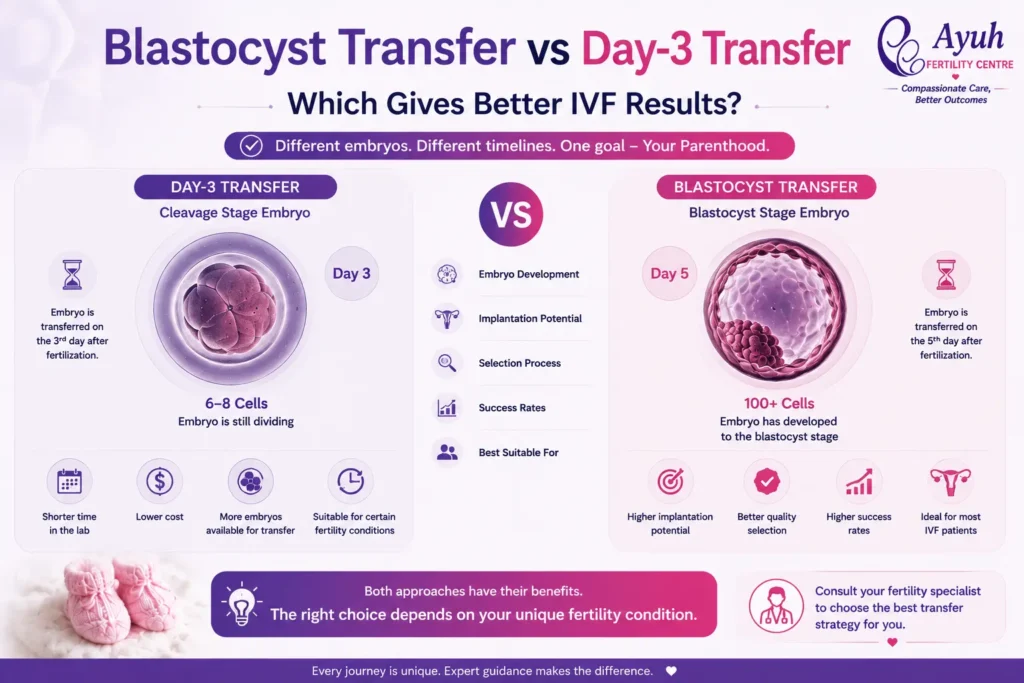
Blastocyst transfer vs Day-3 transfer — it is one of the most common questions couples ask after their embryos start developing in the laboratory. You have been through the stimulation, the egg retrieval, the anxious wait for the fertilisation call. Now your embryos are growing — and your doctor is discussing when to transfer them. Day 3 or Day 5?
For many couples, this question arrives at a moment of already-high anxiety. And without clear explanation, it can feel like one of those clinical decisions being made about you rather than with you.
The truth is that the timing of embryo transfer is one of the most carefully considered decisions in an IVF cycle — and the right answer depends entirely on your specific situation. How many embryos are developing? How well are they growing? What does your history show? What does your embryologist observe?
There is no universal answer. But there is a clear and honest explanation of what each option means, why one might be recommended over the other, and what the current evidence actually shows.
Dr. Krupa A. Shah, founder of Ayuh Fertility Centre in Ahmedabad, makes this decision based on each couple’s embryo development data, clinical history, and individual circumstances — never as a blanket protocol.
This blog gives you the complete, balanced picture.
Author Bio
Dr. Krupa A. Shah MBBS · MS (Obstetrics & Gynaecology) · Infertility Specialist Founder, Ayuh Fertility Centre, Ahmedabad
19+ Years of Experience in reproductive medicine, obstetrics, and gynaecology.
Dr. Krupa Shah completed her MBBS from Baroda Medical College (2006) and her MS in Obstetrics & Gynaecology from B.J. Medical College, Ahmedabad (2010). After 12 years of experience at leading clinics in Chennai — including Apollo Hospital and Iswarya Fertility Centre — she completed an Advanced IVF Fellowship at Ludwig Maximilians University, Munich, Germany, one of Europe’s most prestigious reproductive medicine institutions.
She is a member of the Ahmedabad Obstetrics and Gynaecology Society (AOGS), the Indian Society of Assisted Reproduction (ISAR), and the Federation of Obstetric and Gynaecological Societies of India (FOGSI).
IVF laboratory is ART National Board Certified.
🩺 Medically Reviewed By
This article is medically reviewed by Dr. Krupa M. Shah, ensuring accurate and reliable fertility information.
Understanding Embryo Development in IVF
Before comparing transfer timings, it helps to understand what is actually happening inside the laboratory incubator during those critical first days.
After egg retrieval and fertilisation — either through conventional IVF or ICSI — the embryo begins its development journey in Ayuh’s ART National Board Certified, ISO-certified embryology lab:
Day 1 — Fertilisation Confirmed 16–18 hours after insemination or ICSI, the embryologist checks for successful fertilisation. A normally fertilised egg (2PN stage) shows two pronuclei — one from the egg and one from the sperm — confirming that a unique genetic combination has formed.
Day 2 — First Cell Division The embryo divides into 2–4 cells. The embryologist assesses cell number, symmetry, and fragmentation. A normally developing embryo at this stage typically has 2–4 evenly sized cells with minimal fragmentation.
Day 3 — Cleavage Stage The embryo now has 6–10 cells, with 8 cells being the ideal number at this stage. Day-3 embryo quality is assessed using established grading criteria — cell number, symmetry, and percentage of fragmentation. This is the first key decision point: transfer now, or continue culture?
Day 4 — Morula Stage The embryo compacts into a tight cluster of cells called a morula. This is a transitional stage — the cells are beginning to communicate and differentiate. Morula-stage transfers are very rare.
Day 5/6 — Blastocyst Stage The embryo has now differentiated into two distinct cell populations:
- Inner Cell Mass (ICM) — the cells that will become the baby
- Trophectoderm (TE) — the cells that will form the placenta
A cavity (blastocoel) filled with fluid develops in the centre. This advanced structure — the blastocyst — is what is transferred in a Day-5 or Day-6 embryo transfer.
The embryologist grades blastocysts on three criteria: expansion degree (1–6), ICM quality (A–C), and TE quality (A–C). A 4AA or 5AB blastocyst, for example, is a fully expanded blastocyst with excellent ICM and good trophectoderm.
Importantly: not every fertilised egg reaches blastocyst stage. Approximately 40–60% of Day-3 embryos progress to blastocysts — and in older women or those with egg quality issues, this proportion may be lower.
What Is a Day-3 Embryo Transfer?
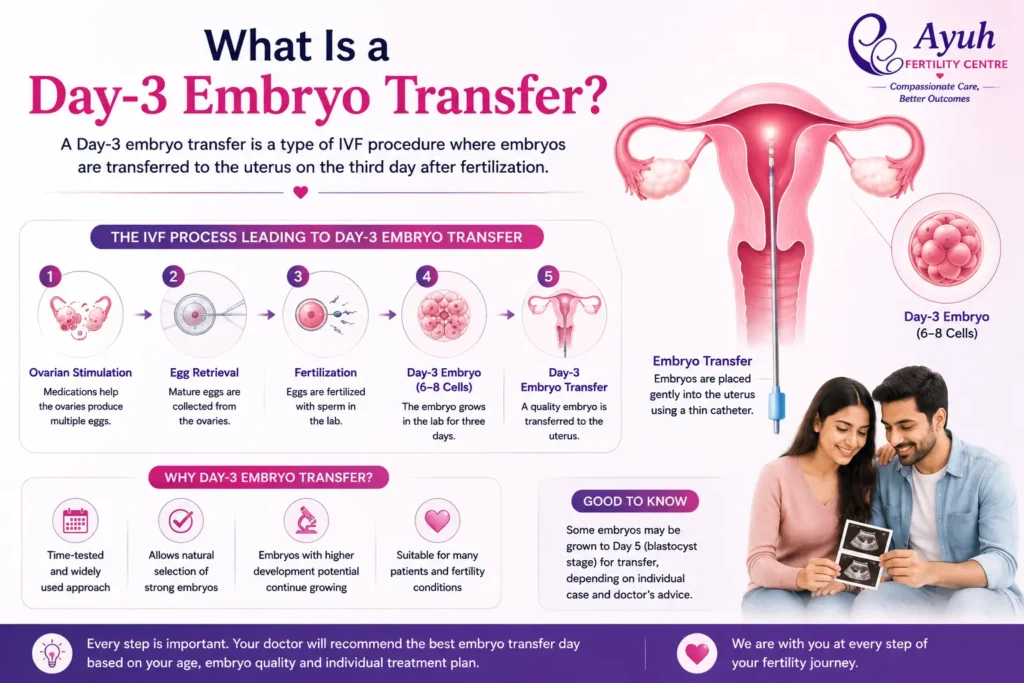
A Day-3 embryo transfer — also called a cleavage-stage transfer — involves placing the embryo into the uterus at the 6–10 cell stage, three days after egg retrieval.
How it works: A thin catheter is used to gently place the embryo — suspended in a small amount of culture media — into the uterine cavity under ultrasound guidance. The procedure takes only a few minutes, requires no anaesthesia, and is generally well-tolerated. The same basic procedure applies to both Day-3 and Day-5 transfers.
Why Day-3 transfer is recommended in certain situations:
- Fewer embryos available — if only 1–3 embryos are developing, waiting until Day 5 risks finding no transferable embryos if they arrest before blastocyst
- Concern about embryo quality — if embryos are showing signs of poor development, earlier transfer returns them to the more physiologically natural uterine environment
- Previous poor blastocyst conversion — if prior cycles showed all embryos arresting before Day 5, Day-3 transfer is preferable
- Laboratory limitations in certain settings
Advantages of Day-3 Transfer:
- Reduces risk of losing all embryos to culture arrest before transfer
- Returns embryos to uterine environment earlier
- Suitable when embryo numbers are low
- Less laboratory time required
Limitations of Day-3 Transfer:
- Less embryo selection information — more embryos have similar morphological grades at Day 3, making it harder to identify the single best one
- Lower per-transfer implantation rates compared to blastocysts in most patient groups
- Higher proportion of chromosomally abnormal embryos may be transferred (since the natural selection that occurs between Day 3 and Day 5 has not yet happened)
What Is a Blastocyst Transfer?
A blastocyst transfer — or Day-5 embryo transfer — involves culturing embryos in the laboratory until they reach the fully developed blastocyst stage before transfer.
The blastocyst is the most advanced pre-implantation embryo stage. It is the stage at which embryos naturally arrive in the uterus after travelling through the fallopian tube for 5 days — so a blastocyst transfer mirrors the natural biological timing more closely than a Day-3 transfer.
Why blastocyst transfer has become increasingly important:
The 5 days of extended culture serve as a natural selection process. Embryos that survive to blastocyst stage have demonstrated:
- The genetic machinery to complete early developmental transitions
- Sufficient mitochondrial energy production to sustain rapid cell division
- Developmental competence that strongly — though not perfectly — correlates with chromosomal normality
Studies on the blastocyst transfer success rate India and globally consistently show higher per-transfer implantation rates for blastocysts compared to cleavage-stage embryos — particularly in women under 38 with multiple good-quality embryos.
The blastocyst structure matters for implantation: The trophectoderm cells — which will form the placenta — are already differentiated at the blastocyst stage. This means that when the embryo is transferred, the very cells responsible for implantation are already present and identifiable, allowing the embryologist to assess not just the embryo itself but its implantation potential more directly.
Lab quality is essential: Growing embryos to Day 5 requires a laboratory with the technical expertise, equipment calibration, culture media quality, and environmental controls to maintain optimal embryo development for the full 5 days. This is why Ayuh Fertility Centre’s ISO-certified, ART National Board Certified embryology laboratory is central to blastocyst culture outcomes — the environment in which the embryo spends those 5 days directly affects whether it reaches the blastocyst stage and its quality when it does.
Blastocyst Transfer vs Day-3 Transfer — Key Differences
Here is a clear comparison of both approaches — the foundation of understanding blastocyst transfer vs Day-3 transfer:
| Factor | Day-3 Transfer (Cleavage Stage) | Day-5 Transfer (Blastocyst) |
|---|---|---|
| Embryo Stage | 6–10 cells | 100–200+ cells, differentiated structure |
| Natural Timing | Earlier than natural uterine arrival | Matches natural embryo arrival timing |
| Implantation Potential Per Transfer | Lower on average | Higher on average |
| Embryo Selection Accuracy | Less precise — more similar embryos | More precise — natural selection has occurred |
| Risk of No Transfer | Lower — more embryos available earlier | Higher — some embryos may not reach Day 5 |
| Multiple Pregnancy Risk | Higher if multiple embryos transferred | Lower — single blastocyst transfer is effective |
| Lab Dependency | Less — shorter culture period | More — requires high-quality extended culture |
| Suitable For | Fewer embryos, poor Day-3 development, specific clinical situations | Multiple good embryos, previous IVF failure, single embryo transfer planning |
| Chromosomal Screening (PGT-A) | Less ideal — embryos still differentiating | Ideal — biopsy performed at trophectoderm |
| Frozen Embryo Potential | Surplus Day-3 embryos can be frozen | Surplus blastocysts freeze extremely well with vitrification |
The key insight: Neither is universally superior. The right choice depends on how many embryos you have, how they are developing, your clinical history, and the recommendation of an experienced embryologist and fertility specialist working together.
Blastocyst Transfer Success Rate India — What Current Evidence Suggests
The blastocyst transfer success rate India data aligns broadly with international evidence — with important nuances worth understanding.
What the evidence generally shows:
Per-transfer implantation rates: Studies consistently show that blastocyst transfers have higher per-transfer implantation rates than Day-3 transfers in good-prognosis patients — typically in the range of:
- Blastocyst transfer: 45–60% implantation rate per transfer (in women under 38 at experienced centres)
- Day-3 transfer: 30–40% implantation rate per transfer (same age group)
This difference exists primarily because:
- Blastocysts represent a self-selected group of developmentally competent embryos
- The synchrony between the blastocyst stage and uterine receptivity is more precise
- The trophectoderm is already differentiated, supporting implantation more actively
Where the comparison becomes more complex:
Cumulative success rates matter more than per-transfer rates. If a couple has 4 Day-3 embryos and transfers 2, they have 2 remaining for a frozen cycle. If those same 4 embryos are cultured to Day 5 and only 1 becomes a blastocyst, the couple has 1 higher-quality embryo for transfer and nothing frozen. The per-transfer success rate of the blastocyst may be higher — but the cumulative success rate over multiple attempts may be similar.
Age changes the calculation: In women above 38, the proportion of embryos reaching blastocyst is lower. Extended culture in this group carries a higher risk of finding no transferable embryo — which may make Day-3 transfer the more clinically prudent approach in some cases.
Laboratory quality determines everything: An ISO-certified, highly experienced embryology lab achieves significantly better blastocyst conversion rates than less well-equipped facilities. A blastocyst transfer at an experienced centre like Ayuh is a meaningfully different clinical event than a blastocyst transfer at a centre without these standards.
When Day-3 Transfer May Be Recommended
Dr. Krupa Shah recommends Day-3 transfer in the following clinical situations:
1. Very few embryos available If only 1–2 embryos are fertilising and developing, the risk of finding no transferable embryo after extended culture to Day 5 is real and significant. Transferring on Day 3 ensures the best available embryo reaches the uterus rather than being lost to laboratory arrest.
2. Previous poor blastocyst conversion If a prior IVF cycle showed that all embryos arrested between Day 3 and Day 5, this is a documented pattern — and a Day-3 transfer in the next cycle is the appropriate response.
3. Specific clinical conditions In some cases — including certain uterine conditions, unusual cycle characteristics, or cases where the embryologist identifies development patterns suggesting earlier transfer is optimal — Day 3 is the preferred approach.
4. Patient preference with full information After a complete explanation of the options and their implications for the specific cycle, some patients prefer Day-3 transfer. This is always respected at Ayuh when there is no strong clinical reason to override it.
When Blastocyst Transfer May Be Recommended
The best embryo transfer day IVF Ahmedabad is determined by the embryology team’s assessment of development plus the clinical context. Blastocyst transfer is generally recommended when:
1. Good embryo development with multiple blastocyst-quality embryos If 5 or more embryos are fertilising and developing well by Day 3, extended culture to Day 5 gives the embryologist the best possible information for single embryo selection — identifying the 1 or 2 embryos with the highest real implantation potential.
2. Previous IVF failure despite good-quality Day-3 transfer If prior cycles showed good Day-3 embryos that failed to implant, blastocyst transfer in the next cycle provides natural selection that may identify better-quality embryos for transfer.
3. Single embryo transfer planning Blastocyst stage is the optimal stage for elective single embryo transfer (eSET) — the practice of transferring one embryo at a time to maximise success while minimising multiple pregnancy risk. At Ayuh, Dr. Krupa Shah discusses eSET with every patient where it is clinically appropriate.
4. PGT-A genetic testing PGT-A — chromosomal screening of embryos — is only performed at the blastocyst stage, as the trophectoderm cells required for biopsy are only available at Day 5/6. If genetic testing is indicated, blastocyst culture is essential.
5. Donor egg IVF cycles Donor egg cycles typically produce multiple high-quality embryos with excellent development potential — making blastocyst culture and selection highly appropriate.
Factors That Affect IVF Success More Than Transfer Day
Here is an important clinical truth: the day of transfer is one factor in IVF success — but far from the most important one. Dr. Krupa Shah is clear about this at every consultation.
1. Female Age The single most powerful predictor of IVF success. Egg quality declines with age regardless of whether Day-3 or Day-5 transfer is used. A 28-year-old with two Day-3 embryos may have better outcomes than a 42-year-old with two blastocysts.
2. Egg Quality Determined by age, ovarian reserve (AMH), and the biological environment in which eggs matured (influenced by stimulation protocol, oxidative stress, and lifestyle factors). No transfer timing decision overcomes fundamentally poor egg quality.
3. Sperm Quality and DNA Integrity Sperm quality — including DNA fragmentation not visible on standard semen analysis — directly affects fertilisation rates, embryo development rates, and ultimately which embryos reach blastocyst stage. Male factor evaluation before IVF is always part of Ayuh’s workup.
4. Embryo Quality The intrinsic developmental competence of the embryo — related to chromosomal status, mitochondrial function, and gene expression patterns — is the primary determinant of implantation success. Transfer timing affects selection but cannot improve the quality of the available embryos.
5. Endometrial Receptivity The uterine lining must be adequately prepared to receive the embryo. Endometrial thickness, pattern, and the expression of implantation markers all influence whether an embryo implants successfully — regardless of its quality or transfer timing.
6. Laboratory Quality As emphasised throughout this blog, the quality of the embryology laboratory determines both embryo development rates and the conditions in which embryos are maintained. Ayuh’s ART National Board Certified, ISO-certified lab maintains the highest available standards — because the environment embryos develop in shapes the embryos themselves.
7. Specialist Experience and Protocol Design The stimulation protocol, monitoring approach, trigger timing, and transfer technique all affect outcomes. An experienced specialist like Dr. Krupa Shah integrates all of these factors into a personalised plan — not a standardised template.
Risks and Limitations of Blastocyst Transfer
Blastocyst transfer is not without risk — and honest discussion of these limitations is part of ethical fertility care.
Not all embryos reach blastocyst stage Approximately 40–60% of fertilised embryos in a typical IVF cycle will reach the blastocyst stage. This means that a couple with 3 Day-3 embryos may find that none have developed to blastocyst by Day 5 — resulting in a cancelled cycle. This is the most significant risk of extended culture, and it is one that Dr. Krupa Shah discusses transparently before making the Day-5 recommendation.
Emotional stress of waiting Two additional days of waiting — with daily updates from the embryology team — significantly increases anxiety. Couples should be prepared for this emotionally before choosing extended culture.
Laboratory dependency The outcome of extended culture is heavily dependent on laboratory quality. This is why choosing a centre with an ISO-certified, highly experienced embryology lab — not just any facility offering Day-5 transfer — matters so much.
May miss some viable embryos Occasionally, an embryo that does not reach blastocyst stage in the laboratory might have implanted successfully in the natural uterine environment. This is rare — but it is a known biological phenomenon.
Risks and Limitations of Day-3 Transfer
Less embryo selection information At Day 3, many embryos have similar morphological grades — making it harder to identify the single embryo with the highest real implantation potential. More embryos may need to be transferred to achieve a good success rate, which increases multiple pregnancy risk.
Higher multiple pregnancy risk Transferring 2 Day-3 embryos carries a higher multiple pregnancy risk than transferring 1 blastocyst. Twin and triplet pregnancies carry significantly higher maternal and foetal complication rates — including premature birth, low birth weight, and gestational diabetes.
Lower per-transfer implantation rate in good prognosis patients In women under 38 with multiple good-quality embryos, Day-3 transfer generally has a lower per-transfer implantation rate than blastocyst transfer — because the natural selection process between Day 3 and Day 5 has not yet occurred.
Common Myths About Blastocyst and Day-3 Transfers
Myth 1: Blastocyst transfer always guarantees pregnancy. False. Blastocyst transfer significantly improves per-transfer implantation rates compared to Day-3 transfer in selected patients — but it does not guarantee pregnancy. Uterine receptivity, embryo chromosomal status, and other variables still influence every transfer outcome.
Myth 2: Day-3 transfers never work. False. Day-3 transfers result in successful pregnancies every day at experienced fertility centres worldwide — including at Ayuh Fertility Centre. For couples with fewer embryos or specific clinical circumstances, Day-3 transfer is the most appropriate and often very successful approach.
Myth 3: All embryos should be grown to Day 5. False. Extended culture is appropriate for some couples — not all. For patients with few embryos or a history of poor blastocyst conversion, Day-3 transfer is clinically preferable to risking loss of all embryos in extended culture.
Myth 4: Transferring more embryos means higher success. False. Transferring more embryos — Day-3 or Day-5 — increases multiple pregnancy risk without proportionally improving the chance of a single healthy baby. Single embryo transfer of a high-quality blastocyst achieves excellent success rates while minimising the significant medical risks of multiple pregnancy.
Myth 5: All IVF laboratories produce the same blastocyst conversion rates. False. Blastocyst conversion rates vary enormously between laboratories based on equipment quality, culture media, air quality, temperature stability, and embryologist expertise. The published blastocyst conversion rates at an ART National Board Certified, ISO-certified laboratory like Ayuh’s are meaningfully better than at less-equipped facilities.
Questions to Ask Your Fertility Specialist About Embryo Transfer Timing
Before your transfer day is decided, these are the questions worth asking Dr. Krupa Shah at Ayuh:
- How many embryos are currently developing, and how well are they growing?
- Based on this cycle’s development, why are you recommending Day-3 or Day-5 transfer?
- What is your laboratory’s blastocyst conversion rate for my age group?
- If we wait until Day 5, what is the risk of finding no transferable embryo?
- Is single embryo transfer appropriate for me, or would you transfer two?
- If surplus embryos are frozen, what stage will they be frozen at — and what are the success rates from those frozen embryo transfers?
- Is PGT-A genetic testing indicated for my situation before transfer?
A specialist who answers these questions clearly — and adjusts the recommendation based on your specific cycle data — is demonstrating the kind of individualised, evidence-based care this decision deserves.
FAQs
1. Is blastocyst transfer more successful than Day-3 transfer?
In good-prognosis patients — typically women under 38 with multiple developing embryos — blastocyst transfer consistently shows higher per-transfer implantation rates than Day-3 transfer. This is because the 5-day culture period serves as a natural selection process, identifying embryos with the strongest developmental competence. However, blastocyst transfer is not universally better — for patients with fewer embryos or a history of poor blastocyst conversion, Day-3 transfer may be the safer clinical choice. Dr. Krupa Shah at Ayuh makes this decision based on each couple’s specific embryo development data.
2. What is the blastocyst transfer success rate in India?
At well-equipped, experienced centres like Ayuh Fertility Centre, blastocyst transfer achieves per-transfer implantation rates of approximately 45–60% for women under 38 with good-quality blastocysts. These rates vary significantly based on female age, embryo quality, laboratory standards, and the specialist’s protocol expertise. It is important to ask for age-specific, patient-group-specific data rather than aggregate figures — which can obscure the variation between patient groups. Ayuh’s IVF success rates are available for review at your first consultation.
3. Can Day-3 embryos lead to healthy pregnancies?
Absolutely. Day-3 embryo transfers result in healthy pregnancies and healthy babies regularly — at Ayuh and at fertility centres worldwide. The per-transfer implantation rate may be lower than blastocyst in certain patient groups, but Day-3 transfers are highly appropriate and successful in the right clinical circumstances. Many families at Ayuh Fertility Centre were conceived from Day-3 transfers where blastocyst culture was not clinically indicated. The quality of the embryo and the uterine environment matter more than the transfer day in determining the ultimate outcome.
4. Why do some embryos stop growing before Day 5?
Embryo arrest before reaching blastocyst stage reflects the embryo’s intrinsic developmental competence — primarily related to chromosomal status, mitochondrial energy production, and the quality of the egg and sperm that formed it. An embryo that arrests between Day 3 and Day 5 was almost certainly chromosomally abnormal and would not have resulted in a successful pregnancy even if transferred on Day 3. In this sense, extended culture functions as a natural quality filter — though it can be emotionally difficult when the embryo lost was one a couple had hoped to transfer.
5. Which transfer is best after a failed IVF cycle?
After a failed IVF cycle, the embryo transfer approach for the next cycle depends on what the previous cycle revealed. If Day-3 embryos were transferred and implantation failed despite good morphological grades, blastocyst transfer in the next cycle — combined with possible PGT-A testing — may identify chromosomally normal embryos that the previous cycle selected without this information. If Day-5 culture was attempted and embryos arrested before blastocyst, Day-3 transfer may be the better approach in the next cycle. Dr. Krupa Shah conducts a full post-failure review before making any recommendation.
Conclusion
The question of blastocyst transfer vs Day-3 transfer does not have a single right answer — and any clinic that presents it as a simple choice is oversimplifying a genuinely nuanced clinical decision.
What the evidence does show: blastocyst transfer offers advantages in embryo selection and per-transfer implantation rates for good-prognosis patients with multiple developing embryos. And Day-3 transfer remains the appropriate, successful, and clinically correct choice for couples with fewer embryos, specific development concerns, or documented poor blastocyst conversion in prior cycles.
The goal of embryo transfer timing is not to follow a protocol — it is to give each specific embryo, in each specific cycle, for each specific couple, the best possible chance of becoming a healthy pregnancy.
Dr. Krupa A. Shah makes this decision with precisely that individualist approach — reviewing every developing embryo’s data, every patient’s clinical history, and every cycle’s specific context before recommending Day-3 or Day-5 transfer. Her Advanced IVF Diploma from the International School of Medicine, Kiel–Goettingen–Munich, Germany, her ART National Board Certified and ISO-Certified embryology laboratory, and her 19+ years of clinical experience mean that when she makes this recommendation, it is grounded in both the evidence and your specific embryology report.
An informed conversation about your embryos is the best starting point for this decision.
👉 Book your consultation with Ayuh Fertility Centre today
👉 Get expert guidance for PCOS and fertility treatment
👉 Start your journey toward a healthy and successful pregnancy
📍 Visit us in Ahmedabad
📞 Call now to schedule your appointment