
Quick Answer :
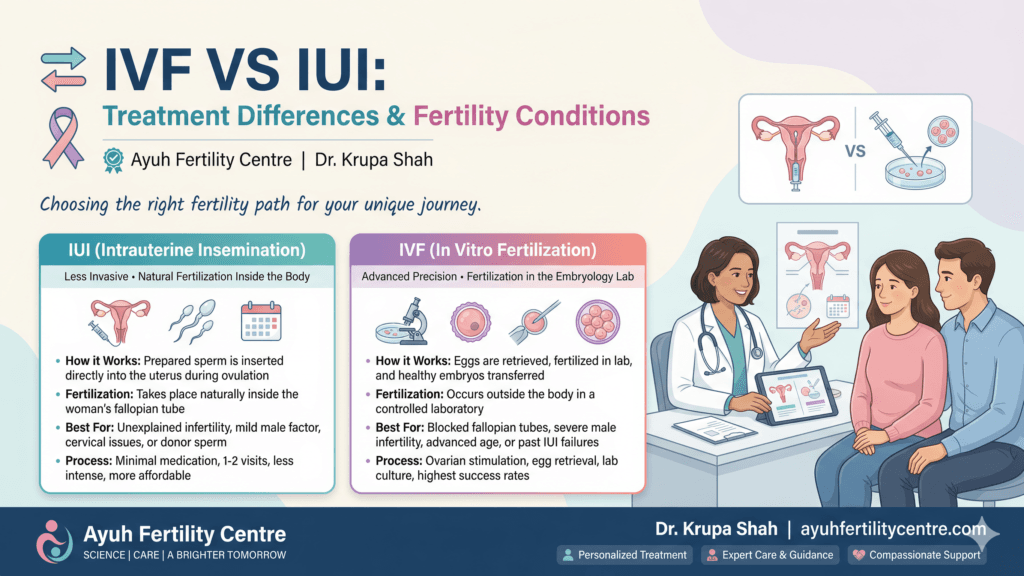
Trying to conceive but unsure whether IVF vs IUI is the right fertility treatment for you? Both Intrauterine Insemination (IUI) and In Vitro Fertilisation (IVF) are commonly used fertility treatments, but they work differently and are suitable for different reproductive conditions.
The choice between IVF and IUI depends on several factors, including the woman’s age, ovarian reserve, fallopian tube health, ovulation patterns, sperm quality and the underlying cause of infertility.
For some couples, IUI (Intrauterine Insemination) may be considered an initial fertility treatment option, while others may require IVF (In Vitro Fertilisation) depending on their fertility condition, medical diagnosis, or previous treatment history. Understanding the key differences between IVF vs IUI, including their procedures and suitability for different fertility conditions, is an important step in exploring the right fertility treatment approach.
Understanding how these treatments work and when doctors consider each option can help couples make informed decisions about their fertility journey.
What Is IUI (Intrauterine Insemination)?
Intrauterine Insemination (IUI) is a fertility treatment in which specially processed sperm are placed directly into the woman’s uterus around the time of ovulation.
The aim is to bring healthy, motile sperm closer to the egg, increasing the opportunity for fertilisation to occur naturally inside the fallopian tube.
How Does IUI Treatment Work?
- Fertility evaluation: The doctor assesses ovulation, uterine health, fallopian tube condition and the male partner’s semen parameters.
- Ovulation monitoring: Ultrasound scans and, when required, medications help monitor or stimulate egg development.
- Sperm preparation: The semen sample is processed in a laboratory to separate motile sperm from seminal fluid and other components.
- Insemination: Prepared sperm are placed inside the uterus using a thin catheter.
- Pregnancy testing: A pregnancy test is usually advised approximately two weeks after the procedure.
IUI is generally a relatively simple procedure and does not involve retrieving eggs or fertilising them outside the body.
What Is IVF (In Vitro Fertilisation)?
In Vitro Fertilisation (IVF) is an assisted reproductive technology in which eggs are collected from the ovaries and fertilised with sperm in a laboratory.
After fertilisation, the resulting embryos are monitored for development. A suitable embryo may then be transferred into the woman’s uterus.
How Does IVF Treatment Work?
- Ovarian stimulation: Hormonal medications stimulate the ovaries to develop multiple follicles.
- Follicle monitoring: Ultrasound scans and hormone tests help doctors monitor follicular development.
- Egg retrieval: Mature eggs are collected from the ovaries through a minor procedure, usually under sedation.
- Fertilisation: Eggs and sperm are combined in a laboratory. Depending on the clinical indication, conventional IVF or Intracytoplasmic Sperm Injection (ICSI) may be used.
- Embryo development: Fertilised eggs are monitored as they develop into embryos.
- Embryo transfer: A suitable embryo is transferred into the uterus.
- Pregnancy testing: A blood test is performed at the recommended time to check for pregnancy.
IVF allows fertilisation to take place outside the body and provides additional options for managing certain fertility conditions.
IVF vs IUI: Understanding the Key Differences
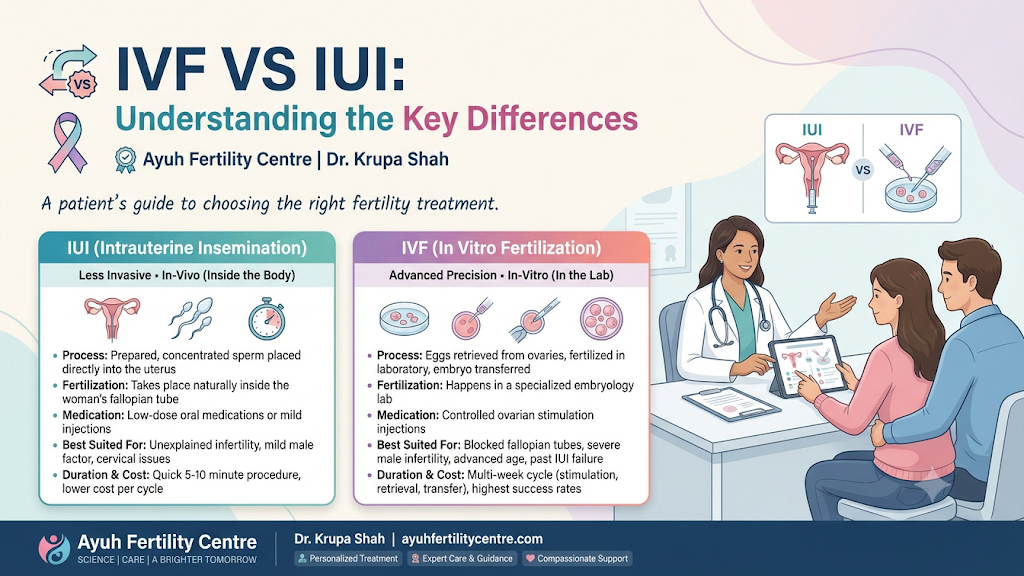
Although both treatments aim to help couples achieve pregnancy, their procedures, laboratory involvement and clinical applications differ.
| Comparison | IUI Treatment | IVF Treatment |
| Full form | Intrauterine Insemination | In Vitro Fertilisation |
| Fertilisation | Inside the body | In a laboratory |
| Egg retrieval | Not required | Required |
| Sperm preparation | Processed sperm placed in uterus | Sperm used for laboratory fertilisation |
| Medication | May or may not be required | Usually required for ovarian stimulation |
| Procedure | Relatively simple | More involved treatment process |
| Fallopian tubes | At least one functional tube is generally needed | Does not require functional fallopian tubes for fertilisation |
| Embryo development | Occurs inside the body | Monitored in the laboratory |
| Treatment planning | Depends on ovulation, tubes and sperm parameters | Depends on ovarian response, egg and sperm factors, and embryo development |
Neither treatment is appropriate for every fertility condition. The decision requires an individual assessment of both partners.
When Is IUI Treatment Considered?
IUI may be considered when certain fertility conditions are present and the basic requirements for the procedure are met.
Mild Male-Factor Infertility
When the male partner has mildly reduced sperm count or motility, IUI may be considered if enough motile sperm are available after laboratory processing. The semen analysis helps doctors understand whether the sperm parameters are suitable for this treatment. In cases of severe male-factor infertility, the doctor may evaluate other assisted reproductive techniques, including IVF with ICSI.
Unexplained Infertility
Unexplained infertility refers to situations where standard fertility investigations do not identify a clear cause of difficulty conceiving. If ovulation is occurring, at least one fallopian tube is functional and semen parameters are suitable, doctors may consider ovarian stimulation combined with IUI. The number of cycles and whether IVF should be considered later depend on factors such as age, infertility duration and previous treatment response.
Ovulation-Related Problems
Some women experience irregular ovulation or do not release eggs regularly. Depending on the underlying hormonal condition, doctors may recommend ovulation induction medications. In selected cases, this treatment may be combined with IUI. Conditions such as PCOS require individual assessment because treatment depends on the woman’s ovulatory status and other fertility factors.
Certain Cervical or Intercourse-Related Difficulties
In selected cases involving cervical factors or difficulties with intercourse, IUI may help by placing prepared sperm directly into the uterus. However, the doctor must first assess whether IUI is clinically appropriate.
When Is IVF Treatment Considered?
IVF may be recommended when the underlying fertility condition requires fertilisation outside the body or when other treatment approaches are unlikely to be suitable.
Blocked Fallopian Tubes
Fallopian tubes play an important role in natural fertilisation and the movement of the early embryo towards the uterus. If both fallopian tubes are severely blocked or damaged, sperm and egg may not be able to meet naturally. Because IUI still depends on fertilisation inside the body, it cannot overcome bilateral tubal blockage. IVF may be considered because eggs are collected from the ovaries and fertilised in the laboratory, bypassing the need for the fallopian tubes.
Severe Male-Factor Infertility
Significantly low sperm count, poor sperm motility or other severe sperm abnormalities can affect the chances of fertilisation. In selected cases, IVF combined with ICSI may be recommended. ICSI involves injecting a single sperm directly into a mature egg under laboratory conditions. This technique may help address certain male-factor fertilisation problems, although its use depends on the clinical indication.
Advanced Maternal Age
Female age is an important factor in fertility because both egg quantity and egg quality generally decline with increasing age. For women in their late 30s and above, doctors may evaluate fertility more promptly and consider whether proceeding directly to IVF is appropriate. The decision depends on ovarian reserve, previous treatment history, infertility duration and other clinical findings.
Endometriosis
Endometriosis can affect fertility through inflammation, pelvic adhesions, ovarian involvement and changes in reproductive anatomy. Treatment depends on the severity of the condition, age, ovarian reserve, tubal health and previous treatments. While some women with endometriosis may be considered for less invasive fertility treatments, IVF may be recommended in certain cases.
Unsuccessful Previous IUI Cycles
When pregnancy does not occur after several appropriately selected IUI cycles, the fertility specialist may reassess the treatment approach. Depending on the couple’s age, diagnosis and previous response, IVF may be considered as the next step. Repeatedly continuing the same treatment without reassessing the underlying condition may not be appropriate for every couple.
IVF vs IUI: What Factors Help Doctors Choose?
There is no single test that determines whether a couple should undergo IVF or IUI. Doctors generally evaluate several factors together.
Female Partner’s Age
Age influences egg quality, ovarian response and reproductive outcomes. It can also affect how long doctors recommend trying less invasive treatment options.
Ovarian Reserve
Tests such as Anti-Müllerian Hormone (AMH), Antral Follicle Count (AFC) and other hormonal investigations may help assess ovarian reserve. These results assist in treatment planning, particularly when considering ovarian stimulation for IVF. However, ovarian reserve tests do not independently predict whether a woman will conceive naturally or guarantee IVF success.
Fallopian Tube Health
Doctors may recommend investigations such as Hysterosalpingography (HSG) to evaluate whether the fallopian tubes are open. At least one functional tube is generally needed for IUI to be a reasonable option.
Sperm Quality
Semen analysis evaluates sperm concentration, total sperm count, sperm motility, sperm morphology and semen volume. The findings help determine whether processed sperm are suitable for IUI or whether IVF with or without ICSI should be considered.
Duration of Infertility
The length of time a couple has been trying to conceive is another important consideration. A couple who has been trying for several years may require a different treatment approach from a couple who has recently started fertility evaluation.
Previous Fertility Treatments
Doctors also review previous ovulation induction cycles, IUI attempts, IVF outcomes, miscarriages and other relevant reproductive history. This information helps determine whether to continue, modify or change the treatment plan.
What Tests Are Required Before IVF or IUI?
A fertility evaluation helps identify the factors affecting conception and guides treatment selection.
| Test | Purpose |
| AMH test | Helps assess ovarian reserve |
| FSH and other hormonal tests | Evaluate reproductive hormone levels when indicated |
| Transvaginal ultrasound | Examines ovaries, uterus and follicular development |
| Antral Follicle Count | Assesses the number of visible small ovarian follicles |
| HSG | Evaluates fallopian tube patency |
| Semen analysis | Assesses sperm count, motility and morphology |
| Thyroid and prolactin tests | Evaluates relevant hormonal conditions when indicated |
Not every patient needs every test. Investigations are selected according to the couple’s symptoms, age and clinical history.
Important: Both partners should undergo fertility evaluation. Male-factor infertility can contribute to difficulty conceiving, so evaluating only the female partner may leave important causes unidentified.
Can a Couple Move From IUI to IVF?
Yes. Some couples begin with IUI and later move to IVF if pregnancy does not occur or if further investigations identify a condition that makes IVF more appropriate.
For example, a couple with unexplained infertility and suitable initial investigations may be considered for a limited course of IUI. If these attempts are unsuccessful, the specialist may recommend IVF after reviewing the treatment response and other fertility factors.
However, couples with certain conditions, such as bilateral tubal blockage or severe male-factor infertility, may be advised to consider IVF without first undergoing multiple IUI cycles.
The transition depends on the medical findings rather than a fixed treatment sequence.
IVF vs IUI: Why Individualised Fertility Treatment Matters
Fertility treatment should be planned according to the specific reproductive challenges faced by each couple. Two couples with the same diagnosis may have different treatment requirements because of differences in age, ovarian reserve, sperm parameters and previous treatment history.
- A woman with regular ovulation and at least one functional fallopian tube may be evaluated for IUI in suitable circumstances.
- A woman with bilateral blocked fallopian tubes may be considered for IVF.
- A couple with severe male-factor infertility may require IVF with ICSI.
- A woman with reduced ovarian reserve may need an individualised treatment plan based on age and other clinical findings.
This is why a fertility specialist’s evaluation is important before deciding on a treatment.
Frequently Asked Questions About IVF vs IUI
What is the main difference between IVF and IUI?
The main difference is where fertilisation takes place. In IUI, prepared sperm are placed inside the uterus, and fertilisation occurs naturally inside the body. In IVF, eggs are collected and fertilised with sperm in a laboratory before an embryo is transferred into the uterus.
Can IUI work if the fallopian tubes are blocked?
IUI generally requires at least one functional fallopian tube because fertilisation takes place inside the body. If both tubes are blocked, IVF may be considered because it bypasses the fallopian tubes.
Is IVF recommended for low sperm count?
IVF, particularly when combined with ICSI, may be considered for severe male-factor infertility. However, treatment depends on the severity of the sperm abnormality and the complete fertility evaluation.
Can PCOS patients undergo IUI or IVF?
Yes. Women with PCOS may be considered for different fertility treatments depending on ovulation, age, ovarian response and other reproductive factors. Ovulation induction may be considered in selected cases, with IUI or IVF depending on the overall diagnosis and treatment response.
How many IUI cycles should a couple try before considering IVF?
There is no universal number for every couple. The decision depends on age, infertility diagnosis, ovarian reserve, sperm quality and previous treatment response. Some couples may be considered for a limited number of IUI cycles, while others may need IVF earlier.
Does IVF guarantee pregnancy?
No. IVF does not guarantee pregnancy. Outcomes depend on several factors, including age, egg and sperm quality, embryo development, uterine health and the underlying fertility condition.
Is IUI a suitable option for unexplained infertility?
IUI combined with ovarian stimulation may be considered for selected couples with unexplained infertility after confirming suitable tubal function, ovulation and semen parameters. The treatment plan depends on age and other clinical factors.
When should a couple consult a fertility specialist?
Couples are generally advised to seek a fertility evaluation after 12 months of regular unprotected intercourse without pregnancy if the woman is under 35, or after six months if she is 35 or older. Earlier evaluation may be appropriate when there are irregular periods, known reproductive conditions, suspected male-factor infertility or other fertility concerns.
Consult a Fertility Specialist in Ahmedabad to Understand Your Treatment Options
Choosing between IVF and IUI starts with understanding the underlying cause of infertility. The right treatment approach depends on your reproductive health, diagnostic findings, age and previous treatment history.
At Ayuh Fertility Centre, Ahmedabad, couples can discuss their fertility concerns, undergo appropriate evaluations and understand the treatment options that may be suitable for their individual conditions.
If you are experiencing difficulty conceiving, consult a fertility specialist to understand whether IUI, IVF or another fertility treatment may be appropriate for your situation.
Take the first step towards understanding your fertility health with a personalised consultation at Ayuh Fertility Centre, Ahmedabad.