
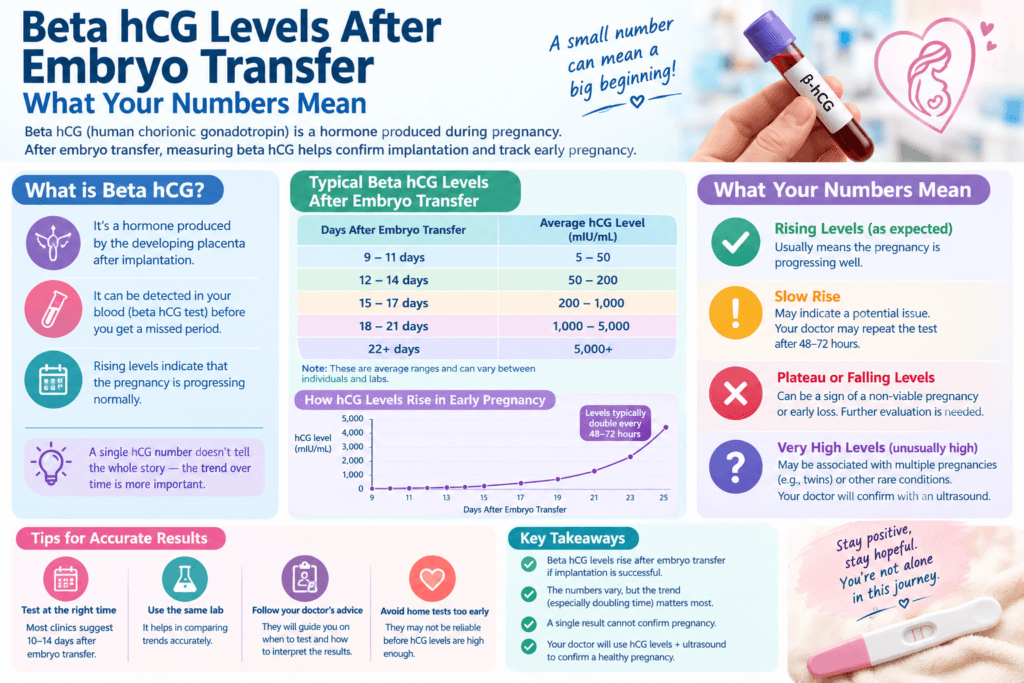
The two weeks after embryo transfer can feel like the longest of your life. Then comes the beta hCG blood test, and with it a number that most people do not know how to read. This guide explains what the beta hCG test measures, what counts as positive, and why the second test matters even more than the first.
What Is Beta hCG?
hCG (human chorionic gonadotropin) is the pregnancy hormone. It is made by cells of the developing placenta soon after the embryo implants in the uterine lining. A “beta hCG” blood test measures the exact amount in your blood, in mIU/mL. It is far more sensitive and accurate than a urine pregnancy kit.
When Should You Take the Test?
Most clinics schedule the blood test about 9 to 12 days after a day-5 (blastocyst) transfer, and about 12 to 14 days after a day-3 transfer. Testing earlier at home can give false hope or false worry, because:
- The hCG trigger injection given before egg collection can stay in the body and cause a false positive.
- Implantation may still be happening, causing a false negative.
How to Read Your Beta hCG Result
| Beta hCG level (mIU/mL) | What it usually means |
|---|---|
| Below 5 | Negative |
| 5 to 25 | Borderline. A repeat test in 48 hours is needed |
| Above 25 | Positive |
| Above 100 on the scheduled test day | A reassuring start in most cases |
These are general guides. Cut-offs vary by lab and by the day of testing, so always discuss your exact number with your doctor.
Why the Second Test Matters: hCG Doubling
One number shows that implantation happened. The trend shows how the pregnancy is progressing. In a healthy early pregnancy, hCG usually doubles every 48 to 72 hours. A rise of at least about 50 to 60% over 48 hours is generally considered acceptable in early pregnancy.
Example: If your first result is 120 mIU/mL, a second result of around 200 to 260 mIU/mL two days later is an encouraging trend.
What If My hCG Is Low or Rising Slowly?
A low first value does not automatically mean a failed pregnancy. Some healthy pregnancies start low and rise well. But low or slowly rising levels can also point to:
- Chemical pregnancy: an early loss soon after implantation
- Ectopic pregnancy: a pregnancy outside the uterus, which needs urgent attention
- Late implantation
Your doctor will usually repeat the test every 48 hours and arrange an ultrasound when the level is high enough to see the pregnancy sac.
What About Twins?
Very high hCG values can suggest twins, but hCG alone cannot confirm it. Only an ultrasound can.
What Happens After a Positive Result?
- Continue all medicines (progesterone, oestrogen) exactly as prescribed. Do not stop them on your own.
- A repeat hCG in 48 hours to confirm a healthy rise.
- A first ultrasound at around 5 to 6 weeks to see the gestational sac in the uterus.
- A second scan at around 6 to 7 weeks to see the heartbeat.
Warning Signs: Call Your Doctor Immediately
- Heavy bleeding with clots
- Severe one-sided abdominal pain
- Shoulder-tip pain or fainting
Support After Transfer at Ayuh Fertility Centre
At Ayuh Fertility Centre in Ranip, Ahmedabad, every patient gets a clear plan for the two-week wait, the beta hCG test date, and follow-up scans. After a positive result, Dr. Krupa Shah continues your care through early pregnancy, including high-risk pregnancy monitoring when needed.
Have questions about your hCG report? Call or WhatsApp +91 94260 28483.
Frequently Asked Questions
What is a good beta hCG level 14 days after transfer?
Most doctors are reassured by a value above 100 mIU/mL on the scheduled day, followed by a good rise.
Can I take a home pregnancy test after embryo transfer?
You can, but it may be inaccurate. The blood test gives a reliable answer.
Is 50 hCG good after embryo transfer?
It is positive. What matters next is whether it rises well over 48 hours.
Can hCG be positive and the pregnancy still fail?
Yes, as in a chemical pregnancy. That is why repeat tests and scans are important.
Does spotting after transfer mean failure?
Not necessarily. Light spotting is common. Tell your doctor, and do not stop medicines.