
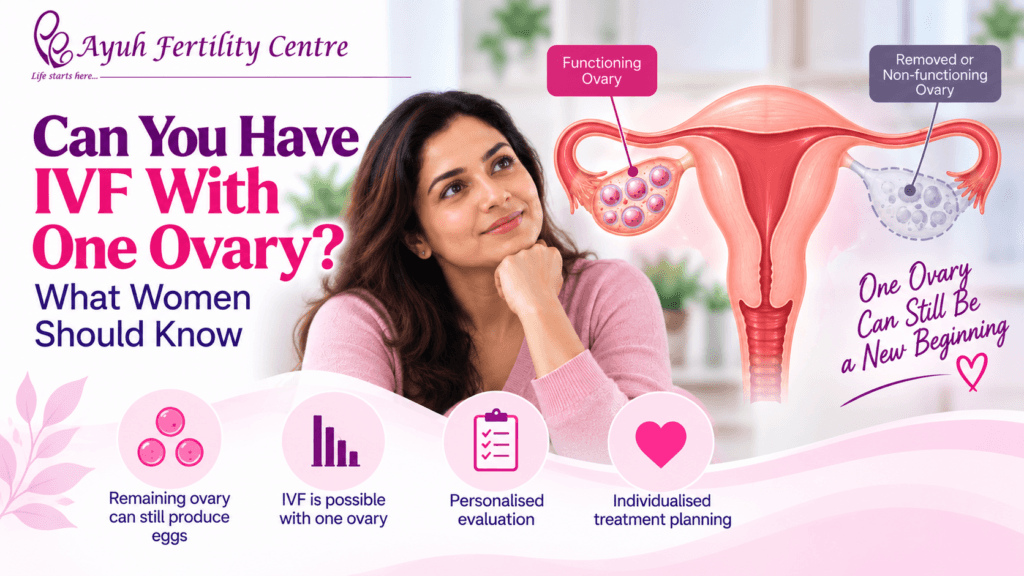
Having one ovary does not automatically mean that IVF is impossible. Many women have one ovary because of previous ovarian surgery, an ovarian cyst, endometriosis, torsion, cancer treatment or another medical condition and later consider fertility treatment.
The important question is not simply “Do I have one ovary?” but rather “How is my remaining ovary functioning, and what does my overall fertility profile look like?”
Women with one ovary may have a different ovarian response during IVF compared with women who have two ovaries. Research has found that women who have had one ovary removed may produce fewer eggs during ovarian stimulation and may require different stimulation management. However, individual outcomes vary considerably.
This is why a personalized fertility assessment is important before starting IVF with one ovary.
Can You Have IVF With One Ovary?
Yes, IVF can be considered for women with one functioning ovary.
The remaining ovary can still contain follicles and release eggs. During IVF, fertility medications stimulate the available follicles so that eggs can potentially be retrieved.
However, having one ovary may reduce the number of follicles available for stimulation compared with having two ovaries. A systematic review and meta-analysis found that women with previous unilateral oophorectomy generally had lower ovarian response and fewer retrieved oocytes during IVF/ICSI treatment.
This does not mean that every woman with one ovary will have the same response.
Your age, ovarian reserve, health of the remaining ovary, previous fertility history and sperm factors all need to be considered.
Why Might a Woman Have Only One Ovary?
There are several reasons why a woman may have one functioning ovary.
Previous Ovarian Surgery
An ovary may have been removed because of:
- Large ovarian cysts
- Recurrent ovarian cysts
- Ovarian torsion
- Severe endometriosis
- Suspicious ovarian masses
- Certain ovarian cancers
- Other surgical conditions
The reason for the surgery can be important when planning fertility treatment.
Congenital Absence
In some cases, a woman may be born with only one functioning ovary.
Previous Fertility or Medical Treatment
Certain medical conditions or treatments may result in the loss of ovarian function on one side.
Regardless of the reason, the remaining ovary should be evaluated before deciding on an IVF treatment plan.
Does One Ovary Mean Low Fertility?
Not necessarily.
Having one ovary is different from having no ovarian function.
A functioning ovary can continue to release eggs and produce reproductive hormones. Some women with one ovary can conceive naturally, depending on factors such as age, ovulation, fallopian tube function, sperm health and other fertility factors.
However, the number of available follicles may be lower after removal of one ovary.
ASRM explains that ovarian reserve refers to the quantity of remaining oocytes and that ovarian reserve testing can help predict response to ovarian stimulation, but it does not independently determine a woman’s reproductive potential.
Therefore, having one ovary should not automatically be interpreted as infertility.
How Does One Ovary Affect IVF?
The main difference doctors may consider is ovarian response.
During IVF, medication is used to stimulate multiple follicles. If only one ovary is functioning, there may be fewer follicles available to respond to stimulation.
Research comparing women with one ovary with women with two ovaries has generally found:
- Lower ovarian reserve measurements
- Fewer retrieved oocytes
- Greater medication requirements in some studies
- Reduced ovarian response to stimulation
However, the effect on pregnancy and live birth outcomes is not identical across all studies, and the available research is largely observational.
This means that statistics from studies cannot be used to predict an individual patient’s IVF outcome.
What Tests Are Needed Before IVF With One Ovary?
A fertility specialist may recommend a comprehensive evaluation before beginning treatment.
AMH Test
Anti-Müllerian hormone (AMH) can provide information about ovarian reserve.
It may help your fertility specialist estimate how the remaining ovary could respond to ovarian stimulation.
However, AMH is not a direct measurement of egg quality.
ASRM states that AMH and antral follicle count are useful predictors of oocyte yield during IVF but have only a weak association with outcomes such as oocyte quality, pregnancy and live birth.
Antral Follicle Count
Antral follicle count (AFC) is performed using ultrasound.
The doctor evaluates the small follicles visible in the remaining ovary.
AFC can help estimate the number of follicles that may respond to IVF stimulation.
Ultrasound Assessment
A transvaginal ultrasound may be used to assess:
- Remaining ovary
- Follicle count
- Ovarian appearance
- Uterine anatomy
- Endometrial lining
Additional evaluation may be recommended depending on your medical history.
Semen Analysis
IVF treatment involves both partners.
A semen analysis can evaluate sperm concentration, movement and morphology and identify possible male-factor infertility.
Review of Previous Surgery
Your fertility specialist may also review:
- Why the ovary was removed
- When the surgery occurred
- Whether the remaining ovary was affected
- Previous ovarian procedures
- Endometriosis history
- Previous fertility treatment
This information can help your doctor develop a more individualized treatment strategy.
Does One Ovary Affect Egg Quality?
Having one ovary does not automatically mean that the eggs from the remaining ovary are of poor quality.
Egg quantity and egg quality are different concepts.
Ovarian reserve tests mainly provide information about the quantity of remaining eggs and expected response to stimulation. Egg quality is influenced by several factors, particularly age.
ASRM specifically distinguishes ovarian reserve, which relates to egg quantity, from oocyte quality and notes that ovarian reserve tests are not strong independent predictors of reproductive potential.
Therefore, a woman with one ovary should not assume that all of her eggs are poor quality.
Can the Remaining Ovary Compensate?
The remaining ovary may show compensatory follicular recruitment after removal of the other ovary.
Research has observed compensatory activity in the remaining ovary during IVF stimulation, although the overall number of available eggs may still be lower than in women with two ovaries.
This is one reason why the actual ovarian reserve of the remaining ovary is more useful than simply counting the number of ovaries.
What If AMH Is Low With One Ovary?
This is an important situation to discuss with your fertility specialist.
A woman with one ovary may also have a low AMH level, particularly if the remaining ovarian reserve is reduced.
Low AMH may suggest that fewer eggs could be retrieved during ovarian stimulation, but it does not automatically mean that IVF cannot be considered.
ASRM states that extremely low AMH should not by itself be used to refuse IVF treatment. Ovarian reserve results should be interpreted alongside age, diagnosis and previous treatment response.
Your doctor may therefore consider:
- Age
- AMH
- AFC
- Previous IVF response
- Menstrual history
- Remaining ovarian health
- Uterine health
- Sperm parameters
- Previous pregnancy history
Can IVF With One Ovary Produce Multiple Eggs?
It may be possible to retrieve multiple eggs from the remaining ovary, but the number varies from patient to patient.
IVF stimulation does not guarantee a specific number of eggs.
Some women may produce several follicles, while others may have a lower response.
Research comparing women with unilateral oophorectomy with women with two ovaries has generally found a lower number of retrieved oocytes after one ovary has been removed.
Your fertility specialist can provide a more individualized expectation based on your AMH, AFC, age and previous treatment response.
What Happens During IVF With One Ovary?
The overall IVF process can still involve the usual stages.
Step 1: Fertility Evaluation
Your doctor reviews your medical history and performs appropriate fertility tests.
Step 2: Ovarian Stimulation
Medications are used to encourage follicles in the remaining ovary to develop.
Step 3: Ultrasound Monitoring
The follicles are monitored regularly to assess their growth.
Step 4: Trigger Medication
When the follicles reach the appropriate stage, a trigger medication may be administered according to the treatment plan.
Step 5: Egg Retrieval
Egg retrieval is performed using ultrasound guidance to collect the available eggs from the functioning ovary.
Step 6: Fertilization
The retrieved eggs are fertilized with sperm in the laboratory using the method recommended for the couple.
Step 7: Embryo Development
The resulting embryos are monitored as they develop.
Step 8: Embryo Transfer
If appropriate, an embryo may be transferred into the uterus according to the treatment plan.
The exact protocol can vary depending on the patient’s ovarian reserve, age, previous response and clinical circumstances.
Is IVF With One Ovary More Difficult?
It may require more careful treatment planning because the number of available follicles may be lower.
However, the presence of one ovary does not mean that the IVF process is automatically unsuccessful.
A systematic review found that women with unilateral oophorectomy generally had lower ovarian response and fewer retrieved eggs, while pregnancy and live-birth outcomes require individualized interpretation because studies have differed and most available evidence is observational.
The most important step is understanding your own fertility profile rather than comparing your treatment with someone who has two ovaries.
Does Age Matter More When You Have One Ovary?
Age remains an important factor in fertility regardless of the number of ovaries.
A woman with one ovary may have a reasonable ovarian reserve, while another woman of the same age may have a lower reserve.
ASRM identifies age as the strongest predictor of fecundity and recommends interpreting ovarian reserve testing within the broader clinical picture.
Therefore, fertility treatment planning should consider both age and ovarian reserve, rather than focusing only on the number of ovaries.
Can You Get Pregnant Naturally With One Ovary?
Natural pregnancy may be possible with one functioning ovary.
The possibility of natural conception depends on several factors, including:
- Age
- Ovulation
- Health of the remaining ovary
- Fallopian tube function
- Sperm health
- Uterine health
- Other causes of infertility
Having one ovary does not automatically mean that IVF is required.
A fertility evaluation can help determine whether natural conception, IUI or IVF may be appropriate based on the complete clinical picture.
When Should You Consider IVF With One Ovary?
The decision to consider IVF depends on the reason for infertility and the patient’s overall fertility profile.
IVF may be discussed when factors such as the following are present:
- Reduced ovarian reserve
- Blocked or damaged fallopian tubes
- Significant male-factor infertility
- Previous unsuccessful fertility treatment
- Age-related fertility decline
- Certain reproductive conditions
- Other indications identified during fertility evaluation
There is no single treatment pathway that applies to every woman with one ovary.
What Questions Should You Ask Your Fertility Specialist?
Before starting IVF with one ovary, consider asking:
1. What is my current ovarian reserve?
Ask about your AMH and AFC results and what they mean for your expected response to stimulation.
2. How may my previous ovarian surgery affect IVF?
Your doctor can explain whether the reason for ovary removal or previous surgery could affect your treatment planning.
3. How many eggs might I expect?
Your specialist can discuss your expected response based on your age, ovarian reserve and previous treatment history.
4. Does my remaining ovary look healthy?
Ultrasound can provide useful information about the remaining ovary and its follicle count.
5. Does my AMH indicate diminished ovarian reserve?
Ask your doctor to explain whether your AMH result is consistent with your age and other fertility findings.
6. Will my IVF medication plan be different?
Your fertility specialist can explain how your ovarian reserve and previous treatment history influence medication selection and dosing.
7. Are there other fertility factors we should evaluate?
Ask whether sperm testing, uterine assessment, tubal evaluation or other investigations are appropriate for your situation.
FAQ | IVF With One Ovary
Can I Have IVF With One Ovary?
Yes. IVF with one ovary can be considered when the remaining ovary is functioning. During IVF treatment, fertility medications stimulate the follicles in the available ovary, followed by ultrasound monitoring and egg retrieval.
The expected response can vary depending on age, ovarian reserve, AMH level, antral follicle count (AFC), previous fertility treatment and the health of the remaining ovary. Having one ovary does not automatically mean that IVF is not possible.
Can You Get Pregnant With One Ovary?
Yes, natural pregnancy may be possible with one functioning ovary. The remaining ovary can continue to release eggs, provided it is functioning normally.
However, pregnancy depends on several factors, including age, ovulation, fallopian tube function, sperm health, uterine health and other reproductive factors. If pregnancy does not occur naturally, a fertility evaluation can help determine whether treatments such as IUI or IVF with one ovary may be appropriate.
Does One Ovary Mean Low AMH?
Not necessarily. Having one ovary does not automatically mean that your AMH will be low.
AMH is one of the tests used to assess ovarian reserve and may help your fertility specialist estimate how the remaining ovary could respond to IVF stimulation. Your AMH result should be interpreted together with age, AFC, ultrasound findings and fertility history.
Will I Produce Fewer Eggs During IVF With One Ovary?
Women with one ovary may produce fewer eggs during IVF stimulation, on average, compared with women who have two ovaries. However, the response is different for every patient.
The number of eggs retrieved can depend on ovarian reserve, age, AMH, AFC, previous IVF response and the stimulation protocol. Your fertility specialist can use these factors to estimate your expected response rather than relying only on the number of ovaries.
Does Having One Ovary Affect Egg Quality?
Having one ovary does not automatically mean poor egg quality. Egg quantity and egg quality are different concepts.
Ovarian reserve tests mainly provide information about the quantity of eggs and expected response to stimulation. Egg quality is influenced by several factors, with age being an important consideration.
Therefore, having one ovary does not by itself determine the quality of the eggs produced by the remaining ovary.
Can the Remaining Ovary Produce Enough Eggs for IVF?
The remaining ovary may produce enough eggs for IVF, but the number of eggs retrieved varies between women.
Your fertility specialist may consider AMH, AFC, age, ultrasound findings and previous IVF response when discussing what you might expect from ovarian stimulation.
Even when fewer eggs are retrieved, the IVF process continues to assess egg maturity, fertilization and embryo development. The egg count alone does not describe the entire IVF outcome.
Can I Have IVF After Ovary Removal?
Yes. IVF after ovary removal may be considered when the remaining ovary is functioning.
Your fertility specialist may first evaluate your ovarian reserve, including AMH and AFC, and review why the ovary was removed. Your previous surgery, age, reproductive history and other fertility factors may also be important when developing an IVF treatment plan.
Final Takeaway
IVF with one ovary is possible for many women. Having one ovary may affect ovarian reserve and the number of eggs retrieved during stimulation, but it does not automatically mean that IVF cannot be considered.
The most useful approach is to evaluate the remaining ovary, AMH, AFC, age, previous fertility treatment, sperm health and overall reproductive health together.
If you have one ovary and are considering fertility treatment, a consultation with a fertility specialist can help you understand your ovarian reserve and develop a treatment plan based on your individual circumstances.
Author / Medical Reviewer
Dr. Krupa A. Shah
Fertility Specialist & Founder
Ayuh Fertility Centre, Ahmedabad
Medical Disclaimer
This article is for general educational purposes and does not replace individualized medical advice. IVF treatment, ovarian stimulation and fertility testing should be planned by a qualified fertility specialist based on your medical history and investigation results.