
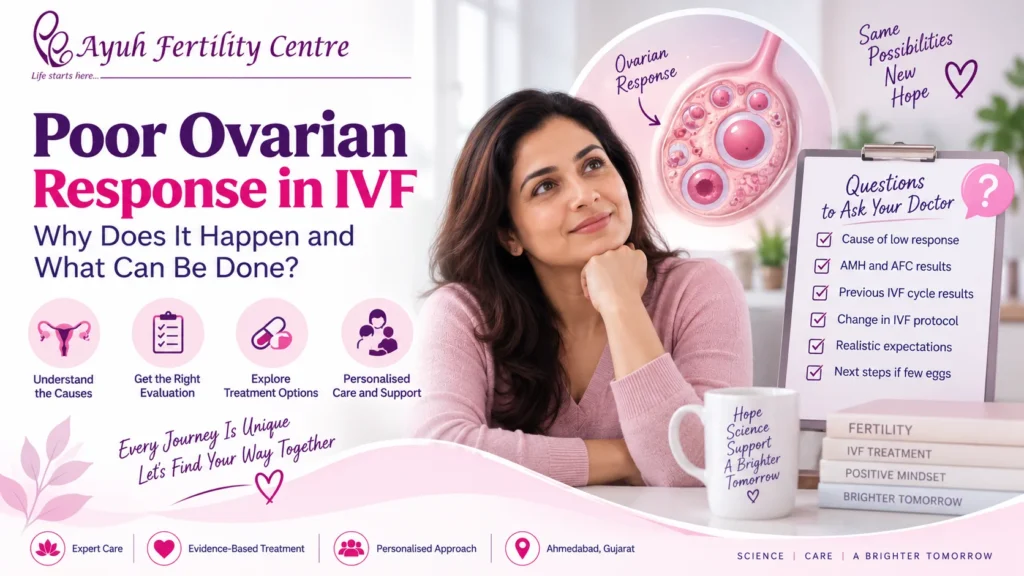
Starting IVF can bring many questions, especially when fewer eggs are retrieved than expected. Some women respond less strongly to ovarian stimulation and produce fewer developing follicles or retrieved eggs during an IVF cycle. This is commonly described as poor ovarian response in IVF.
Hearing that you have had a low response can be worrying, but the number of eggs retrieved from one IVF cycle does not tell the complete story. Ovarian response can vary between individuals and, in some cases, between treatment cycles. Your age, ovarian reserve, previous treatment response and overall fertility history all need to be considered together.
The goal of evaluating poor ovarian response in IVF is not simply to count eggs. It is to understand how your ovaries are likely to respond to stimulation and use that information to develop an individualized treatment plan.
The American Society for Reproductive Medicine (ASRM) notes that ovarian reserve tests such as AMH and antral follicle count (AFC) can help predict oocyte yield during IVF, but they should not be used alone to determine reproductive potential or to deny IVF treatment.
What Is Poor Ovarian Response in IVF?
During IVF, medications are used to stimulate the ovaries so that multiple follicles can develop. The follicles are monitored with ultrasound and, when appropriate, eggs are retrieved.
Poor ovarian response generally refers to a lower-than-expected response to ovarian stimulation, resulting in a reduced number of retrieved oocytes.
It is important to distinguish ovarian reserve from ovarian response.
- Ovarian reserve refers mainly to the remaining quantity of oocytes.
- Ovarian response describes how the ovaries actually respond to stimulation during an IVF cycle.
- Egg quality is a separate consideration and is influenced strongly by age.
ASRM describes ovarian reserve tests as useful for predicting ovarian response and oocyte yield, while emphasizing that these tests are not direct measures of egg quality.
Does Retrieving Few Eggs Mean You Have Poor Ovarian Reserve?
Not necessarily.
A low number of eggs retrieved can be associated with diminished ovarian reserve, but the result needs to be interpreted in the context of the entire IVF cycle.
Your fertility specialist may consider:
- Your age
- AMH level
- Antral follicle count
- Previous IVF response
- Follicle development during stimulation
- Medication protocol
- Previous ovarian surgery
- Certain medical or genetic factors
- Your overall reproductive history
A single IVF cycle with fewer eggs does not necessarily provide the complete picture of ovarian function.
ESHRE’s Bologna consensus established commonly used criteria for identifying poor ovarian response, incorporating factors such as advanced maternal age or other risk factors, previous poor response and abnormal ovarian reserve testing.
What Causes Poor Ovarian Response During IVF?
There is no single cause of poor ovarian response. Different women may have different reasons for producing fewer eggs during ovarian stimulation.
1. Age-Related Changes
Age is an important factor in fertility. As women get older, ovarian reserve generally declines, and the response to stimulation may become less predictable.
Women over 40 may have a higher likelihood of reduced ovarian response, although individual results can vary.
This is one reason why IVF after 40 should involve an individualized fertility assessment rather than relying on age alone.
2. Diminished Ovarian Reserve
Women with diminished ovarian reserve may have a smaller pool of recruitable follicles.
Tests such as:
- AMH
- Antral follicle count
- FSH and estradiol in appropriate circumstances
may provide information about ovarian reserve.
AMH and AFC are particularly useful for predicting ovarian response and the approximate number of eggs that may be retrieved during stimulation.
3. Previous Ovarian Surgery
Certain ovarian procedures may affect the available ovarian tissue or follicle pool.
If you have previously undergone ovarian surgery, cyst surgery or other reproductive procedures, your fertility specialist may take this history into account when planning IVF.
4. Genetic or Medical Factors
Certain medical or genetic conditions may be associated with reduced ovarian reserve or ovarian response.
Your doctor may recommend additional evaluation when your medical history suggests a possible underlying cause.
5. Previous Poor Response to IVF
A previous IVF cycle that resulted in a low number of retrieved eggs can provide important information for planning future treatment.
However, ovarian response can vary from one cycle to another. Your specialist may therefore review the complete previous cycle rather than focusing only on the final egg count.
How Is Poor Ovarian Response Diagnosed?
There is no single blood test that can independently diagnose every case of poor ovarian response.
Your fertility specialist may use a combination of ovarian reserve testing, ultrasound findings and previous IVF response.
AMH Testing
Anti-Müllerian hormone (AMH) is commonly used as a marker of ovarian reserve.
AMH can help doctors estimate how the ovaries may respond to stimulation and may help with IVF treatment planning.
However, an important point is that AMH is not a direct test of egg quality.
ASRM states that AMH and AFC have a strong relationship with ovarian response and oocyte yield but only a weak association with qualitative outcomes such as oocyte quality, pregnancy and live birth.
Antral Follicle Count
Antral follicle count (AFC) is assessed using ultrasound.
The doctor counts small follicles visible in the ovaries during the appropriate stage of the menstrual cycle.
AFC can help estimate the number of follicles that may respond to stimulation.
Previous IVF Results
Previous IVF treatment can provide real-world information about how your ovaries responded.
Your doctor may review:
- Number of follicles
- Medication doses
- Duration of stimulation
- Number of mature follicles
- Number of eggs retrieved
- Number of mature eggs
- Fertilization results
- Embryo development
This information may be more useful when considered alongside AMH, AFC and age rather than interpreted separately.
What Does Low AMH Mean for IVF?
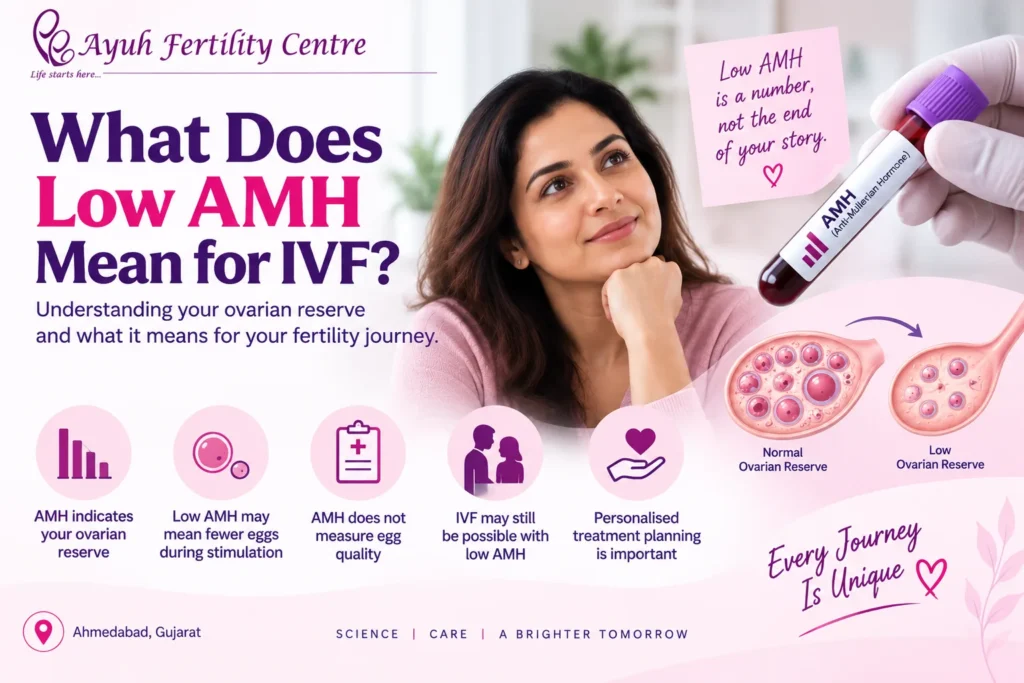
Low AMH and poor ovarian response are related concepts, but they are not exactly the same thing.
A low AMH may indicate reduced ovarian reserve and can help predict that fewer eggs may be retrieved during stimulation.
However, low AMH does not automatically mean that IVF cannot be performed.
ASRM specifically notes that even extremely low AMH values should not by themselves be used to refuse IVF treatment. Instead, they may help doctors counsel patients about the possibility of a lower response and fewer retrieved oocytes.
This is especially important for women searching for IVF with low AMH because a laboratory result should always be interpreted alongside age, ultrasound findings, previous treatment response and the rest of the fertility evaluation.
What Happens If Only a Few Eggs Are Retrieved During IVF?
Retrieving fewer eggs can be disappointing, but it does not automatically mean that the IVF cycle has failed.
The next steps depend on what happens after egg retrieval.
For example, the laboratory will determine:
- How many retrieved eggs are mature
- How many mature eggs fertilize
- How embryos develop
- Whether embryos reach the blastocyst stage
- Whether an embryo is suitable for transfer or freezing
This means the number of eggs retrieved is only one stage of the IVF process.
A smaller number of eggs can still lead to embryo development, although individual outcomes vary.
Can Treatment Be Adjusted for Poor Ovarian Response?
Yes. When a patient is expected to have a low ovarian response, the fertility specialist may review and individualize the ovarian stimulation strategy.
Treatment planning may involve considering:
Individualized Stimulation
The medication type and dose may be selected according to your ovarian reserve, age and previous response.
There is no single stimulation protocol that is appropriate for every poor responder.
Reviewing Previous IVF Protocols
If you have undergone IVF previously, your doctor can review how you responded to the previous medications and determine whether adjustments should be considered.
Considering Different Stimulation Approaches
Depending on the patient’s situation, the fertility specialist may discuss conventional ovarian stimulation, modified approaches or other strategies.
The 2025 ESHRE ovarian stimulation guideline notes that low responders are a heterogeneous group and that treatment should be individualized; it also states that a low response alone is not necessarily a reason to cancel an IVF cycle.
Considering More Than One Treatment Cycle
In some situations, your fertility specialist may discuss whether another IVF cycle could provide additional opportunities to obtain eggs and embryos.
The decision depends on age, ovarian reserve, previous response, embryo development and the patient’s goals.
Does Increasing IVF Medication Always Give More Eggs?
Not necessarily.
It may seem logical that increasing stimulation medication will automatically result in more eggs, but ovarian response depends on the available follicle pool and individual biology.
More medication does not guarantee that the ovaries will produce more eggs.
The 2025 ESHRE guideline emphasizes individualized ovarian stimulation and notes that low responders represent a heterogeneous group.
Therefore, medication dosage should be determined by a fertility specialist rather than increased independently.
Can Lifestyle Changes Improve Poor Ovarian Response?
Patients often ask whether diet, exercise, supplements or lifestyle changes can increase egg numbers during IVF.
A healthy lifestyle can be an important part of general preconception care, but there is no lifestyle change that can reliably restore ovarian reserve or guarantee a higher number of eggs retrieved.
Your doctor may discuss:
- Balanced nutrition
- Healthy weight management
- Regular physical activity
- Avoiding smoking
- Limiting alcohol
- Adequate sleep
- Management of existing health conditions
Supplements should also be discussed with your fertility specialist rather than started solely based on online recommendations.
Does Poor Ovarian Response Mean Poor Egg Quality?
No.
Ovarian response and egg quality are different concepts.
A woman may produce fewer eggs but still have an egg that fertilizes and develops into an embryo.
At the same time, having a higher number of retrieved eggs does not automatically mean that all eggs will be of good quality.
Age is an important factor when discussing egg quality and reproductive outcomes.
This distinction is particularly important for patients with low AMH and IVF, because AMH primarily provides information about ovarian reserve and expected response rather than directly measuring egg quality.
Poor Ovarian Response After 40
For women considering IVF after 40, ovarian reserve and response may be important parts of the initial assessment.
Your doctor may review:
- AMH
- AFC
- Previous IVF response
- Menstrual and reproductive history
- Uterine health
- Sperm parameters
- Previous pregnancy history
- Overall medical health
Age is also an important consideration because fertility and reproductive outcomes change with increasing maternal age.
This does not mean that every woman over 40 will have the same ovarian response. Individual assessment remains important.
What Questions Should You Ask Your Fertility Specialist?
If you have experienced poor ovarian response in IVF, asking detailed questions can help you understand your previous cycle and prepare for future treatment. Every IVF case is different, so your fertility specialist can explain how your test results and treatment history may affect your options.
1. What Caused My Low Response?
Ask whether your low response may be related to ovarian reserve, age, previous treatment response, medication protocol, or another medical factor.
Understanding the possible reason for a low ovarian response can help you understand why fewer follicles or eggs developed during your IVF cycle. Your doctor may review your AMH, AFC, previous ultrasound findings, medication doses and egg retrieval results before discussing the next step.
2. What Did My AMH and AFC Results Show?
Ask your fertility specialist to explain what your AMH level and antral follicle count (AFC) mean for your IVF treatment.
These tests can provide information about ovarian reserve and may help your doctor estimate how your ovaries could respond to stimulation. You can also ask how your current results compare with your previous fertility assessments.
Remember that ovarian reserve tests mainly provide information about egg quantity and expected ovarian response, not a direct measurement of egg quality.
3. How Did My Previous IVF Cycle Compare With Expectations?
Your previous IVF cycle can provide valuable information for planning future treatment.
Ask your doctor to review:
- Number of follicles developed
- Number of eggs retrieved
- Number of mature eggs
- Fertilization results
- Embryo development
- Medication doses and duration
- Response seen during ultrasound monitoring
Looking at the complete IVF cycle rather than only the final egg count can help you understand what happened and what may be considered in another cycle.
4. Should My IVF Protocol Be Changed?
Ask whether your previous ovarian response suggests that your IVF stimulation protocol should be reviewed.
Your fertility specialist may consider your age, ovarian reserve, previous response and other clinical factors when planning stimulation. You can ask why a particular medication, dosage or stimulation approach has been recommended.
Do not change fertility medications or dosages on your own. IVF stimulation should be monitored and adjusted by your fertility care team.
5. What Should I Realistically Expect From Another Cycle?
Ask your fertility specialist what your previous response, age, ovarian reserve and medical history may mean for another IVF cycle.
You may want to discuss the possible number of follicles, expected egg retrieval and what factors could affect the development of embryos. Your doctor can explain what is known from your individual results rather than relying only on general IVF statistics.
6. What Happens If I Retrieve Only a Few Eggs Again?
If you previously had a low egg yield, ask what the possible next steps would be if a future cycle produces only a few eggs.
Your doctor may explain how the treatment team would assess egg maturity, fertilization and embryo development after retrieval. This can help you understand that egg retrieval is only one stage of the IVF process.
Having a clear plan can also help you prepare emotionally, financially and practically for another treatment cycle.
Is IVF Still Possible With Poor Ovarian Response?
In many cases, a poor ovarian response does not automatically mean that IVF is impossible.
The appropriate approach depends on the individual’s age, ovarian reserve, medical history, previous IVF response and treatment goals.
ASRM notes that ovarian reserve testing should be used to help tailor treatment and counsel patients, rather than being used as the sole reason to deny assisted reproductive treatment.
Your fertility specialist can explain whether another IVF cycle, a modified treatment approach or another fertility option should be considered.
FAQ
1. What is considered poor ovarian response in IVF?
Poor ovarian response refers to a lower-than-expected response of the ovaries to stimulation, generally resulting in fewer developing follicles or retrieved eggs. Formal definitions can incorporate factors such as age, previous poor response and abnormal ovarian reserve testing.
2. Can low AMH cause poor ovarian response?
Low AMH can be associated with reduced ovarian reserve and may predict a lower response to ovarian stimulation. However, AMH should not be interpreted as a direct measurement of egg quality or used alone to determine whether IVF is appropriate.
3. Can I have IVF if I have poor ovarian response?
A poor response does not automatically mean that IVF cannot be considered. Your fertility specialist will evaluate your age, ovarian reserve, previous treatment response and overall reproductive history before recommending a treatment approach.
4. Can poor ovarian response improve in another IVF cycle?
Ovarian response can vary between treatment cycles. A previous low response is important information, but it does not necessarily predict exactly what will happen in every subsequent cycle.
5. Does poor ovarian response mean I cannot get pregnant?
No. Poor ovarian response primarily describes the response to ovarian stimulation. It does not by itself mean that pregnancy is impossible.
6. Is AMH enough to predict IVF success?
No. AMH is useful for predicting ovarian response and egg yield, but it does not independently predict an individual’s overall IVF outcome. Age, embryo development, sperm factors, uterine factors and other clinical considerations also matter.
7. Does age affect poor ovarian response?
Age can be associated with a greater likelihood of reduced ovarian reserve and poor ovarian response. It is also an important factor in reproductive outcomes, which is why age and ovarian reserve are considered together during fertility evaluation.
8. Can lifestyle changes increase ovarian reserve?
Lifestyle measures can support general health, but there is no proven lifestyle change that can reliably restore a depleted ovarian reserve. Speak with your fertility specialist before using supplements or alternative treatments marketed for increasing egg count.
9. What if only one or two eggs are retrieved?
Your IVF team will assess whether the eggs are mature and whether fertilization and embryo development occur. Even when the number of eggs is small, the subsequent laboratory results provide additional information about the cycle.
10. Should I try IVF again after poor ovarian response?
There is no universal answer. Your fertility specialist may review your previous stimulation protocol, ovarian reserve results, age, egg maturity, fertilization and embryo development before discussing whether another IVF cycle is appropriate.
Final Takeaway
Poor ovarian response in IVF means that the ovaries produce fewer follicles or eggs than expected during stimulation. It can be associated with diminished ovarian reserve, age, previous ovarian response and other individual factors.
Importantly, low AMH, low egg retrieval or a previous poor response should not be interpreted in isolation. AMH and AFC can help predict ovarian response, but they do not directly measure egg quality or provide a complete prediction of pregnancy or live birth.
If you have experienced low ovarian response during IVF, a detailed review of your previous cycle and fertility assessment can help your specialist discuss the available treatment options and realistic expectations.
For couples considering IVF treatment in Ahmedabad, an individualized consultation with a fertility specialist can help clarify what your ovarian reserve results and previous treatment history mean for your particular situation.
Author / Medical Reviewer
Dr. Krupa A. Shah
Fertility Specialist & Founder
Ayuh Fertility Centre, Ahmedabad
Medical Disclaimer
This article is intended for general educational purposes and does not replace consultation with a qualified fertility specialist. IVF treatment and ovarian stimulation should always be planned according to an individual’s medical history, investigations and clinical requirements.