
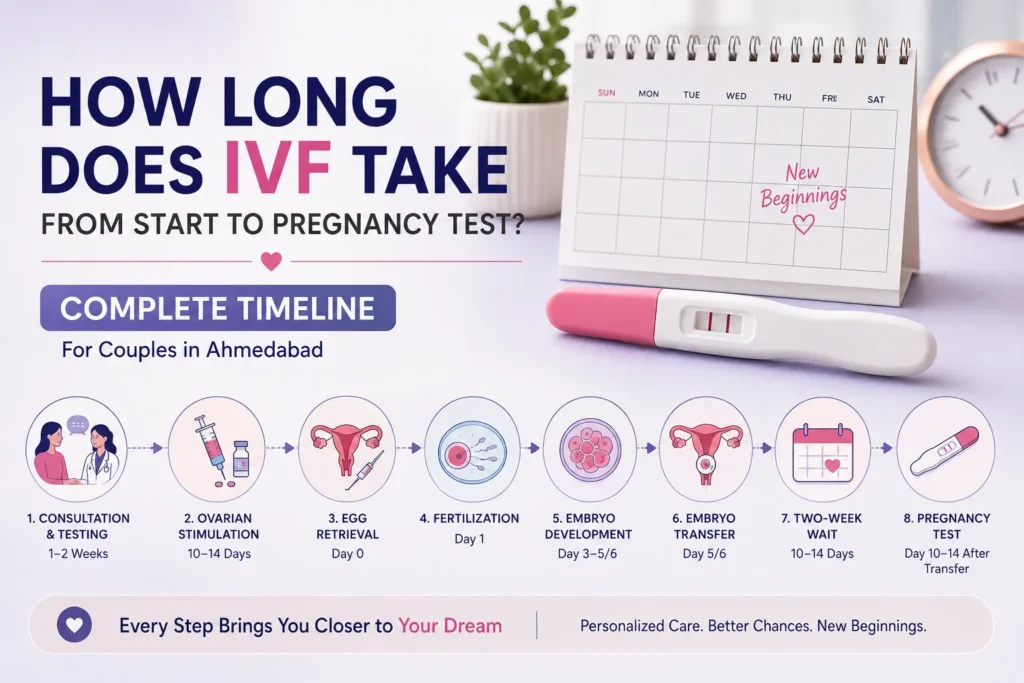
One of the first questions couples ask before starting IVF is:
“How long does the IVF process take?”
It is an important question because IVF involves more than just the egg retrieval and embryo transfer.
There are several stages, including fertility evaluation, ovarian stimulation, monitoring, egg retrieval, fertilization, embryo development, embryo transfer and finally the pregnancy test.
For a typical IVF treatment, the active treatment cycle may take around 4–6 weeks, although the complete journey from the first consultation and pre-treatment evaluation can take longer depending on your individual circumstances. Ayuh Fertility Centre currently describes its standard IVF process as approximately 4–6 weeks from treatment start to pregnancy testing, with the initial consultation and work-up potentially extending the overall timeline to around 6–8 weeks.
However, there is no single IVF timeline that applies to every couple.
Some patients may need additional testing or treatment before starting IVF, while others may have frozen embryo transfer in a later cycle.
IVF Timeline at a Glance
A simplified IVF timeline looks like this:
Consultation & Testing → Ovarian Stimulation → Egg Retrieval → Fertilization → Embryo Development → Embryo Transfer → Two-Week Wait → Pregnancy Test
Let’s look at each stage in detail.
Step 1: Initial Fertility Consultation
Before IVF begins, your fertility specialist needs to understand your medical and fertility history.
The first consultation may include discussion of:
- Previous pregnancies
- Previous fertility treatments
- Menstrual history
- Age
- Medical conditions
- Previous IVF or IUI attempts
- Male fertility history
- Previous investigations
Your doctor may then recommend appropriate fertility tests.
The purpose is not simply to start IVF as quickly as possible.
It is to determine whether IVF is appropriate and, if so, which treatment approach is most suitable for you.
At Ayuh Fertility Centre, the published IVF pathway begins with a consultation, diagnostic evaluation and personalized treatment plan before the active IVF cycle starts.
Step 2: Fertility Testing and IVF Preparation
The exact tests depend on your history.
Your doctor may consider investigations such as:
For the woman
- AMH
- Hormonal testing
- Antral follicle count
- Pelvic ultrasound
- Uterine evaluation when indicated
For the man
- Semen analysis
- Additional male fertility testing when clinically indicated
Your doctor may also review previous reports rather than repeating every test.
This stage can take days or several weeks depending on which investigations are needed.
If a condition requiring treatment is identified, IVF may be postponed until it is appropriately managed.
Step 3: Ovarian Stimulation
Once the treatment plan is finalized, ovarian stimulation begins.
Unlike a natural menstrual cycle, where usually one dominant follicle develops, IVF stimulation aims to develop multiple follicles.
During this stage, fertility medications are used according to the individualized protocol.
The ovaries are monitored through:
- Ultrasound scans
- Hormonal blood tests when required
- Follicle measurements
- Endometrial assessment
The exact duration varies between protocols, but ovarian stimulation commonly takes approximately 10–14 days.
The goal is not simply to produce as many eggs as possible.
The goal is to achieve an appropriate response while maintaining patient safety.
Step 4: Trigger Injection
When the follicles reach the appropriate stage of development, your fertility specialist will decide when the eggs should be retrieved.
A trigger injection is then administered at a carefully calculated time.
The timing matters because egg retrieval is scheduled according to the expected maturation of the eggs.
This is one reason IVF involves close monitoring during the stimulation phase.
Step 5: Egg Retrieval
Egg retrieval, also called oocyte pickup (OPU), is the procedure used to collect mature eggs from the ovaries.
It is generally performed under appropriate sedation or anaesthesia according to the clinic’s protocol.
The retrieved eggs are then taken to the embryology laboratory.
The number of eggs retrieved can vary considerably between patients.
A higher number of eggs does not automatically guarantee pregnancy.
Egg maturity and subsequent embryo development are also important.
Step 6: Fertilization
After egg retrieval, the eggs are fertilized with sperm in the embryology laboratory.
Depending on the clinical situation, fertilization may involve conventional IVF or ICSI (intracytoplasmic sperm injection).
ICSI involves injecting a single sperm directly into an egg.
It may be recommended in selected cases, particularly when there are significant male-factor infertility concerns or previous fertilization problems.
Not every patient undergoing IVF requires ICSI.
The appropriate method depends on the individual case.
Step 7: Embryo Development
After fertilization, embryos are monitored in the laboratory.
Embryos may be cultured for several days, with many modern IVF programs aiming for blastocyst-stage development around Day 5–6, when clinically appropriate.
During this period, the embryology team monitors embryo development.
Not every fertilized egg will continue developing to the blastocyst stage.
This is an important part of understanding the IVF journey.
You may start with several eggs, but the number gradually changes through each stage:
Eggs retrieved → Mature eggs → Fertilized eggs → Developing embryos → Blastocysts → Transferable embryos
This is why the number of eggs retrieved alone cannot predict the final outcome.
Step 8: Fresh or Frozen Embryo Transfer
Depending on your individual treatment plan, embryo transfer may happen during the same treatment cycle or at a later time.
Fresh embryo transfer
A suitable embryo may be transferred into the uterus during the same treatment cycle when clinically appropriate.
Frozen embryo transfer
An embryo may instead be frozen and transferred during a later cycle.
A frozen embryo transfer can be recommended for several reasons depending on the patient’s circumstances and treatment strategy.
The timing of FET is therefore different from a fresh transfer.
Step 9: The Two-Week Wait
After embryo transfer comes the part many couples find emotionally difficult:
The waiting period.
The pregnancy test is generally scheduled approximately 10–14 days after embryo transfer, depending on the embryo stage and the clinic’s protocol. Ayuh’s patient guidance describes the post-transfer period as the approximately 10–14-day interval before the recommended blood pregnancy test.
During this period, you may experience:
- Mild cramping
- Bloating
- Breast tenderness
- Fatigue
- No symptoms at all
Importantly, symptoms cannot reliably tell you whether IVF has worked.
Many symptoms can also be caused by progesterone or other medications used during treatment.
Step 10: Pregnancy Test
The pregnancy test is usually performed using a blood beta-hCG test.
The timing is important.
Testing too early may lead to confusion because hCG levels may not yet be sufficiently detectable.
In addition, fertility medications used during the treatment cycle can sometimes complicate very early testing.
Your fertility clinic will provide the specific date for your blood test.
So, How Long Does IVF Take?
For many patients, the active IVF treatment process can take approximately:
4–6 weeks
This can include:
Stimulation → Egg Retrieval → Fertilization → Embryo Development → Transfer → Pregnancy Test
But if you include:
- Initial consultation
- Fertility testing
- Treatment planning
- Treatment of an underlying condition
- Frozen embryo transfer preparation
the overall journey can take longer.
Ayuh currently states that when the initial consultation and work-up are included, the overall process may extend to approximately 6–8 weeks, depending on the individual case.
Can IVF Be Completed in One Month?
Sometimes the active treatment cycle can fit within approximately one month, but this should not be treated as a guarantee.
The timeline depends on:
- Your menstrual cycle
- IVF protocol
- Ovarian response
- Egg retrieval timing
- Embryo development
- Fresh versus frozen transfer
- Additional investigations
- Medical conditions
For example, if your doctor recommends treating a uterine problem before embryo transfer, your overall timeline may become longer.
A slightly longer timeline is not necessarily a problem.
The priority should be preparing for treatment appropriately rather than rushing to transfer an embryo.
Why Does IVF Sometimes Take Longer Than Expected?
Several factors can extend the IVF timeline.
1. Additional Fertility Testing
Your doctor may need additional information before starting treatment.
2. Low or Unexpected Ovarian Response
Your stimulation protocol may need to be adjusted based on how your ovaries respond.
3. Risk of OHSS
In patients at increased risk of ovarian hyperstimulation syndrome, your doctor may modify the treatment plan and, in selected cases, recommend freezing embryos and transferring them later.
4. Uterine Problems
Conditions such as polyps, certain fibroids or uterine adhesions may need evaluation or treatment before embryo transfer.
5. No Suitable Embryo for Fresh Transfer
If the treatment plan involves embryo freezing, transfer will take place during a later cycle.
6. Previous IVF Failure
After an unsuccessful cycle, your fertility specialist may recommend reviewing the previous treatment before starting another attempt.
Fresh IVF vs Frozen Embryo Transfer: Which Takes Longer?
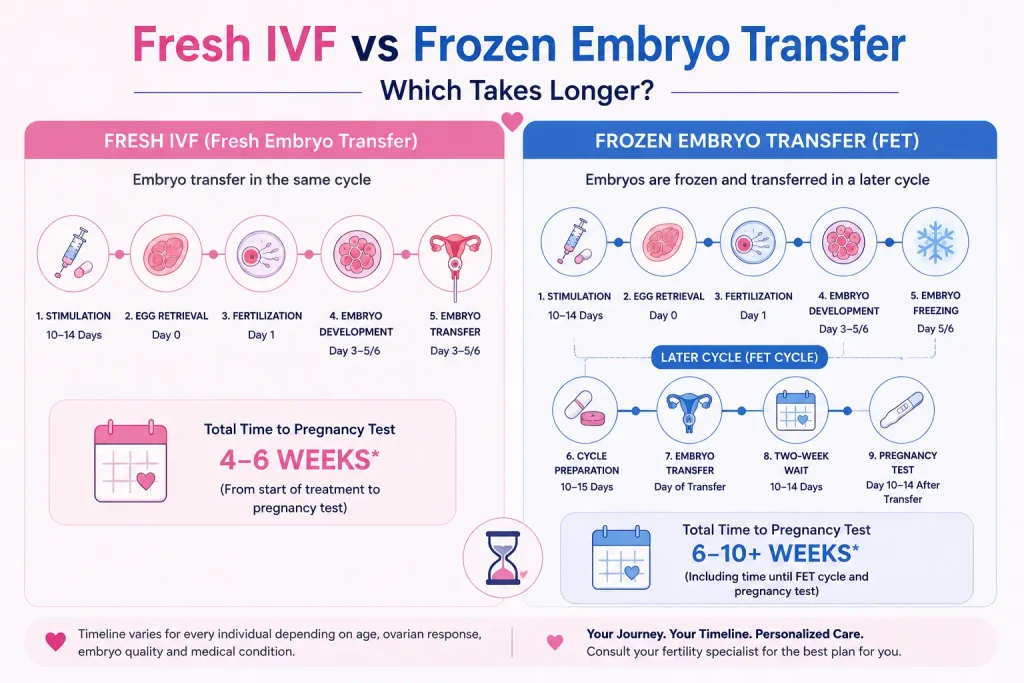
The timeline is different.
Fresh Transfer
The embryo transfer occurs during the same treatment cycle after egg retrieval and embryo development.
Frozen Transfer
Embryos are frozen after development and transferred during a later prepared cycle.
A frozen transfer can therefore add time to the overall journey, but it may be the more appropriate option for certain patients.
The decision should be based on medical factors rather than simply choosing whichever option is faster.
What Can You Do While Waiting for IVF?
The waiting period can feel stressful, but there are practical things you can do.
Follow your medication schedule
Take fertility medications exactly as instructed.
Attend monitoring appointments
Ultrasound and blood tests help your doctor make decisions about the treatment cycle.
Maintain normal healthy habits
A balanced diet, appropriate physical activity and adequate sleep can support general wellbeing.
Avoid unnecessary supplements
Do not start fertility supplements or medications simply because they are promoted online.
Ask your fertility specialist first.
Look after your emotional wellbeing
IVF can be stressful. Give yourself permission to step away from online forums and symptom-checking if they increase anxiety.
Does the IVF Timeline Change With Age?
The basic stages of IVF remain similar, but age can influence treatment planning.
For example, your fertility specialist may consider:
- Ovarian reserve
- Egg quality
- Previous treatment history
- Embryo development
- Genetic testing considerations where appropriate
- The urgency of treatment
This is particularly important when treatment is being considered at an older reproductive age.
The timeline should therefore be personalized rather than copied from another patient’s IVF journey.
What If You Need More Than One IVF Cycle?
Not every IVF cycle results in pregnancy.
If the first attempt is unsuccessful, your doctor may review the cycle before recommending another attempt.
The review may include:
- Number of eggs retrieved
- Egg maturity
- Fertilization
- Embryo development
- Embryo quality
- Endometrial preparation
- Transfer
- Sperm factors
- Overall medical history
A second IVF cycle may therefore have a different timeline depending on what was learned from the first attempt.
IVF Timeline: Simple Week-by-Week Example
Week 1
Consultation and fertility evaluation
Review your history and complete the recommended investigations.
Week 2
IVF stimulation begins
Medications and monitoring are started according to your protocol.
Week 3
Follicle monitoring + egg retrieval
Follicles are monitored and egg retrieval is performed when appropriate.
Week 3–4
Fertilization + embryo development
Eggs are fertilized and embryos are monitored in the laboratory.
Week 4
Embryo transfer
A fresh transfer may occur when appropriate, or embryos may be frozen for a later transfer.
Following 10–14 days
Waiting period
Continue medications as prescribed and wait for the scheduled pregnancy test.
Test day
Beta-hCG blood test
Your fertility team will interpret the result and advise you about the next step.
This is an illustrative timeline, not a guaranteed schedule. Your actual IVF timeline may be shorter or longer.
When Should You Start Planning IVF?
If you are considering IVF, don’t wait until you want to start injections before beginning the planning process.
The first step is a fertility consultation.
During this consultation, your doctor can determine:
- Which tests you need
- Whether IVF is appropriate
- Whether another treatment may be more suitable
- What protocol may be considered
- How long your expected treatment timeline may be
- Whether there are factors that need to be addressed first
This can make the treatment journey much more predictable.
IVF Timeline at Ayuh Fertility Centre Ahmedabad
At Ayuh Fertility Centre, the published IVF pathway includes:
Consultation → Diagnostics → Personalized Treatment Plan → IVF Cycle → Embryo Transfer → Pregnancy Test
The centre currently states that the standard IVF treatment cycle generally takes around 4–6 weeks from treatment start to pregnancy testing, while including the initial consultation and work-up may bring the overall timeline to approximately 6–8 weeks, depending on the patient.
The exact timeline is determined after reviewing your fertility profile and treatment needs.
Frequently Asked Questions
How long does IVF take from start to pregnancy test?
A typical active IVF cycle may take around 4–6 weeks, while the complete process including consultation and pre-treatment evaluation can take longer. Individual timelines vary.
How many days are IVF injections given?
Ovarian stimulation commonly lasts around 10–14 days, although the exact duration depends on your protocol and ovarian response.
How long after egg retrieval is embryo transfer?
For a fresh blastocyst transfer, embryo development typically takes several days after retrieval. If a frozen embryo transfer is planned, the transfer occurs in a later cycle.
How long after embryo transfer is the pregnancy test?
A blood beta-hCG test is generally performed around 10–14 days after embryo transfer, according to the clinic’s protocol.
Can IVF take longer than 6 weeks?
Yes. Additional testing, medical treatment, a freeze-all approach, frozen embryo transfer or other individual factors can extend the timeline.
Does IVF always require a fresh embryo transfer?
No. Some treatment plans involve freezing embryos and transferring them during a later cycle.
Can I work during IVF treatment?
Many people continue working during IVF, although the experience varies. Monitoring appointments and procedures may require some schedule flexibility.
Does the IVF process start on Day 1 of the period?
The exact start depends on your treatment protocol. Your fertility specialist will tell you when medications and monitoring should begin.
Final Takeaway
How long does IVF take?
For many couples, the active IVF cycle takes approximately 4–6 weeks, but the full journey from the first consultation to the pregnancy test can take longer.
The major stages are:
Consultation → Testing → Stimulation → Egg Retrieval → Fertilization → Embryo Development → Transfer → Pregnancy Test
The most important thing to remember is that IVF is not a one-size-fits-all process.
Your age, ovarian reserve, diagnosis, treatment history, ovarian response, embryo development and uterine health can all influence the timeline.
A personalized plan can help you understand not only how long your IVF treatment may take, but also what will happen at each stage.
Medical Disclaimer
This article is for general educational purposes and does not replace personalized medical advice, diagnosis or treatment. IVF protocols and timelines vary between patients. Your fertility specialist should determine the appropriate treatment schedule based on your medical history, investigations and response to treatment.
Author / Medical Reviewer:
Dr. Krupa A. Shah
Fertility Specialist & Founder
Ayuh Fertility Centre, Ahmedabad
Suggested CTA
Planning IVF in Ahmedabad?
Speak with the fertility team at Ayuh Fertility Centre to understand your personalized IVF timeline, treatment options and expected next steps.