
If you are considering IVF, one of the most common questions is:
“How many IVF cycles are needed to get pregnant?”
Some couples become pregnant after their first IVF attempt. Others may need more than one cycle, while some may need a different treatment strategy after an unsuccessful attempt.
There is no fixed number of IVF cycles that guarantees pregnancy.
Your individual chances depend on factors such as age, egg quality, ovarian reserve, sperm health, embryo development, uterine health, the cause of infertility, and your previous treatment history.
Current fertility guidance also emphasizes individualized counselling rather than applying one cycle number to every patient.
At Ayuh Fertility Centre Ahmedabad, the goal should not simply be to count IVF cycles. It is to understand what each cycle tells your fertility specialist and use that information to plan the next step.
Is One IVF Cycle Enough?
Sometimes, yes.
A couple may achieve pregnancy following the first IVF cycle, particularly when the overall fertility profile is favorable.
However, IVF is not successful in every first attempt.
A first cycle may provide important information about:
- How the ovaries respond to stimulation
- Number of eggs retrieved
- Egg maturity
- Fertilization
- Embryo development
- Blastocyst formation
- Embryo quality
- Endometrial preparation
- Sperm-related factors
- Response to the treatment protocol
Therefore, if the first IVF cycle does not result in pregnancy, it does not automatically mean that IVF will not work.
The information obtained from the first cycle can help your fertility specialist decide whether anything should be changed before another attempt.
How Many IVF Cycles Do Most Couples Need?
There is no medically appropriate universal number such as “everyone needs three cycles” or “one cycle is enough.”
Some patients may succeed in the first cycle. Others may need multiple attempts.
Recent Indian fertility resources similarly emphasize that the number of attempts varies substantially between individuals and should be interpreted according to age, ovarian reserve, sperm health, diagnosis and treatment response.
Instead of asking only:
“How many IVF cycles do I need?”
it can be more useful to ask:
“What is my expected chance of success, and what will we learn from each cycle?”
What Does “One IVF Cycle” Actually Mean?
This is important because the word cycle can be confusing.
An IVF treatment cycle may involve:
- Ovarian stimulation
- Follicle monitoring
- Egg retrieval
- Fertilization in the laboratory
- Embryo culture
- Fresh embryo transfer or embryo freezing
- Pregnancy testing
However, an egg retrieval can sometimes produce multiple embryos.
Some embryos may be frozen for future frozen embryo transfer (FET).
This means that one ovarian stimulation and egg retrieval may potentially provide more than one embryo-transfer opportunity.
Therefore, when discussing the number of IVF attempts, ask your fertility clinic what they mean by “cycle.”
IVF Cycle vs Embryo Transfer: What’s the Difference?
An IVF cycle and an embryo transfer are not necessarily the same thing.
For example, during one ovarian stimulation:
Egg retrieval → Fertilization → Embryo development → Embryo freezing
If more than one suitable embryo is available, a patient may have a transfer later without repeating ovarian stimulation and egg retrieval.
This is why it can be misleading to compare clinics based only on the number of “cycles.”
Ask whether their statistics refer to:
- Cycle started
- Egg retrieval
- Fresh embryo transfer
- Frozen embryo transfer
- Clinical pregnancy
- Live birth
This distinction is particularly important when evaluating IVF success rates.
Does IVF Success Increase With More Attempts?
The chance of having a baby can accumulate over multiple treatment attempts, but this does not mean that everyone will eventually become pregnant after a certain number of cycles.
A patient who has several embryos available from one retrieval may have multiple transfer opportunities without repeating ovarian stimulation.
On the other hand, if a cycle produces few or no usable embryos, another retrieval may be necessary.
Cumulative outcomes therefore depend on the individual’s reproductive biology and the results of each treatment stage.
Some current Indian fertility resources describe cumulative outcomes across multiple attempts, but the reported percentages differ considerably depending on the population and outcome definition. This is why couples should avoid treating a generic internet percentage as their personal prediction.
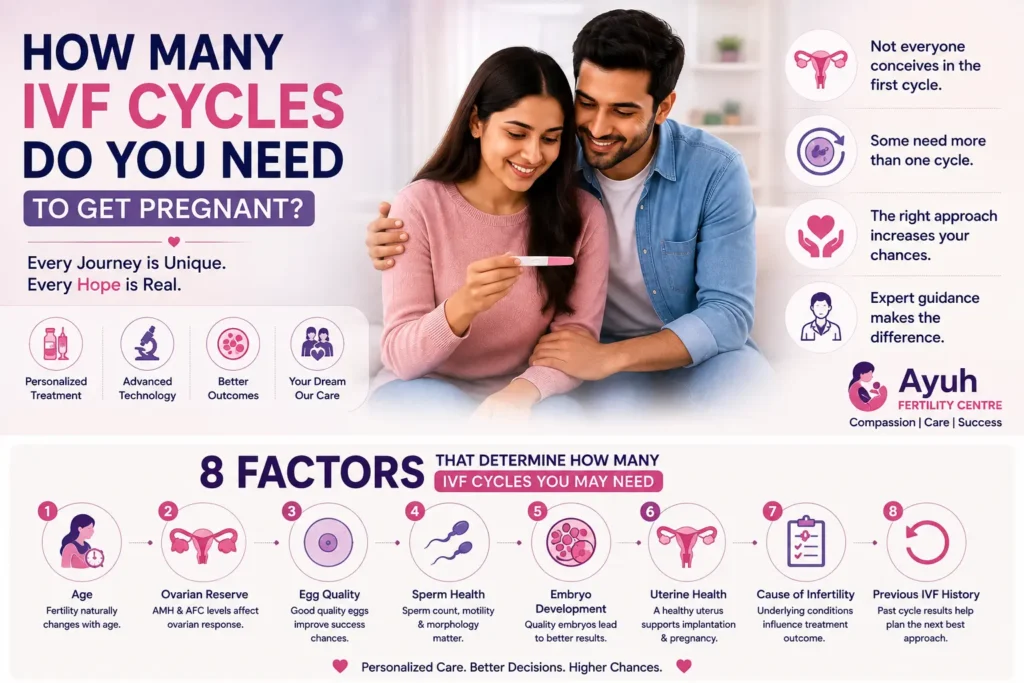
8 Factors That Determine How Many IVF Cycles You May Need
1. Age
Age is one of the most important factors influencing IVF outcomes, especially when using your own eggs.
As reproductive age increases, egg quality can decline and the likelihood of chromosomal abnormalities in embryos increases.
This can mean that some older patients may need more attempts to obtain a suitable embryo.
However, age alone cannot predict an individual’s outcome.
2. Ovarian Reserve
Tests such as AMH and antral follicle count (AFC) can help your fertility specialist understand ovarian reserve and anticipate how the ovaries may respond to stimulation.
A low ovarian reserve may result in fewer eggs being retrieved during a cycle.
But ovarian reserve and egg quality are not the same thing.
Your doctor needs to interpret these results alongside your age and other fertility factors.
3. Egg Quality
Egg quality is an important component of embryo development.
A good number of eggs does not necessarily mean that all eggs will fertilize or develop into viable embryos.
This is one reason why two women of the same age can have very different IVF outcomes.
4. Sperm Health
Male fertility factors can also influence IVF outcomes.
Depending on the situation, your fertility team may assess:
- Sperm count
- Motility
- Morphology
- Previous fertilization results
- Other advanced sperm factors when clinically indicated
If a male factor is identified, the treatment approach may be adjusted accordingly.
5. Embryo Development
Not every fertilized egg develops into a blastocyst.
Your embryology team monitors embryo development and evaluates embryos according to established laboratory criteria.
If a cycle produces several suitable embryos, future transfers may be possible without another egg retrieval.
6. Uterine and Endometrial Health
The embryo is only one part of implantation.
The uterus and endometrium also need to be evaluated when clinically appropriate.
Conditions such as:
- Fibroids
- Polyps
- Uterine adhesions
- Adenomyosis
- Endometriosis
- Abnormal endometrial development
may influence fertility treatment and may require evaluation or treatment.
7. Cause of Infertility
The reason a couple needs IVF can also influence treatment planning.
For example, treatment considerations may differ for:
- Tubal blockage
- Male infertility
- Endometriosis
- PCOS
- Low ovarian reserve
- Unexplained infertility
- Repeated implantation failure
- Previous IVF failure
There is therefore no single IVF protocol or cycle number that is appropriate for every couple.
8. What Happened During Previous IVF Cycles
If you have already undergone IVF, the previous cycle provides valuable information.
Your doctor may review:
Stimulation → Follicle growth → Egg retrieval → Fertilization → Embryo development → Transfer → Implantation → Pregnancy
Looking at the entire sequence can help identify where difficulties occurred.
What If the First IVF Cycle Fails?
A failed first IVF cycle can be emotionally difficult.
It is normal to wonder:
“Should I try again?”
The answer depends on why the cycle did not succeed.
Your fertility specialist may review:
- Number of eggs retrieved
- Egg maturity
- Fertilization rate
- Embryo development
- Blastocyst formation
- Embryo quality
- Endometrial preparation
- Transfer details
- Sperm factors
- Age and ovarian reserve
- Any underlying medical condition
A failed cycle does not automatically mean that the next attempt will fail.
But it also does not mean that you should immediately repeat the same protocol without reviewing what happened.
The goal is to learn from the previous cycle and decide whether another attempt, additional evaluation, or a different strategy makes sense.
Should You Try IVF Again After a Failed Cycle?
In many cases, another IVF attempt can be considered.
However, the timing and strategy should be individualized.
Your doctor may recommend proceeding with another attempt when:
- The treatment response was reasonable
- There were embryos available
- The uterus has been appropriately evaluated
- No major untreated factor has been identified
- The couple is emotionally and financially ready
Additional evaluation may be appropriate when there are repeated failures or specific clinical concerns.
The key question is not simply:
“How many times can I do IVF?”
It is:
“Is another attempt appropriate for me, and what should be different or confirmed before we proceed?”
When Should You Consider Changing the IVF Strategy?
A repeated unsuccessful cycle deserves careful review.
Depending on the findings, your fertility specialist may consider:
- Adjusting ovarian stimulation
- Reassessing ovarian reserve
- Reviewing sperm factors
- Reviewing laboratory and embryo development results
- Evaluating the uterus
- Changing the embryo-transfer strategy
- Considering frozen embryo transfer
- Addressing an identified medical condition
- Discussing donor egg treatment when medically appropriate
Not every patient needs additional tests or IVF “add-ons.”
Testing should be recommended based on the individual’s history and clinical indications.
How Many IVF Cycles Are Reasonable Before Considering Other Options?
There is no universal cutoff.
For some patients, another IVF attempt may be reasonable after one unsuccessful cycle.
For others, repeated unsuccessful attempts may lead to a more detailed evaluation.
The decision depends on:
- Age
- Ovarian reserve
- Egg and embryo quality
- Sperm factors
- Diagnosis
- Previous IVF results
- Financial considerations
- Emotional readiness
- Overall medical condition
For couples with unexplained infertility, treatment pathways can also differ. For example, ASRM guidance notes that in women under 38, a limited course of ovarian stimulation with IUI may be considered before IVF in many cases, whereas immediate IVF can be more appropriate in some older patients.
This is why treatment should be individualized rather than based on a fixed “three-cycle rule.”
What Can You Do Before Your Next IVF Cycle?
If you are preparing for another attempt, discuss your previous cycle in detail with your fertility specialist.
Useful questions include:
About eggs
- How many eggs were retrieved?
- How many were mature?
- Was the ovarian response expected?
About fertilization
- How many eggs fertilized?
- Was there any unexpected fertilization problem?
About embryos
- How many embryos developed?
- Did any reach the blastocyst stage?
- Were embryos frozen?
About transfer
- Was the uterine lining appropriate?
- Was the transfer technically straightforward?
- Were there any concerns regarding implantation?
About the next attempt
- Should the protocol be changed?
- Do I need any additional evaluation?
- What is my realistic chance of success?
- Would another retrieval or a frozen embryo transfer be appropriate?
These questions can make your next consultation much more productive.
Does a Failed IVF Cycle Mean You Cannot Have a Baby?
No.
One unsuccessful IVF cycle does not prove that future treatment will fail.
However, repeated unsuccessful cycles should not simply be repeated without appropriate review.
The results of each attempt can provide useful information about:
- Ovarian response
- Egg quality
- Fertilization
- Embryo development
- Uterine factors
- Implantation
Your fertility specialist can use this information to determine whether another attempt is appropriate and whether the treatment strategy should change.
IVF Success Depends on More Than the Number of Cycles
It is tempting to think:
1st cycle → unsuccessful
2nd cycle → more likely
3rd cycle → definitely successful
But fertility treatment does not work like a fixed mathematical formula.
The outcome of every attempt depends on the biological factors involved.
For some couples, one retrieval may provide several embryos and multiple transfer opportunities.
For others, another stimulation cycle may be needed to obtain embryos.
And for some patients, a different treatment strategy may be more appropriate after a failed attempt.
How Ayuh Fertility Centre Approaches IVF Treatment
At Ayuh Fertility Centre, fertility treatment should be approached as an individualized journey rather than a predetermined number of attempts.
A fertility specialist can review your:
- Age
- Ovarian reserve
- Egg-related factors
- Sperm health
- Uterine health
- Infertility diagnosis
- Previous IVF history
- Embryo development
- Treatment response
This information can help determine whether you should proceed with another IVF cycle, consider a frozen embryo transfer, undergo additional evaluation, or explore another treatment option.
The aim is not simply to perform more cycles.
The aim is to make each treatment decision meaningful and medically appropriate for your circumstances.
Frequently Asked Questions
How many IVF cycles are needed to get pregnant?
There is no fixed number. Some couples conceive during the first attempt, while others need additional cycles or embryo transfers. Your age, diagnosis, ovarian reserve, sperm health, embryo development and previous treatment results all matter.
Is IVF successful in the first attempt?
It can be, but first-cycle success is not guaranteed. IVF success varies between individuals.
How many IVF attempts are usually recommended?
There is no universal recommendation. Your fertility specialist should review the results of each attempt before deciding whether another cycle is appropriate.
Does IVF success increase with each cycle?
Cumulative chances can increase across treatment attempts, but this does not guarantee pregnancy. The outcome depends on individual factors and what happens during each treatment cycle.
Should I repeat IVF after one failed cycle?
Sometimes. Your doctor should first review why the cycle did not succeed and determine whether another attempt is appropriate.
Is a frozen embryo transfer considered another IVF cycle?
Not necessarily. A frozen embryo transfer can use embryos created during a previous ovarian stimulation and retrieval cycle. Ask your clinic how it defines a “cycle.”
Does age affect the number of IVF cycles needed?
Age can influence IVF outcomes, particularly when using one’s own eggs. As age increases, egg quality and embryo chromosomal factors can affect the probability of success.
Can IVF work after several failed attempts?
It can, depending on the underlying circumstances. After repeated failures, a detailed review of previous cycles is important before deciding on the next step.
Final Takeaway
So, how many IVF cycles are needed to get pregnant?
There is no single answer.
Some couples may achieve pregnancy after their first IVF attempt. Others may need additional treatment cycles or frozen embryo transfers.
Instead of planning around a fixed number, focus on understanding your individual prognosis.
Your age, egg quality, ovarian reserve, sperm health, embryo development, uterine health, diagnosis and previous IVF results can all influence the treatment journey.
If you are considering IVF in Ahmedabad or have already experienced an unsuccessful IVF cycle, discuss your complete history with a fertility specialist before deciding on the next step.
The goal is not simply to do more IVF cycles. The goal is to understand each cycle, learn from the results, and choose the next step carefully.
Medical Disclaimer
This article is intended for general educational purposes and should not be considered a substitute for medical diagnosis or individualized fertility advice. IVF outcomes vary between individuals. The appropriate number and type of treatment attempts should be determined by a qualified fertility specialist after reviewing your medical history, investigations and previous treatment results.
Author / Medical Review:
Dr. Krupa M. Shah
Fertility Specialist
Ayuh Fertility Centre, Ahmedabad
Suggested CTA:
Planning IVF in Ahmedabad? Book a consultation with Ayuh Fertility Centre to discuss your fertility profile, previous treatment history and personalized IVF options.