
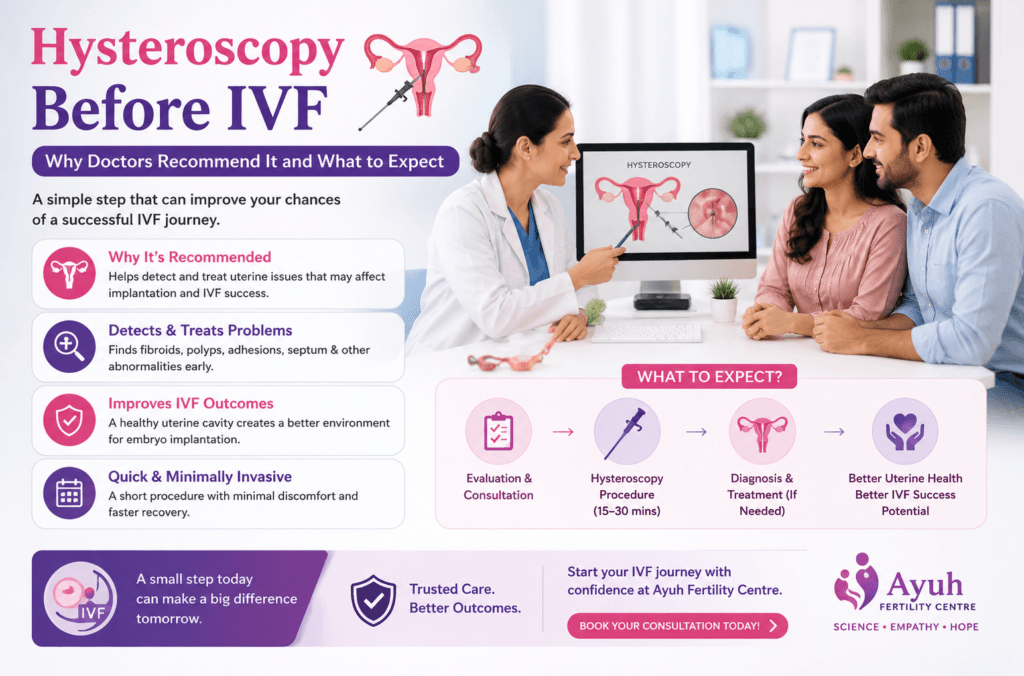
Hysteroscopy before IVF is a recommendation that many women receive during their fertility workup — and one that sometimes comes as a surprise. After months of investigations focused on hormones, egg quality, and sperm health, being told that the uterus itself needs to be examined more closely can feel like an unexpected step.
But it is a genuinely important one.
Even the best-quality embryo can fail to implant if the uterine environment it is placed into has a hidden problem. Polyps, fibroids distorting the cavity, scar tissue, a uterine septum, or subtle inflammation — none of these are reliably visible on a standard ultrasound scan. And any of them can significantly reduce the chances of a successful IVF cycle.
At Ayuh Fertility Centre in Ahmedabad, Dr. Krupa M. Shah recommends hysteroscopy as part of a thorough pre-IVF evaluation for patients where uterine factors may be relevant — because identifying and treating a correctable uterine issue before embryo transfer is always better than discovering it after a failed cycle.
This guide explains what hysteroscopy is, why it matters before IVF, what it can find and fix, and what you can realistically expect from the procedure — including an honest answer to the question everyone wants to ask: does it hurt?
Author Bio
Dr. Krupa A. Shah MBBS · MS (Obstetrics & Gynaecology) · Infertility Specialist Founder, Ayuh Fertility Centre, Ahmedabad
19+ Years of Experience in reproductive medicine, obstetrics, and gynaecology.
Dr. Krupa Shah completed her MBBS from Baroda Medical College (2006) and her MS in Obstetrics & Gynaecology from B.J. Medical College, Ahmedabad (2010). After 12 years of experience at leading clinics in Chennai — including Apollo Hospital and Iswarya Fertility Centre — she completed an Advanced IVF Fellowship at Ludwig Maximilians University, Munich, Germany, one of Europe’s most prestigious reproductive medicine institutions.
She is a member of the Ahmedabad Obstetrics and Gynaecology Society (AOGS), the Indian Society of Assisted Reproduction (ISAR), and the Federation of Obstetric and Gynaecological Societies of India (FOGSI).
IVF laboratory is ART National Board Certified.
🩺 Medically Reviewed By
This article is medically reviewed by Dr. Krupa M. Shah, ensuring accurate and reliable fertility information.
What Is Hysteroscopy?
Hysteroscopy is a minimally invasive medical procedure that allows a doctor to look directly inside the uterine cavity using a thin, lighted telescope called a hysteroscope.
The hysteroscope is gently passed through the vagina and cervix — no incisions are made anywhere on the body. A small amount of fluid or gas is used to gently expand the uterine cavity, giving the surgeon a clear, magnified, real-time view of the entire inner surface of the uterus.
What a hysteroscopy can show that an ultrasound often cannot:
An ultrasound scan provides an image of the uterus from the outside. It shows the shape, size, and overall structure — and can detect some abnormalities. But the inner surface of the uterus — the endometrium — is where an embryo must implant, and fine-detail abnormalities of this surface are often not reliably visible on ultrasound.
Hysteroscopy sees the endometrium directly and precisely — the way a camera sees a room rather than looking at its outline from outside the building. Small polyps, adhesions, subtle septums, and areas of abnormal tissue that are invisible on scan become clearly visible and assessable under hysteroscopic view.
When a problem is found, it can often be treated during the same procedure — making hysteroscopy both a diagnostic and a therapeutic tool in a single visit.
Why Do Doctors Recommend Hysteroscopy Before IVF?
The uterine cavity is where the entire implantation process happens. A beautifully developed embryo, placed into a uterus with an undetected polyp blocking the implantation site, faces a significant and entirely avoidable disadvantage.
Hysteroscopy before IVF serves several critical clinical purposes:
Comprehensive uterine evaluation Before investing the significant emotional energy and financial resources of an IVF cycle, confirming that the uterine cavity is normal and ready for embryo transfer is sound clinical practice. If a problem exists, addressing it first gives the embryo the best possible environment.
Detecting hidden abnormalities Studies consistently show that a meaningful proportion of women with normal ultrasound findings have abnormalities detected when hysteroscopy is performed — estimates vary but figures of 20–40% are reported in fertility literature. These are abnormalities that would have been missed without direct visual examination.
Improving implantation conditions The endometrial surface must be smooth, unobstructed, and hormonally responsive for an embryo to implant successfully. Any physical distortion — a polyp, a fibroid protruding into the cavity, adhesions — can disrupt this. Correcting these issues before transfer removes a significant potential barrier.
Reducing preventable IVF failure A failed IVF cycle is emotionally devastating and financially costly. If a correctable uterine abnormality was present and undetected, that failure was potentially preventable. Hysteroscopy before IVF is an investment in reducing that risk.
Better treatment planning The findings from hysteroscopy directly inform how your fertility specialist plans your IVF protocol — particularly the endometrial preparation phase before embryo transfer.
How Uterine Problems Can Affect IVF Success
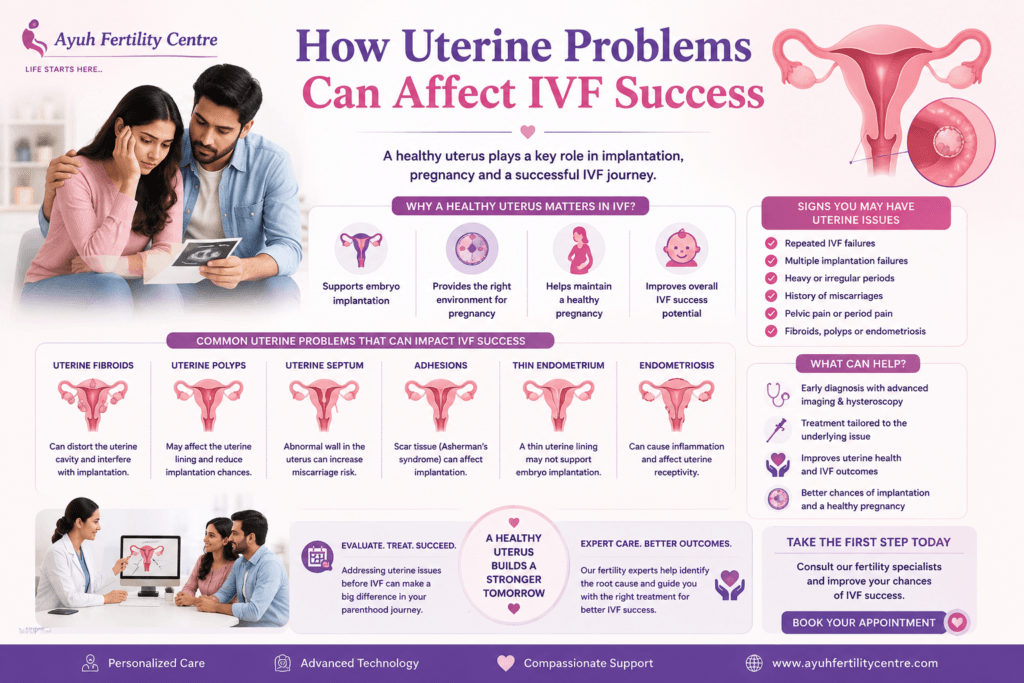
The connection between uterine conditions and IVF failure is one of the most underappreciated aspects of fertility treatment in India — and understanding it helps explain why uterine polyps, fibroids, and IVF failure are so closely linked in clinical practice.
Endometrial Polyps Polyps are overgrowths of the uterine lining that project into the cavity. Even small polyps near the site of embryo implantation can physically block or disrupt the attachment process. They may also create a local inflammatory environment that is unfavourable to implantation. Studies have found that removing polyps before IVF improves pregnancy rates meaningfully in affected women.
Fibroids (Submucosal) Fibroids are benign muscle tumours of the uterus. Not all fibroids affect fertility — the location matters critically. Fibroids that distort the uterine cavity (submucosal fibroids) are the most likely to affect implantation and are associated with higher rates of IVF failure and early pregnancy loss. Fibroids within the cavity wall are visible and treatable through hysteroscopy.
Scar Tissue (Intrauterine Adhesions / Asherman’s Syndrome) Adhesions — bands of scar tissue inside the uterus — can form after surgical procedures, infections, or previous uterine trauma. They can partially or completely obstruct the cavity, prevent normal endometrial development, and significantly impair implantation. Hysteroscopy is both the definitive diagnostic tool and the primary treatment for intrauterine adhesions.
Uterine Septum A uterine septum is a band of tissue that partially or completely divides the uterine cavity — a congenital abnormality that affects approximately 2–3% of women. A septum is associated with recurrent miscarriage and implantation failure because it has poor blood supply and does not respond normally to hormonal signals. Hysteroscopic septoplasty (removal of the septum) is a straightforward and effective procedure.
Chronic Endometritis Subtle, chronic inflammation of the uterine lining — often caused by low-grade infection — can exist without obvious symptoms. The endometrium may appear normal on ultrasound while harbouring a bacterial environment hostile to implantation. Hysteroscopy allows direct visual assessment and biopsy for diagnosis.
Endometrial Abnormalities Irregular or poorly developed endometrial tissue, areas of abnormal vascularity, or other structural irregularities can be assessed and biopsied during hysteroscopy when ultrasound findings are inconclusive.
Conditions That Can Be Diagnosed During Hysteroscopy
One of the most clinically valuable aspects of hysteroscopy is that it can identify conditions that are easily missed through conventional ultrasound — even high-quality 3D ultrasound.
Endometrial Polyps Small polyps (under 1 cm) are frequently missed on standard ultrasound. Even larger polyps can be misidentified as normal endometrial tissue depending on the phase of the cycle. Under hysteroscopic view, they are immediately visible — their precise size, location, and number can be accurately assessed, and removal can be performed in the same session.
Submucosal Fibroids Fibroids that protrude into the uterine cavity are detectable on ultrasound but their exact degree of cavity distortion is better assessed hysteroscopically. This distinction directly affects surgical planning.
Uterine Septum A septum can sometimes be suggested on 2D ultrasound but is most accurately diagnosed — and distinguished from a bicornuate uterus — through hysteroscopy combined with laparoscopy if needed.
Intrauterine Adhesions Adhesions may be suspected on saline infusion sonography but are definitively diagnosed and treated through hysteroscopy. Their extent and density, which determine surgical complexity, are clearly visible under hysteroscopic view.
Retained Tissue Retained products of conception from a previous pregnancy or miscarriage can cause recurrent implantation failure and irregular bleeding. Hysteroscopy identifies and removes retained tissue directly.
Chronic Endometritis The endometrium in chronic endometritis may show characteristic features under hysteroscopy — micropolyps, stromal oedema, and irregular vascularisation. A targeted biopsy can confirm the diagnosis and guide antibiotic treatment before IVF.
Can Hysteroscopy Improve IVF Success Rates?
This is the question most women ask — and it deserves an honest, evidence-grounded answer rather than a simple yes or no.
The evidence broadly supports this:
Several well-conducted studies have found that in women with detected uterine abnormalities — particularly polyps, adhesions, and submucosal fibroids — treating these abnormalities through hysteroscopy before IVF is associated with improved pregnancy rates compared to proceeding with IVF without treatment.
The reasoning is clinically logical: if a correctable physical barrier to implantation is present, removing it before embryo transfer improves the implantation environment. This is not a miracle — it is simply sound preparation.
For women with normal uterine findings:
The picture is more nuanced. Some research has suggested a benefit from hysteroscopy even in women with normal ultrasound findings — a possible “endometrial scratching” effect — but the evidence here is less consistent, and routine hysteroscopy for all IVF patients regardless of findings remains debated.
The balanced clinical view:
Hysteroscopy is most clearly indicated — and most clearly beneficial — when there is a specific clinical reason: recurrent IVF failure, suspected uterine abnormality, abnormal ultrasound findings, or a history of uterine surgery. In these situations, the evidence for benefit is strongest.
What can be said with confidence is this: hysteroscopy does not guarantee IVF success. But identifying and treating a uterine problem that would otherwise silently undermine implantation is a meaningful and potentially critical step for the patients who need it.
Who Should Consider Hysteroscopy Before IVF?
Not every woman requires hysteroscopy before IVF treatment. Your fertility specialist in Ahmedabad will recommend it based on your specific clinical history and investigation findings.
Hysteroscopy before IVF is most commonly recommended for:
- Recurrent IVF failure — Two or more failed embryo transfer cycles with good-quality embryos is one of the strongest indications. Uterine factors should be systematically excluded before further cycles.
- Recurrent miscarriage — Two or more early pregnancy losses, particularly after IVF, warrant thorough uterine evaluation for structural abnormalities like septum or adhesions.
- Abnormal or inconclusive ultrasound findings — If a routine ultrasound suggests a polyp, fibroid, irregular endometrium, or other abnormality that needs clarification, hysteroscopy provides definitive assessment.
- Suspected endometrial polyps — Women with irregular bleeding, intermenstrual spotting, or ultrasound findings suggestive of polyps benefit from hysteroscopic confirmation and removal before transfer.
- History of uterine surgery — Previous caesarean section, myomectomy, curettage (D&C), or other uterine procedures increase the risk of adhesion formation. Pre-IVF hysteroscopy confirms cavity integrity.
- Unexplained infertility — Where standard investigations have not identified a cause, uterine evaluation through hysteroscopy may reveal a hidden factor.
- Suspected uterine septum — Particularly relevant for women with a history of recurrent miscarriage or an abnormal uterine shape on imaging.
What Happens During a Hysteroscopy Procedure?
Understanding what to expect can significantly reduce pre-procedure anxiety. Here is a straightforward, step-by-step explanation of what happens during hysteroscopy at a well-equipped fertility centre.
Before the Procedure
- The procedure is usually scheduled in the first half of the menstrual cycle (days 6–12), when the endometrial lining is thinnest and the uterine cavity is most clearly visible
- You may be asked to avoid food and water for a few hours if sedation or anaesthesia is planned
- A brief pre-procedure consultation confirms your medical history, current medications, and any allergies
- Your blood group and routine pre-operative blood tests may be checked
During the Procedure
- You will be positioned as for a gynaecological examination
- Anaesthesia or sedation is administered if used — or local anaesthetic gel may be applied for an office procedure
- The hysteroscope (a thin, lighted telescope — typically 4–5mm in diameter) is gently guided through the cervix into the uterine cavity
- Saline fluid is introduced to gently expand the cavity and improve visibility
- The surgeon carefully examines the entire inner surface of the uterus — the endometrial lining, both tubal openings (ostia), and the uterine walls
- If a polyp, fibroid, adhesion, or septum is found, small instruments can be passed through the hysteroscope to treat the problem during the same procedure
- The hysteroscope is gently withdrawn. No sutures are required.
- The entire procedure typically takes 15–30 minutes for a diagnostic hysteroscopy and slightly longer if treatment is performed
After the Procedure
- You will rest in a recovery area for 30–60 minutes
- Mild cramping and light spotting are common for 1–2 days after the procedure
- Most women are able to go home the same day — hysteroscopy is a day-care procedure in the vast majority of cases
- A follow-up consultation is scheduled to discuss findings and plan next steps for IVF
Is Hysteroscopy Painful?
This is the question almost every patient asks first — and the honest answer will reassure most women.
For most patients, hysteroscopy involves mild to moderate discomfort rather than significant pain.
The experience varies depending on whether anaesthesia or sedation is used, the patient’s individual pain threshold, and whether treatment (removal of a polyp, for example) is performed during the procedure.
With general anaesthesia or intravenous sedation: You are fully asleep or deeply relaxed and feel nothing during the procedure. Any discomfort experienced is post-procedure — mild cramping similar to period pain, typically lasting a few hours and manageable with standard pain relief.
With local anaesthesia or as an office procedure (no sedation): Some pressure and mild cramping may be felt as the hysteroscope passes through the cervix and the uterine cavity is distended. Most women tolerate this well with oral pain relief taken before the procedure. The discomfort is usually brief and settles quickly once the procedure is complete.
Shoulder tip pain (from fluid causing mild diaphragm irritation) is occasionally reported and resolves within a few hours.
The overall verdict from most patients: The anticipation is worse than the reality. Many women who were very anxious beforehand describe the procedure as “not as bad as I expected.” If you have concerns about pain, discuss your options — including sedation — with your fertility specialist before your appointment.
Hysteroscopy Treatment in Ahmedabad — What Patients Should Know
Hysteroscopy treatment in Ahmedabad is widely available at specialist fertility centres, and the city’s fertility care infrastructure has developed significantly to support both diagnostic and operative hysteroscopy as part of comprehensive IVF preparation.
What to look for when choosing a centre for hysteroscopy:
- Experienced fertility specialist — Hysteroscopy should be performed by a doctor with specific training in operative hysteroscopy, not just general gynaecology. The precision of the procedure matters enormously, particularly for operative cases (polyp removal, septal resection, adhesiolysis).
- Modern equipment — High-definition hysteroscopic equipment provides significantly better visualisation than older systems. Image quality directly affects diagnostic accuracy.
- Day-care facility — A well-equipped day-care theatre with proper anaesthesia support makes the procedure safe and comfortable, with same-day discharge for most patients.
- In-house fertility team — Having hysteroscopy performed within the same fertility centre as your IVF treatment ensures seamless communication between the surgical findings and your IVF protocol planning.
- Clear post-procedure communication — Findings should be explained clearly after the procedure, with a specific plan for how and when IVF will proceed.
At Ayuh Fertility Centre, hysteroscopy is performed by Dr. Krupa M. Shah using modern equipment as a day-care procedure, with findings communicated clearly and integrated directly into each patient’s IVF preparation plan.
Risks and Safety of Hysteroscopy
Hysteroscopy is considered a safe, well-established procedure with a very low risk profile when performed by an experienced specialist. Understanding the possible risks — however rare — is part of informed consent.
Possible risks include:
- Infection — Rare; typically prevented by standard sterile technique and, when appropriate, prophylactic antibiotics
- Bleeding — Minor bleeding is common and normal. Significant bleeding requiring further intervention is uncommon.
- Uterine perforation — A very rare complication where the hysteroscope inadvertently passes through the uterine wall. In experienced hands, this risk is extremely low. If it occurs, it is usually managed conservatively.
- Cervical injury — Minor cervical trauma during instrument passage is possible but rarely clinically significant
- Fluid overload — In longer operative procedures, the distension fluid used can rarely cause fluid absorption issues. Experienced teams monitor for this carefully.
- Anaesthesia reactions — Managed by an experienced anaesthetist present throughout any procedure performed under sedation or general anaesthesia
The safety context: The vast majority of hysteroscopies are completed without any complication. The risk-benefit profile strongly favours the procedure for patients with appropriate clinical indications — particularly when the alternative is proceeding with IVF without detecting a potentially significant uterine problem.
Choosing an experienced fertility specialist who performs hysteroscopy regularly — not occasionally — is the single most important factor in minimising procedural risk.
Recovery After Hysteroscopy
Recovery from hysteroscopy is generally quick and straightforward — particularly for diagnostic procedures or minor operative work.
What to expect in the days after hysteroscopy:
- Mild cramping for 1–3 days, similar to period pain. Standard pain relief (as recommended by your doctor) manages this comfortably.
- Light spotting or vaginal discharge for a few days to 1–2 weeks depending on whether treatment was performed. This is normal and expected.
- Return to normal activities — Most women return to light daily activities within 24–48 hours. Office work can typically resume the following day.
- Avoid swimming, baths, and sexual intercourse for 1–2 weeks as advised, to reduce infection risk while the cervix and endometrium heal.
When can IVF be planned after hysteroscopy?
- For a diagnostic hysteroscopy with no treatment: IVF can typically be planned in the next 1–2 cycles
- After polyp removal: usually 1–2 cycles to allow endometrial healing
- After adhesion treatment: your specialist may recommend a second-look hysteroscopy before IVF to confirm adequate healing
- After septoplasty: typically 1–3 months to allow the endometrium to regenerate over the treated area
Your fertility specialist will give you a specific timeline based on what was found and treated during your procedure.
Common Myths About Hysteroscopy Before IVF
Myth: Hysteroscopy is always very painful. Reality: For most women, hysteroscopy involves mild to moderate discomfort, not severe pain. With appropriate anaesthesia or sedation, many patients feel nothing during the procedure and experience only mild cramping afterwards. Discussing pain management options with your doctor before the procedure is always recommended.
Myth: It unnecessarily delays IVF. Reality: Hysteroscopy typically requires only 1–2 weeks of recovery before IVF planning can proceed. Detecting and treating a uterine abnormality before embryo transfer is far preferable to experiencing a failed IVF cycle and then investigating. The slight delay is a clinical investment, not a setback.
Myth: Ultrasound and hysteroscopy show the same things. Reality: This is one of the most important myths to correct. Ultrasound provides an external image of the uterus; hysteroscopy provides direct internal visualisation of the endometrial surface. They are complementary tools, not interchangeable ones. Studies consistently show that hysteroscopy detects abnormalities missed by ultrasound in a significant proportion of patients.
Myth: Hysteroscopy guarantees pregnancy. Reality: Hysteroscopy improves the uterine environment by identifying and treating correctable problems. It does not guarantee IVF success, which depends on multiple factors including embryo quality, age, and overall fertility health. It removes a potential barrier — it does not replace the other requirements for successful IVF.
Myth: Hysteroscopy is only needed if something is obviously wrong. Reality: Many of the conditions hysteroscopy detects — small polyps, minor adhesions, subtle septums — produce no symptoms and appear normal on ultrasound. The whole point of the procedure is to identify problems that cannot be detected any other way.
Questions to Ask Your Fertility Specialist
Before agreeing to hysteroscopy — or before deciding whether you need it — these questions will help you make a fully informed decision:
- “Do I specifically need hysteroscopy before IVF, and why?” — Ask for the clinical reason based on your individual history and investigations.
- “What abnormalities are you looking for in my case?” — Understanding the specific concern helps you contextualise the recommendation.
- “If a problem is found, can it be treated during the same procedure?” — This is often possible and avoids a second procedure.
- “How soon after hysteroscopy can I begin my IVF cycle?” — Get a specific timeline relevant to your situation.
- “What anaesthesia options are available?” — Discuss sedation or general anaesthesia if you have concerns about discomfort.
- “What are the risks in my specific case?” — A personalised risk discussion is more meaningful than a generic list.
- “What happens if hysteroscopy finds nothing?” — Understanding the plan in both scenarios (normal and abnormal findings) helps with emotional preparation.
FAQ
Q1: Is hysteroscopy necessary before every IVF cycle?
No — hysteroscopy is not routinely required before every IVF cycle. It is most clearly indicated for women with recurrent IVF failure, recurrent miscarriage, abnormal ultrasound findings, suspected uterine polyps or fibroids, a history of uterine surgery, or unexplained infertility. For women with normal ultrasound findings and no clinical risk factors undergoing their first IVF cycle, the decision is made on an individual basis in discussion with the fertility specialist. The procedure is recommended when there is a specific clinical reason to evaluate the uterine cavity more thoroughly than a scan allows.
Q2: Does hysteroscopy improve IVF success rates?
For women in whom a uterine abnormality is detected and treated, the evidence reasonably supports improved IVF outcomes. Removing a polyp, adhesion, or fibroid that was distorting the cavity creates a better implantation environment — and several studies have shown improved pregnancy rates following hysteroscopic treatment before IVF. For women with entirely normal uterine findings, the evidence for benefit is less consistent. No claim of guaranteed success can be made, but identifying and correcting a correctable uterine problem is always preferable to overlooking it.
Q3: Is hysteroscopy painful?
Most women experience mild to moderate discomfort rather than significant pain during hysteroscopy. The experience depends on the type of anaesthesia used and what is performed. With general anaesthesia or IV sedation, patients feel nothing during the procedure. Without sedation, mild cramping similar to a smear test or period pain is typical. After the procedure, mild cramping and light spotting are common for a day or two. The majority of women who have hysteroscopy find the experience more manageable than they anticipated. Discussing anaesthesia preferences with your doctor before the procedure is always encouraged.
Q4: How long does recovery take after hysteroscopy?
Recovery from diagnostic hysteroscopy is typically quick — most women return to light daily activities within 24–48 hours. Mild cramping and light spotting may persist for a few days to 1–2 weeks depending on what was performed. Swimming, baths, and sexual intercourse are usually avoided for 1–2 weeks to reduce infection risk. IVF planning can generally begin in the next 1–2 menstrual cycles after a straightforward hysteroscopy. More extensive operative procedures — such as adhesion removal or septoplasty — may require a slightly longer healing period before the next IVF cycle.
Q5: Can fibroids affect IVF success?
Yes — but the impact depends entirely on the location of the fibroid. Fibroids that distort the uterine cavity (submucosal fibroids) are clearly associated with reduced IVF implantation rates and increased miscarriage risk. These are the fibroids that hysteroscopy can both diagnose and treat. Fibroids located within the uterine muscle (intramural) or on the outer surface (subserosal) have a less clear impact on IVF outcomes, particularly if they do not significantly distort the cavity. The decision to treat fibroids before IVF depends on their size, location, and clinical context — something discussed individually with your fertility specialist.
Conclusion:
Hysteroscopy before IVF is not an additional hurdle — it is a clinical safeguard. It ensures that the environment into which your embryo will be placed has been properly evaluated and, where necessary, optimised. In the field of reproductive medicine, this kind of thorough preparation is what separates reactive treatment from truly personalised, patient-centred care.
Hidden uterine problems are more common than most patients realise. And because many produce no symptoms and are invisible on standard ultrasound, they go undetected — and uncorrected — unless a specialist takes the step of looking inside.
Dr. Krupa M. Shah at Ayuh Fertility Centre approaches every IVF preparation with the same thoroughness: no assumption that the uterus is fine simply because the scan looks normal; no willingness to transfer precious embryos into a cavity that has not been properly assessed. Because every IVF cycle represents significant hope, time, and investment — and every patient deserves to know that the environment for their embryo has been prepared as carefully as possible.
If your fertility specialist has recommended hysteroscopy, this recommendation comes from exactly that place: careful, evidence-based preparation for the best possible chance of success.
👉 Book your consultation with Ayuh Fertility Centre today
👉 Get expert guidance for PCOS and fertility treatment
👉 Start your journey toward a healthy and successful pregnancy
📍 Visit us in Ahmedabad
📞 Call now to schedule your appointment