
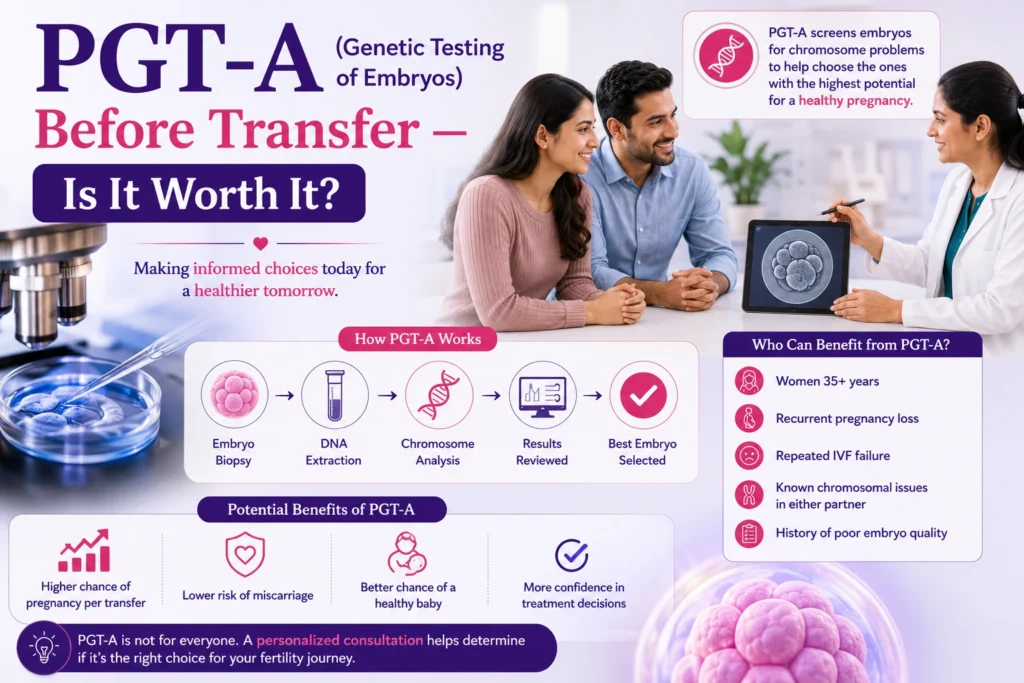
PGT-A — Preimplantation Genetic Testing for Aneuploidy — has become one of the most important decisions couples face during an IVF journey. Before you even reach the transfer stage, this test looks inside each embryo at the chromosomal level, helping your doctor identify which embryos are truly healthy and which ones may never lead to a pregnancy.
Every IVF journey carries an enormous emotional weight. Couples invest not just money, but hope, time, and a deep piece of their hearts into each cycle. When you have gone through the injections, the scans, the egg retrievals — the last thing you want is to transfer an embryo that has no real chance of becoming your baby.
That is exactly why PGT-A has changed the way fertility specialists make embryo selection decisions — allowing science to go beyond what any microscope can see.
But is PGT-A right for everyone? Does it guarantee success? And is the added cost justified?
Dr. Krupa M. Shah, a leading fertility specialist in Ahmedabad with over 19 years of experience and 10,000+ successful cases, explains everything you need to know — clearly, honestly, and without the jargon.
Author Bio
Dr. Krupa A. Shah MBBS · MS (Obstetrics & Gynaecology) · Infertility Specialist Founder, Ayuh Fertility Centre, Ahmedabad
19+ Years of Experience in reproductive medicine, obstetrics, and gynaecology.
Dr. Krupa Shah completed her MBBS from Baroda Medical College (2006) and her MS in Obstetrics & Gynaecology from B.J. Medical College, Ahmedabad (2010). After 12 years of experience at leading clinics in Chennai — including Apollo Hospital and Iswarya Fertility Centre — she completed an Advanced IVF Fellowship at Ludwig Maximilians University, Munich, Germany, one of Europe’s most prestigious reproductive medicine institutions.
She is a member of the Ahmedabad Obstetrics and Gynaecology Society (AOGS), the Indian Society of Assisted Reproduction (ISAR), and the Federation of Obstetric and Gynaecological Societies of India (FOGSI).
IVF laboratory is ART National Board Certified.
🩺 Medically Reviewed By
This article is medically reviewed by Dr. Krupa M. Shah, ensuring accurate and reliable fertility information.
What Is PGT-A?
PGT-A stands for Preimplantation Genetic Testing for Aneuploidy. It is a type of genetic testing of embryos performed during an IVF treatment cycle, before the embryo is transferred into the uterus.
The word “aneuploidy” refers to an abnormal number of chromosomes. Human embryos should have exactly 46 chromosomes — 23 pairs. When an embryo has too many or too few chromosomes, it is called aneuploid. These chromosomally abnormal embryos are the leading cause of failed implantation and early miscarriage.
PGT-A helps identify which embryos have the correct number of chromosomes (called euploid embryos) and which ones do not. By selecting a euploid embryo for transfer, fertility specialists can potentially reduce the chance of a failed cycle or pregnancy loss.
It is important to understand that PGT-A does not test for every genetic disease — it specifically screens for chromosomal number errors. For more specific hereditary conditions, a different test called PGT-M is used.
How Does PGT-A Work?
The process happens in stages and fits naturally within your IVF cycle:
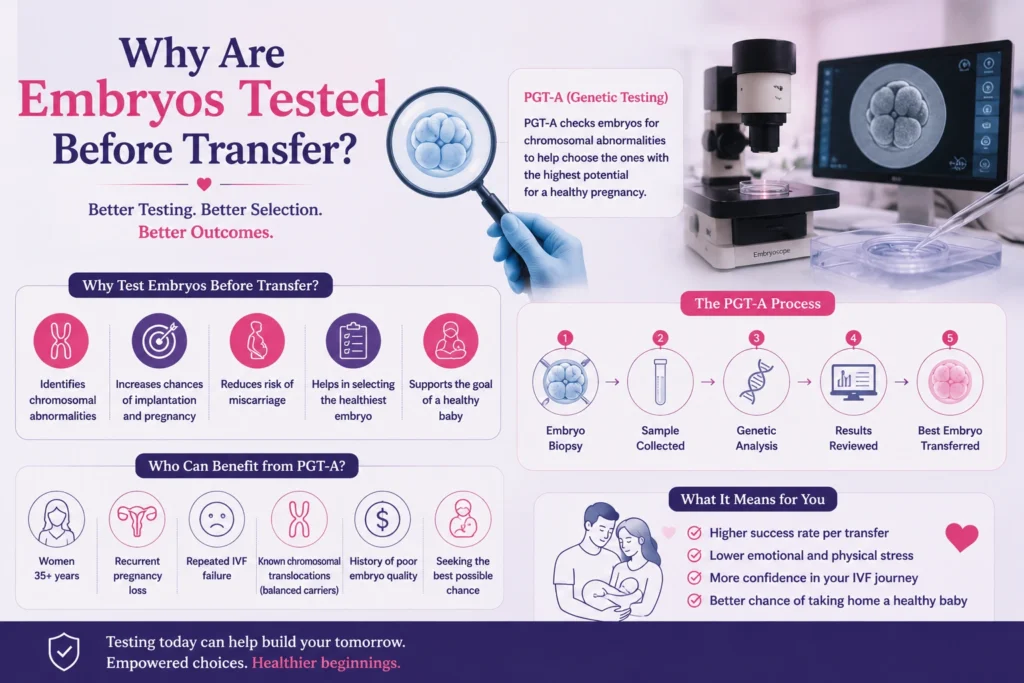
1. IVF Stimulation You begin with hormone injections to stimulate your ovaries to produce multiple eggs. This is the same process as a standard IVF treatment cycle.
2. Egg Retrieval Mature eggs are collected using a minimally invasive procedure. At Ayuh Fertility Centre, this is known as the egg pick up procedure, performed under ultrasound guidance and light sedation.
3. Fertilisation Eggs are fertilised in the laboratory — either by conventional IVF or by ICSI (Intracytoplasmic Sperm Injection), where a single sperm is injected directly into the egg.
4. Embryo Development to Blastocyst Stage Fertilised embryos are cultured for five to six days until they reach the blastocyst stage — the ideal stage for biopsy and transfer.
5. Embryo Biopsy A few cells (called trophectoderm cells) are carefully removed from the outer layer of each blastocyst. This outer layer forms the placenta, not the baby itself, so the biopsy does not damage the embryo’s developmental potential.
6. Genetic Analysis The biopsied cells are sent to a specialist genetics laboratory where the chromosomes are analysed using Next Generation Sequencing (NGS) or a similar technique. Results typically take five to ten days.
7. Embryo Freezing While waiting for results, all biopsied embryos are cryopreserved (frozen) to keep them safe.
8. Frozen Embryo Transfer Once results are available, a chromosomally normal embryo is selected for frozen embryo transfer in a subsequent cycle.
Why Are Embryos Tested Before Transfer?
Even embryos that look perfect under a microscope can carry chromosomal abnormalities that are invisible to the human eye. This is a core problem in IVF — appearance alone does not predict chromosomal health.
Chromosomally abnormal embryos are the primary reason for:
- Implantation failure — the embryo does not attach to the uterine lining
- Early miscarriage — the pregnancy ends before 12 weeks
- Repeated IVF failure — multiple cycles with no successful pregnancy
- Biochemical pregnancies — a positive test followed by an early loss
PGT-A testing before IVF transfer allows the embryologist and fertility specialist to go beyond appearance and make embryo selection decisions based on genetic data. This is particularly meaningful for couples who have experienced previous losses or failed cycles.
At Ayuh Fertility Centre, Dr. Krupa Shah evaluates each patient’s full history — including infertility workup findings — before recommending whether PGT-A is appropriate for a specific couple.
Who May Benefit Most from PGT-A?
PGT-A is not for everyone, but for certain groups of patients, it can play a meaningful role in their fertility treatment plan.
Women Over 35 / Advanced Maternal Age
As women age, the rate of chromosomally abnormal embryos increases significantly. By age 40, more than half of all embryos may be aneuploid. PGT-A helps identify the healthy ones faster.
Recurrent IVF Failure
Couples who have had multiple failed IVF cycles despite good embryo quality may benefit from PGT-A to rule out chromosomal issues as the cause.
Recurrent Miscarriage
If you have experienced two or more pregnancy losses, chromosomal abnormalities in embryos are a common underlying cause. PGT-A combined with genetic testing and screening can help identify this.
Multiple Failed Embryo Transfers
When embryos have been transferred multiple times without implantation, PGT-A can help rule out embryo-related chromosomal factors.
Couples with Known Genetic Concerns
Couples who have had a child with a chromosomal condition, or have a family history of genetic disorders, may find PGT-A — along with genetic screening — valuable before transfer.
Younger Women with Good Prognosis
For younger women with a first IVF cycle and multiple healthy embryos, the benefit of PGT-A is less clear. In such cases, the decision should be made based on individual factors.
PGT-A IVF Success Rate — Does It Improve Outcomes?
This is the question most couples ask, and the honest answer is: it depends.
Research suggests that PGT-A IVF success rates can be improved in specific patient groups — particularly older women and those with a history of failed cycles. Here is what studies show:
- In women over 35–37, PGT-A has been associated with higher live birth rates per transfer compared to untested embryos
- PGT-A may reduce the rate of miscarriage by avoiding transfer of chromosomally abnormal embryos
- For couples with recurrent implantation failure, selecting euploid embryos has shown benefits in some studies
- In younger patients with good ovarian reserve, the cumulative live birth rate may not be significantly different with or without PGT-A
It is important to be clear: PGT-A does not guarantee pregnancy. A chromosomally normal embryo can still fail to implant due to uterine factors, immune issues, or other unknown reasons. However, it does give your doctor the best possible information to make the transfer decision.
At Ayuh Fertility Centre, Dr. Krupa Shah interprets PGT-A results alongside the full clinical picture, never in isolation.
Benefits of PGT-A
When used appropriately, PGT-A offers several potential advantages:
- Better embryo selection — transfer of the most chromosomally viable embryo
- Reduced risk of transferring chromosomally abnormal embryos
- Lower miscarriage risk in selected patient groups
- Fewer unsuccessful transfer attempts — saving time and emotional strain
- Improved confidence during embryo transfer decision-making
- Useful for embryo prioritisation when multiple embryos are available
- Peace of mind for couples who have experienced previous losses
Limitations of PGT-A
This section matters just as much as the benefits. Honest fertility care means sharing both sides.
Not all embryos survive biopsy and freezing Although the technique has improved significantly, a small number of embryos may not survive the biopsy or the freeze-thaw process.
No guarantee of pregnancy A euploid (chromosomally normal) embryo still needs to implant successfully. PGT-A does not address uterine lining issues, immune factors, or other causes of implantation failure.
Mosaic embryos — a grey area Some embryos receive a “mosaic” result — meaning a mixture of normal and abnormal cells. These embryos present complex decisions and require careful counselling by a specialist like Dr. Krupa Shah.
Additional cost PGT-A adds to the overall IVF treatment cost. It is important to weigh this against the potential benefit for your individual situation.
Inconclusive results Occasionally, a biopsy sample may not yield a clear result, requiring further analysis or repeat testing.
Smaller patient population for transfer In some cycles — especially those with fewer embryos — PGT-A may result in fewer (or no) euploid embryos available for transfer.
Is PGT-A Worth It for Every IVF Patient?
Simply put: No. PGT-A is a powerful tool, but it is not universally beneficial for every patient.
Younger women (under 35) on their first IVF cycle The natural rate of chromosomal abnormalities is lower in younger women. For those with multiple good embryos and no history of loss or failure, PGT-A may not change the outcome significantly.
Older women (35–42) This is where PGT-A tends to show the clearest benefit. The rate of aneuploid embryos rises sharply with age, and selecting a confirmed euploid embryo can meaningfully improve outcomes.
Couples with recurrent miscarriage or failed transfers Strong candidates for PGT-A, as chromosomal issues are a common underlying factor.
Donor egg IVF Since donor eggs come from younger women, the aneuploid rate is generally lower. PGT-A may be less impactful here, although it is still an option in some cases.
The decision should always be made with your fertility specialist, after reviewing your individual diagnosis, age, embryo numbers, and history. At Ayuh Fertility Centre, this discussion happens in detail during your personalised consultation.
Common Myths About PGT-A
Myth 1: PGT-A guarantees IVF success False. PGT-A improves embryo selection but cannot guarantee implantation or live birth. Many factors beyond chromosomes influence pregnancy outcomes.
Myth 2: PGT-A detects every genetic disease False. PGT-A only screens for chromosomal number errors (aneuploidy). It does not detect single-gene conditions like cystic fibrosis or thalassaemia — those require specialised genetic testing.
Myth 3: Every IVF patient needs PGT-A False. Younger patients on their first IVF cycle with no history of loss often do not need PGT-A. It is most useful for specific clinical situations.
Myth 4: A normal embryo will always result in pregnancy False. Even a chromosomally normal embryo can fail to implant due to uterine receptivity issues, lining problems, or other factors that PGT-A cannot predict.
Myth 5: PGT-A is harmful to the embryo Not accurate with modern techniques. Biopsy of trophectoderm cells at the blastocyst stage is now highly refined, with very low impact on embryo viability when performed by experienced embryologists.
Risks Associated with PGT-A
Like any medical procedure, PGT-A carries considerations worth understanding:
- Embryo biopsy carries a small risk of damage, though modern blastocyst biopsy techniques have significantly minimised this
- Additional IVF cost — PGT-A adds to the overall expense of your IVF cycle, which should be factored into your planning
- Delay due to freezing — since all biopsied embryos must be frozen while awaiting results, transfer cannot happen in the same cycle as retrieval
- Emotional expectations — couples can place excessive hope on PGT-A results. It is important to go in with realistic expectations and a clear conversation with your fertility specialist
- Reduced embryo availability — in cycles with few blastocysts, a mosaic or abnormal result may leave a couple with no embryos for transfer in that cycle
Questions to Ask Your Fertility Specialist About PGT-A
Before deciding on PGT-A, bring these questions to your consultation:
- Am I a good candidate for PGT-A based on my age and history?
- How many blastocyst-quality embryos do I typically produce per cycle?
- Will PGT-A meaningfully improve my chances given my specific diagnosis?
- What happens if all my embryos come back abnormal or mosaic?
- What is the additional cost, and is it included in the IVF treatment pricing?
- Do you recommend PGT-A for my first cycle, or after a failure?
- How do you handle mosaic embryo results — will you explain the options to me clearly?
At Ayuh Fertility Centre, no question is too small. Dr. Krupa Shah takes time to walk every couple through their options before any decision is made.
Emotional Considerations Before Choosing PGT-A
The IVF journey is emotionally demanding at every stage. Adding PGT-A brings its own layer of anxiety.
Some couples feel deeply reassured knowing their embryo has been chromosomally screened. Others find the waiting period — and the possibility of no euploid embryos — extremely difficult to manage emotionally.
A few things to hold onto:
- A result of “no euploid embryos this cycle” does not mean your journey is over. It means the next step needs a different approach.
- Decision fatigue is real. You do not have to make this decision alone. Your specialist, a counsellor, or a trusted support person can help.
- Balancing hope with realistic expectations is not pessimism — it is self-protection.
- Cost pressure is a real concern for many families. At Ayuh Fertility Centre, transparent IVF pricing and flexible payment options are available so that cost never becomes a barrier to getting the right care.
Whatever you decide, make sure it is your informed decision — not driven by fear or pressure, but by understanding.
FAQs
1.What is PGT-A?
PGT-A (Preimplantation Genetic Testing for Aneuploidy) is a genetic screening test performed on embryos during an IVF cycle before transfer. It analyses the chromosomes of each embryo to identify those with a normal chromosome count (46 chromosomes). By selecting chromosomally normal embryos, fertility specialists aim to reduce the risk of failed implantation and miscarriage. PGT-A is performed at the blastocyst stage, with a small number of cells biopsied from the embryo’s outer layer. Results guide which embryo is best suited for transfer.
2.Does PGT-A improve IVF success?
PGT-A can improve outcomes for specific groups — particularly women over 35, those with recurrent miscarriage, and couples with repeated IVF failures. Research shows improved live birth rates per transfer in these groups when euploid embryos are selected. However, it does not guarantee pregnancy. For younger patients on a first cycle with no prior losses, the benefit is less clear. Success still depends on uterine receptivity, embryo quality beyond chromosomes, and other clinical factors. Always discuss expected outcomes with your IVF specialist.
3.Is PGT-A necessary for all IVF patients?
No. PGT-A is not a requirement for every IVF patient. It is most beneficial for women over 35, those with repeated implantation failure, recurrent miscarriage, or chromosomal concerns. Younger women on their first IVF cycle with good ovarian reserve and no history of losses may not need PGT-A to achieve a successful pregnancy. The decision should be personalised based on clinical history, age, diagnosis, and embryo numbers. Speak to your fertility specialist at Ayuh Fertility Centre for an individualised recommendation.
4.Can PGT-A prevent miscarriage?
PGT-A can reduce the risk of chromosomally-driven miscarriage by helping doctors avoid transferring aneuploid embryos. A significant proportion of early pregnancy losses are caused by chromosomal abnormalities, so selecting euploid embryos addresses one major contributing factor. However, PGT-A cannot prevent all miscarriages — other causes such as uterine abnormalities, hormonal imbalances, or immune factors are not addressed by embryo chromosome testing. For high-risk pregnancies, additional monitoring and care is also essential.
5.How accurate is PGT-A?
PGT-A using modern Next Generation Sequencing (NGS) technology is highly accurate for detecting full chromosomal abnormalities. However, it has limitations — mosaic embryos (with a mix of normal and abnormal cells) may produce ambiguous results, and very small segmental abnormalities can sometimes be missed. No test is 100% perfect. PGT-A provides the best available genetic information before transfer, but it should always be interpreted alongside clinical evaluation by an experienced fertility specialist.
Conclusion
Choosing to do PGT-A is one of the most personal decisions in an IVF journey. It is not a simple yes or no — it is a conversation that deserves honesty, data, and compassion.
PGT-A can be a genuinely valuable tool for the right patient at the right time. For couples with recurrent loss, advanced maternal age, or repeated IVF failures, it can bring both clinical benefit and emotional clarity. For others — particularly younger patients on an early cycle — it may not change the outcome in a meaningful way.
What matters most is that the decision is yours, made with full information and the support of a specialist who knows your complete history.
Dr. Krupa M. Shah and the team at Ayuh Fertility Centre, Ahmedabad are committed to exactly that kind of care. With 19+ years of experience, globally accredited training, and a track record of 10,000+ successful fertility treatments, Dr. Shah takes time with every couple to help them understand their options — clearly, without pressure, and with your long-term wellbeing at heart.
If you are wondering whether PGT-A is right for your journey, the first step is a conversation.
👉 Book your consultation with Ayuh Fertility Centre today
👉 Get expert guidance for PCOS and fertility treatment
👉 Start your journey toward a healthy and successful pregnancy
📍 Visit us in Ahmedabad
📞 Call now to schedule your appointment