

Choosing the best IVF doctor in Ahmedabad is one of the most important decisions you will ever make. Not just medically — but emotionally and financially too. And yet, most couples make this decision with very little guidance on what actually matters.
You search online. You read reviews. You compare a few websites. Maybe you call one or two clinics and hear a price. Then you try to figure out who to trust with something as precious as your dream of starting a family.
It is overwhelming. And it is completely understandable to feel lost.
IVF is not a simple procedure. It is a multi-week, highly personalised medical journey that requires a specialist who knows your body, listens to your concerns, communicates honestly, and has the experience and technology to give you the best possible chance. That is why the doctor you choose matters as much as the treatment itself.
At Ayuh Fertility Centre in Ahmedabad, Dr. Krupa M. Shah — Fertility Specialist with 19+ years of experience and a Diploma in Reproductive Medicine from Germany — has helped more than 10,000 couples navigate this exact decision with clarity and confidence.
This guide gives you a 12-point checklist to evaluate any IVF doctor or fertility clinic before committing to treatment. It also covers the questions you should ask, the red flags to avoid, and the qualities that truly separate a good fertility specialist from a great one.
Author Bio
Dr. Krupa A. Shah MBBS · MS (Obstetrics & Gynaecology) · Infertility Specialist Founder, Ayuh Fertility Centre, Ahmedabad
19+ Years of Experience in reproductive medicine, obstetrics, and gynaecology.
Dr. Krupa Shah completed her MBBS from Baroda Medical College (2006) and her MS in Obstetrics & Gynaecology from B.J. Medical College, Ahmedabad (2010). After 12 years of experience at leading clinics in Chennai — including Apollo Hospital and Iswarya Fertility Centre — she completed an Advanced IVF Fellowship at Ludwig Maximilians University, Munich, Germany, one of Europe’s most prestigious reproductive medicine institutions.
She is a member of the Ahmedabad Obstetrics and Gynaecology Society (AOGS), the Indian Society of Assisted Reproduction (ISAR), and the Federation of Obstetric and Gynaecological Societies of India (FOGSI).
IVF laboratory is ART National Board Certified.
Medically Reviewed By
This article is medically reviewed by Dr. Krupa A. Shah, MD — ensuring accurate, evidence-based, and reliable fertility information for couples seeking guidance on infertility treatment options.
1. Why Choosing the Right IVF Doctor Matters So Much
People often think of IVF as a procedure. A technical process. Something that either works or it does not. But that framing misses the most important truth about fertility treatment: the outcome depends enormously on the person designing and managing it.
Your Doctor Designs Your Protocol
IVF is not a standard recipe. The stimulation dose, the medication protocol, the trigger timing, the embryo selection strategy, and the transfer decision — all of these are made by your doctor, based on your specific test results, history, and response. Two patients at the same clinic can have completely different protocols. The quality of those decisions directly affects your outcomes.
Your Doctor Is Your Partner Through Uncertainty
IVF involves a lot of waiting, a lot of monitoring, and a significant amount of emotional uncertainty. A doctor who communicates clearly, explains what is happening at each stage, and is genuinely available when you have concerns makes an enormous difference to how you experience the process — especially if things do not go according to plan.
Trust Affects Your Ability to Stay the Course
Many couples abandon fertility treatment not because IVF failed, but because they lost trust in their clinic — because of unexpected charges, poor communication, or feeling like just another patient in a busy queue. Choosing a doctor you genuinely trust from the beginning reduces this risk significantly.
2. The 12-Point IVF Doctor Checklist
Use this IVF doctor checklist at every consultation. It covers the factors that genuinely distinguish a specialist you should trust from one you should approach with caution.
1. Years of Experience in Fertility Treatment Look for a specialist with at least 8 to 10 years of dedicated fertility practice — not just general obstetrics and gynaecology. IVF is a subspecialty. A doctor who performs 200 to 300 egg retrievals per year has a fundamentally different skill set from one who does 20 to 30. Ask specifically: how many IVF cycles do you personally perform per year?
2. IVF Success Rate Transparency A confident, ethical clinic will share its success rates openly. But always ask for age-specific rates — not just an overall number. A clinic that primarily treats younger patients with better prognosis will naturally show higher rates. Ask: what is your success rate for patients in my age group with my diagnosis? Be cautious of clinics that refuse to answer this specifically.
3. Qualifications and Specialisation Your fertility specialist should hold an MD or MS in Obstetrics and Gynaecology at minimum. Advanced qualifications — such as a Fellowship in Reproductive Medicine, DipNB, or an international Diploma in Reproductive Medicine — signal deeper specialist training. Check whether their qualifications are real and verifiable. Membership of recognised fertility bodies (FOGSI, ISAR) is also a positive indicator.
4. In-House IVF Laboratory Quality The IVF lab is where fertilisation, embryo culture, and embryo selection happen. This is arguably the most critical infrastructure in IVF. An in-house lab with ISO certification, strict temperature and air quality controls, and experienced embryologists produces meaningfully better embryo quality than a shared or outsourced lab. Always ask: is your embryology lab in-house, and what certifications does it hold?
5. Personalised Treatment Approach Avoid any clinic that gives you a treatment plan before reviewing your test results. A good fertility specialist designs your protocol after reviewing your AMH, AFC, semen analysis, hormonal panel, and medical history. The stimulation protocol for a 28-year-old with PCOS is completely different from that of a 38-year-old with low ovarian reserve. One-size-fits-all IVF is a warning sign, not a value proposition.
6. Honest and Clear Communication Your doctor should explain your diagnosis in language you can understand, be honest about your realistic chances, and clearly tell you why each medication and procedure is being recommended. If a doctor rushes through consultations, avoids difficult questions, or gives you only positive information without discussing risks or failure scenarios — that is a concern. Good fertility medicine requires honest conversations, even the uncomfortable ones.
7. Availability During Your Treatment Cycle IVF cycles move quickly. Monitoring results need timely review. Dose adjustments may be needed within hours. Will you actually see your specialist during monitoring appointments, or will you be managed by junior staff? Ask directly: will I have regular access to you throughout my cycle, or will consultations be delegated? Continuity of care during a live cycle matters significantly.
8. Access to Advanced Fertility Technology Modern IVF outcomes depend on access to the right tools: ICSI for male factor infertility, PGT-A and PGT-M for genetic embryo testing, time-lapse embryo monitoring where clinically indicated, and surgical sperm retrieval (TESA/PESA) for azoospermia. A clinic that refers patients to other facilities for these procedures introduces risk and delay. Confirm that advanced technologies are available in-house.
9. Genuine Patient Reviews and Testimonials Online reviews are useful, but require interpretation. Look for reviews that describe the actual patient experience: how did the doctor communicate? How were difficult conversations handled? What happened when a cycle failed? Reviews that only say ‘great success, very happy’ tell you less than reviews that describe a compassionate, transparent, and supportive experience during a difficult moment.
10. Full Transparency in IVF Costs The best fertility specialists ensure that you receive a written, itemised cost estimate before any treatment begins. This includes the base procedure, medications, potential ICSI, embryo freezing, FET costs, and genetic testing if relevant. If a clinic is reluctant to provide a written estimate, or if the first verbal quote seems too low to include all services, ask more questions before proceeding.
11. Emotional Support and Counselling Access Fertility treatment is psychologically demanding. The waiting, the uncertainty, the physical demands of stimulation, and the grief of a failed cycle are all genuinely difficult experiences. A clinic that offers structured emotional support — formal counselling, regular check-ins, access to a support team — takes the full patient experience seriously. This is not a luxury. It is part of good fertility care.
12. Ethical Medical Practice This is the most important point and the hardest to evaluate from a website. An ethical fertility specialist will tell you when IVF is NOT the right option for you. They will counsel you out of unnecessary treatments. They will not recommend expensive add-ons without strong clinical justification. They will discuss donor options honestly when that is the realistic pathway. Ethical practice is what separates a specialist who genuinely prioritises your outcomes from one who prioritises revenue.
✅ At Ayuh Fertility Centre, Dr. Krupa M. Shah applies all 12 of these principles as standard practice — not as aspirations. Every patient receives personalised protocols, written cost estimates, full transparency, and direct access to Dr. Shah throughout their treatment cycle.
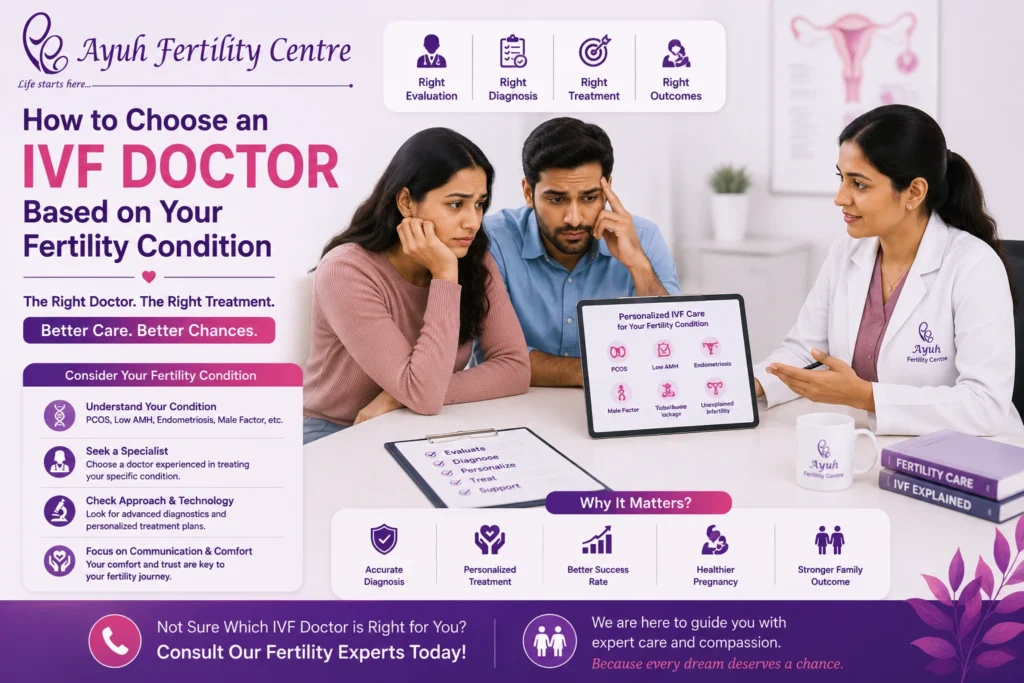
3. How to Choose an IVF Doctor Based on Your Fertility Condition
Different fertility conditions require different levels of specialist expertise. Here is a guide to how to choose an IVF doctor based on your specific diagnosis:
| Fertility Condition | What to Look for in Your IVF Doctor |
|---|---|
| PCOS (Polycystic Ovary Syndrome) | Experience with low-dose antagonist protocols that stimulate adequately without triggering OHSS. Ask how many PCOS IVF cycles the doctor manages per year and what their OHSS rate is. |
| Low AMH / Poor Ovarian Reserve | Experience with poor-responder protocols, dual stimulation (DuoStim), and managing expectations around egg numbers. Seek a doctor who is honest about realistic outcomes rather than one who over-promises. |
| Severe Male Factor Infertility | ICSI expertise is non-negotiable. Also confirm that TESA and PESA (surgical sperm retrieval) are available in-house. Some cases of severe male infertility require microsurgical TESE, which requires specialist urological collaboration. |
| Repeated IVF Failure (2+ failed cycles) | Look for a specialist who will conduct a thorough review of prior cycle records before recommending a new protocol. ERA, PGT-A, immune testing, and hysteroscopy may all be relevant. Avoid doctors who just repeat the same protocol after failure. |
| Advanced Maternal Age (38+) | Experience with older patients, realistic counselling about egg quality and success rates, and access to PGT-A for chromosomal screening. A doctor who gives overly optimistic projections to older patients without discussing donor eggs as an option is a concern. |
| Endometriosis | Experience managing endometriosis-related infertility, including laparoscopic assessment and surgical collaboration where needed. IVF protocols in endometriosis cases are often more complex and require a genuinely experienced specialist. |
| Recurrent Miscarriage | Experience with PGT-M and PGT-A for embryo screening, thrombophilia workup, uterine assessment, and immune protocol management. This is a subspecialty within a subspecialty — experience matters significantly. |
4. What Makes a Fertility Specialist Truly the Best?
The phrase best fertility specialist in Ahmedabad is used frequently in clinic marketing. But what does it actually mean? Here is an honest assessment of the qualities that genuinely matter.
It Is Not Just About Success Rate Numbers
A clinic can show impressive success rate statistics and still not be the right choice for you. Success rates are influenced by patient selection, how failed cycles are recorded, and whether the clinic accepts complex or difficult cases. A clinic that turns away older patients or poor responders will naturally show higher rates than one that treats all patients regardless of prognosis.
It Is About Honest, Calibrated Expectations
The best fertility specialists tell you the truth about your realistic chances. They explain why your AMH is relevant. They discuss what happens if this cycle does not work. They mention donor eggs when that is a realistic path forward. Honesty about difficult realities is a sign of clinical confidence and ethical practice — not pessimism.
It Is About Personal Attention
In many large fertility chains, patients are managed by a rotating team of junior doctors with limited involvement from the named specialist. The best fertility care happens when one experienced doctor knows your case from start to finish. Ask directly who will be managing your monitoring, who will perform your egg retrieval, and who makes the final protocol decisions.
It Is About Lab Quality
The embryologist is an invisible but critical member of your fertility team. An experienced embryologist working in a well-equipped in-house lab significantly improves fertilisation rates, blastocyst development rates, and ultimately outcomes. The quality of the lab is often a better predictor of IVF success than the marketing materials of the clinic.
It Is About Communication
A truly excellent fertility specialist is available to answer your questions, explains results clearly, and does not leave you waiting anxiously for information. This is particularly important during the two-week wait after embryo transfer and when delivering difficult news about cycle outcomes.
5. Red Flags to Avoid When Choosing an IVF Clinic
Knowing what to avoid is as important as knowing what to look for. Here are the most common warning signs:
| Red Flag | What It Signals |
|---|---|
| Clinic advertises ‘100% IVF success rate’ | No clinic in the world has a 100% IVF success rate. This claim is either dishonest or based on very selective patient data. It signals a willingness to mislead patients. |
| No written cost estimate before treatment | Verbal quotes are not protection against unexpected bills. A clinic that will not provide a written itemised estimate before treatment starts does not prioritise financial transparency. |
| Vague or changing treatment plans | If a clinic cannot clearly explain why a specific protocol was chosen for your test results, that is a concern. Your treatment plan should be explained with reference to your specific diagnosis and test results. |
| Pressure to start treatment immediately | Urgency without clinical justification is a sales tactic, not medical advice. A good fertility specialist gives you time to ask questions and make an informed decision. |
| Poor response to difficult questions | If a doctor becomes defensive, dismissive, or evasive when you ask about success rates by age group, costs excluded, or what happens if the cycle fails — that tells you something important. |
| No in-house embryology lab | Clinics that send embryos to external labs for culture introduce risk and reduce quality control. This is a significant structural limitation that affects outcomes. |
| Heavy push for unnecessary add-ons | Procedures like endometrial scratching, time-lapse monitoring, PRP infusions, or extensive immune panels are sometimes recommended without strong clinical indication. Ask for the evidence supporting any add-on specific to your case. |
| Reviews only showing successes | A clinic that appears to have only positive reviews — and no evidence of how they handle difficult cases, failed cycles, or patient concerns — may be curating its feedback rather than building genuine trust. |
6. Questions You Should Ask Before Starting IVF Treatment
These are the questions every couple should bring to their first fertility consultation. Write them down. The answers will tell you more than any clinic brochure.
- What are my realistic chances of success with IVF, given my specific age and test results?
- Can you give me a written, itemised cost estimate before we begin?
- What is specifically included in the base price and what is charged separately?
- Is your IVF lab in-house? What certifications does it hold?
- Will I meet with you personally at each monitoring appointment, or will junior staff manage my cycle?
- Who performs the egg retrieval and embryo transfer?
- How many IVF cycles do you personally perform per year?
- What happens if my first cycle does not succeed? What does a second cycle cost?
- Is ICSI included in your base price or is it an additional charge?
- Will my embryos be frozen, and what are the annual storage charges?
- Do you recommend any add-on procedures for my case, and what is the clinical evidence behind them?
- What emotional support or counselling is available during treatment?
- Are EMI or flexible payment options available?
💡 A good IVF doctor will welcome all of these questions and answer them clearly and honestly. A doctor who rushes you through the consultation, deflects specific questions, or makes you feel that asking about costs or outcomes is inappropriate — is giving you important information about what your treatment experience will be like.
7. IVF Success Rate vs Doctor Experience — Which Matters More?
When couples research top IVF specialists in Ahmedabad, they often fixate on success rate percentages. But experience and success rates are not competing factors. They are interrelated — and experience is often the more reliable indicator.
Why Raw Percentages Can Mislead
Success rates can be presented in many different ways. Per-embryo-transfer rate. Per-cycle-started rate. Per-patient rate. Cumulative rate over multiple cycles. Clinical pregnancy rate versus live birth rate. Each of these calculations produces a different number from the same data.
A clinic with a 70% success rate that primarily accepts patients under 35 with good ovarian reserve is not more skilled than a clinic with a 55% success rate that accepts complex cases across all age groups. Context matters enormously.
What Doctor Experience Actually Means
An experienced fertility specialist has seen a wide range of patient profiles, managed difficult stimulation responses, navigated failed cycles, and developed the clinical judgment to make the right decision under uncertainty. That accumulated experience translates directly into better protocol design, better embryo selection decisions, and better outcomes over time.
Ethical Counselling Is Part of Expertise
An experienced specialist knows when IVF is unlikely to work and will tell you that honestly. They will discuss donor eggs when that is the realistic path to parenthood. They will advise when a break is appropriate rather than pushing for another cycle. That kind of honest, patient-first guidance is a direct product of clinical experience and ethical practice.
⚠️ Important Reminder: No IVF clinic can guarantee success. Medically responsible language is: “Success rates vary significantly based on individual age, diagnosis, and treatment response.” Any clinic that claims guaranteed outcomes should be approached with serious caution.
8. Emotional Comfort Matters More Than Most Couples Realise
When couples evaluate IVF doctors, they naturally focus on qualifications, success rates, and costs. What they often underestimate is how much the emotional dimension of the patient-doctor relationship affects their experience of treatment.
IVF Is Emotionally Demanding at Every Stage
From the first injection to the two-week wait after embryo transfer, IVF involves sustained uncertainty, physical discomfort, and significant emotional vulnerability. Every monitoring scan comes with anticipation. Every blood result carries weight. A doctor who acknowledges this and communicates with compassion makes the process genuinely more manageable.
Anxiety Affects Outcomes
There is growing evidence that psychological stress during IVF can affect treatment response and implantation rates. A clinic that provides structured emotional support, clear communication, and a calm, reassuring environment is not just being kind — it is providing better care.
How Your Doctor Handles Bad News
Failed IVF cycles happen. They happen at excellent clinics, with excellent doctors, in patients who did everything right. How your doctor communicates a failed cycle, provides an honest explanation, and discusses next steps is one of the most telling indicators of their character and competence. A good specialist meets that moment with empathy, honesty, and a clear plan.
When you visit a clinic for the first time, pay attention to how you feel during the consultation. Does the doctor listen? Do they explain things clearly? Do they make you feel rushed? That initial consultation is a preview of what your entire treatment journey will feel like.
9. Ahmedabad as a Fertility Treatment Destination
Ahmedabad has grown significantly as a fertility treatment destination over the past decade. For couples in Gujarat — and increasingly for those travelling from other states — it offers a strong combination of experienced specialists, modern infrastructure, and meaningfully lower costs compared to Mumbai, Delhi, or Bangalore.
What Has Changed in Ahmedabad’s IVF Landscape
- Several dedicated fertility centres with in-house ISO-certified labs now operate in the city
- Specialist fertility doctors with international training are increasingly based in Ahmedabad rather than exclusively in larger metros
- Advanced procedures including ICSI, PGT, TESA, and ERA are now available locally without the need for referral to other cities
- Regulatory compliance (ICMR registration) has improved the standard of care across the city’s fertility sector
Cost Advantage Over Other Cities
Standard IVF in Ahmedabad typically costs ₹1,20,000 to ₹1,40,000 per cycle at quality specialist centres. Equivalent treatment in Mumbai or Delhi would typically cost ₹1,50,000 to ₹3,00,000 or more. For couples from across Gujarat and neighbouring states, Ahmedabad offers specialist-quality fertility care at a significantly more accessible price point.
What to Look for in Ahmedabad Specifically
Not all fertility clinics in Ahmedabad are equal. When evaluating options in the city, apply the same 12-point checklist above — particularly regarding in-house lab quality, specialist experience, and cost transparency. The fact that a clinic is local does not by itself make it the right choice.
10. Common Myths About Choosing an IVF Doctor
| Common Myth | The Reality |
|---|---|
| The most expensive clinic always has the best outcomes | Price reflects many things: location, branding, overhead, and marketing — not exclusively clinical quality. Some of the most effective IVF specialists work at clinics with moderate pricing. Focus on outcomes data and doctor experience, not cost as a proxy for quality. |
| A big hospital always means better IVF | Large hospitals often have strong general medical infrastructure but may not have dedicated, specialist fertility teams. A standalone fertility centre with an expert team and a purpose-built in-house lab often delivers better IVF outcomes than a large hospital with a part-time fertility department. |
| A foreign-trained doctor guarantees better results | International training is a genuine credential, but it is not sufficient on its own. Practical experience, protocol expertise, and the quality of the supporting lab and embryology team are equally if not more important to your outcomes. |
| Online reviews tell the full story | Reviews capture a subset of patient experiences, often skewed toward strong positives and strong negatives. They are a useful data point — not a complete picture. Always combine review research with a direct consultation. |
| You must stick with your first IVF doctor | If you have lost confidence in your current clinic after a failed cycle or poor experience, it is entirely reasonable to seek a second opinion or change providers. A new specialist may identify something the previous protocol missed. |
| IVF success is only about egg quality | Egg quality matters enormously, but so does sperm quality, uterine receptivity, embryo culture conditions, transfer technique, and the quality of the luteal support protocol. IVF is a multi-factor process. |
11. FAQs
Q1. How do I choose the best IVF doctor in Ahmedabad? Start with qualifications and experience — look for an MD or MS in OB-GYN with a dedicated fertility subspecialisation and at least 8 to 10 years of specialist IVF practice. Then assess lab quality (in-house, ISO-certified), success rates by patient age group (not just headline numbers), cost transparency (written estimates before treatment), and communication style (does the doctor listen and explain clearly?). Use the 12-point checklist in this guide at your first consultation. The doctor who welcomes your questions, answers them honestly, and gives you a personalised rather than generic assessment is usually the right choice.
Q2. What qualifications should a good IVF specialist have? At minimum, an IVF specialist should hold an MD or MS in Obstetrics and Gynaecology from a recognised medical institution. Advanced qualifications that indicate deeper fertility subspecialisation include: Diploma in Reproductive Medicine (DRM or equivalent), Fellowship in Reproductive Medicine, DipNB in reproductive medicine, or international training in fertility. Membership of bodies like FOGSI, ISAR, and ESHRE indicates engagement with the latest evidence and standards in the field.
Q3. Is IVF success rate the most important factor when choosing a clinic? It is an important factor but not the most important one in isolation. Success rates need context: are they per-transfer or per-cycle-started? Are they broken down by patient age group? Does the clinic accept complex or poor-prognosis cases? A clinic with a high overall success rate that only accepts younger patients with good reserves may not be the right choice for a 38-year-old with low AMH. Experience, lab quality, personalised protocol design, and honest communication often matter more to your individual outcome than a headline percentage on a clinic’s website.
Q4. How important is the IVF lab quality? The IVF lab is arguably the most critical infrastructure in fertility treatment. This is where your eggs are fertilised, embryos are cultured, and the best embryo is selected for transfer. An in-house lab with ISO certification, experienced embryologists, optimal culture conditions (temperature, pH, air quality), and advanced equipment significantly improves fertilisation rates and embryo development. A shared or outsourced lab introduces transport risk, reduced quality control, and reliance on external embryologists who are not accountable to your clinic. Always ask specifically whether the lab is in-house and what certifications it holds.
Q5. Can I change my IVF doctor after a failed cycle? Absolutely, and sometimes it is the right decision. If you have experienced a failed cycle and feel that the protocol was not adequately personalised, costs were not transparent, communication was poor, or you simply do not have confidence in the current plan — seeking a second opinion or transferring to a new specialist is entirely reasonable. A new fertility specialist will review your previous cycle records, identify what might be changed in the protocol, and give you an honest assessment of your options going forward. Changing doctors is not giving up — it can be a step toward finding the right fit.
Q6. How do I know if an IVF clinic is ICMR compliant? ICMR registration is a mandatory requirement for all fertility clinics in India that perform IVF and other ART procedures. A compliant clinic will have its ICMR registration certificate available for review. You can ask the clinic directly to confirm their ICMR registration number and the date of their last compliance review. ICMR compliance covers donor egg and sperm practices, embryo handling protocols, patient consent procedures, and record keeping. Non-compliance is a significant red flag.
Conclusion
Choosing the best IVF doctor in Ahmedabad is not a decision to rush, and it is not one that should be made based on proximity, price, or a single online review. It is a decision that deserves the same care and research that you would give to any major life decision — because that is exactly what it is.
Use the 12-point checklist in this guide as your framework. Bring it to every consultation. Ask the difficult questions. Pay attention to how they are answered — and how the doctor makes you feel. Trust your instincts, but back them up with the evidence.
At Ayuh Fertility Centre, Dr. Krupa M. Shah has built her practice around every one of the principles in this guide. Personalised protocols. Complete cost transparency. In-house ISO-certified lab. Honest conversations about realistic outcomes. Direct, consistent involvement throughout every patient’s treatment cycle. And a genuine commitment to emotional support, not just clinical results.
If you are beginning your search for the right fertility specialist, we encourage you to start with a proper diagnostic consultation. Meet the doctor in person. Ask your questions. And make your decision based on trust, transparency, and genuine clinical expertise.
You deserve a doctor who will fight for your parenthood as hard as you will.
👉 Book your consultation with Ayuh Fertility Centre today
👉 Get expert guidance for PCOS and fertility treatment
👉 Start your journey toward a healthy and successful pregnancy
📍 Visit us in Ahmedabad
📞 Call now to schedule your appointment