
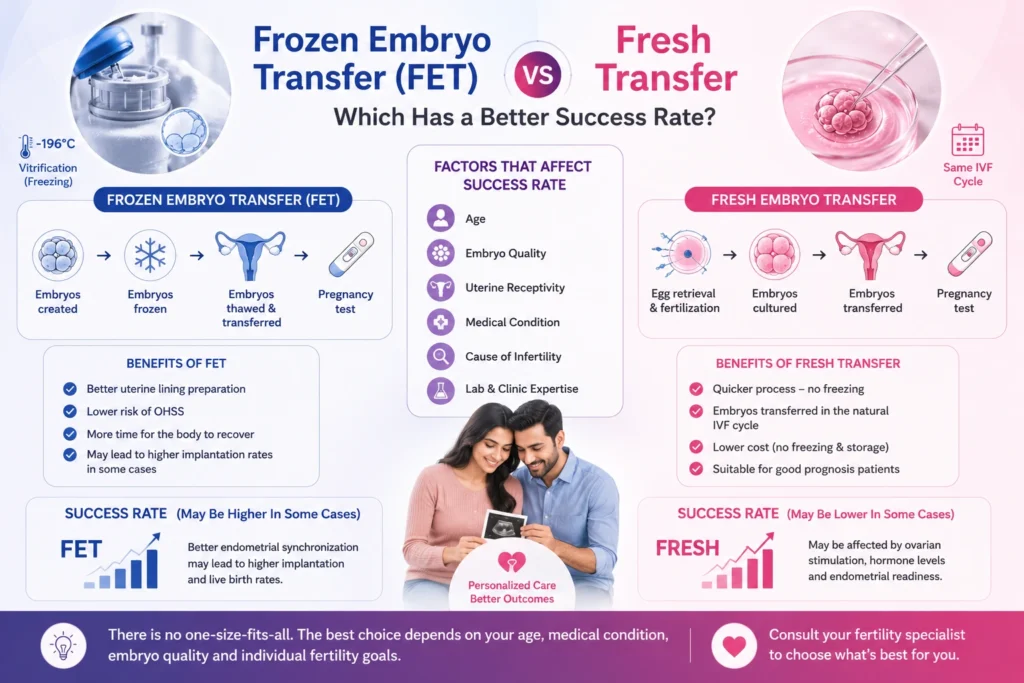
Frozen Embryo Transfer vs Fresh Transfer — this is one of the most common questions couples ask when they reach the embryo transfer stage of their IVF journey. Should the embryo be transferred in the same cycle it was created? Or is it better to freeze it first and transfer later?
It is a completely reasonable question. And the honest answer is — there is no single correct answer for everyone.
Many couples assume that “fresh is always better.” Others hear that frozen transfers have higher success rates and feel confused. The truth is, success depends on your individual medical situation, uterine readiness, hormone levels, embryo quality, and several other factors that vary from person to person.
Dr. Krupa M. Shah, a leading fertility specialist in Ahmedabad with 19+ years of experience and 10,000+ successful treatments, explains both options clearly — so you can walk into your consultation with understanding, not anxiety.
Author Bio
Dr. Krupa A. Shah MBBS · MS (Obstetrics & Gynaecology) · Infertility Specialist Founder, Ayuh Fertility Centre, Ahmedabad
19+ Years of Experience in reproductive medicine, obstetrics, and gynaecology.
Dr. Krupa Shah completed her MBBS from Baroda Medical College (2006) and her MS in Obstetrics & Gynaecology from B.J. Medical College, Ahmedabad (2010). After 12 years of experience at leading clinics in Chennai — including Apollo Hospital and Iswarya Fertility Centre — she completed an Advanced IVF Fellowship at Ludwig Maximilians University, Munich, Germany, one of Europe’s most prestigious reproductive medicine institutions.
She is a member of the Ahmedabad Obstetrics and Gynaecology Society (AOGS), the Indian Society of Assisted Reproduction (ISAR), and the Federation of Obstetric and Gynaecological Societies of India (FOGSI).
IVF laboratory is ART National Board Certified.
🩺 Medically Reviewed By
This article is medically reviewed by Dr. Krupa M. Shah, ensuring accurate and reliable fertility information.
What Is Embryo Transfer in IVF?
Embryo transfer is the final and perhaps most emotionally significant step in an IVF cycle. After eggs are retrieved, fertilised in the laboratory, and cultured into embryos, the best-quality embryo is selected and gently placed into the uterus using a thin, flexible catheter.
The goal is straightforward — for the embryo to attach to the uterine lining and begin developing into a pregnancy. But the timing, preparation, and method of that transfer can differ significantly between patients.
There are two main approaches:
- Fresh Embryo Transfer — the embryo is transferred in the same cycle as egg retrieval, usually 3–5 days after fertilisation.
- Frozen Embryo Transfer (FET) — the embryo is cryopreserved (frozen) and transferred in a separate, later cycle.
Understanding the difference between these two approaches — and knowing when each is appropriate — is key to making informed decisions about your fertility treatment.
What Is a Fresh Embryo Transfer?
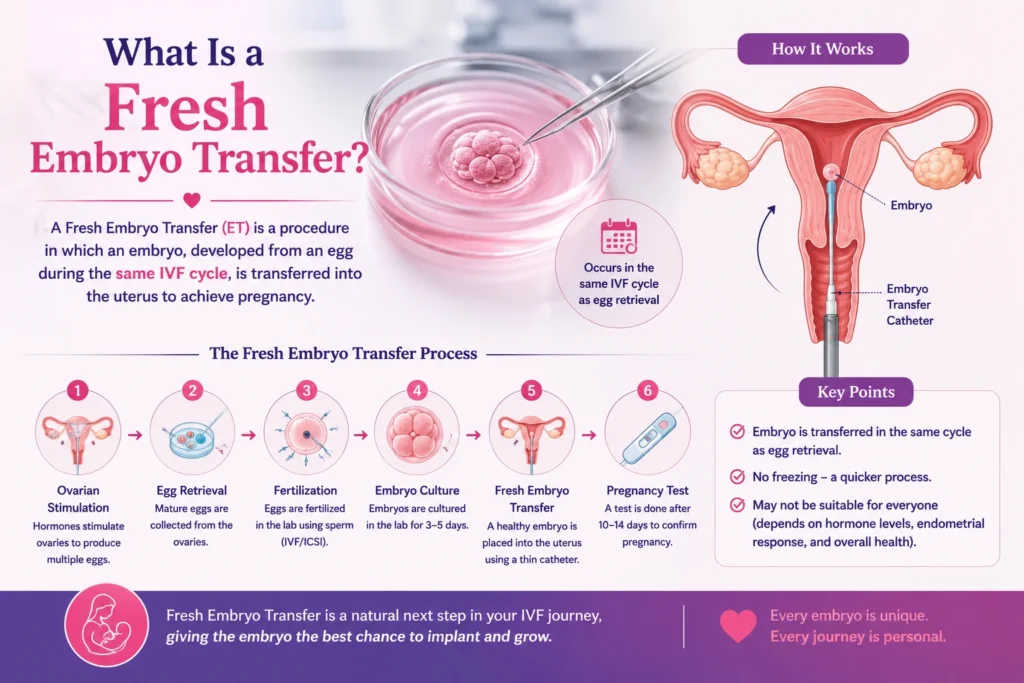
A fresh embryo transfer happens within the same stimulated IVF cycle as egg retrieval. After your eggs are collected and fertilised, the embryo is transferred directly into the uterus — typically on Day 3 (cleavage stage) or Day 5 (blastocyst stage) — without any freezing in between.
How It Works
- Ovarian stimulation begins with hormone injections
- Eggs are retrieved via the egg pick up procedure
- Fertilisation occurs — either through standard IVF or ICSI
- The best embryo is selected and transferred 3–5 days later
- No freezing is involved
When Fresh Transfer Is Usually Done
Fresh transfer is typically considered when the uterine lining looks good, hormone levels are within an acceptable range after stimulation, and there is no medical reason to delay.
Advantages of Fresh Transfer
- No additional waiting time between stimulation and transfer
- No freeze-thaw step required
- Slightly lower overall cost in some cases
- Can be emotionally easier for couples who want to move forward quickly
Potential Limitations
- Ovarian stimulation hormones (especially elevated progesterone and oestrogen) can sometimes affect uterine receptivity
- In cases of Ovarian Hyperstimulation Syndrome (OHSS) risk, a fresh transfer may not be safe
- Less flexibility to perform genetic testing of embryos before transfer
- The uterine environment may not always be optimal immediately after a stimulated cycle
The fresh embryo transfer success rate varies depending on age, embryo quality, and individual response to stimulation. It remains a valid option when the clinical picture is favourable.
What Is Frozen Embryo Transfer (FET)?
Frozen Embryo Transfer (FET) is a procedure in which embryos created during a previous IVF cycle are cryopreserved using vitrification — an ultra-rapid freezing technique — and then thawed and transferred into the uterus in a separate, later cycle.
How Embryo Freezing Works
Modern embryo freezing uses a technique called vitrification. Unlike older slow-freezing methods, vitrification rapidly converts embryos into a glass-like state, preventing ice crystal formation that could damage cells. Survival rates for vitrified embryos are now over 95% in most quality IVF laboratories.
How FET Is Performed
- Embryos from a previous IVF cycle are stored in a cryobank
- When the patient is ready, a new cycle begins — either a natural cycle or a medicated cycle using hormone tablets/injections
- The uterine lining is carefully prepared and monitored
- Once the lining reaches optimal thickness, the embryo is thawed and transferred
- The process of embryo transfer itself is identical to a fresh transfer — a thin catheter places the embryo gently into the uterus
Why FET Has Become Increasingly Common
Over the past decade, FET has become the preferred approach in many IVF clinics worldwide — and for good reason. The ability to freeze embryos allows for better uterine preparation, genetic screening if needed, and transfer at a time when the body is fully ready.
Frozen Embryo Transfer vs Fresh Transfer — Key Differences
| Factor | Fresh Transfer | Frozen Embryo Transfer (FET) |
|---|---|---|
| Timing | Same cycle as egg retrieval | Separate cycle — weeks or months later |
| Hormonal Environment | Elevated after stimulation | Controlled and normalised |
| Uterine Preparation | Natural (post-stimulation) | Carefully prepared with medication |
| Flexibility | Less flexible | Highly flexible — transfer when ready |
| Genetic Testing | Not possible in same cycle | Compatible with PGT-A before transfer |
| OHSS Risk | Higher if not cancelled | Eliminated — no fresh stimulation |
| Waiting Time | Minimal | Requires additional cycle planning |
| Cost | Lower upfront | Slightly higher due to freezing & prep |
| Emotional Experience | Faster, less waiting | Requires patience but allows recovery |
FET Success Rate vs Fresh Embryo Transfer Success Rate
This is where the data gets interesting — and where honest, evidence-based communication matters most.
What Research Suggests
Multiple large studies over the past several years have shown that FET success rates are comparable to — and in many patient groups, higher than — fresh transfer rates. Here is what the evidence broadly suggests:
- Uterine receptivity is often better in a FET cycle because the uterus has recovered from the hormonal effects of ovarian stimulation
- Elevated progesterone during a stimulated cycle can sometimes impair endometrial receptivity, affecting implantation in a fresh transfer
- FET allows the lining to be prepared in a calmer hormonal environment, potentially improving implantation conditions
- Studies have shown lower miscarriage rates in some FET groups compared to fresh transfer groups
- For women with PCOS or high ovarian response, FET tends to show particularly favourable outcomes
Does This Mean FET Is Always Better?
No. The evidence is not that clear-cut. For women with a good response, optimal lining, and normal hormone levels post-retrieval, a fresh transfer can be equally successful. The fresh embryo transfer success rate in the right patient, at the right time, is well-established.
What matters most is individual patient assessment — not a blanket rule. At Ayuh Fertility Centre, Dr. Krupa Shah evaluates every patient’s hormonal profile, lining thickness, embryo quality, and complete infertility evaluation before recommending which approach gives the best chance of success.
Why Doctors Sometimes Recommend Frozen Embryo Transfer
There are specific clinical situations where freezing embryos and performing a FET is clearly the safer, smarter choice:
1. Risk of Ovarian Hyperstimulation Syndrome (OHSS) When the ovaries over-respond to stimulation, proceeding with a fresh transfer increases OHSS severity. A freeze-all strategy eliminates this risk entirely.
2. Elevated Progesterone Levels If progesterone rises prematurely during the stimulation phase, uterine receptivity may be compromised. Freezing and waiting for a controlled cycle gives the lining a better environment.
3. Thin or Suboptimal Uterine Lining If the endometrial lining does not reach adequate thickness post-retrieval, a fresh transfer may be cancelled in favour of a FET once the lining is optimised. This is part of comprehensive infertility care and evaluation.
4. Need for Genetic Testing If PGT-A or genetic screening is planned, embryos must be biopsied and frozen while awaiting results. FET is the only option in this scenario.
5. Medical Optimisation Before Pregnancy Some patients need to treat underlying conditions — fibroids, polyps, or hormonal imbalances — before transfer. FET allows time for this without losing the embryos.
6. Patient Recovery Sometimes a patient needs physical or emotional recovery time after a demanding stimulation cycle before being ready for transfer.
When Fresh Transfer May Still Be a Good Option
FET is not automatically the right choice for every patient. Fresh transfer remains a perfectly valid option when:
- The ovarian response was moderate and controlled
- Post-retrieval hormone levels — oestrogen and progesterone — are within acceptable ranges
- The uterine lining is of good thickness and appearance
- There is no OHSS risk
- No genetic testing is required
- The patient prefers to proceed without delay and the clinical picture supports it
In these situations, a fresh transfer can achieve excellent outcomes and avoids the additional time and cost of a freeze cycle.
Factors That Affect Success More Than Transfer Type
It is worth stepping back and recognising that whether you choose FET or fresh transfer, several other factors have a bigger influence on your overall IVF success:
- Female Age — egg and embryo quality decline with age; this is the single strongest predictor of IVF outcome
- Egg Quality — directly impacts fertilisation and embryo development
- Embryo Quality — grading at the blastocyst stage reflects developmental potential
- Sperm Quality — affects fertilisation rates; ICSI is used when sperm parameters are suboptimal
- Endometrial Receptivity — a well-prepared, receptive lining is essential for implantation regardless of transfer type
- IVF Laboratory Standards — embryo culture conditions, air quality, equipment calibration, and embryologist expertise all matter enormously. Ayuh Fertility Centre’s ISO-certified IVF lab meets national ART Board standards.
- Lifestyle Factors — smoking, BMI, stress levels, and nutrition all play a supporting role in outcomes
The transfer type — fresh or frozen — is one variable among many. The best approach is always the one tailored to your full clinical picture.
Emotional Considerations — Waiting for FET vs Fresh Transfer
The emotional weight of waiting for a Frozen Embryo Transfer cycle is something many couples underestimate.
After an egg retrieval, the natural instinct is to move forward as quickly as possible. The idea of waiting weeks or months for a FET can feel like a setback — even when it is medically the right decision.
A few things worth remembering:
- Choosing FET when recommended is not a sign that something has gone wrong — it is your doctor acting in your best interest
- The waiting period can be used productively: resting, preparing the body, addressing any underlying conditions
- Anxiety during the freeze-and-wait phase is completely normal and valid
- Open conversations with your fertility specialist — and support from a counsellor if needed — can make this period feel less isolating
- Many couples later reflect that the FET cycle felt calmer, less rushed, and more controlled than their fresh transfer attempt
At Ayuh Fertility Centre, emotional support is considered part of treatment — not an afterthought.
Common Myths About Frozen Embryo Transfer
Myth 1: Frozen embryos are weaker than fresh embryos False. With modern vitrification technology, frozen embryos survive and perform comparably to fresh embryos. Thousands of healthy babies are born from frozen embryos every year worldwide.
Myth 2: Fresh transfer always has a better success rate Not accurate. Research consistently shows FET performs as well as — and in many groups, better than — fresh transfer, particularly when the uterine environment is optimised. The FET success rate in well-prepared cycles is well-documented.
Myth 3: Freezing damages embryos Vitrification has an embryo survival rate of over 95% in quality laboratories. Ice crystal damage, which was a concern with older slow-freezing methods, is effectively eliminated with modern vitrification.
Myth 4: FET is only done after IVF failure False. FET is proactively recommended in many first-cycle patients — particularly those at OHSS risk, those pursuing genetic testing, or those whose uterine lining needs optimisation.
Myth 5: You cannot choose between FET and fresh transfer Your fertility specialist will make a clinical recommendation, but you are always part of the conversation. At Ayuh Fertility Centre, Dr. Krupa Shah explains both options and the reasoning behind each recommendation clearly.
Questions to Ask Your Fertility Specialist
Before your embryo transfer, bring these questions to your consultation:
- Why are you recommending FET or fresh transfer for my specific situation?
- What does my uterine lining look like — is it ready for transfer?
- What were my post-retrieval hormone levels, and do they affect my transfer decision?
- Should I consider genetic testing (PGT-A) before transfer?
- What is my realistic chance of success with each option?
- What is the additional cost of freezing and FET versus a fresh transfer?
- How long will I need to wait before the FET cycle begins?
- Are there any conditions I should address before transfer to improve success?
Who Is an Ideal Candidate for Frozen Embryo Transfer?
Frozen Embryo Transfer is strongly considered for the following patient groups:
- PCOS patients — who typically have high ovarian response and elevated OHSS risk, making fresh transfer risky
- High responders — women who produce a large number of eggs and have elevated post-retrieval hormone levels
- Patients undergoing PGT-A — genetic screening requires embryo freezing while results are awaited
- Patients with previous implantation failure — where uterine optimisation in a separate cycle may improve conditions
- Patients with thin lining — who need additional time and medication to develop adequate endometrial thickness
- Patients needing medical treatment — such as removal of polyps or fibroids, or management of hormonal and menstrual health issues before transfer
- Patients requiring emotional recovery — who need more time before proceeding with transfer
FAQs
1.Is Frozen Embryo Transfer more successful than fresh transfer?
Research suggests that FET success rates are comparable to — and in certain patient groups, higher than — fresh transfer rates. This is largely because FET allows the uterine lining to be prepared in a controlled hormonal environment, free from the elevated oestrogen and progesterone of an ovarian stimulation cycle. However, the answer depends on each patient’s individual profile. For women with a well-prepared lining and good post-retrieval hormone levels, a fresh transfer can be equally effective. Your fertility specialist will recommend the approach most likely to succeed for you specifically.
2.Are frozen embryos as healthy as fresh embryos?
Yes. With modern vitrification technology, frozen embryos are just as developmentally capable as fresh ones. Vitrification freezes embryos so rapidly that ice crystal formation — which could damage cells — is essentially eliminated. Embryo survival rates following vitrification are over 95% in quality IVF labs. Extensive research and thousands of healthy births from frozen embryos confirm that freezing, when done correctly, does not compromise embryo health.
3.Does embryo freezing damage embryos?
Modern vitrification has largely eliminated the damage risk associated with older slow-freezing techniques. In experienced hands using quality equipment, the vast majority of embryos survive the freeze-thaw process without any detectable harm. A small percentage of embryos may not survive thawing — typically those that were already fragile before freezing. At Ayuh Fertility Centre, our ISO-certified embryology lab follows strict protocols to maximise embryo survival throughout the cryopreservation process.
4.Why do doctors recommend FET instead of fresh transfer?
Doctors recommend FET in several situations: when ovarian stimulation has elevated hormone levels that may reduce uterine receptivity; when there is OHSS risk; when the lining is not optimal; when genetic testing is planned; or when the patient needs time to recover or address an underlying condition. FET allows the body to reset and the uterine environment to be carefully prepared before embryo transfer. It is a proactive, evidence-based strategy — not a fallback after failure.
5.Is FET painful?
The embryo transfer procedure itself — whether fresh or frozen — is generally well tolerated. It is similar to a gynaecological examination and does not typically require anaesthesia. A thin, flexible catheter is used to gently place the embryo into the uterus under ultrasound guidance. Some patients feel mild cramping during or after the procedure, which usually settles quickly. The preparatory phase of FET, involving hormone tablets or injections to build the lining, may cause mild bloating or discomfort in some patients.
Conclusion
Whether you are weighing Frozen Embryo Transfer against a fresh transfer, the most important thing to know is this: the right answer is the one that fits your body, your clinical situation, and your readiness — not a generalised rule.
Both approaches have produced countless successful pregnancies. Both have their place in modern IVF treatment. The question is always which one gives you the best chance at this specific point in your journey.
Dr. Krupa M. Shah and the team at Ayuh Fertility Centre, Ahmedabad bring 19+ years of experience, globally accredited training, and a deeply personalised approach to every embryo transfer decision. With 10,000+ successful treatments and a fully ICMR-compliant, ISO-certified IVF lab, you can trust that your treatment plan is built around your best outcome — not a one-size-fits-all protocol.
If you are unsure which transfer option is right for you, the best next step is a conversation.
👉 Book your consultation with Ayuh Fertility Centre today
👉 Get expert guidance for PCOS and fertility treatment
👉 Start your journey toward a healthy and successful pregnancy
📍 Visit us in Ahmedabad
📞 Call now to schedule your appointment