
Endometriosis and fertility — two words that far too many women hear together for the first time after years of painful periods, unexplained pelvic pain, and months of trying to conceive without success. If you are one of them, you already know how isolating that journey feels. The pain that was dismissed as “normal periods.” The conception attempts that went nowhere. And then, finally, a diagnosis that explained everything — but raised a dozen new questions at once.
Can I still get pregnant? Do I need surgery? Will IVF work? Should I do surgery first or go straight to IVF?
These are not simple questions. And the answers are different for every woman — because endometriosis is not a single, uniform condition. It ranges from mild to severe, affects fertility differently at each stage, and requires a genuinely personalised treatment plan.
Dr. Krupa A. Shah, founder of Ayuh Fertility Centre in Ahmedabad, has managed hundreds of women with endometriosis-related infertility. Her approach combines advanced laparoscopic surgical expertise with internationally trained IVF protocols — giving every patient the most complete, individually designed path to pregnancy possible.
This blog is written to give you clear, honest, compassionate answers — starting right now.
Author Bio
Dr. Krupa A. Shah MBBS · MS (Obstetrics & Gynaecology) · Infertility Specialist Founder, Ayuh Fertility Centre, Ahmedabad
19+ Years of Experience in reproductive medicine, obstetrics, and gynaecology.
Dr. Krupa Shah completed her MBBS from Baroda Medical College (2006) and her MS in Obstetrics & Gynaecology from B.J. Medical College, Ahmedabad (2010). After 12 years of experience at leading clinics in Chennai — including Apollo Hospital and Iswarya Fertility Centre — she completed an Advanced IVF Fellowship at Ludwig Maximilians University, Munich, Germany, one of Europe’s most prestigious reproductive medicine institutions.
She is a member of the Ahmedabad Obstetrics and Gynaecology Society (AOGS), the Indian Society of Assisted Reproduction (ISAR), and the Federation of Obstetric and Gynaecological Societies of India (FOGSI).
IVF laboratory is ART National Board Certified.
🩺 Medically Reviewed By
This article is medically reviewed by Dr. Krupa M. Shah, ensuring accurate and reliable fertility information.
What Is Endometriosis?
Endometriosis is a chronic gynaecological condition in which tissue similar to the inner lining of the uterus (the endometrium) grows outside the uterus — on the ovaries, fallopian tubes, pelvic lining, or other surrounding structures.
Every month, this displaced tissue responds to the same hormonal changes as the uterine lining — it thickens, breaks down, and bleeds. But unlike the normal lining, this blood has nowhere to go. The result is inflammation, scar tissue formation, and in the ovaries, the development of chocolate cysts (endometriomas) filled with old blood.
Common symptoms of endometriosis include:
- Painful, heavy periods — often significantly worse than average
- Chronic pelvic pain that persists beyond menstruation
- Pain during or after intercourse
- Pain during bowel movements or urination (especially around periods)
- Bloating and fatigue
- Difficulty conceiving
Why is it so often undiagnosed?
Because period pain has been normalised for generations. Women are told to “manage it” with painkillers and carry on. On average, women with endometriosis wait 7–10 years from the onset of symptoms to a confirmed diagnosis. That delay is not just painful — it is clinically costly, particularly for fertility.
Endometriosis is diagnosed definitively through laparoscopy — a minimally invasive surgical procedure that allows the surgeon to directly visualise and assess the extent of disease.
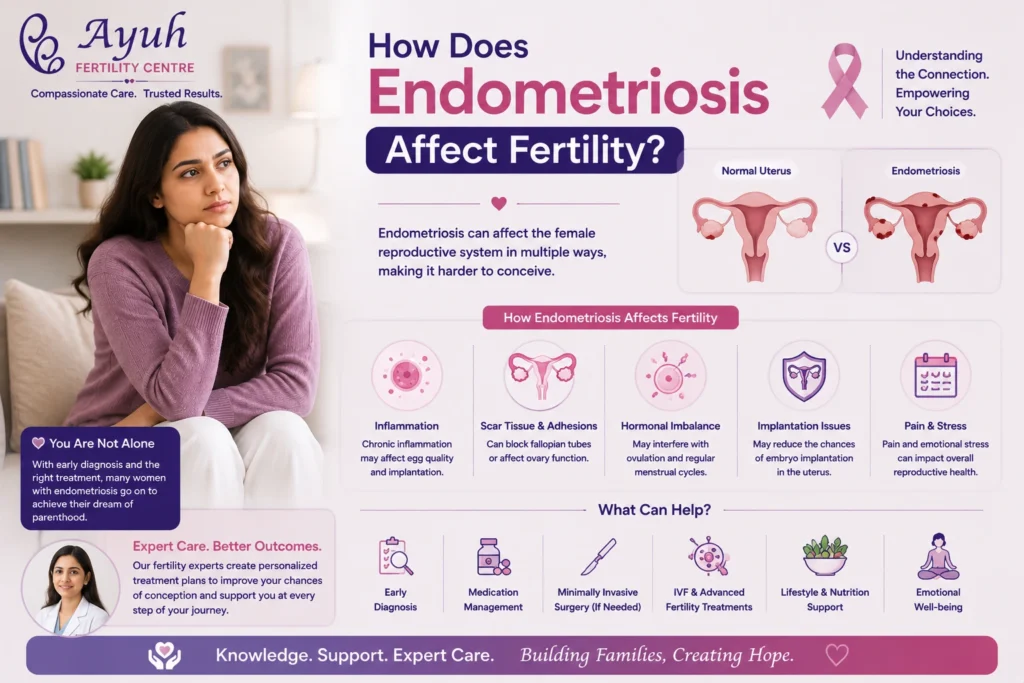
How Does Endometriosis Affect Fertility?
Endometriosis and fertility are connected through multiple biological mechanisms — and understanding them helps you understand why treatment decisions matter so much.
1. Inflammation and Toxic Pelvic Environment Endometriosis creates a chronic inflammatory environment in the pelvis. The fluid surrounding the ovaries and tubes contains elevated levels of inflammatory cytokines that are directly toxic to eggs and sperm — reducing fertilisation rates even when anatomy appears normal.
2. Fallopian Tube Damage Progressive endometriosis can cause adhesions (scar tissue) that distort or block the fallopian tubes. When tubes are blocked, sperm cannot reach the egg and natural conception becomes impossible. This is why infertility care and evaluation at Ayuh includes tubal patency assessment for all women with suspected endometriosis.
3. Endometriomas (Ovarian Cysts) Endometriomas — chocolate cysts — develop when endometriosis affects the ovaries. They directly damage ovarian tissue and significantly reduce ovarian reserve (AMH levels). Women with endometriomas often have lower egg counts and reduced response to IVF stimulation compared to their baseline age.
4. Poor Egg Quality The toxic pelvic environment and direct ovarian damage caused by endometriosis affect egg quality — particularly chromosomal integrity. This increases the risk of poor embryo development and implantation failure.
5. Implantation Problems Even when fertilisation succeeds, women with endometriosis may have altered endometrial receptivity — the uterine lining may not be as welcoming to an embryo as it should be. This is increasingly studied through ERA (Endometrial Receptivity Analysis) testing in women with recurrent implantation failure.
6. Scar Tissue and Distorted Anatomy Severe endometriosis can completely distort pelvic anatomy — displacing the ovaries, fusing organs together, and creating an environment where natural conception has virtually no chance of occurring.
The degree to which fertility is affected depends on the stage of endometriosis (Stage I–IV), the specific structures involved, the woman’s age, and her ovarian reserve at the time of diagnosis.
Can Women with Endometriosis Get Pregnant Naturally?
Yes — and this is an important truth that often gets lost in fear.
Endometriosis pregnancy is not only possible — it happens regularly, even without fertility treatment. Approximately 70% of women with mild-to-moderate endometriosis (Stage I–II) can conceive naturally, though often with more difficulty and over a longer timeframe than women without the condition.
What affects natural conception chances in endometriosis:
- Stage of disease — Stage I–II: reasonable natural conception chances. Stage III–IV: natural conception significantly harder.
- Fallopian tube status — open tubes allow natural fertilisation; blocked tubes make it impossible
- Age — younger women have better egg reserve and more time; every year matters more with endometriosis
- Ovarian reserve — AMH levels at diagnosis give the clearest picture of remaining fertility potential
- Partner’s sperm quality — a full semen analysis is essential before any treatment decision
When does natural conception become unlikely?
- Both fallopian tubes are blocked or severely damaged
- Large bilateral endometriomas have significantly reduced AMH
- Stage IV endometriosis with severe pelvic distortion
- Age above 35 with reduced ovarian reserve
- Combination with male infertility
The critical message: do not wait too long before seeking evaluation. Endometriosis is a progressive condition — it typically worsens over time without treatment. An early fertility evaluation at Ayuh gives you the most options, because you are making decisions from a position of knowledge rather than crisis.
Endometriosis IVF Success — What Patients Should Know
Endometriosis IVF success is a nuanced topic — and one where honest, age-specific information matters more than broad reassurances.
The good news: IVF can effectively bypass many of the fertility barriers that endometriosis creates. It sidesteps blocked tubes entirely. It retrieves eggs directly from the ovaries, bypassing the toxic pelvic environment. And it allows embryo selection in a controlled laboratory environment — Ayuh’s ART National Board Certified, ISO-certified embryology lab — before transfer.
IVF success rates in endometriosis patients at Ayuh Fertility Centre:
- Stage I–II (mild–moderate), under 35: 45–55% per cycle with own eggs
- Stage III–IV (severe), under 35: 30–45% per cycle — lower due to reduced egg quality and ovarian reserve impact
- Above 35 with endometriosis: varies significantly by AMH and remaining ovarian reserve
What reduces IVF success in endometriosis:
- Significantly reduced AMH from endometrioma damage
- Multiple prior surgeries reducing ovarian cortex and reserve
- Poor egg quality from chronic inflammatory exposure
- Implantation failure related to endometrial receptivity changes
What improves IVF success in endometriosis:
- Hormone suppression therapy before stimulation (downregulation)
- Personalised stimulation protocol accounting for reduced reserve
- Careful embryo selection with blastocyst culture
- PGT genetic testing where implantation failure is recurrent
- Freeze-all strategy in some cases to allow endometrial recovery
No treatment guarantees pregnancy. But IVF, in the hands of an experienced endometriosis-specialist fertility team, gives women with this condition their best realistic chance.
Endometriosis IVF Protocol — How Treatment Differs
IVF for endometriosis patients is not standard IVF. The endometriosis IVF protocol must account for the specific biology of the condition — and this is where specialist experience makes a critical difference.
Hormonal Suppression Before Stimulation Many endometriosis IVF protocols begin with a period of hormonal suppression — using GnRH agonists (like Lupride/Decapeptyl) for 4–8 weeks before stimulation begins. This suppresses endometriosis activity, reduces inflammatory mediators, and improves the pelvic environment before egg retrieval. Evidence supports improved embryo quality and implantation rates after adequate downregulation in Stage III–IV endometriosis.
Modified Stimulation Doses Women with endometriosis — particularly those with reduced AMH from endometrioma involvement — often require carefully adjusted stimulation protocols. Too aggressive a protocol risks OHSS in some; too mild fails to retrieve adequate eggs in others. Dr. Krupa Shah calibrates the protocol based on your current AMH, AFC, and prior cycle response.
Careful Egg Retrieval Endometriomas near the ovaries require experienced hands during egg retrieval (OPU). Puncturing an endometrioma inadvertently during retrieval can contaminate the follicular fluid. An experienced surgical team minimises this risk through precise ultrasound-guided technique.
Freeze-All Strategy in Selected Cases For some endometriosis patients — particularly those with high inflammatory activity or suspected endometrial receptivity issues — a freeze-all approach is used. All embryos are cryopreserved, and transfer occurs in a subsequent FET (Frozen Embryo Transfer) cycle when the uterine environment is better prepared.
ERA Testing for Recurrent Implantation Failure Women with endometriosis who have experienced repeated implantation failures despite good embryo quality may benefit from ERA (Endometrial Receptivity Analysis) — a biopsy-based test that identifies the precise window of implantation. This is offered at Ayuh for patients where standard timing may not be optimal.
When Is Surgery Recommended for Endometriosis?
Laparoscopic surgery is the gold standard for both diagnosis and treatment of endometriosis — but it is not always the first step for every patient trying to conceive.
Surgery is generally recommended when:
- Severe pelvic pain that is not controlled by medication and is significantly affecting quality of life
- Large endometriomas (above 3–4 cm) — particularly before IVF, as very large cysts can impair ovarian access during egg retrieval and contaminate follicular fluid
- Distorted pelvic anatomy — tubes displaced or fused, ovaries adhered to the uterus
- Blocked fallopian tubes that prevent natural conception and require surgical assessment
- Failed IVF cycles where surgical evaluation may reveal a treatable cause
- Diagnostic confirmation — when endometriosis is strongly suspected but not yet confirmed
Surgery is generally NOT the immediate recommendation when:
- The primary fertility barrier is poor ovarian reserve — surgery may further reduce reserve
- Small endometriomas (below 3 cm) with good AMH and egg retrieval access — IVF first is often the better approach
- Age above 37–38 with limited time — surgery delays IVF and may cost valuable time
This surgery-vs-IVF decision is one of the most important clinical judgements in endometriosis management. At Ayuh, Dr. Krupa Shah makes this recommendation after a complete evaluation — reviewing ultrasound findings, AMH, age, pain severity, and prior treatment history — never based on a single factor alone.
Laparoscopic Surgery for Endometriosis — What to Expect
Laparoscopic surgery for endometriosis at Ayuh Fertility Centre is performed as a minimally invasive day-care or overnight procedure. Understanding what it involves removes much of the fear around it.
How it works: Three or four small incisions (5–10mm) are made in the abdomen. A camera (laparoscope) is inserted through one incision; surgical instruments through the others. The surgeon directly visualises the pelvis, confirms the diagnosis, and — in the same procedure — removes endometriosis lesions, drains and removes cysts, and releases adhesions.
What to expect after surgery:
- Mild to moderate abdominal discomfort for 2–5 days
- Return to light activity within 5–7 days
- Return to normal activity within 2–4 weeks
- IVF can usually begin 4–8 weeks after recovery
Fertility benefits of laparoscopic surgery:
- Restores pelvic anatomy where distortion was present
- Removes endometriomas — improving ovarian access for egg retrieval
- Reduces the inflammatory pelvic environment
- Can restore tubal patency in selected cases
- Provides definitive histological diagnosis
Why surgeon experience matters enormously: Endometriosis surgery near the ovaries carries the risk of inadvertently removing healthy ovarian cortex — reducing AMH permanently. A fertility-conscious laparoscopic surgeon operates with specific intention to preserve ovarian tissue. Dr. Krupa Shah’s dual expertise in reproductive surgery and IVF means every surgical decision is made with your fertility future explicitly in mind.
Endometriosis Surgery Ahmedabad — Choosing the Right Specialist
Endometriosis surgery Ahmedabad is not a procedure to approach without careful consideration of surgeon experience and fertility intent.
Here is what to look for:
Fertility-Preserving Surgical Approach A surgeon who also manages IVF will naturally approach endometriosis surgery with fertility preservation as a primary goal — not just symptom relief. Every millimetre of ovarian tissue matters when reserve is already compromised.
Laparoscopic Expertise Minimally invasive surgery requires significant technical skill — particularly in Stage III–IV disease where anatomy is distorted and structures are fused. Ask specifically: “How many laparoscopic endometriosis surgeries have you performed? How do you manage endometriomas near the ovary?”
Integrated Surgeon + IVF Team The best outcome for fertility patients with endometriosis comes from a coordinated plan — not a surgeon who operates and then hands you off to a separate IVF team with no communication. At Ayuh Fertility Centre, surgical and IVF planning is integrated under Dr. Krupa Shah’s expertise — the same specialist who performs your laparoscopy also designs your IVF protocol, ensuring clinical continuity.
Post-Surgical IVF Timing An experienced team plans the transition from surgery to IVF deliberately — considering recovery, hormonal status, and endometrial environment. Rushing this transition, or waiting too long, both affect outcomes.
IVF vs Surgery — Which Option Is Better for You?
This is the question most women with endometriosis ask first — and the honest answer is: it depends entirely on your individual clinical picture.
| Factor | Lean Toward Surgery First | Lean Toward IVF First |
|---|---|---|
| Endometrioma size | Above 4 cm — surgery recommended | Below 3 cm — IVF first acceptable |
| Pelvic pain | Severe, quality-of-life limiting | Mild to moderate, manageable |
| AMH and ovarian reserve | Normal to good reserve | Already compromised — protect what remains |
| Age | Under 35 — time allows surgery | Above 37 — IVF urgency outweighs surgical delay |
| Tubal status | Blocked tubes requiring surgical assessment | At least one open tube — IVF can proceed |
| Previous IVF failures | Failed cycles with unexplained implantation failure | No prior IVF attempts |
| Partner’s sperm | Normal parameters | Severe male factor — IVF with ICSI is needed regardless |
At Ayuh Fertility Centre, this decision is never made based on a single factor. Dr. Krupa Shah reviews your complete picture — ultrasound, AMH, tubal assessment, pain severity, age, and any prior treatment history — and then explains the reasoning behind each option clearly and honestly.
The Emotional Impact of Endometriosis and Infertility
Endometriosis does not just affect your body. It affects how you experience every month, every cycle, every pregnancy announcement from a friend, every family gathering where the questions come.
Chronic Pain and Exhaustion Living with endometriosis means living with a condition that flares monthly, interrupts daily life, and is often invisible to the people around you. The physical exhaustion of chronic pain compounds the emotional exhaustion of infertility.
Delayed Diagnosis Frustration Many women with endometriosis spent years being told their pain was “normal.” The anger and grief of that delayed recognition is real and valid. It was not normal. It was a condition that deserved diagnosis and care much sooner.
Anxiety Around Fertility Decisions Surgery or IVF? One more natural cycle or start treatment now? Every decision feels loaded with consequence. That anxiety is understandable — and it is one of the reasons that having a compassionate, genuinely communicative specialist matters so much.
Relationship Impact Infertility stresses relationships. Painful intercourse — a common endometriosis symptom — adds an additional layer of strain that is rarely discussed openly.
What Helps At Ayuh Fertility Centre, emotional support is built into the consultation model. Dr. Krupa Shah takes time to explain every finding, every decision, and every option — because understanding your situation reduces anxiety far more than any reassurance alone. You are not just a diagnosis. You are a person navigating one of life’s most complex challenges, and you deserve a care team that treats you accordingly.
Lifestyle Changes That May Help Fertility with Endometriosis
These recommendations are grounded in clinical evidence — not miracle promises.
Anti-Inflammatory Nutrition Endometriosis is an inflammatory condition. A diet that reduces systemic inflammation — based on vegetables, whole grains, legumes, olive oil, fatty fish, and antioxidant-rich foods — is consistently associated with reduced disease progression and better fertility outcomes. Reducing red meat, processed foods, refined sugar, and trans fats is clinically supported.
Omega-3 Fatty Acids Found in fatty fish, flaxseed, and walnuts, omega-3s have documented anti-inflammatory effects and have been shown in research to reduce endometriosis lesion activity. Discuss supplementation with Dr. Krupa Shah before starting.
Regular Moderate Exercise Exercise reduces systemic inflammation and improves hormonal balance. Moderate activity — walking, yoga, swimming — is beneficial. Intense exercise, particularly high-impact cardio, may worsen pelvic pain acutely.
Stress Management Chronic stress elevates cortisol and promotes a pro-inflammatory hormonal state that can worsen endometriosis activity. Yoga, mindfulness, and adequate sleep are clinically relevant — not just wellness suggestions.
Avoiding Smoking and Alcohol Both are independently associated with worse endometriosis outcomes and poorer IVF results. Complete avoidance — not reduction — is the medical recommendation during fertility treatment.
Sleep Quality Disrupted sleep impairs immune regulation and promotes inflammation. 7–9 hours of consistent, quality sleep directly affects hormonal balance and treatment outcomes.
Common Myths About Endometriosis and Fertility
Myth 1: Pregnancy cures endometriosis. False. Pregnancy temporarily suppresses endometriosis activity — but it does not cure it. Symptoms and disease activity typically return after delivery. Endometriosis requires ongoing management.
Myth 2: Women with endometriosis cannot conceive. False. Many women with endometriosis — particularly Stage I–II — conceive naturally or with fertility treatment. Endometriosis is a fertility challenge, not an infertility sentence.
Myth 3: IVF always fails in endometriosis. False. IVF can be highly effective in endometriosis patients when the protocol is tailored appropriately and the specialist has endometriosis-specific IVF expertise. Many women with Stage III–IV endometriosis have achieved successful pregnancies through IVF at Ayuh.
Myth 4: Surgery alone always fixes endometriosis infertility. False. Surgery improves fertility conditions — it does not guarantee conception. In women with significantly reduced ovarian reserve, surgery may reduce reserve further. The surgery-vs-IVF decision requires careful individual assessment.
Myth 5: If you have endometriosis, you must have surgery before IVF. False. For many women — particularly those with small endometriomas, reduced ovarian reserve, or age above 35 — IVF first is the more appropriate clinical approach. Surgery is not always a prerequisite.
FAQs
1. Can I get pregnant with endometriosis?
Yes — many women with endometriosis conceive, both naturally and through fertility treatment. Women with Stage I–II endometriosis have a reasonable natural conception chance, particularly if younger with good ovarian reserve and at least one open tube. Women with Stage III–IV disease or significantly reduced AMH typically need fertility treatment — either IVF or a surgical-then-IVF approach. The key is early evaluation by an experienced specialist. At Ayuh Fertility Centre, Dr. Krupa Shah assesses your specific disease stage, ovarian reserve, and tubal status before making any treatment recommendation.
2. Is IVF successful in women with endometriosis?
IVF can be very successful in endometriosis patients when the protocol is tailored appropriately. Women with mild endometriosis and good ovarian reserve typically achieve IVF success rates comparable to non-endometriosis patients of the same age. Women with severe endometriosis or significantly reduced AMH may have lower per-cycle rates, but cumulative success over 2–3 cycles remains meaningful. Personalised endometriosis-specific protocols — including hormonal downregulation before stimulation, careful egg retrieval, and PGT testing where indicated — significantly improve outcomes at Ayuh.
3. Is laparoscopic surgery necessary before IVF for endometriosis?
Not always. The decision depends on endometrioma size, pelvic anatomy, ovarian reserve, age, and pain severity. For endometriomas above 3–4 cm that would impair egg retrieval, surgery before IVF is generally recommended. For smaller endometriomas with good AMH and egg access, IVF first often produces better outcomes — because surgery carries the risk of reducing already-compromised ovarian reserve. Dr. Krupa Shah evaluates this decision individually for every patient — never applying a blanket rule.
4. Can endometriosis return after laparoscopic surgery?
Yes — endometriosis can recur after surgery. Recurrence rates vary by disease stage, surgical completeness, and post-surgical management. Hormonal suppression therapy after surgery (GnRH agonists or the oral contraceptive pill) can significantly reduce recurrence risk in women not immediately trying to conceive. For women who are fertility-focused, the post-surgical plan is designed specifically to minimise recurrence risk while maximising the fertility window. This is discussed in detail at Ayuh Fertility Centre as part of post-surgical fertility planning.
5. Does endometriosis reduce egg quality?
Yes, it can — but not inevitably. The toxic pelvic inflammatory environment created by endometriosis affects egg quality over time, particularly chromosomal integrity. Endometriomas specifically damage ovarian cortex, reducing the pool of healthy eggs. However, many women with endometriosis — particularly younger women diagnosed early — still produce good-quality eggs and embryos. The degree of egg quality impact depends on disease stage, duration, and ovarian reserve at the time of treatment. Dr. Krupa Shah assesses egg quality through AMH, AFC, and — ultimately — embryo development during IVF stimulation.
Conclusion
Endometriosis and fertility is not a story with a single ending. It is a story that looks different for every woman — and one that, with the right specialist, the right timing, and the right treatment approach, very often ends with a healthy pregnancy.
The biological challenges endometriosis creates are real. Inflammation, adhesions, endometriomas, reduced ovarian reserve — these are genuine obstacles. But they are not insurmountable. Laparoscopic surgery can restore anatomy and reduce disease burden. IVF can bypass the barriers that surgery cannot fix. And the combination of both — planned carefully and in the right sequence — gives women with endometriosis some of their best chances.
Dr. Krupa A. Shah brings 19+ years of combined laparoscopic and IVF expertise to every endometriosis case at Ayuh Fertility Centre. Her Advanced IVF Diploma from the International School of Medicine, Kiel–Goettingen–Munich, Germany, her ART National Board Certified, ISO-certified, ICMR-compliant laboratory, and her integrated surgical-plus-IVF approach mean you receive a genuinely complete plan — not a fragmented one.
You do not have to choose between a surgeon and a fertility specialist. At Ayuh, they are the same person.
Book your personalised cost consultation at Ayuh Fertility Centre today.
👉 Book your consultation with Ayuh Fertility Centre today
👉 Get expert guidance for PCOS and fertility treatment
👉 Start your journey toward a healthy and successful pregnancy
📍 Visit us in Ahmedabad
📞 Call now to schedule your appointment