
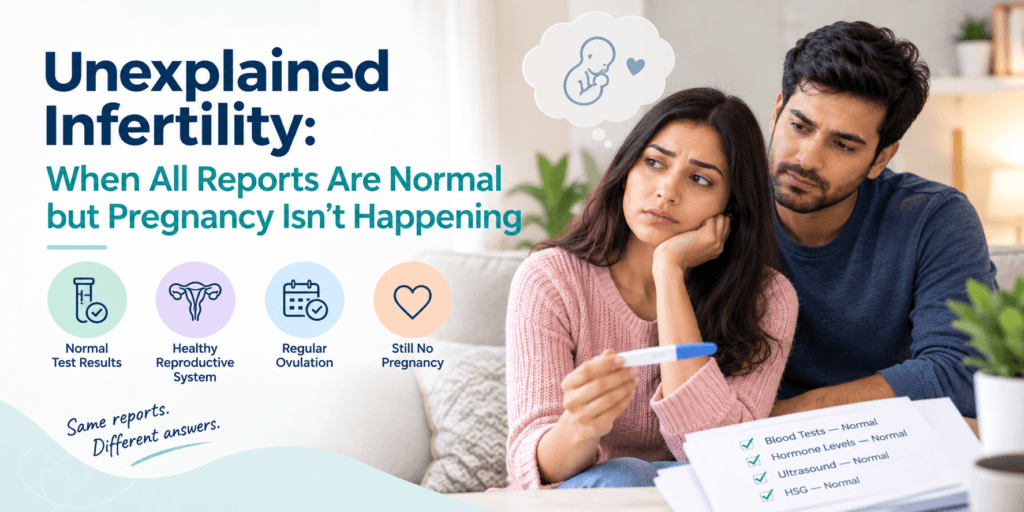
What Is Unexplained Infertility?
Unexplained infertility is diagnosed when a couple has not conceived after 12 months of trying (6 months if the woman is 35 or older), and the standard tests show no clear cause. It accounts for roughly 15 to 30% of couples who are evaluated for infertility.
“Unexplained” does not mean “no reason.” It means the reason is not visible with routine tests.
Which Tests Should Be Done First?
A diagnosis of unexplained infertility is only valid after a complete basic evaluation:
- Ovulation: cycle history, progesterone test or follicle monitoring
- Ovarian reserve: AMH and antral follicle count
- Tubes: HSG or laparoscopy
- Uterus: ultrasound, and hysteroscopy if needed
- Male partner: a complete semen analysis
- General health: thyroid, prolactin, blood sugar
If any of these has been skipped, the infertility may not truly be “unexplained.”
Possible Hidden Causes
Routine tests cannot see everything. Possible underlying factors include:
- Egg quality problems that are not shown by AMH
- Sperm function problems, such as high DNA fragmentation, despite normal counts
- Mild endometriosis, which is often only visible on laparoscopy
- Fertilisation problems where sperm cannot penetrate the egg
- Implantation factors in the uterine lining
- Timing issues: intercourse not matching the fertile window
IVF itself sometimes reveals the cause, for example by showing poor fertilisation in the lab.
Treatment Options: A Step-by-Step Path
Treatment usually moves from simple to advanced, depending on age and how long you have been trying.
| Step | Treatment | Best suited for |
|---|---|---|
| 1 | Lifestyle changes and timed intercourse with ovulation tracking | Younger couples, short duration of trying |
| 2 | Ovulation induction with IUI (usually 3 to 4 cycles) | Women under 35, open tubes, normal sperm |
| 3 | IVF, with ICSI if needed | Age 35 or above, long duration, or failed IUI |
Why age changes the plan
For women under 35, starting with IUI is reasonable. For women over 35 or 37, many specialists move to IVF sooner, because time is the most important factor. Waiting through several unsuccessful IUI cycles may reduce overall chances.
Why IVF often helps
IVF bypasses many hidden barriers. It lets the embryologist see fertilisation and embryo development directly, which can reveal problems no blood test can find.
Lifestyle Steps That Help
- Maintain a healthy weight (BMI 18.5 to 25)
- Stop smoking and limit alcohol, for both partners
- Take folic acid daily
- Manage stress and get adequate sleep
- Have intercourse every 2 to 3 days through the cycle
Unexplained Infertility Care at Ayuh Fertility Centre
At Ayuh Fertility Centre in Ranip, Ahmedabad, Dr. Krupa Shah first checks that nothing has been missed, reviewing previous reports and adding tests such as sperm DNA fragmentation or laparoscopy where they help. The treatment plan is then matched to your age and history, so you do not lose time on treatments unlikely to work for you.
Every report normal, still no pregnancy? Get a fresh look at your case. Call or WhatsApp +91 94260 28483.
Frequently Asked Questions
Can you get pregnant naturally with unexplained infertility?
Yes, some couples do, especially when the woman is younger and the duration of trying is shorter.
How many IUI cycles should we try before IVF?
Usually 3 to 4 cycles. Many doctors suggest fewer if the woman is over 35.
Is IVF successful for unexplained infertility?
IVF is one of the most effective treatments for unexplained infertility. Success depends mainly on the woman’s age.
Can stress cause unexplained infertility?
Stress alone is rarely the cause, but managing it helps you cope with treatment.
Should my husband get tested again?
If his last test was more than a year ago, or only one test was done, a repeat is sensible.
Pingback: IVF vs IUI: Treatment Differences & Fertility Conditions - Ayuh Fertility Centre