
IVF Failed Once : Going through IVF takes emotional strength, time, money and physical effort. So when an IVF cycle does not result in pregnancy, it is completely natural to ask:
“Why did my IVF fail?”
And perhaps the next question is even more important:
“Should I try IVF again, or should something change first?”
A single unsuccessful IVF cycle does not necessarily mean that future treatment will fail.
IVF outcomes can vary according to age, infertility diagnosis, ovarian reserve, egg and sperm factors, embryo development, uterine factors and the specific treatment used. Major ART data sources also caution that average success rates cannot predict an individual couple’s outcome.
The right next step after a failed cycle is therefore not always “repeat the same treatment.”
Instead, your fertility specialist should review what happened during the previous cycle and determine whether there is something important to address before trying again.
What Does a Failed IVF Cycle Actually Mean?
“IVF failure” can describe different situations.
For example:
- Eggs were retrieved but did not fertilize
- Fertilization occurred but embryos did not develop as expected
- No suitable embryo was available for transfer
- An embryo was transferred but pregnancy did not occur
- A pregnancy occurred but ended in miscarriage
- A frozen embryo transfer did not result in pregnancy
These situations are not medically identical.
The reason your IVF cycle was unsuccessful can influence what your doctor recommends next.
That is why the first step is to understand exactly where the previous cycle stopped progressing.
Ovarian stimulation
- How many follicles developed?
- Was the response expected for your age and ovarian reserve?
- Were there too few or too many follicles?
Egg retrieval
- How many eggs were retrieved?
- How many were mature?
Fertilization
- How many eggs fertilized?
- Was fertilization lower than expected?
Embryo development
- How many embryos developed?
- Did embryos reach the blastocyst stage?
- How many embryos were suitable for freezing or transfer?
Embryo transfer
- Was the embryo transferred successfully?
- Was the endometrium adequately prepared?
- Were there any technical difficulties?
Pregnancy outcome
- Was there no implantation?
- Was there a biochemical pregnancy?
- Was there a clinical pregnancy followed by miscarriage?
This detailed review can be more useful than simply labelling the treatment as “failed IVF.”
Why Can IVF Fail?
IVF is a complex process involving several stages.
An IVF cycle can be thought of as:
Egg development → Egg retrieval → Fertilization → Embryo development → Embryo transfer → Implantation → Pregnancy
A problem at any stage can affect the final outcome.
Some common factors include:
1. Age and Egg Quality
Age is an important factor in IVF outcomes, particularly when using a woman’s own eggs.
As reproductive age increases, egg quality and the probability of chromosomal abnormalities in embryos can change.
This is one reason two women of the same age can still have very different IVF outcomes.
2. Ovarian Reserve
Ovarian reserve gives information about the expected quantity of eggs available and how the ovaries may respond to stimulation.
Tests such as:
- AMH
- Antral follicle count
- FSH
may be used as part of fertility assessment.
However, ovarian reserve is not the same as egg quality.
A low AMH result does not automatically mean IVF cannot work, and a higher AMH does not guarantee pregnancy.
Your results need to be interpreted in context.
3. Fertilization Problems
Sometimes eggs are retrieved but fewer than expected fertilize.
Possible contributing factors can include egg-related factors, sperm factors, laboratory factors and the method of fertilization used.
If fertilization was unexpectedly poor, your fertility team may review the previous cycle before deciding how to approach another attempt.
4. Embryo Development
Not every fertilized egg becomes a blastocyst.
Embryo development can be influenced by several biological factors, including egg and sperm quality.
If the previous cycle produced few or no transferable embryos, your fertility specialist may focus on understanding the results of the stimulation and laboratory stages before planning another retrieval.
5. Uterine and Endometrial Factors
Successful IVF also requires appropriate conditions for implantation.
Depending on your history, your doctor may consider evaluation of:
- Uterine fibroids
- Polyps
- Uterine adhesions
- Endometrial thickness
- Adenomyosis
- Other uterine abnormalities
Not every patient needs every test.
Testing should be guided by your medical history and clinical findings.
6. Sperm Factors
IVF is not only about female fertility.
Sperm count, motility and morphology can affect fertilization and embryo development.
If the previous cycle showed an unexpected fertilization or embryo-development problem, your doctor may review the male partner’s fertility evaluation as well.
Should You Repeat the Same IVF Protocol?
Not necessarily.
The answer depends on what happened during your previous cycle.
For example:
If ovarian response was poor
Your doctor may review whether the stimulation strategy was appropriate for your ovarian reserve.
If many eggs were retrieved but few fertilized
The fertilization stage and sperm/egg factors may deserve closer review.
If embryos developed poorly
Egg quality, sperm factors, laboratory factors and age may all be considered.
If good-quality embryos were transferred but pregnancy did not occur
The discussion may shift toward implantation, uterine factors and the individual probability of success.
The goal is not to change treatment simply for the sake of changing it.
The goal is to make the next treatment decision based on information from the previous cycle.
What Tests Should You Have After Failed IVF?
This is one of the most common questions after an unsuccessful IVF attempt.
The answer is:
There is no universal list of tests that every patient needs after one failed IVF cycle.
Your doctor may recommend further evaluation when your history suggests a specific concern.
Depending on the situation, this may include reviewing or reassessing:
- Ovarian reserve
- Semen analysis
- Uterine anatomy
- Endometrial thickness
- Hormonal factors
- Previous embryo development
- Previous fertilization results
- Medical conditions affecting fertility
For patients with repeated implantation failure, ESHRE recommends an individualized assessment based on the person’s expected chance of implantation rather than a simple fixed number of failed embryo transfers.
Do You Need Every IVF Add-On After a Failed Cycle?
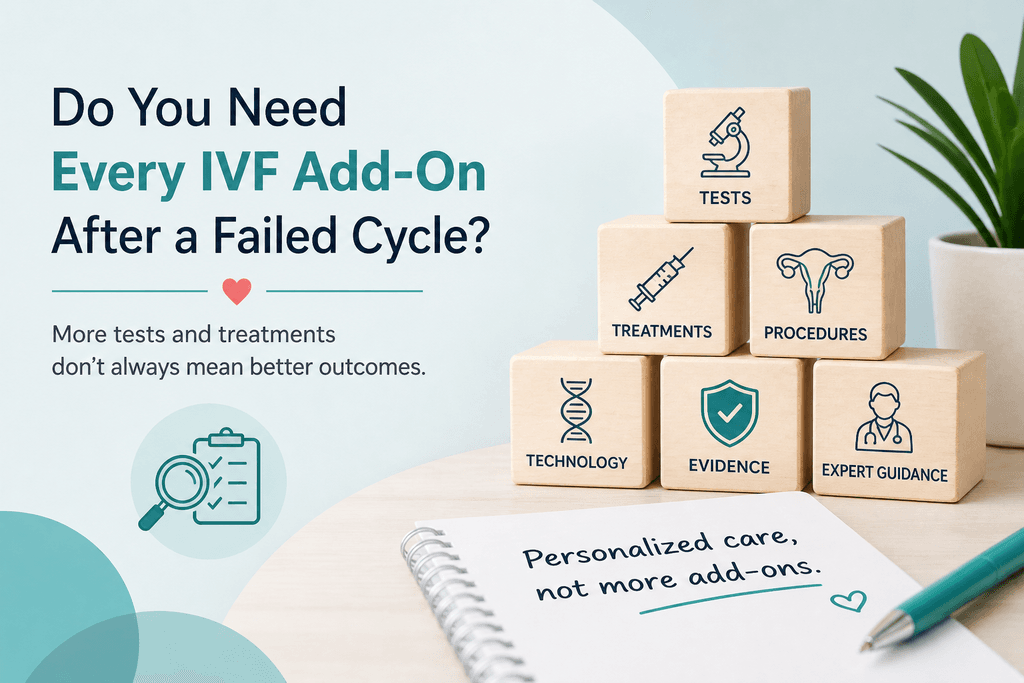
This is an important point.
After an unsuccessful IVF cycle, couples may encounter many tests and treatments promoted as ways to “improve implantation.”
But more testing does not automatically mean better treatment.
ESHRE specifically notes that many investigations and interventions offered for recurrent implantation failure have limited or uncertain evidence and recommends restricting investigations and treatments to those with a clear rationale and evidence of likely benefit.
Therefore, before paying for an additional test or procedure, ask:
- Why is this test being recommended?
- What problem is it looking for?
- If the result is abnormal, will treatment change?
- Is there good evidence that the treatment improves pregnancy or live-birth outcomes?
- Is the test appropriate for my particular history?
This can help you avoid unnecessary investigations.
What Is Recurrent Implantation Failure?
One unsuccessful IVF cycle should not automatically be called recurrent implantation failure.
ESHRE describes recurrent implantation failure as a situation in which transfer of embryos considered viable repeatedly fails to result in a positive pregnancy test often enough, in the context of the individual’s predicted chances, to justify considering further investigation or intervention.
This is important because patients have different underlying chances of implantation.
A fixed rule such as “three failures means RIF for everyone” does not adequately account for individual prognosis.
When Should You Try IVF Again?
There is no universal waiting period that applies to every patient.
The appropriate timing can depend on:
- Your physical recovery
- Menstrual cycle
- Ovarian response
- Any medical condition requiring treatment
- Availability of frozen embryos
- Your emotional readiness
- Your fertility specialist’s assessment
If you already have suitable frozen embryos, the next step may be a frozen embryo transfer rather than another ovarian stimulation and egg retrieval.
If there are no suitable embryos remaining, another retrieval may be considered depending on your circumstances.
What If You Have Frozen Embryos?
If embryos were frozen during your previous IVF cycle, you may not need to repeat the entire stimulation and egg-retrieval process before another transfer.
Your fertility specialist may discuss a frozen embryo transfer (FET).
The preparation can involve:
- Monitoring the endometrium
- Preparing the uterine lining
- Timing progesterone appropriately
- Scheduling embryo transfer
Whether FET is appropriate depends on your individual clinical situation.
Can IVF Work After One Failed Attempt?
Yes, it can.
A failed IVF cycle does not automatically mean that another cycle will fail.
However, it is also important not to assume that repeating the exact same treatment is always the best option.
The previous cycle can provide useful information about:
- Ovarian response
- Egg yield
- Fertilization
- Embryo development
- Endometrial preparation
- Transfer
- Implantation
That information can help your fertility specialist decide what should happen next.
What Should You Ask Your IVF Specialist After Failure?
Before starting another cycle, consider asking these questions:
About my previous cycle
- Why do you think the previous cycle was unsuccessful?
- At which stage did the biggest difficulty occur?
- Was my ovarian response expected?
- Were the eggs mature?
- Was fertilization normal?
- How did the embryos develop?
- Was my uterine lining appropriate?
About the next cycle
- Would you change anything in my treatment?
- Do I need any additional evaluation?
- Do I have frozen embryos available?
- Should we consider a frozen embryo transfer?
- What is my realistic chance of success in another attempt?
About additional treatments
- Why do I need this particular test?
- What will we do differently based on its result?
- Is there evidence that this treatment improves outcomes for someone with my history?
These questions can help turn an emotionally difficult experience into a more informed treatment discussion.
How Age Changes the Conversation After IVF Failure
Your age matters when deciding what to do after a failed IVF cycle.
For patients using their own eggs, age can influence:
- Egg quality
- Embryo development
- Chromosomal abnormalities
- Miscarriage risk
- Overall IVF prognosis
This means that the decision to wait, repeat treatment, or change strategy can be different for a 30-year-old patient compared with a patient in her early 40s.
ART success statistics are also commonly reported according to age because outcomes vary significantly across age groups.
A personalized assessment is therefore more useful than relying on a general internet success percentage.
Should You Change IVF Clinics After One Failure?
Not necessarily.
One unsuccessful cycle does not by itself mean that your doctor or fertility clinic was responsible.
Before making a decision, consider whether your clinic:
- Clearly explained the previous cycle
- Provided access to your treatment and laboratory results
- Discussed possible reasons for failure
- Explained the plan for the next attempt
- Recommended tests for a specific reason
- Communicated honestly about expected outcomes
- Offered appropriate emotional support
If you feel your questions are not being answered or you want another professional opinion, seeking a second opinion can be reasonable.
How Ayuh Fertility Centre Can Help After Failed IVF
At Ayuh Fertility Centre Ahmedabad, the next IVF decision should be based on understanding the patient’s complete fertility history rather than simply counting failed cycles.
A consultation may involve reviewing:
- Age
- Ovarian reserve
- Previous stimulation response
- Egg retrieval results
- Fertilization
- Embryo development
- Embryo transfer
- Endometrial and uterine factors
- Sperm parameters
- Previous pregnancy history
The purpose is to understand what happened and determine what treatment approach may be appropriate next.
For some patients, the next step may be another IVF cycle.
For others, it may be a frozen embryo transfer, additional evaluation, treatment of an identified condition, or discussion of alternative options.
How to Prepare Emotionally for Another IVF Attempt
A failed IVF cycle is not only a medical event.
It can affect:
- Emotional wellbeing
- Relationships
- Work
- Finances
- Confidence about future treatment
It is reasonable to take time before deciding what comes next.
ESHRE’s recommendations for recurrent implantation failure emphasize supportive, individualized care, including allowing patients time for questions, information, discussion and emotional support.
You do not have to make the next decision immediately.
A good fertility consultation should give you enough information to make a decision that feels medically and personally appropriate.
Frequently Asked Questions
Can IVF work after one failed cycle?
Yes. A failed first IVF attempt does not mean that future treatment cannot result in pregnancy. The next step should be based on the findings from the previous cycle and your individual fertility profile.
Should I change doctors after failed IVF?
Not automatically. First understand why the cycle failed and whether your doctor has a clear plan for the next attempt. A second opinion can be considered if you want another professional assessment.
How long should I wait after failed IVF?
The appropriate timing varies. Your doctor may consider your physical recovery, treatment history, menstrual cycle, frozen embryos and emotional readiness before recommending the next step.
Do I need more tests after one failed IVF cycle?
Not necessarily. Additional testing should be based on your individual history and clinical indications rather than automatically ordering every available test.
Does one failed IVF cycle mean I have recurrent implantation failure?
No. Recurrent implantation failure is an individualized clinical concept. ESHRE recommends considering the patient’s expected chance of implantation rather than using a fixed number of unsuccessful transfers for everyone.
Can I try IVF again immediately?
Whether you can or should proceed immediately depends on your medical situation. Your fertility specialist can advise you about appropriate timing.
What if I have frozen embryos after failed IVF?
If suitable embryos remain frozen, your doctor may discuss a frozen embryo transfer rather than repeating ovarian stimulation and egg retrieval.
Is IVF more likely to work the second time?
There is no guarantee that a second cycle will be successful. However, the results of your first cycle can provide valuable information that may help guide future treatment.
Final Takeaway: IVF Failed Once — What Should You Do?
If IVF failed once, don’t assume that your fertility journey is over.
Instead:
1. Review the previous cycle carefully.
2. Understand where the treatment did not progress as expected.
3. Review egg, sperm, embryo and uterine factors.
4. Ask whether anything needs to be addressed before another attempt.
5. Avoid unnecessary tests or treatments without a clear reason.
6. Discuss whether another IVF cycle or frozen embryo transfer is appropriate.
7. Get a realistic, individualized assessment of your chances.
Most importantly, don’t measure your future chances solely by what happened during one cycle.
Your previous IVF attempt is a piece of information—not necessarily a prediction of what will happen next.
Medical Disclaimer
This article is for general educational purposes and does not replace medical diagnosis, treatment or individualized fertility advice. IVF outcomes vary between individuals. Tests and treatments should be recommended according to your medical history, investigations and clinical circumstances.
Author / Medical Reviewer:
Dr. Krupa M. Shah
Fertility Specialist
Ayuh Fertility Centre, Ahmedabad
Suggested CTA
IVF didn’t work the first time? Don’t lose hope—and don’t rush into another cycle without understanding what happened. Consult a fertility specialist at Ayuh Fertility Centre Ahmedabad to review your previous IVF cycle and discuss the next appropriate step.