
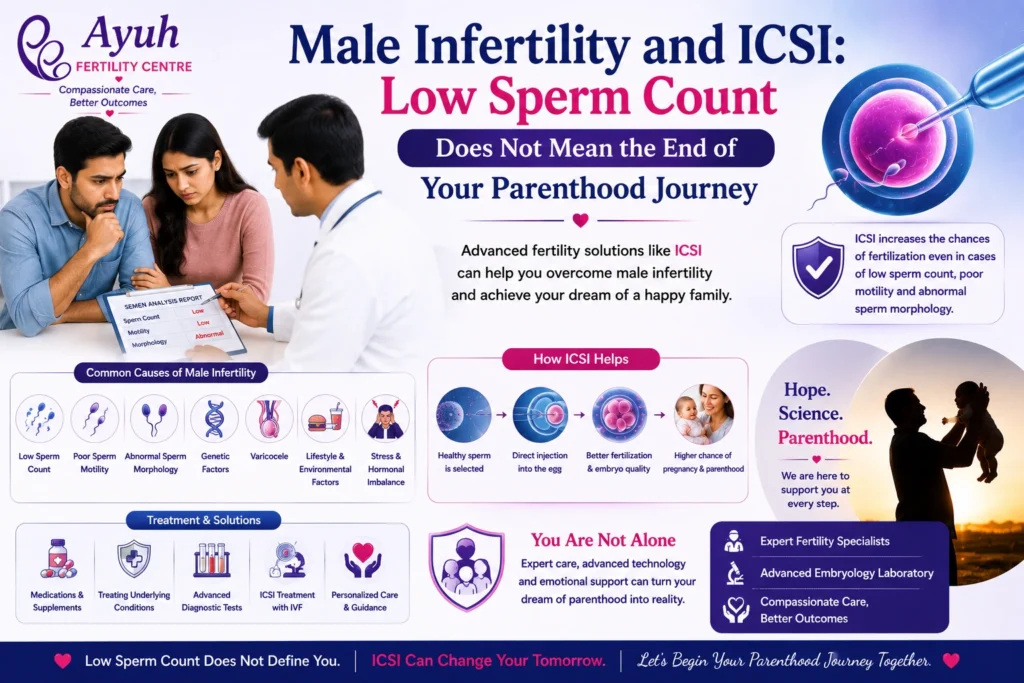
When a couple discovers that the fertility challenge lies with the male partner, it can feel like the ground has shifted beneath them. There is often shock, silence, and a question that feels too heavy to ask out loud: “Does this mean we can never have a child?”
The answer, in most cases, is a firm and compassionate no.
Male infertility and ICSI — Intracytoplasmic Sperm Injection — have together changed what is possible for millions of couples worldwide. At Ayuh Fertility Centre in Ahmedabad, Dr. Krupa M. Shah has helped thousands of couples navigate male infertility with honesty, expert care, and genuine hope.
Low sperm count is one of the most common causes of infertility in men — and it is also one of the most treatable. This article will walk you through what male infertility means, why it happens, and exactly how modern treatments like ICSI are giving couples real reasons to hope.
Author Bio
Dr. Krupa A. Shah MBBS · MS (Obstetrics & Gynaecology) · Infertility Specialist Founder, Ayuh Fertility Centre, Ahmedabad
19+ Years of Experience in reproductive medicine, obstetrics, and gynaecology.
Dr. Krupa Shah completed her MBBS from Baroda Medical College (2006) and her MS in Obstetrics & Gynaecology from B.J. Medical College, Ahmedabad (2010). After 12 years of experience at leading clinics in Chennai — including Apollo Hospital and Iswarya Fertility Centre — she completed an Advanced IVF Fellowship at Ludwig Maximilians University, Munich, Germany, one of Europe’s most prestigious reproductive medicine institutions.
She is a member of the Ahmedabad Obstetrics and Gynaecology Society (AOGS), the Indian Society of Assisted Reproduction (ISAR), and the Federation of Obstetric and Gynaecological Societies of India (FOGSI).
IVF laboratory is ART National Board Certified.
🩺 Medically Reviewed By
This article is medically reviewed by Dr. Krupa M. Shah, ensuring accurate and reliable fertility information.
Understanding Male Infertility
Male infertility is far more common than most people realise. Studies consistently show that male factors contribute to infertility in 40 to 50 percent of all cases where a couple is having difficulty conceiving. Yet it remains a topic that many men find difficult to discuss — even with their doctors.
Infertility does not discriminate by lifestyle, profession, or physical appearance. Many men who appear completely healthy and feel no different may still have fertility challenges that are only discovered during testing.
Emotionally, a male infertility diagnosis can be deeply unsettling. Men often carry feelings of shame, inadequacy, or guilt — emotions that are understandable, but do not reflect the reality of the situation. Infertility is a medical condition, not a reflection of masculinity or worth.
The most important thing to understand early is this: male infertility is not a dead end. It is a starting point for evaluation, treatment, and in most cases, a genuine path forward.
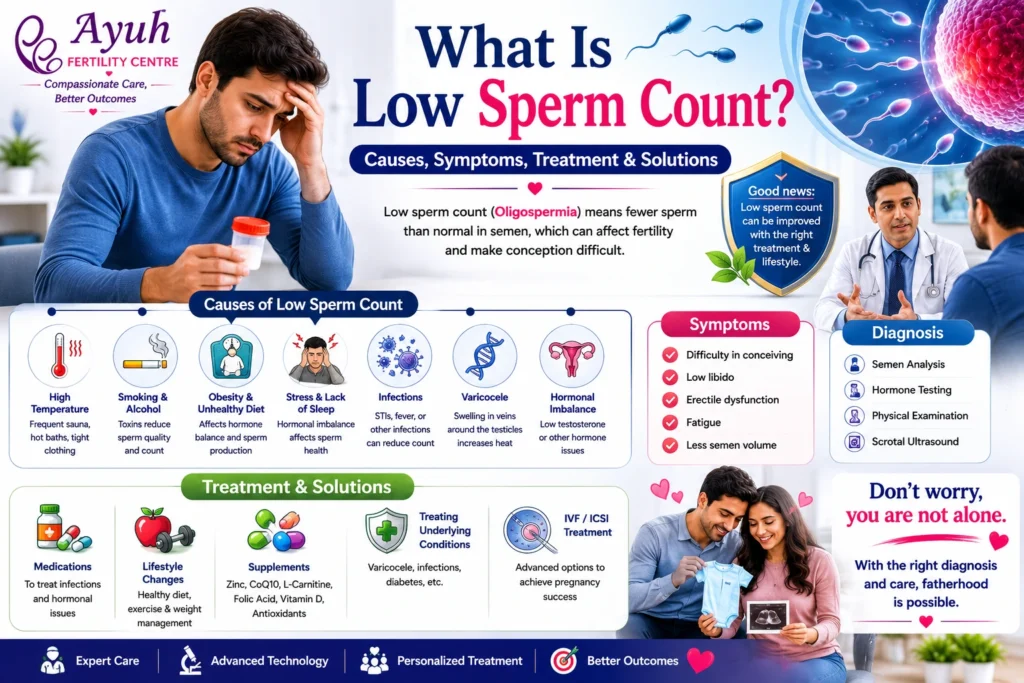
What Is Low Sperm Count?
Low sperm count — medically known as oligospermia — means there are fewer sperm than normal in the semen produced during ejaculation.
Normal sperm count is defined as 15 million sperm per millilitre (ml) or more. A count below this threshold is considered low. Doctors generally classify oligospermia into three categories:
| Category | Sperm Count |
|---|---|
| Mild Oligospermia | 10–15 million/ml |
| Moderate Oligospermia | 5–10 million/ml |
| Severe Oligospermia | Less than 5 million/ml |
| Azoospermia | No sperm present in semen |
Sperm count is important because natural conception requires sperm to travel through the female reproductive tract, locate the egg, and fertilise it. Fewer sperm reduce the probability of this happening. However — and this is important — even very low sperm counts can achieve pregnancy with the right fertility treatment.
This is where low sperm count treatment options like ICSI become genuinely life-changing.
📎 Related: IVF Treatment at Ayuh Fertility Centre
Common Causes of Male Infertility
Understanding why low sperm count or poor sperm quality occurs is the first step toward treating it. Causes fall into three main categories.
Medical Causes
- Varicocele — Enlarged veins in the scrotum that raise temperature around the testes, reducing sperm production. This is the most common correctable cause of male infertility.
- Hormonal imbalances — Low testosterone or imbalances in FSH and LH can disrupt sperm production.
- Infections — Some sexually transmitted infections or urinary tract infections can cause blockages or reduce sperm quality.
- Genetic conditions — Klinefelter syndrome, Y-chromosome microdeletions, and other genetic issues can affect sperm production.
- Ejaculation problems — Retrograde ejaculation (where sperm enters the bladder instead of exiting) affects fertility but can often be treated.
- Blocked vas deferens — Previous surgeries, infections, or congenital absence of the vas deferens can prevent sperm from being ejaculated.
Lifestyle Causes
- Smoking — Directly damages sperm DNA and reduces both count and motility.
- Alcohol — Disrupts testosterone levels and reduces sperm quality.
- Obesity — Excess body fat raises oestrogen levels in men, suppressing sperm production.
- Stress — Chronic stress elevates cortisol, which suppresses testosterone production.
- Poor diet — Deficiencies in zinc, selenium, folate, and antioxidants affect sperm health.
- Heat exposure — Frequent use of saunas, hot baths, or tight clothing raises scrotal temperature, reducing sperm count.
- Anabolic steroids — Use of performance-enhancing steroids severely suppresses natural testosterone and sperm production.
Age-Related Factors
While men can father children much later in life than women, sperm quality — including motility and DNA integrity — does gradually decline with age, particularly after 45. This can affect both conception rates and embryo quality.
Symptoms and Signs of Male Infertility
One of the most challenging aspects of male infertility is that most men have no obvious symptoms at all. They feel healthy, have a normal sex life, and have no reason to suspect a fertility issue until they try to conceive.
Some signs that may indicate a problem include:
- Difficulty achieving or maintaining an erection
- Reduced sex drive
- Pain, swelling, or a lump in the testicular area
- Decreased facial or body hair (possible hormonal signal)
- Signs of a varicocele (a feeling of heaviness in the testicle)
However, in the majority of cases, a semen analysis is the only way to identify the issue. If you and your partner have been trying to conceive for 12 months without success — or 6 months if your female partner is over 35 — it is time to get evaluated.
📎 Related: Infertility Care and Evaluation at Ayuh Fertility Centre
How Male Infertility Is Diagnosed
The diagnostic process for male infertility is straightforward and non-invasive in most cases. Your fertility specialist will typically recommend:
Semen Analysis
The most fundamental test. A semen sample is examined for:
- Sperm count (total number of sperm)
- Motility (percentage of moving sperm)
- Morphology (percentage of normally shaped sperm)
- Volume and pH of the semen
A single abnormal result is not conclusive — two or three samples over time give a more accurate picture.
Hormonal Testing
Blood tests measure testosterone, FSH, LH, and prolactin levels to assess whether hormonal imbalances are affecting sperm production.
Scrotal Ultrasound
Used to detect varicoceles, blockages, or structural abnormalities in the testes and epididymis.
Genetic Testing
In cases of very low or absent sperm count, genetic testing can identify chromosomal or Y-chromosome issues that explain why sperm production is impaired.
Physical Examination
A clinical examination by a urologist or andrologist can identify varicoceles, undescended testes, or other physical findings.
📎 Related: Fertility Services at Ayuh Fertility Centre
Male Infertility Treatment Options
Male infertility treatment has expanded considerably in recent decades. Today, most men with fertility challenges have real options.
1. Lifestyle Changes
For mild cases, targeted lifestyle improvements alone can meaningfully improve sperm quality over 2–3 months:
- Stopping smoking and alcohol
- Weight loss if overweight
- Reducing heat exposure
- Improving diet and nutritional intake
- Managing stress and improving sleep quality
2. Medications
- Hormonal treatments can correct testosterone or FSH imbalances affecting sperm production.
- Antioxidant supplements (vitamin C, vitamin E, zinc, CoQ10) may improve sperm quality in some men.
- Antibiotics are prescribed if an active infection is identified.
3. Surgical Treatments
- Varicocelectomy — Surgical repair of varicoceles is one of the most effective treatments for male infertility, and can significantly improve sperm count and quality.
- Sperm retrieval procedures — TESA (Testicular Sperm Aspiration) and PESA (Percutaneous Epididymal Sperm Aspiration) are used to collect sperm surgically when none is present in the ejaculate.
📎 Related: TESA/PESA Sperm Retrieval — Ayuh Fertility Centre
4. Assisted Reproductive Techniques (ART)
When sperm count or quality is too low for natural conception or IUI, ICSI (Intracytoplasmic Sperm Injection) is the most effective ART option for male infertility. More on this in the next section.
What Is ICSI? How It Helps Male Infertility
ICSI stands for Intracytoplasmic Sperm Injection. It is a specialised form of IVF that was developed specifically to address cases where sperm quality is a challenge.
In standard IVF, thousands of sperm are placed near each egg in a laboratory dish, and fertilisation is left to happen naturally. In ICSI, a single healthy sperm is selected by an expert embryologist and injected directly into the egg — bypassing any barriers related to count, motility, or shape.
How ICSI Works — Step by Step
- Ovarian stimulation — The female partner takes hormonal injections to encourage the ovaries to produce multiple eggs.
- Egg retrieval — Eggs are collected under light sedation using a fine needle guided by ultrasound.
- Sperm preparation — A semen sample (or surgically retrieved sperm) is prepared in the laboratory.
- Microinjection — A single sperm is injected directly into each mature egg under a high-powered microscope.
- Fertilisation and embryo culture — Fertilised eggs are monitored over 3–5 days as they develop into embryos.
- Embryo transfer — The best-quality embryo is transferred into the uterus. Remaining embryos may be frozen for future cycles.
- Pregnancy test — A blood HCG test approximately 14 days after transfer confirms whether implantation has occurred.
The key advantage of male infertility and ICSI combined is that only one viable sperm is needed per egg. This makes ICSI effective even in cases of very low sperm count, poor motility, or abnormal morphology.
📎 Related: ICSI Treatment at Ayuh Fertility Centre
When Is ICSI Recommended?
ICSI is specifically recommended in the following situations:
- Very low sperm count — When count is too low for conventional IVF or IUI to be effective
- Poor sperm motility — When sperm cannot swim adequately to reach and penetrate an egg
- Abnormal sperm morphology — When the shape of sperm affects their ability to fertilise
- Previous IVF fertilisation failure — When standard IVF did not result in fertilisation
- Surgically retrieved sperm — When sperm is obtained via TESA or PESA rather than from ejaculate
- Antisperm antibodies — When the immune system produces antibodies that impair sperm function
- Unexplained infertility — Sometimes recommended to maximise fertilisation chances
📎 Related: IUI Treatment — When It’s Used and When ICSI Is Better
Success Rates of ICSI for Male Infertility
ICSI has dramatically improved outcomes for couples with male infertility. However, it is important to be clear and honest about what success rates mean.
Factors that most influence ICSI success include:
- Female partner’s age — Egg quality declines with age and is one of the most significant factors in IVF/ICSI success.
- Egg quality — Directly affects fertilisation rates and embryo development.
- Embryo quality — Not all fertilised eggs develop into transferable embryos.
- Uterine receptivity — The condition of the uterine lining at the time of transfer matters significantly.
- Laboratory quality — The expertise of the embryology team and quality of the lab environment are crucial.
- Underlying cause of infertility — Some conditions respond better to ICSI than others.
Globally, ICSI fertilisation rates (percentage of injected eggs that fertilise) are typically in the 60–80% range — a significant improvement over natural fertilisation in cases of male infertility.
It is important to be honest: no clinic can guarantee pregnancy. Success depends on multiple factors, and not every cycle will result in a baby. What ICSI does is maximise the chance of fertilisation when sperm quality is a concern — and that is genuinely meaningful.
📎 Related: IVF Success Rates at Ayuh Fertility Centre — Transparent & Honest
Can Men with Zero Sperm Count Become Fathers?
Yes — in many cases, they can. The condition of having no sperm in the ejaculate is called azoospermia, and it affects approximately 1% of all men and around 10–15% of infertile men.
There are two types of azoospermia:
- Obstructive azoospermia — Sperm are being produced, but a blockage prevents them from appearing in the ejaculate. This is often correctable.
- Non-obstructive azoospermia — Sperm production itself is impaired.
For men with azoospermia, surgical sperm retrieval procedures make biological fatherhood possible in many cases:
- TESA (Testicular Sperm Aspiration) — A fine needle extracts sperm directly from the testicular tissue.
- PESA (Percutaneous Epididymal Sperm Aspiration) — Sperm is retrieved from the epididymis using a fine needle.
- Micro-TESE (Microdissection TESE) — For non-obstructive cases, a microsurgical technique used to find sperm in small pockets of productive tissue.
Sperm retrieved through any of these methods can be used immediately in an ICSI cycle or frozen for future use.
If no sperm can be retrieved after all options are explored, donor sperm is an option that many couples choose to consider. This is a deeply personal decision and one that fertility specialists support with sensitivity and without judgment.
📎 Related: Embryo Freezing at Ayuh Fertility Centre
The Emotional Impact of Male Infertility
Male infertility carries an emotional weight that is rarely discussed openly — and that silence makes it heavier.
For many men, an infertility diagnosis triggers feelings of shame, emasculation, and inadequacy. These feelings are deeply human and completely understandable — but they are also based on a profound misunderstanding. Infertility is a medical condition. It says nothing about who you are as a person, a partner, or a potential father.
Partners sometimes pull in different directions when coping with the news. One person may want to talk; the other may go quiet. One may want to act immediately; the other may need time. These differences are normal — but they need to be navigated together.
How to Cope
- Talk to each other honestly — Avoiding the conversation doesn’t make the feelings go away. It just creates distance.
- Seek professional support — A counsellor experienced in fertility challenges can provide tools that genuinely help both partners.
- Don’t carry it alone — Sharing with a trusted friend, family member, or support group can reduce the isolation that infertility often creates.
- Protect your relationship — Infertility puts stress on relationships. Make intentional time for each other outside of the fertility journey.
- Remember your worth — A sperm count does not define a man. The courage to face this and seek help does.
📎 Related: About Dr. Krupa Shah — Compassionate Fertility Care
Lifestyle Tips to Improve Male Fertility
For men who have been diagnosed with mild to moderate fertility challenges, targeted lifestyle changes can make a real difference — particularly when combined with medical treatment.
Sperm regenerate approximately every 74 days. This means changes you make today can show measurable improvement in your semen analysis results in about 2–3 months.
- Reach and maintain a healthy weight — Even modest weight loss (5–10%) in overweight men has been shown to improve testosterone and sperm quality.
- Exercise moderately — Aim for 30 minutes of moderate activity most days. Avoid excessive cycling or intense training that increases scrotal heat.
- Eat an antioxidant-rich diet — Include nuts, seeds, colourful vegetables, eggs, fish, and legumes. Zinc and selenium are particularly important for sperm health.
- Stop smoking — Smoking damages sperm DNA. This is non-negotiable for anyone preparing for fertility treatment.
- Reduce or eliminate alcohol — Alcohol reduces testosterone and disrupts sperm production.
- Improve sleep — Testosterone production peaks during sleep. Aim for 7–9 hours of good quality sleep each night.
- Manage stress — Chronic stress suppresses testosterone. Yoga, mindfulness, walking, and breathing exercises all help.
- Avoid heat exposure — No long hot baths, saunas, or laptops on your lap. Keep the scrotal environment cool.
Common Myths About Male Infertility
There is a lot of misinformation around male fertility. Let’s clear up the most common myths.
| Myth | Reality |
|---|---|
| Male infertility is rare | It contributes to roughly 40–50% of all infertility cases. It is very common. |
| Low sperm count means no chance of fatherhood | ICSI and sperm retrieval procedures have made biological fatherhood possible even with very low or zero sperm count. |
| Infertility is always the woman’s problem | This is one of the most damaging myths in reproductive health. Male factors are involved in half of all infertility cases. |
| IVF or ICSI always works immediately | No fertility treatment guarantees pregnancy, and many couples need more than one cycle. Realistic expectations matter. |
| Only older men have fertility problems | Men of any age can have fertility challenges. Lifestyle, genetics, and medical conditions all play a role. |
| A healthy sex life means healthy sperm | Sexual performance has no bearing on sperm count, motility, or quality. Only a semen analysis can reveal sperm health. |
Frequently Asked Questions
Q 1: Can low sperm count be treated?
Yes, in many cases. Treatment depends on the underlying cause. Lifestyle changes, medications, and surgical correction of varicoceles can all improve sperm count in suitable candidates. When count remains low despite treatment, ICSI allows fertilisation with just a single sperm per egg — making conception possible even with very limited sperm. The first step is always a thorough evaluation to understand why the count is low and which approach is most appropriate for your specific situation.
Q 2: Is ICSI better than IVF for male infertility?
For significant male factor infertility, yes — ICSI is generally the preferred option over standard IVF. Standard IVF relies on sperm swimming to and penetrating the egg naturally in a dish. ICSI removes that requirement entirely by injecting one sperm directly into each egg. This is particularly valuable when sperm count is low, motility is poor, or morphology is abnormal. Your fertility specialist will assess your semen analysis results and recommend whether IVF, ICSI, or another approach is most appropriate for your case.
Q 3: Can pregnancy happen naturally with low sperm count?
Yes, natural pregnancy is possible with mild to moderate low sperm count — particularly when other fertility factors are normal. Some couples with mild oligospermia conceive without any treatment. However, if you have been trying for 12 months (or 6 months if the female partner is over 35) without success, it is important to seek evaluation rather than wait. Delaying assessment uses time that could be spent on effective treatment.
Q 4: What is the success rate of ICSI?
ICSI fertilisation rates — meaning the percentage of injected eggs that successfully fertilise — are typically between 60 and 80 percent globally. Pregnancy rates per embryo transfer depend on multiple factors: the woman’s age, egg quality, embryo quality, and uterine health. No clinic can ethically guarantee a specific success rate for any individual. Success rates at experienced centres like Ayuh Fertility Centre are discussed transparently at consultation, based on your personal test results and medical history.
Q 5: Can men with zero sperm count (azoospermia) have biological children?
In many cases, yes. Surgical sperm retrieval procedures such as TESA and PESA can extract sperm directly from the testes or epididymis in men with obstructive azoospermia. In non-obstructive cases, a procedure called Micro-TESE can locate sperm in small productive areas of testicular tissue. Retrieved sperm can be used in an ICSI cycle. Success depends on whether viable sperm can be found and retrieved — which is determined through proper evaluation by a fertility specialist and urologist working together.
Conclusion: Your Parenthood Journey Is Not Over
A diagnosis of male infertility — whether it’s low sperm count, poor motility, or even azoospermia — is not the end of your story. It is the beginning of a new chapter, one where medicine, science, and the right medical team stand alongside you.
Male infertility and ICSI have together transformed what is possible for couples who once had very few options. Today, even men with extremely low sperm counts or no sperm in their ejaculate have pathways to biological fatherhood that are medically sound and genuinely achievable.
Dr. Krupa M. Shah and the team at Ayuh Fertility Centre understand that behind every test result is a real person — and a real dream. Every couple that walks through our doors receives personalised evaluation, honest answers, and a treatment plan built around their specific situation.
If you or your partner have concerns about male fertility, don’t wait and wonder. The sooner you seek evaluation, the more options are available to you.
👉 Book your consultation with Ayuh Fertility Centre today
👉 Get expert guidance for PCOS and fertility treatment
👉 Start your journey toward a healthy and successful pregnancy
📍 Visit us in Ahmedabad
📞 Call now to schedule your appointment