
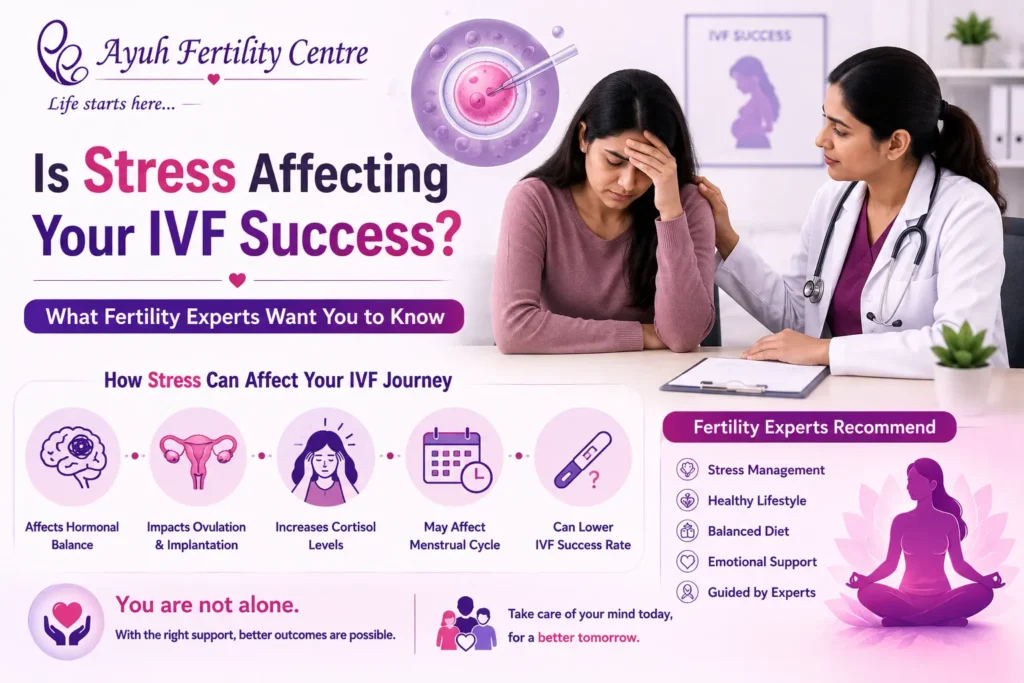
IVF success is something every couple on the fertility journey thinks about — often constantly, and sometimes obsessively — and that relentless thinking is itself one of the heaviest emotional burdens the treatment brings.
You watch your diet. You count your injections. You track every scan result and every hormone number. You read forums at midnight. You manage the hope and manage the fear simultaneously, every single day, for weeks at a time. And somewhere in the middle of all that, someone — a well-meaning relative, an article online, maybe even a quiet voice in your own head — plants the question: “Am I too stressed? Is my stress ruining my chances?”
That question deserves a proper, honest answer. Not a dismissive reassurance, and not a frightening list of ways your emotions might be working against you. Something in between — grounded in medical reality, delivered with the care you actually deserve.
At Ayuh Fertility Centre in Ahmedabad, Dr. Krupa M. Shah has walked alongside hundreds of couples through the emotional landscape of IVF — the early hope, the anxious waiting, the grief of a failed cycle, and the renewed courage it takes to try again. In her experience, the emotional dimension of fertility treatment is one of the most underestimated factors in a couple’s overall wellbeing during the process — not because stress directly causes failure, but because unmanaged stress quietly erodes the quality of life, the quality of sleep, the quality of decisions, and the quality of the relationship that makes this journey survivable.
This blog is written to give you clarity. Not guilt. Not fear. Just an honest, compassionate look at what we know about stress and IVF — and what you can actually do about it.
Author Bio
Dr. Krupa A. Shah MBBS · MS (Obstetrics & Gynaecology) · Infertility Specialist Founder, Ayuh Fertility Centre, Ahmedabad
19+ Years of Experience in reproductive medicine, obstetrics, and gynaecology.
Dr. Krupa Shah completed her MBBS from Baroda Medical College (2006) and her MS in Obstetrics & Gynaecology from B.J. Medical College, Ahmedabad (2010). After 12 years of experience at leading clinics in Chennai — including Apollo Hospital and Iswarya Fertility Centre — she completed an Advanced IVF Fellowship at Ludwig Maximilians University, Munich, Germany, one of Europe’s most prestigious reproductive medicine institutions.
She is a member of the Ahmedabad Obstetrics and Gynaecology Society (AOGS), the Indian Society of Assisted Reproduction (ISAR), and the Federation of Obstetric and Gynaecological Societies of India (FOGSI).
IVF laboratory is ART National Board Certified.
🩺 Medically Reviewed By
This article is medically reviewed by Dr. Krupa M. Shah, ensuring accurate and reliable fertility information.
Can Stress Really Affect IVF Success?
This is the question most people arrive with — and it deserves a careful answer, because the truth is more nuanced than a simple yes or no.
The short answer: Stress alone does not directly cause IVF to fail.
There is currently no strong clinical evidence that emotional stress — even significant anxiety or worry — directly prevents embryo implantation or causes a cycle to fail. IVF outcomes are primarily determined by biological factors: egg quality, sperm quality, embryo development, endometrial receptivity, and the woman’s age and ovarian reserve.
So if your IVF cycle did not succeed, it was not because you were not calm enough. Please hold on to that.
The longer answer: Chronic, unmanaged stress does affect the body in real ways that can influence the overall treatment experience.
High and sustained stress activates the body’s cortisol response. Elevated cortisol over a long period can disrupt sleep quality, affect hormonal regulation, reduce immune function, and change eating and lifestyle behaviours. None of these things directly block IVF from working — but collectively, they affect how well your body is functioning during treatment.
When people ask can stress affect IVF success, the most accurate answer is: stress does not decide the outcome of your cycle, but your emotional wellbeing affects how well you sleep, how consistently you manage your medication schedule, how your hormones are regulated, and how supported you feel throughout the process. Those things matter — not as medical guarantees, but as part of good overall care.
The takeaway: manage stress because it is good for you as a whole person — not because you are afraid it will ruin your cycle.
Why IVF Treatment Feels Emotionally Overwhelming
If you are finding IVF emotionally exhausting, you are not fragile. You are responding normally to an abnormally difficult situation.
Stress during IVF treatment comes from multiple directions at once, and they compound each other in ways that are hard to explain to someone who has not been through it.
- Hormonal changes — the stimulation medications used in IVF directly affect mood, causing heightened emotional sensitivity, irritability, and tearfulness that are physiological, not psychological
- Financial pressure — IVF is a significant investment, and the fear of spending that amount without a guaranteed outcome creates a layer of anxiety that never fully quiets
- The waiting — the two-week wait after embryo transfer is one of the most psychologically demanding periods most couples ever experience; every symptom is over-interpreted, every day feels slow
- Fear of failure — particularly for couples who have already had a failed cycle, the fear going into the next one is compounded and harder to manage
- Repeated appointments — blood tests, scans, and phone calls with clinic staff become a part-time job that disrupts normal life rhythms
- Social pressure — family members asking questions, friends announcing pregnancies, colleagues noticing your stress — the social environment during IVF is rarely gentle
- Emotional isolation — many couples feel they cannot talk openly about what they are going through, which leaves them carrying the weight alone
All of these are real, valid, and entirely understandable. You are not too sensitive. You are carrying a lot.
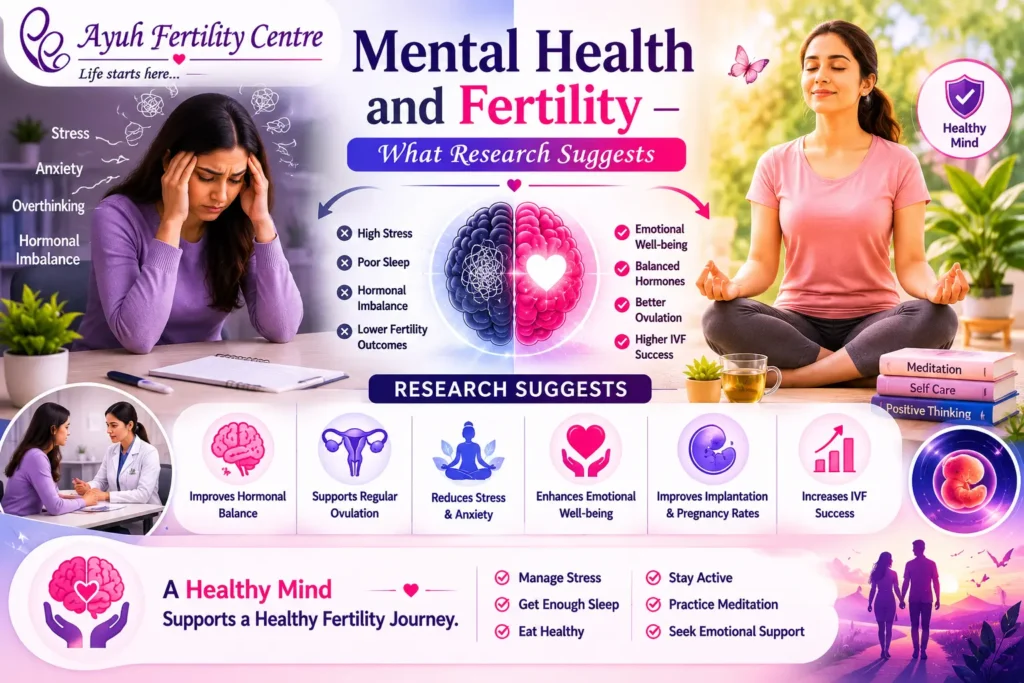
Mental Health and Fertility — What Research Suggests
The relationship between mental health and fertility is an active area of research, and the findings are worth understanding clearly.
Studies have shown that people undergoing fertility treatment experience rates of anxiety and depression comparable to those diagnosed with serious chronic illnesses. That tells us something important: the emotional burden of IVF is not trivial or performative. It is measurable and significant.
What research has found:
- Anxiety and depression are more common during IVF than in the general population, particularly during the waiting phases of treatment
- Sleep disruption — which often accompanies anxiety — can affect the body’s natural hormonal rhythms, including those that regulate the menstrual cycle and stress response
- Cortisol, the body’s primary stress hormone, when chronically elevated, can influence inflammatory processes in the body that may affect overall reproductive health
- Emotional burnout — the decision to stop treatment, even when medical options remain — is often driven by psychological exhaustion more than physical factors
None of this means anxiety causes IVF failure. It means that poor mental health during treatment is a real clinical issue that deserves proper attention and support — not dismissal.
At Ayuh Fertility Centre, the understanding of infertility care and evaluation in Ahmedabad extends to the emotional dimension of treatment, not just the clinical one.
Common Signs of High Stress During IVF
Sometimes stress builds gradually and couples do not realise how much they are carrying until a small thing tips them over. These are signs worth paying attention to:
- Persistent trouble sleeping — waking at 2 or 3am, unable to quiet the mind
- Constant, circular worry — the same fears replaying without resolution
- Irritability or short temper — especially toward your partner, who is also struggling
- Emotional exhaustion — feeling depleted even on days when nothing particularly difficult happened
- Panic before test results — disproportionate fear in the hours before a phone call from the clinic
- Relationship tension — feeling disconnected from your partner, or like you are grieving differently
- Loss of motivation — struggling to find interest in things that used to bring enjoyment
- Compulsive internet searching — spending hours reading IVF forums and success rate statistics late at night
Recognising these signs is not a sign of weakness. It is information. And information allows you to act.
How to Reduce Stress During IVF
How to reduce stress during IVF is one of the most practical questions couples ask — and the answers are simpler than most people expect. They do not require perfection. They require consistency.
Breathe Deliberately
Slow, deep breathing activates the parasympathetic nervous system — the body’s natural calming mechanism. Even five minutes of intentional breathing before your daily injection or before a scan can lower cortisol levels measurably.
Protect Your Sleep
Sleep is where hormonal regulation, emotional processing, and physical recovery all happen. Try to maintain consistent sleep and wake times. Keep screens out of the bedroom in the last hour before sleep. If anxiety is making sleep difficult, mention it to Dr. Shah — it is a clinical issue worth addressing.
Move Your Body Gently
Light walking, yoga, and swimming are generally safe and beneficial during IVF. They reduce cortisol, improve mood through endorphin release, and give the body something productive to do with the physical tension that builds during stressful waiting periods. Avoid high-intensity exercise during stimulation and after embryo transfer.
Limit Your Internet Time
This is harder than it sounds, but important. Online IVF forums contain real stories — but they skew toward extreme outcomes, are rarely representative of your specific situation, and reading them at midnight rarely produces comfort. Set boundaries around this deliberately.
Talk to Your Partner — Really Talk
Not just about logistics and medication schedules, but about how you are feeling. Many couples in IVF are so focused on managing the process that they stop connecting emotionally. A shared ritual — a short walk together, a meal without phones — can maintain the relationship that will carry you through this.
Consider Fertility Counselling
Talking to a counsellor who specialises in fertility-related emotional support is one of the most underused and most effective tools available to IVF patients. It is not a sign that something is wrong with you. It is a sign that you are taking your wellbeing seriously.
Create Space From Social Pressure
You are not obligated to update everyone on your treatment timeline. Deciding in advance which people you will share information with — and keeping the circle small — removes a significant source of stress.
Does Staying Positive Guarantee IVF Success?
This is an important myth to address — because toxic positivity during IVF is a real and underacknowledged harm.
You may have been told to “stay positive,” “think good thoughts,” or “just relax and it will happen.” These phrases, however well-intentioned, carry an implied threat: if this does not work, it will be because you were not positive enough.
That is not medically true, and it is not emotionally fair.
IVF success is determined by biological factors — egg quality, sperm quality, embryo development, uterine receptivity, and the expertise of the clinical team managing your cycle. A positive mindset does not change your antral follicle count. Worrying does not prevent implantation.
What positive emotional health does do is help you:
- Cope better with uncertainty
- Make clearer decisions about your treatment
- Maintain your relationship and support system
- Stay physically consistent with the habits that support your body
That is genuinely valuable. But it is not a guarantee — and you should never be made to feel that a failed cycle was your emotional fault.
If your IVF cycle does not succeed, it is not because you cried too much. It is not because you Googled too many times. It is a medical outcome shaped by complex biological factors, and it deserves a medical explanation — not self-blame.
Emotional Support During IVF Matters More Than Most People Realise
The quality of emotional support a person receives during IVF significantly affects how they cope — with the process, with uncertainty, and with difficult outcomes.
Partner support is the first and most important layer. Couples who communicate openly, share the emotional weight equitably, and make decisions together consistently report a better experience of IVF — regardless of the outcome.
Doctor communication matters enormously. When your fertility specialist explains what is happening at every stage, sets realistic expectations honestly, and makes time to answer your questions, anxiety drops significantly. At Ayuh Fertility Centre, Dr. Krupa Shah’s approach to IVF treatment in Ahmedabad is built around this — clear communication at every stage, no false promises, and genuine time given to each couple.
Family pressure is often the least manageable source of stress for Indian couples in particular. Extended family timelines, unsolicited advice, and the cultural weight attached to having children can make an already difficult process feel like a public performance. Setting clear, gentle boundaries with family — and leaning on the one or two people who truly understand — is not selfish. It is necessary.
How Fertility Clinics Can Help Reduce IVF Stress
A good fertility clinic does not just manage your medical treatment. It manages the environment in which that treatment happens.
The things that genuinely reduce patient stress in a clinical setting include:
- Clear, honest communication about what to expect at every stage — not just when things go well
- Realistic expectation setting from the very first consultation — so couples are not blindsided by what IVF actually involves
- Transparent treatment planning — knowing why each decision is being made, and what the alternatives are
- Accessible clinical staff — being able to reach someone with a question without waiting days
- A calm physical environment — the waiting area, the consultation room, the tone of every interaction
These things are not luxuries. They are part of what good fertility care actually looks like. At Ayuh Fertility Centre, our comprehensive fertility services in Ahmedabad are designed with exactly this philosophy — because the experience of treatment matters, not just the outcome.
Lifestyle Habits That Support IVF Success
While no lifestyle habit guarantees IVF success, several evidence-supported habits create the best possible internal environment for treatment to work.
- Nutrition — a balanced, anti-inflammatory diet rich in leafy greens, lean protein, healthy fats, and antioxidants supports egg and embryo quality. The Mediterranean diet pattern has the most fertility research support
- Sleep — seven to eight hours of quality sleep per night is genuinely therapeutic during IVF. It regulates cortisol, supports immune function, and improves emotional resilience
- Moderate exercise — walking, swimming, and gentle yoga are beneficial. Avoid high-impact or very intense training during stimulation and the two-week wait
- Hydration — adequate water intake supports ovarian response to stimulation medications and overall uterine health
- Reducing alcohol and smoking — both are linked to poorer egg quality, lower fertilisation rates, and reduced implantation success. This is one of the clearest lifestyle recommendations in fertility medicine
- Work-life balance — if your working environment is highly stressful, discussing a temporary adjustment with your employer during active IVF phases is worth considering
- Reducing caffeine — moderate reduction (under 200mg daily) is generally recommended during IVF treatment
These habits matter because your body is the environment in which this treatment takes place. Taking care of it is an act of self-respect — not a guarantee of a specific outcome.
When to Seek Professional Mental Health Support During IVF
Sometimes the emotional challenges of IVF go beyond what self-care strategies and partner support can adequately address. This is more common than it is discussed — and it is nothing to be ashamed of.
Consider speaking to a mental health professional if you are experiencing:
- Panic attacks — sudden episodes of intense fear, racing heart, difficulty breathing
- Severe anxiety that is significantly interfering with sleep, work, or relationships
- Persistent low mood or depression — feeling hopeless, tearful most of the time, or unable to find any moments of relief
- Emotional burnout — reaching a point where you feel completely unable to continue, even when you still want to try
- Serious relationship strain — feeling like the fertility journey is causing irreparable damage to your partnership
A fertility counsellor or therapist who understands the specific emotional terrain of infertility can provide tools that make a genuine difference. Seeking this support is one of the wisest things you can do for yourself and your relationship during this time.
Common Myths About Stress and IVF
Myth 1: Stress alone causes IVF to fail. Fact: IVF outcomes are determined by biological factors — egg and sperm quality, embryo development, and uterine receptivity. Stress does not override these clinical variables.
Myth 2: If you just stay positive, IVF will work. Fact: Positive thinking supports emotional wellbeing, but it does not change ovarian reserve, embryo quality, or implantation biology. Placing this kind of pressure on patients is unhelpful and unfair.
Myth 3: Crying or being upset will harm implantation. Fact: Emotional expression has no direct mechanical effect on embryo implantation. Crying is a normal, healthy response to a genuinely difficult experience.
Myth 4: Working women cannot succeed in IVF. Fact: Continuing to work during IVF is completely compatible with treatment for most women. Maintaining some normality in daily life often supports mental health better than complete withdrawal from routine.
Myth 5: If you relaxed more, you would get pregnant naturally. Fact: Infertility has medical causes — hormonal, structural, genetic, or related to sperm or egg quality. Relaxation does not fix blocked tubes, poor ovarian reserve, or severe male factor infertility.
FAQs-
Can stress reduce IVF success? Stress does not directly prevent IVF from succeeding. IVF outcomes are primarily determined by medical factors such as egg quality, sperm quality, embryo development, and uterine receptivity. However, chronic high stress can affect sleep quality, hormonal balance, and lifestyle consistency — all of which are relevant to overall health during treatment. Managing stress is recommended not because it guarantees a better outcome, but because it genuinely improves your wellbeing during a demanding process. At Ayuh Fertility Centre, Dr. Krupa Shah always discusses emotional health as part of every IVF treatment consultation in Ahmedabad.
Is anxiety normal during IVF? Completely. Research consistently shows that anxiety and depression rates during fertility treatment are significantly higher than in the general population — comparable to those seen in chronic illness. If you are feeling anxious, you are not unusual and you are not weak. You are responding to a genuinely stressful medical and emotional experience. Acknowledging this honestly is the first step toward managing it. Do not wait for anxiety to become overwhelming before mentioning it to your clinical team.
Should I stop working during IVF? For most women, there is no medical reason to stop working during IVF — and for many, the routine and purpose that work provides can actually support mental health during treatment. There may be days around egg retrieval and embryo transfer where rest is recommended. But the idea that working women cannot or should not undergo IVF is a myth. If your workplace is extremely high-pressure, discussing a temporary adjustment during active treatment phases is worth considering. Talk to Dr. Shah about what is right for your specific protocol and lifestyle.
How can I stay calm during IVF treatment? Staying completely calm is an unrealistic goal — and chasing it often creates additional stress. A more realistic aim is managing stress well enough that it does not dominate your experience. Practical steps include: protecting sleep, practising slow breathing daily, limiting late-night forum reading, maintaining gentle exercise, staying connected with your partner, and considering fertility counselling if anxiety feels unmanageable. The ICSI and IVF teams at Ayuh Fertility Centre are available to answer clinical questions promptly — which itself reduces uncertainty-driven anxiety significantly.
Can sleep affect fertility treatment outcomes? Yes — not directly in terms of implantation, but meaningfully in terms of overall health. Sleep is when the body regulates cortisol, repairs cellular damage, and balances the hormonal systems that support reproductive health. Chronic sleep deprivation can raise cortisol, disrupt melatonin (which plays a role in egg quality), and reduce the physical and emotional resilience you need during treatment. Prioritising sleep is one of the most effective and underrated things you can do for yourself during IVF. If anxiety is making sleep difficult, mention it to your doctor — it is worth addressing directly.
Does the two-week wait always feel this difficult? Yes, for almost everyone — and that is completely normal. The two-week wait is one of the most psychologically demanding parts of IVF because you are waiting for information you cannot control or predict. The most helpful strategies are: maintaining gentle routine, spending time with people who bring you calm, avoiding obsessive symptom-checking, and planning something small to look forward to each day. Knowing that the difficulty of this period does not mean something is wrong — it means you care deeply — can itself bring some relief.
Will reducing stress improve my next IVF cycle? Reducing stress will improve your experience of your next IVF cycle and your overall health going into it. Whether it changes the biological outcome depends on many factors that stress management cannot control. What it can do is help you sleep better, make healthier lifestyle choices, approach the process with more emotional steadiness, and maintain the relationship and support system that will matter regardless of the result. For a full evaluation of what medical factors may be relevant to your next cycle, an infertility evaluation at Ayuh Fertility Centre in Ahmedabad will give you the clearest picture.
Conclusion
IVF success is not something you achieve by being perfectly calm, perfectly positive, or perfectly in control of your emotions. It is something that happens — or does not happen — as the result of complex biological factors, expert clinical care, and a great deal of things that are simply outside anyone’s hands.
What you can control is how you take care of yourself through this process. And that matters — genuinely, deeply, independently of what any scan or blood test shows.
You deserve to sleep. You deserve to cry when you need to. You deserve to have days where you do not think about IVF from the moment you wake up. You deserve a partner who shows up for you, a doctor who tells you the truth, and a space where your emotional health is treated as seriously as your hormone levels.
At Ayuh Fertility Centre, Dr. Krupa M. Shah’s approach has always been built on one belief: that the couple sitting across from her is a whole human being — not a semen report, not an AMH level, not a previous cycle outcome. Every consultation begins with listening. Every treatment plan begins with honest conversation about what is realistic, what is possible, and what the next right step looks like for this specific couple at this specific moment.
If you are in the middle of IVF and feeling overwhelmed — or if you are preparing for a cycle and trying to go into it as well-supported as possible — please know that reaching out for help, clinical or emotional, is always the right decision.
You are not failing by struggling. You are not weak for needing support. You are doing one of the hardest things a person can do — and you deserve to do it with the best possible care beside you.
👉 Book your consultation with Ayuh Fertility Centre today
👉 Get expert guidance for PCOS and fertility treatment
👉 Start your journey toward a healthy and successful pregnancy
📍 Visit us in Ahmedabad
📞 Call now to schedule your appointment