
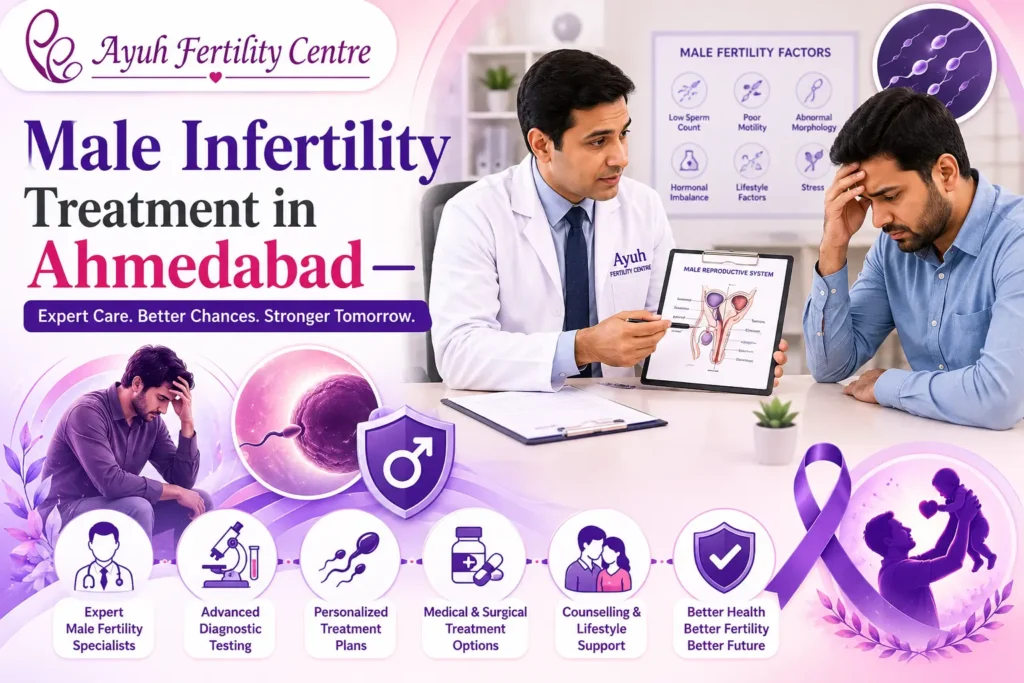
Male infertility treatment in Ahmedabad is one of the most searched yet least openly spoken about topics in reproductive health — and that silence carries a real cost.
Every day, couples across Ahmedabad and Gujarat sit with semen reports they do not fully understand, diagnoses they were not prepared for, and questions they feel too ashamed to ask out loud. The word “infertility” still carries weight in Indian households — and when it points toward the man, that weight can feel crushing.
But here is what most people are never told clearly enough: male infertility is common, it is medical, and in the majority of cases, it is treatable.
Studies consistently show that a male factor contributes to nearly half of all infertility cases worldwide. Yet in clinic waiting rooms across India, it is still the woman who is tested first, treated first, and emotionally burdened first — while the male partner’s evaluation is either delayed or skipped entirely. That approach costs couples months, sometimes years, of unnecessary treatment.
If your semen report has come back abnormal — whether it shows low sperm count, poor motility, abnormal morphology, or no sperm at all — what you need right now is not fear. What you need is clarity, a proper diagnosis, and a doctor who will talk to you honestly about what your options actually are.
At Ayuh Fertility Centre in Ahmedabad, Dr. Krupa M. Shah brings 19+ years of fertility experience and advanced international training to every male infertility case she sees. She does not treat a report. She treats a couple — with full context, personalised evaluation, and a treatment plan built around your specific biology.
This guide will walk you through everything you need to understand: what male infertility means medically, what causes it, how it is properly diagnosed, which treatments are available in Ahmedabad today, and when it is time to stop waiting and start getting answers.
Author Bio
Dr. Krupa A. Shah MBBS · MS (Obstetrics & Gynaecology) · Infertility Specialist Founder, Ayuh Fertility Centre, Ahmedabad
19+ Years of Experience in reproductive medicine, obstetrics, and gynaecology.
Dr. Krupa Shah completed her MBBS from Baroda Medical College (2006) and her MS in Obstetrics & Gynaecology from B.J. Medical College, Ahmedabad (2010). After 12 years of experience at leading clinics in Chennai — including Apollo Hospital and Iswarya Fertility Centre — she completed an Advanced IVF Fellowship at Ludwig Maximilians University, Munich, Germany, one of Europe’s most prestigious reproductive medicine institutions.
She is a member of the Ahmedabad Obstetrics and Gynaecology Society (AOGS), the Indian Society of Assisted Reproduction (ISAR), and the Federation of Obstetric and Gynaecological Societies of India (FOGSI).
IVF laboratory is ART National Board Certified.
🩺 Medically Reviewed By
This article is medically reviewed by Dr. Krupa M. Shah, ensuring accurate and reliable fertility information.
What Is Male Infertility?
Male infertility is defined as the inability of a man to cause pregnancy in a fertile female partner after 12 months of regular, unprotected intercourse.
It is more common than most people realise. Research consistently shows that male factor infertility accounts for approximately 40–50% of all infertility cases. In another 20–30% of cases, both male and female factors are present together.
Healthy sperm needs to meet three basic standards:
- Count — enough sperm must be produced per ejaculation (normal: above 16 million per ml)
- Motility — sperm must be able to swim forward effectively
- Morphology — the shape and structure of sperm must be normal enough to penetrate and fertilise an egg
When any one of these parameters falls below normal, the chances of natural conception reduce significantly. The good news is that most of these problems are diagnosable and, importantly, treatable.
Common Causes of Male Infertility
Understanding why male infertility occurs is the first step toward addressing it. There is rarely a single cause — often it is a combination of lifestyle and physiological factors.
Medical and physical causes:
- Low sperm count (oligospermia) — fewer sperm than needed for natural fertilisation. If you have received a report showing low sperm count, a specialist at a low sperm count clinic in Ahmedabad can evaluate the full picture.
- Varicocele — swelling of veins in the scrotum that overheats and damages sperm; one of the most common and correctable causes of male infertility
- Azoospermia — a complete absence of sperm in the ejaculate, which may be obstructive or non-obstructive
- Hormonal imbalance — low testosterone, elevated FSH or prolactin can affect sperm production
- Genetic conditions — Klinefelter syndrome, Y-chromosome microdeletion, and other chromosomal issues
- Infections — epididymitis, orchitis, or sexually transmitted infections can damage sperm-carrying tubes
- Blocked vas deferens or epididymis — preventing sperm from being ejaculated
Lifestyle and environmental causes:
- Smoking and tobacco use
- Excessive alcohol consumption
- Unmanaged diabetes
- Obesity and poor metabolic health
- High psychological stress
- Prolonged exposure to heat (tight clothing, hot tubs, laptops on lap)
- Anabolic steroid use or certain medications
- Exposure to pesticides, heavy metals, or industrial chemicals
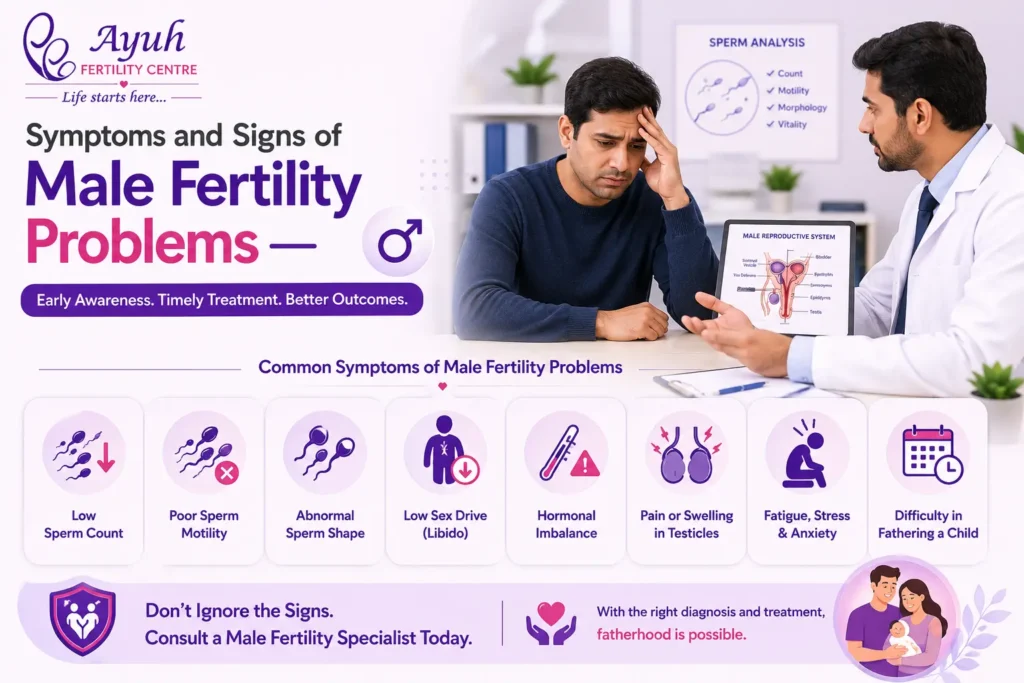
Symptoms and Signs of Male Fertility Problems
Many men with fertility issues have no obvious symptoms at all. That is precisely why this topic often goes unaddressed for years.
However, some signs can point toward an underlying problem:
- Difficulty achieving or maintaining erection
- Low ejaculate volume
- Pain, swelling, or a lump in the testicular area
- Reduced facial or body hair (may suggest hormonal issue)
- History of groin surgery, hernia repair, or undescended testes
- Recurrent respiratory infections (in rare genetic conditions)
The most honest signal of a possible male fertility issue is simply not achieving pregnancy after 12 months of trying — or 6 months if the female partner is over 35. At that point, both partners should be evaluated together without delay.
How Male Infertility Is Diagnosed
Diagnosis begins with a detailed history and physical examination, followed by specific tests. A qualified male fertility doctor will typically recommend:
Semen Analysis
This is the primary test for male fertility evaluation. It measures sperm count, motility, morphology, volume, and pH. Results guide the next steps.
Hormonal Testing
Blood tests to measure FSH, LH, testosterone, and prolactin levels help identify whether the cause is hormonal.
Scrotal Ultrasound
An ultrasound of the scrotum detects varicocele, testicular abnormalities, or blockages in the epididymis. At Ayuh Fertility Centre, our diagnostic and imaging services in Ahmedabad include detailed sonography for male reproductive health evaluation.
Genetic Testing
Karyotyping and Y-chromosome microdeletion testing are recommended in cases of severely low or absent sperm count. These tests can determine whether sperm production is possible at all.
Sperm DNA Fragmentation Testing
High levels of DNA damage in sperm are linked to failed IVF cycles and recurrent miscarriage, even when basic semen analysis looks acceptable. This test is particularly useful in unexplained infertility.
Post-Ejaculatory Urinalysis
If ejaculate volume is very low, this test checks for retrograde ejaculation — where sperm flows backward into the bladder instead of forward.
Male Infertility Treatment Options in Ahmedabad
Once the cause is identified, the right treatment plan can be built. There is no one-size-fits-all solution — and at Ayuh Fertility Centre, Dr. Krupa Shah evaluates every couple’s unique situation before recommending anything.
Here are the main male infertility treatment in Ahmedabad options available today:
Lifestyle Modification
For many men with borderline semen parameters, targeted lifestyle changes can meaningfully improve sperm quality over 2–3 months. This includes quitting smoking, moderating alcohol, losing weight, improving sleep, and reducing heat exposure.
Medicines
Hormonal medicines like clomiphene citrate or HMG injections can stimulate sperm production in men with identified hormonal deficiencies.
Surgical Treatment
- Varicocele repair (varicocelectomy) — improving blood flow to the testes often leads to significant improvement in sperm parameters
- Vasectomy reversal — reconnecting the vas deferens in men who have had prior vasectomy
- Surgical correction of blockages — for obstructive azoospermia
IUI (Intrauterine Insemination)
For mild male infertility — slightly low count or motility — IUI treatment in Ahmedabad is a useful first-line option. Sperm is prepared in the lab to concentrate the healthiest cells, then placed directly into the uterus.
IVF (In Vitro Fertilisation)
When IUI is not sufficient, IVF treatment in Ahmedabad brings the sperm and eggs together in a controlled laboratory environment. This greatly reduces the distance sperm needs to travel.
ICSI (Intracytoplasmic Sperm Injection)
For moderate to severe male infertility, ICSI treatment in Ahmedabad is the most effective option. A single healthy sperm is selected under a powerful microscope and injected directly into the egg. Even men with very low counts can achieve fertilisation through ICSI.
Azoospermia Treatment — What Men Should Know
Azoospermia — the complete absence of sperm in ejaculate — is understandably one of the most distressing diagnoses a man can receive. But it is important to understand that azoospermia does not always mean it is impossible to have a biological child.
There are two types:
Obstructive azoospermia: Sperm are being produced in the testes, but a blockage is preventing them from reaching the ejaculate. This may be caused by a prior infection, vasectomy, or a congenital absence of the vas deferens. In these cases, sperm retrieval procedures can directly collect sperm from the testes or epididymis for use in ICSI.
Non-obstructive azoospermia: The testes are producing little to no sperm. The cause may be hormonal, genetic, or due to prior damage. In some cases — not all — small pockets of sperm production may still exist within testicular tissue. Advanced procedures like micro-TESE can sometimes locate these pockets.
The azoospermia treatment approach depends entirely on which type is diagnosed and why. At Ayuh Fertility Centre, Dr. Shah conducts a full evaluation before any decision is made, and couples are counselled honestly about realistic possibilities.
TESA and PESA Procedures Explained
For men who cannot produce sperm naturally in their ejaculate — whether due to azoospermia or a blockage — surgical sperm retrieval is the answer.
What Is PESA?
PESA (Percutaneous Epididymal Sperm Aspiration) is a minimally invasive procedure where a fine needle is inserted into the epididymis (the coiled tube behind the testes where sperm matures) to aspirate sperm directly. It is typically used in obstructive azoospermia.
What Is TESA?
TESA (Testicular Sperm Aspiration) involves passing a fine needle directly into the testicular tissue to retrieve sperm. It is used when sperm cannot be retrieved from the epididymis or when there is direct testicular dysfunction.
Both procedures are performed under local anaesthesia or light sedation. Recovery is quick — most men return to normal activity within 24–48 hours. The retrieved sperm is used in conjunction with ICSI to fertilise the partner’s eggs.
At Ayuh Fertility Centre, TESA and PESA procedures in Ahmedabad are performed by experienced hands with full embryology lab support on the same day, ensuring that retrieved sperm is handled optimally.
What Is Micro-TESE and When Is It Recommended?
Micro-TESE (Microsurgical Testicular Sperm Extraction) is an advanced form of surgical sperm retrieval specifically designed for men with non-obstructive azoospermia — where standard TESA may not locate usable sperm.
In this procedure, the surgeon uses a powerful operating microscope to identify areas within the testicular tissue that appear more likely to contain active sperm production. These targeted biopsies significantly improve the chances of finding sperm compared to random sampling.
Micro-TESE is typically recommended when:
- Standard TESA has failed to retrieve sperm
- Genetic testing confirms the cause is non-obstructive
- Testicular volume is very small
- Hormone levels suggest severely impaired sperm production
When micro-TESE in Ahmedabad is successful in retrieving sperm, those cells are used directly with ICSI for fertilisation. The procedure requires a highly coordinated team — surgeon, embryologist, and IVF specialist — all working together on the same day.
IVF and ICSI for Male Infertility
IVF with ICSI has completely changed the landscape of male infertility treatment. What was once considered impossible — achieving a biological child with severely compromised sperm — is now achievable for many couples.
Here is how it works when male infertility is the primary diagnosis:
- The female partner undergoes ovarian stimulation to produce multiple mature eggs
- Eggs are retrieved through a minimally invasive egg retrieval procedure
- Sperm is collected on the same day — either through ejaculation or via TESA/PESA if needed
- The embryologist selects the single best quality sperm and injects it directly into each mature egg
- Fertilised embryos are monitored for 3–5 days in the lab
- The best embryo is transferred into the uterus through a gentle embryo transfer procedure
Even men with very few sperm — sometimes just a handful retrieved surgically — have gone on to become biological fathers through this approach. The key is working with an experienced embryology team and a fertility specialist who uses personalised protocols.
The Emotional Impact of Male Infertility
This is the part that does not get spoken about enough.
For many men, a diagnosis of male infertility triggers feelings that are hard to articulate — shame, inadequacy, anger, guilt, and a deep sense of loss of identity. Society still ties masculinity closely to fertility in ways that are neither fair nor accurate, and this makes the emotional burden even heavier.
Partners of men with infertility diagnoses also navigate complex emotions — trying to be supportive while managing their own grief and anxiety about the future.
What we want you to know:
- Infertility is a medical condition, not a measure of manhood
- You did not cause this — most male infertility causes are biological, genetic, or environmental
- Your relationship is not defined by this diagnosis
- Getting help is the bravest and most responsible thing you can do
At Ayuh Fertility Centre, consultations are private, non-judgmental, and handled with complete confidentiality. Dr. Shah makes it a point to involve both partners in every discussion, because this journey is walked together. You can book a consultation at a time that suits you.
Lifestyle Changes That Can Improve Male Fertility
While not every cause of male infertility responds to lifestyle changes, these steps can genuinely improve sperm quality — particularly count and motility — over 2 to 3 months:
- Maintain a healthy weight — obesity is directly linked to reduced testosterone and lower sperm count
- Eat a fertility-supportive diet — foods rich in antioxidants (zinc, selenium, vitamin C, folate) protect sperm from DNA damage
- Prioritise sleep — testosterone production peaks during deep sleep
- Quit smoking — tobacco damages sperm DNA and reduces count and motility
- Limit alcohol — moderate drinking may be acceptable, but heavy drinking impairs hormonal balance
- Exercise regularly — but avoid excessive endurance training or steroid use
- Reduce heat exposure — avoid hot tubs, saunas, and keeping laptops on your lap for extended periods
- Manage stress actively — chronic stress elevates cortisol, which directly suppresses testosterone
These changes work best when combined with medical treatment, not as a replacement for it.
When Should You See an Andrologist or Fertility Specialist?
If you recognise any of the following, it is time to see an andrologist in Ahmedabad or a qualified fertility specialist without delay:
- You and your partner have been trying to conceive for 12+ months without success (or 6 months if your partner is over 35)
- A semen analysis has already shown abnormal results
- You have had a prior diagnosis of varicocele, undescended testes, or groin surgery
- You have erectile or ejaculatory dysfunction
- A previous IVF cycle failed and male factor has not been fully investigated
- Your partner has experienced recurrent miscarriage (which can sometimes be linked to sperm DNA fragmentation)
- You have a prior history of mumps, sexually transmitted infection, or chemotherapy
Early evaluation is always better. Many male infertility conditions worsen over time if untreated, and early action can make a significant difference to outcomes.
At Ayuh Fertility Centre, our infertility care and evaluation services in Ahmedabad cover comprehensive assessment of both partners, so nothing is missed.
Common Myths About Male Infertility
Myth 1: Infertility is mostly a female problem. Fact: Male factor contributes to roughly half of all infertility cases. Both partners should always be evaluated together.
Myth 2: If a man has fathered a child before, he cannot have infertility now. Fact: Sperm health can decline over time due to age, lifestyle changes, medical conditions, or new blockages. Prior fertility does not guarantee current fertility.
Myth 3: A man who looks and feels healthy must have normal sperm. Fact: Sperm production happens deep inside the testes. There are no outward signs of low sperm count or poor motility in the vast majority of cases.
Myth 4: Low sperm count means no chance of pregnancy. Fact: Even with very low counts, ICSI can achieve fertilisation with just a single viable sperm. The chances depend on the full clinical picture, not just the count number.
Myth 5: Male infertility cannot be treated. Fact: Depending on the cause, many male infertility conditions respond well to treatment — whether through lifestyle changes, medicines, surgery, or assisted reproduction techniques like ICSI and TESA.
FAQs
1.Can low sperm count be treated? Yes, in most cases. Treatment depends on the underlying cause. If a hormonal imbalance is responsible, medicines can help increase sperm production. Lifestyle changes — particularly weight loss, quitting smoking, and reducing alcohol — can improve counts in many men. For those where count remains very low, ICSI is often highly effective, as it requires only a single sperm per egg for fertilisation. A detailed semen analysis and hormonal profile at a fertility clinic in Ahmedabad will guide the right approach.
2.What exactly is azoospermia? Azoospermia is the medical term for a complete absence of sperm in the ejaculate. It is diagnosed through semen analysis and confirmed by centrifugation testing. There are two types — obstructive (a blockage prevents sperm from reaching the ejaculate, but production is normal) and non-obstructive (the testes themselves are not producing enough sperm). The treatment differs significantly between the two types, which is why proper diagnosis is critical before any treatment begins.
3.Is TESA painful? TESA is performed under local anaesthesia, so you should not feel pain during the procedure. There may be some mild soreness or discomfort in the testicular area for 24–48 hours afterward, which is manageable with standard pain relief. Most men return to their normal routine within a day or two. It is a short, minimally invasive procedure when performed by an experienced team.
4.Can men with zero sperm in their ejaculate become biological fathers? In many cases, yes. If the cause is obstructive azoospermia, PESA or TESA can retrieve sperm directly from the testes or epididymis. That sperm is then used with ICSI to fertilise the partner’s eggs. In non-obstructive azoospermia, micro-TESE may still locate small pockets of sperm production. Each case is different, and the outcome depends on what the evaluation reveals — but there is hope for many men who receive this diagnosis.
5.When is ICSI recommended over standard IVF? ICSI treatment is recommended in cases of severe low sperm count, very poor motility, high DNA fragmentation, previous failed fertilisation with standard IVF, or when surgically retrieved sperm (TESA/PESA) is being used. Because ICSI directly places sperm inside the egg, it bypasses the natural fertilisation barriers — making it the preferred approach for most male factor infertility cases.
Conclusion
Male infertility treatment in Ahmedabad has come a very long way. What was once an area of medicine that offered little hope to couples now offers real, evidence-based, and increasingly successful solutions.
The single most important step you can take right now is this: do not delay evaluation. A semen analysis is simple, quick, and non-invasive. The information it gives can change the entire direction of your fertility journey.
At Ayuh Fertility Centre, Dr. Krupa M. Shah treats every couple with the same respect, honesty, and care — regardless of what the tests show. Whether you need a simple lifestyle plan, ICSI, TESA, or a more advanced approach, every option is explained clearly so that you make the decisions that are right for your family.
If you or your partner have concerns about male fertility — or if you have already received an abnormal semen report and are not sure what to do next — we would be glad to help you make sense of it.
👉 Book a consultation at Ayuh Fertility Centre, Ahmedabad
👉 Book your consultation with Ayuh Fertility Centre today
👉 Get expert guidance for PCOS and fertility treatment
👉 Start your journey toward a healthy and successful pregnancy
📍 Visit us in Ahmedabad
📞 Call now to schedule your appointment