
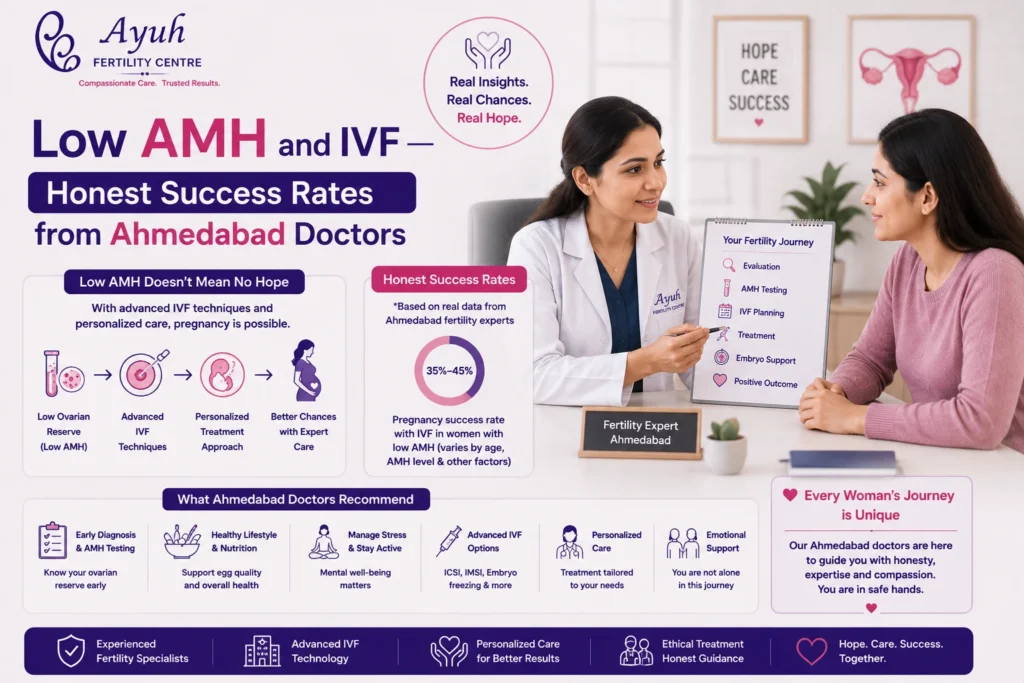
Low AMH AND IVF Ahmedabad — three words that thousands of women search in quiet, anxious moments, usually after receiving news that left them feeling confused, scared, and uncertain about their future. If your doctor recently told you that your AMH is low, you probably felt your heart sink. The fear around fertility and IVF chances after this diagnosis is completely real — and it deserves an honest, compassionate answer.
At Ayuh Fertility Centre, Ahmedabad, Dr. Krupa M. Shah has worked with hundreds of women who came in after a low AMH result, convinced their dream of becoming a mother was over. In most cases, it was not.
A low AMH reading tells us something important about your ovarian reserve — but it does not write the final chapter of your fertility story. This blog is written to give you honest, clear, and emotionally grounded information. No false promises. No unnecessary fear. Just real guidance from experienced fertility specialists who understand what you are going through.
Author Bio
Dr. Krupa A. Shah MBBS · MS (Obstetrics & Gynaecology) · Infertility Specialist Founder, Ayuh Fertility Centre, Ahmedabad
19+ Years of Experience in reproductive medicine, obstetrics, and gynaecology.
Dr. Krupa Shah completed her MBBS from Baroda Medical College (2006) and her MS in Obstetrics & Gynaecology from B.J. Medical College, Ahmedabad (2010). After 12 years of experience at leading clinics in Chennai — including Apollo Hospital and Iswarya Fertility Centre — she completed an Advanced IVF Fellowship at Ludwig Maximilians University, Munich, Germany, one of Europe’s most prestigious reproductive medicine institutions.
She is a member of the Ahmedabad Obstetrics and Gynaecology Society (AOGS), the Indian Society of Assisted Reproduction (ISAR), and the Federation of Obstetric and Gynaecological Societies of India (FOGSI).
IVF laboratory is ART National Board Certified.
🩺 Medically Reviewed By
This article is medically reviewed by Dr. Krupa M. Shah, ensuring accurate and reliable fertility information.
What Is AMH and Why Is It Important?
AMH stands for Anti-Müllerian Hormone — a hormone produced by small follicles in your ovaries. The level of AMH in your blood gives doctors a window into how many eggs your ovaries still contain. This is called your ovarian reserve.
Think of AMH as a rough measure of your remaining egg pool. It reflects egg quantity — not egg quality. This distinction is important and we will return to it throughout this article.
Why does this matter for IVF? Because the number of eggs your ovaries can produce in response to stimulation medications is a key factor in how your IVF cycle is planned. If AMH is low, your doctor knows to expect fewer eggs — and adjusts the protocol accordingly.
An AMH test in Ahmedabad is a simple blood test that can be done on any day of your menstrual cycle. At Ayuh Fertility Centre, it is always interpreted alongside other results — your antral follicle count, age, and full reproductive history — never in isolation.
What Is Considered Low AMH?
AMH levels are measured in nanograms per millilitre (ng/mL). General reference ranges are:
- Normal: 1.0 – 3.5 ng/mL
- Low: 0.5 – 1.0 ng/mL
- Very low: Below 0.5 ng/mL
- High (as in PCOS): Above 3.5 ng/mL
When we talk about AMH below 1, we mean the ovarian reserve is on the lower side — but “low” is always interpreted in the context of age.
An AMH of 0.8 ng/mL in a 29-year-old woman is interpreted very differently from the same reading in a 40-year-old woman. Younger women with low AMH often still have good egg quality — meaning AMH below 1 IVF success remains very much possible.
A low AMH result is never a final verdict. It is a data point — most meaningful when seen alongside your full reproductive picture.
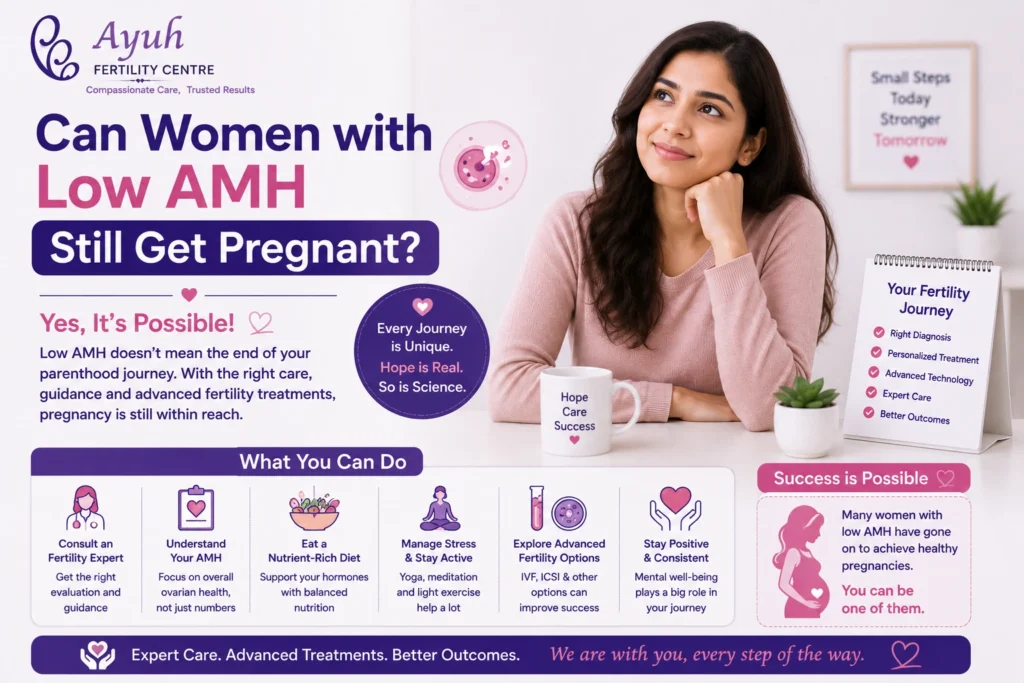
Can Women with Low AMH Still Get Pregnant?
Yes. And this is one of the most important truths shared at Ayuh Fertility Centre.
Low AMH pregnancy chances are lower than average — that is honest. But lower does not mean zero. Here is what every woman with a low AMH result should understand:
- AMH measures quantity, not quality. A woman with low AMH may still produce one or two high-quality eggs — and it only takes one good egg to create a successful pregnancy.
- Low AMH is not premature menopause. You may still be ovulating regularly. Many women with low AMH conceive naturally, especially under 35.
- Younger women have a significant advantage. Higher egg quality in younger women partially compensates for a lower egg count.
- Natural conception is still possible if you are under 35, ovulating regularly, and have been trying for under 12 months.
- IVF remains a viable and effective path — particularly with a personalised stimulation protocol designed specifically for low ovarian reserve.
Every woman’s situation is different. A one-to-one consultation with a fertility specialist in Ahmedabad is always the most important next step.
Low AMH IVF Ahmedabad — Honest Success Rates
This is likely the section you have been most anxious to reach — and we want to be completely transparent with you.
There is no single universal IVF success rate for women seeking low AMH IVF in Ahmedabad. Success varies across individuals, and any clinic promising fixed percentages without knowing your case is not being fully honest.
Based on clinical experience at Ayuh Fertility Centre, here is what genuinely matters:
Factors that support better outcomes with low AMH:
- Being under 35 years of age
- Producing at least 2–4 mature eggs in response to stimulation
- Good embryo quality after fertilisation
- Healthy uterine lining
- No additional fertility issues (tubal, uterine, or sperm-related)
Factors that may reduce IVF success with low AMH:
- Age above 40
- Very poor egg response (1 or fewer eggs retrieved)
- Additional reproductive health conditions
- Poor embryo development
Dr. Krupa M. Shah always evaluates each woman individually before estimating realistic success expectations. This honest, personalised approach is what builds real trust — and real results.
AMH Below 1 IVF Success — What Doctors Consider
When AMH falls below 1 ng/mL, fertility specialists look beyond the number. The following factors are carefully evaluated to assess true AMH below 1 IVF success potential:
- Antral follicle count (AFC): Counted via ultrasound, the AFC reflects the number of small follicles visible at cycle start. A higher AFC — even with low AMH — is an encouraging sign.
- Egg response to stimulation: How many mature eggs are retrieved is often more meaningful than the AMH number alone.
- Embryo quality: Development and grading of embryos after fertilisation is a critical predictor of implantation success.
- Previous IVF history: Prior cycle response provides valuable information for planning the next one.
- Age: The dominant factor in egg and embryo quality.
- Partner’s sperm quality: DNA integrity, motility, and count all affect fertilisation and embryo development.
No single number — including AMH — can fully predict your IVF journey. It is the combination of all these factors, assessed by an experienced IVF specialist in Ahmedabad, that creates the full picture.
Low Ovarian Reserve Treatment Options
A diagnosis of low ovarian reserve does not mean there is only one path forward. At Ayuh Fertility Centre, several approaches are considered:
1. Standard IVF with Modified Stimulation Protocol
Most women with low AMH undergo IVF with a carefully adjusted protocol — typically involving higher doses of gonadotropins to encourage the best possible egg response.
2. Mild Stimulation IVF
For older women or those who respond poorly to high stimulation, a milder protocol focusing on quality over quantity may be preferred.
3. ICSI (Intracytoplasmic Sperm Injection)
When fewer eggs are available, ICSI ensures the best chance of fertilisation by injecting a single selected sperm directly into each mature egg — maximising the value of every egg retrieved.
4. Donor Egg IVF
For women with very low AMH — particularly above 40 — donor egg IVF offers significantly higher success rates. This uses eggs from a young, healthy donor combined with the partner’s sperm.
5. Fertility Preservation (Egg Freezing)
For younger women with low AMH who are not yet ready for pregnancy, egg freezing offers the opportunity to preserve remaining eggs before the reserve declines further.
6. Lifestyle Optimisation
While lifestyle changes cannot reverse low AMH, they can support egg quality, hormonal balance, and overall treatment response.
What Is a Low AMH Protocol in IVF?
A low AMH protocol is the customised medication and monitoring plan your IVF doctor creates specifically for your ovarian reserve situation.
In standard IVF, the goal is stimulating many follicles simultaneously. With low AMH, the approach changes:
- Higher starting doses of stimulation medications may encourage the maximum number of follicles to respond
- Frequent monitoring via ultrasound tracks follicle growth every few days for real-time adjustments
- Trigger timing is carefully managed to retrieve eggs at the precise moment of optimal maturity
- Some specialists prefer a gentle antagonist protocol for low responders — more flexible, adjusted quickly based on your body’s response
Your IVF protocol should never be one-size-fits-all. At Ayuh Fertility Centre, Dr. Krupa Shah designs every protocol individually — informed by your AMH, AFC, age, and previous response history.
Lifestyle Changes That May Help IVF Success with Low AMH
While no lifestyle change can dramatically raise AMH levels, the following habits support egg quality, hormonal balance, and IVF readiness:
- Sleep well: 7–8 hours nightly supports melatonin, which plays a role in protecting egg quality
- Eat a fertility-friendly diet: Antioxidant-rich foods, lean protein, healthy fats, and whole grains. The Mediterranean diet is widely supported in fertility research
- Reduce alcohol and quit smoking: Both impair egg quality and the body’s ability to respond to IVF stimulation
- Manage stress: Chronic stress elevates cortisol, disrupting reproductive hormones. Yoga, mindfulness, and regular breaks all help
- Maintain a healthy weight: Both underweight and overweight conditions affect hormone regulation and IVF response
- Discuss supplements with your doctor: CoQ10, DHEA, and vitamin D are sometimes discussed for low AMH — but always take these under medical guidance, not based on internet advice alone
These steps are supportive, not curative. But they matter — and they are within your control.
Emotional Impact of Low AMH Diagnosis
Let us talk about something clinical guides often skip — how it actually feels to receive a low AMH diagnosis.
For many women, it feels like a loss. A sense of the clock suddenly speeding up. Guilt — even though AMH levels are largely beyond anyone’s control. Social pressure, fear of “running out of time,” the exhaustion of explaining your situation to well-meaning relatives — all of this is real.
If you have felt this, please know: you are not overreacting. These feelings are completely valid.
What helps:
- Talking to someone — a counsellor, therapist, or trusted friend who will listen without judgement
- Connecting with others who have walked the same path — support communities for women with low AMH exist online and locally
- Seeking a consultation sooner rather than later — not because you are “running out of time,” but because having a clear plan relieves the anxiety of uncertainty
- Being honest with your partner — IVF is a shared journey, and facing it together matters
At Ayuh Fertility Centre, emotional wellbeing is considered part of fertility care — not separate from it.
Common Myths About Low AMH and IVF
Myth 1: Low AMH means pregnancy is impossible Not true. Many women with low AMH — particularly younger ones — conceive through IVF or naturally.
Myth 2: IVF never works with low AMH IVF success with low AMH depends on egg quality, age, and the right low AMH protocol — far more than the AMH number alone.
Myth 3: Only older women have low AMH AMH can be low at any age. Women in their 20s and 30s can have reduced ovarian reserve — sometimes due to genetics, autoimmune conditions, or previous surgeries.
Myth 4: AMH alone predicts IVF success AMH is one piece of the puzzle. AFC, age, egg quality, sperm quality, and uterine health all contribute to the complete picture.
Myth 5: Low AMH will keep getting worse no matter what While AMH generally declines with age, lifestyle factors may slow this decline — and with timely intervention from an IVF specialist in Ahmedabad, many women achieve successful pregnancies before the window narrows further.
When Should You See a Fertility Specialist?
Please do not wait until you feel fully “ready.” Book a consultation if any of the following apply:
- You have been trying to conceive for 12 months without success (or 6 months if over 35)
- Your periods are irregular or absent
- You have been told your AMH is low or your ovarian reserve is reduced
- You have experienced two or more miscarriages
- You are over 35 and planning to start a family soon
- You have a history of ovarian surgery, chemotherapy, or pelvic infections
- You are considering egg freezing before your reserve declines further
Early advice from an IVF specialist in Ahmedabad gives you more options — and more time to make decisions that are right for you.
FAQs
Q1. Can I get pregnant naturally with low AMH?
Yes, natural conception is possible with low AMH — particularly if you are under 35, ovulating regularly, and have been trying for under a year. Low AMH indicates a smaller egg pool, but it only takes one good-quality egg to result in a pregnancy. Because the reserve is limited, time is a relevant factor. If natural conception has not occurred after 6 to 12 months — or sooner if you are over 35 — consulting an IVF specialist in Ahmedabad promptly is strongly advisable.
Q2. Is AMH below 1 ng/mL very serious?
AMH below 1 IVF success is still achievable — but it is a clinically relevant finding that warrants attention. Its seriousness depends heavily on your age, antral follicle count, and overall reproductive health. A 28-year-old with AMH of 0.7 has very different prospects from a 41-year-old with the same reading. A thorough evaluation at Ayuh Fertility Centre will give you a far more accurate picture.
Q3. Does low AMH mean my eggs are poor quality?
No — this is one of the most important distinctions in fertility medicine. AMH reflects egg quantity, not quality. Egg quality is primarily influenced by age. Younger women with low AMH often still produce good-quality eggs that can lead to healthy embryos and successful pregnancies. An AMH test in Ahmedabad alone cannot assess egg quality — that requires a full fertility evaluation.
Q4. What is the best IVF protocol for low AMH?
There is no single “best” low AMH protocol — the right approach is always personalised. Common strategies include modified antagonist protocols, high-dose gonadotropin stimulation, or mild stimulation for poor responders. Dr. Krupa Shah at Ayuh Fertility Centre tailors every protocol based on AMH, antral follicle count, age, and any previous IVF history.
Q5. Can low AMH improve naturally?
AMH levels generally decline with age and cannot be significantly reversed. However, lifestyle factors — quitting smoking, maintaining a healthy weight, and taking certain supplements under medical guidance such as CoQ10 or vitamin D — may support egg quality and slow the rate of decline. The most effective strategy for low AMH fertility treatment is timely medical consultation rather than waiting for natural improvement.
Conclusion
Receiving a low AMH diagnosis is hard. It brings uncertainty, fear, and a hundred questions you did not expect to be asking. But it is not the end of your story — and it should not feel that way.
Low AMH AND IVF in Ahmedabad, approached with the right specialist, the right protocol, and the right emotional support, has helped many women go on to achieve the pregnancies they feared were no longer possible. Not everyone — and that honesty matters. But far more women than the internet would have you believe.
At Ayuh Fertility Centre, Dr. Krupa M. Shah brings nearly two decades of experience and genuine compassion to every patient. Her approach is not about numbers on a report — it is about the whole person sitting across from her, with real hopes and real fears, deserving of real answers.
If you have received a low AMH result and do not know what to do next, please do not wait. The sooner you have a personalised assessment, the more options you have.
👉 Book a consultation with Dr. Krupa Shah at Ayuh Fertility Centre today — and take your next step with clarity and confidence.
👉 Book your consultation with Ayuh Fertility Centre today
👉 Get expert guidance for PCOS and fertility treatment
👉 Start your journey toward a healthy and successful pregnancy
📍 Visit us in Ahmedabad
📞 Call now to schedule your appointment