
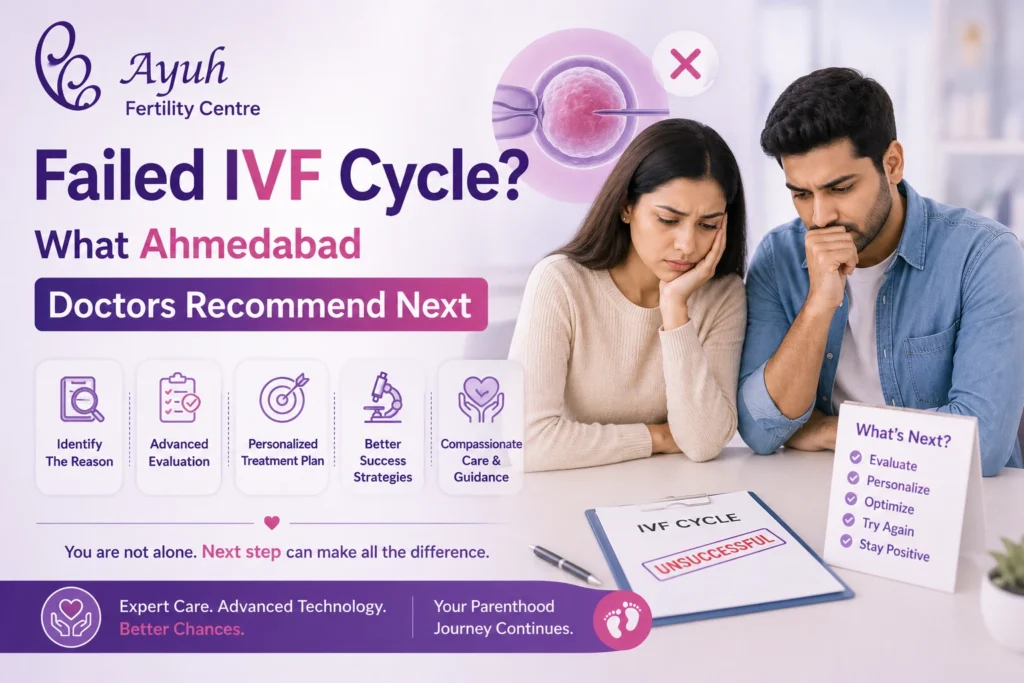
If you are reading this right now, you are probably sitting with a heaviness that words can barely describe. The two-week wait. The hope. And then the news that the cycle did not work.
A failed IVF cycle Ahmedabad couples experience is one of the most painful moments in the fertility journey — and also one of the most misunderstood. Because here is what most people do not tell you: one failed IVF cycle is not the end. It is not even close to the end. For the majority of couples who go on to have successful pregnancies, the first cycle was not the one that worked.
That does not make the pain of this moment any smaller. But it does mean that this setback — as real and as devastating as it feels right now — is part of a story that is still being written.
Dr. Krupa A. Shah, founder of Ayuh Fertility Centre in Ahmedabad, has sat with hundreds of couples after a failed first cycle. Her first message is always the same: this is information, not a verdict. And what you do with that information — the questions you ask, the tests you pursue, the adjustments you make — is what determines what happens next.
This blog is written for you, right now, in exactly this moment.
About the Author
Dr. Krupa A. Shah MBBS · MS (Obstetrics & Gynaecology) · Infertility Specialist Founder, Ayuh Fertility Centre, Ahmedabad
19+ Years of Experience in reproductive medicine, obstetrics, and gynaecology.
Dr. Krupa Shah completed her MBBS from Baroda Medical College (2006) and her MS in Obstetrics & Gynaecology from B.J. Medical College, Ahmedabad (2010). After 12 years of experience at leading clinics in Chennai — including Apollo Hospital and Iswarya Fertility Centre — she completed an Advanced IVF Fellowship at Ludwig Maximilians University, Munich, Germany, one of Europe’s most prestigious reproductive medicine institutions.
She is a member of the Ahmedabad Obstetrics and Gynaecology Society (AOGS), the Indian Society of Assisted Reproduction (ISAR), and the Federation of Obstetric and Gynaecological Societies of India (FOGSI).
IVF laboratory is ART National Board Certified.
🩺 Medically Reviewed By
This article is medically reviewed by Dr. Krupa A. Shah — fertility specialist with 19+ years of experience — ensuring accurate, compassionate, and evidence-based guidance for couples after IVF failure.
Is It Common for the First IVF Cycle to Fail?
Yes. Much more common than most people realise — and much more common than most fertility clinics prepare couples for before treatment begins.
Even at well-equipped, experienced fertility centres, IVF success rates per single cycle typically range from 40–60% for women under 35, and lower for older women. This means that even under the best clinical conditions, a meaningful proportion of first cycles do not result in pregnancy.
This is not a reflection of poor medical care. It is not a reflection of something you did wrong. It is a reflection of the biological complexity of human reproduction — a process that, even naturally, only succeeds roughly 20–25% of the time per cycle in healthy, fertile couples in their twenties.
IVF helps significantly — but it does not override biology entirely. Embryo quality, chromosomal status, uterine receptivity, and a dozen other factors all play a role in whether implantation occurs. Many of these factors only become visible after a first attempt.
This is exactly why experienced fertility specialists like Dr. Krupa Shah treat a failed first cycle as a source of data — not defeat. The cycle has shown what happened at each stage. That information is now available to guide a better approach.
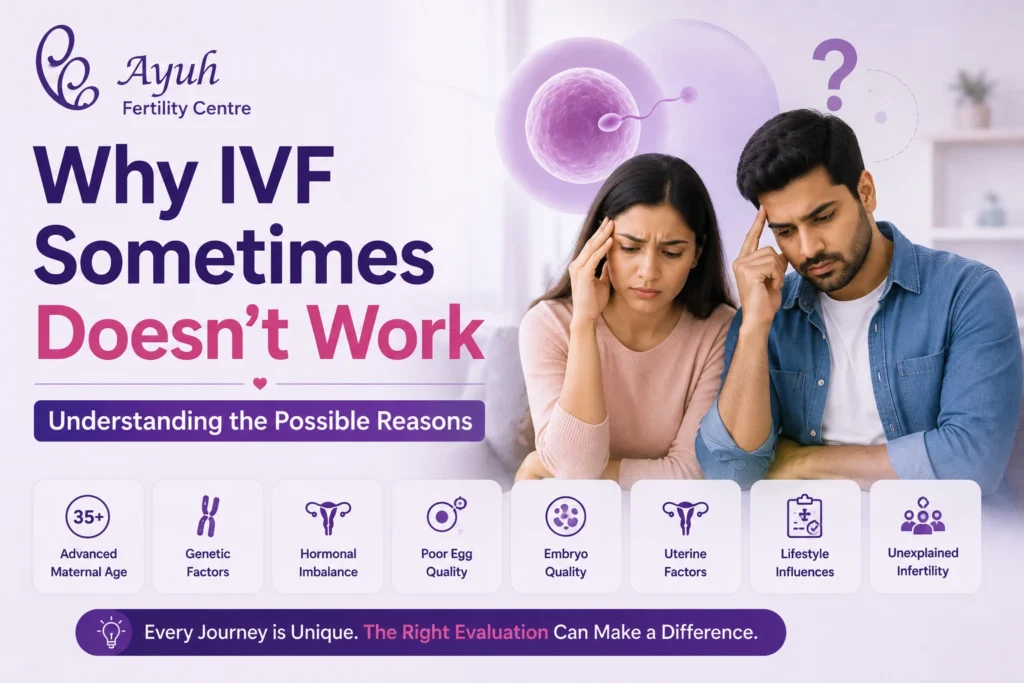
Why IVF Sometimes Doesn’t Work
Understanding why IVF didn’t work does not make the pain disappear — but it does replace helpless confusion with something you can act on.
Here are the most common clinical reasons a first IVF cycle may not result in pregnancy:
1. Embryo Quality Not every fertilised egg develops into a high-quality embryo. Some embryos — even those that look good on Day 3 — carry chromosomal abnormalities that prevent implantation or cause very early miscarriage. This is the single most common reason IVF cycles fail, and it becomes more prevalent with increasing maternal age.
2. Implantation Failure Even a good-quality embryo may not implant if the uterine lining is not fully receptive. Thin endometrium, polyps, fibroids, or an immune response can all interfere with the embryo settling into the uterine wall.
3. Egg Quality Poor egg quality — often related to age, AMH levels, or oxidative stress — means fewer viable embryos are produced even when multiple eggs are retrieved. Quality matters far more than quantity.
4. Sperm Quality and DNA Fragmentation Sperm that appears normal on a basic semen analysis can still carry significant DNA fragmentation — damage to the genetic material inside the sperm. This affects fertilisation rates and embryo development and is often only discovered through specialised testing after a failed cycle.
5. Chromosomal Abnormalities Many embryos — particularly in women above 35 — carry chromosomal errors that prevent normal development. These embryos may fertilise, divide briefly, and then arrest before transfer, or fail to implant after transfer.
6. Uterine Lining Problems An inadequate endometrial thickness (below 7mm) or poor blood flow to the lining reduces implantation chances significantly. Conditions like Asherman’s syndrome (uterine adhesions) or a structural abnormality can also prevent successful implantation.
7. Stimulation Protocol Mismatch Sometimes the ovaries do not respond as expected to a particular protocol — producing too few eggs, or eggs that are not fully mature at retrieval. Protocol adjustment for a subsequent cycle often significantly improves outcomes.
8. Laboratory Factors The quality of the embryology laboratory — its temperature control, air quality, culture media, and incubator technology — directly affects embryo development. This is why an ART National Board Certified, ISO-certified lab like Ayuh’s is not just a credential — it is a clinical advantage.
9. Age-Related Factors The cumulative impact of advancing age on egg quality, ovarian reserve, and chromosomal integrity is the most consistent predictor of IVF outcomes. This is a biological reality — not a personal failure.
10. Lifestyle Factors Smoking, obesity, alcohol, disrupted sleep, and unmanaged chronic stress all have documented negative effects on IVF outcomes. These are modifiable factors that can be meaningfully addressed before a second cycle.
Failed IVF Cycle Ahmedabad — What Doctors Evaluate After Failure
A thorough post-cycle review is one of the most important — and most underused — steps after a failed IVF cycle Ahmedabad patients experience. At Ayuh Fertility Centre, every failed cycle triggers a complete clinical debrief.
Here is what an experienced fertility specialist should review:
Embryo Grading Report How many eggs were retrieved? How many fertilised? What grade were the embryos at transfer — and did any arrest before transfer? Was a blastocyst transfer possible? The answers tell a specific story about egg and sperm quality.
Stimulation Response Did the ovaries respond as expected? Were the follicles growing at the right pace? Was the estrogen level appropriate? A poor or over-response to stimulation may suggest a protocol change is needed.
Egg Maturity What proportion of retrieved eggs were mature (MII stage)? Immature eggs cannot fertilise normally and indicate either a trigger timing issue or an underlying egg quality problem.
Fertilisation Rate What percentage of eggs fertilised normally? A low fertilisation rate — especially with normal sperm — may indicate the need for ICSI or, if ICSI was already used, a sperm DNA fragmentation investigation.
Endometrial Thickness and Pattern What was the lining thickness on transfer day? Was the three-layer (trilaminar) pattern present? Was a hysteroscopy performed to clear the cavity before the cycle?
Hormonal Levels Were progesterone levels elevated on the day of trigger (which can impair endometrial receptivity)? Was the LH surge premature? Hormonal subtleties often only become visible when you look carefully at cycle data.
Lab Quality Review Was the embryo development pattern normal through Days 3 and 5? Did any embryos degenerate? The development pattern gives the embryologist crucial information about culture conditions and embryo viability.
Dr. Krupa Shah reviews all of this data personally with every couple after a failed cycle — because the conversation about what happened is just as important as any procedure that follows.
IVF Failure Next Steps — What Couples Should Do
Knowing the right IVF failure next steps turns a moment of despair into a moment of purposeful action. Here is what we recommend:
Step 1 — Allow Yourself to Grieve Before anything else: give yourself permission to feel this. Grief after IVF failure is real and valid. You do not need to “stay positive” immediately or make any decisions in the first week. Rest. Let the emotions come. Then, when you are ready, move forward.
Step 2 — Request a Detailed Cycle Review Ask your fertility specialist for a complete written review of your cycle — what worked, what did not, and what clinical findings emerged. You have the right to full access to your embryology data, scan reports, and hormonal levels.
Step 3 — Ask the Right Questions Write down your questions before the review appointment. Ask: Why do you think implantation failed? What would you change in the next cycle? Are there any tests I should do before trying again? Is there anything lifestyle-related I can improve?
Step 4 — Consider Additional Testing Depending on what the cycle data shows, your doctor may recommend further investigation — sperm DNA fragmentation, hysteroscopy, genetic testing, ERA (Endometrial Receptivity Analysis), or thyroid and autoimmune panels. These tests are not always necessary — but when indicated, they can change the outcome of the next cycle significantly.
Step 5 — Give Your Body Time to Recover Most fertility specialists recommend waiting at least one full menstrual cycle — ideally two — before beginning a second IVF cycle. This allows the ovaries and uterine lining to recover fully and gives time for any protocol adjustments to be planned properly.
Step 6 — Make Meaningful Lifestyle Adjustments If smoking, alcohol, poor sleep, high stress, or weight management are relevant factors, the recovery period between cycles is the most valuable time to address them.
Step 7 — Decide Your Next Treatment Strategy Together The decision about whether to proceed to a second cycle, modify the protocol, pursue a frozen embryo transfer, or consider alternative approaches should be made calmly — together with your partner and your doctor — not in the immediate emotional aftermath of a failed cycle.
Second IVF Cycle — Are Your Chances Better?
Often, yes. And here is the clinical reason why.
A second IVF cycle is not simply a repeat of the first. It is a protocol informed by real data from your body’s actual response. That is a meaningful advantage the first cycle never had.
What typically changes in a second cycle:
- Stimulation dose adjustments — If the first cycle produced few eggs, the dose may be increased. If there was over-response, it may be reduced.
- Protocol type change — Switching from a long agonist to an antagonist protocol (or vice versa) can produce very different results in the same patient.
- Trigger timing change — Adjusting the trigger by even 12–24 hours can improve egg maturity rates.
- Sperm preparation change — If DNA fragmentation is suspected, sperm preparation techniques or PICSI (physiological ICSI) can be used.
- Endometrial preparation — If the lining was thin or poorly prepared, extended estrogen support or hysteroscopic evaluation before the second cycle can help.
- Frozen Embryo Transfer (FET) — If embryos were frozen from the first cycle, an FET in a subsequent natural or medicated cycle avoids the physical stress of full stimulation and often improves implantation conditions.
- PGT (Pre-Implantation Genetic Testing) — If embryo chromosomal quality is suspected as the cause of failure, PGT can identify which embryos are chromosomally normal before transfer — reducing both miscarriage risk and repeated failure.
Cumulative success rates over 2–3 IVF cycles are significantly higher than for a single attempt. Many couples who did not conceive on cycle one go on to succeed on cycles two or three — particularly when the protocol is thoughtfully revised.
Should You Get a Second Opinion After Failed IVF?
Yes — in certain situations, absolutely. And asking for a second opinion IVF Ahmedabad couples seek after failure is not disloyalty to your current doctor. It is a completely legitimate clinical decision.
Consider a second opinion if:
- You received no clear explanation for why the cycle failed
- You are told to simply “try the same thing again” without any protocol changes
- You have experienced two or more failed IVF cycles with the same outcome
- You feel rushed, unheard, or unclear about your treatment plan
- You want confirmation that the recommended next steps are appropriate for your specific diagnosis
- The laboratory used was not ART National Board Certified or ICMR compliant
A genuine second opinion does not mean starting over from scratch. It means bringing all your existing reports, embryology data, and cycle documentation to an experienced specialist and asking: “Is there something we missed? Is there a better approach?”
At Ayuh Fertility Centre, couples who come for a second opinion after failed cycles at other clinics receive a complete, unhurried review of all prior data. Dr. Krupa Shah has frequently identified protocol gaps, undiagnosed uterine conditions, or overlooked sperm factors that — once addressed — have led to successful pregnancies on a revised cycle.
A second opinion costs very little. The information it provides can be invaluable.
The Emotional Impact of IVF Failure
This section matters just as much as any clinical content in this blog.
IVF failure is a specific kind of grief. It is not quite like any other loss, because it is the loss of something that was possible — something you had hoped was finally happening. And it arrives after weeks of injections, monitoring, hope, and waiting.
What couples commonly feel:
Grief — A genuine mourning for the embryo, for the possibility, for the timeline you had imagined.
Anxiety and Fear — Will it ever work? What if this is the answer we have been dreading?
Guilt — The quiet, unfair voice that asks: Did I do something wrong? Should I have done more? The answer is almost certainly no. IVF failure is rarely caused by anything a patient did or did not do.
Relationship Stress — Partners often grieve differently and on different timelines. One partner may want to talk; the other may go quiet. Both responses are normal. What matters is staying on the same side of the experience, even when you are processing it differently.
Social Pressure — Questions from family. Knowing looks. The exhaustion of explaining — or not explaining — where you are in your journey.
Emotional Burnout — For couples who have been through this more than once, the weight accumulates. Each cycle carries more history, more fear, more hope.
What helps:
At Ayuh Fertility Centre, emotional support is built into the care model — not offered as an afterthought. Dr. Krupa Shah personally takes time with every couple after a failed cycle. She answers questions honestly, creates space for emotion, and ensures no one leaves a consultation with confusion or helplessness.
Fertility counselling — whether formal therapy or simply honest conversations with your care team — is not a sign of weakness. It is a clinically supported strategy for improving outcomes, because emotional resilience during treatment genuinely affects how couples navigate the process.
Tests Doctors May Recommend Before Another IVF Attempt
Depending on what the failed cycle data reveals, Dr. Krupa Shah may recommend one or more of the following investigations before beginning a second cycle:
AMH and AFC Repeat Testing To check whether ovarian reserve has changed since the last test — particularly relevant if several months have passed or if the stimulation response was unexpected.
Sperm DNA Fragmentation Testing A standard semen analysis does not measure DNA integrity. High sperm DNA fragmentation (above 15–25%) is associated with poor embryo development and implantation failure. This test is particularly recommended if fertilisation was poor despite normal sperm parameters.
Hysteroscopy A diagnostic hysteroscopy directly examines the uterine cavity. It can identify polyps, fibroids, adhesions, or a structural irregularity that may have prevented implantation. This is one of the most commonly missed steps before a first IVF cycle — and one of the most impactful investigations before a second.
Pre-Implantation Genetic Testing (PGT) PGT tests embryos for chromosomal abnormalities before transfer. It is particularly recommended after failed cycles where embryo quality appears good but implantation repeatedly fails — a pattern often explained by chromosomal issues invisible on standard grading.
Thyroid and Autoimmune Panel Undetected thyroid dysfunction, elevated NK (natural killer) cells, or autoimmune conditions can interfere with implantation. A targeted blood panel can rule these out or identify them for treatment.
ERA — Endometrial Receptivity Analysis ERA testing identifies the precise “window of implantation” — the optimal moment within your cycle when the endometrium is most receptive to an embryo. Some women have a shifted implantation window, meaning the standard transfer timing is slightly wrong. ERA testing corrects this. It is not needed for every patient — but for women with repeated implantation failure and good embryo quality, it can make a genuine difference.
Lifestyle Changes That May Improve Your Next IVF Cycle
The window between cycles is not empty time — it is an opportunity.
Nutrition A diet rich in antioxidants — colourful vegetables, nuts, olive oil, fatty fish, whole grains — supports both egg and sperm DNA quality. Reduce ultra-processed foods, refined sugar, and trans fats. The Mediterranean diet pattern is consistently associated with better IVF outcomes in published research.
Sleep Poor sleep disrupts melatonin and cortisol — both of which affect reproductive hormones. Aim for 7–9 hours of consistent, quality sleep during your preparation period.
Stress Management Chronic stress elevates cortisol, which interferes with the hormonal cascade needed for successful stimulation and implantation. Yoga, meditation, therapy, gentle exercise, or simply ensuring you have adequate emotional support — all of these are clinically relevant, not just wellness advice.
Smoking and Alcohol Both are directly associated with poorer IVF outcomes. Smoking damages egg and sperm DNA. Alcohol disrupts hormonal balance. Complete cessation — not reduction — is the medical recommendation.
Weight Management A BMI between 18.5 and 24.9 is associated with meaningfully better IVF outcomes. Both obesity and underweight affect hormonal function, ovarian response, and endometrial receptivity.
Male Partner Lifestyle Sperm quality is profoundly affected by lifestyle. Heat exposure (hot baths, laptops on laps), alcohol, tobacco, and poor nutrition all damage sperm DNA over the 72-day sperm production cycle. Improvements made now show in sperm quality approximately 3 months later.
When Donor Eggs or Alternative Approaches May Be Discussed
This is a conversation that deserves to be handled with honesty and sensitivity in equal measure.
For most couples after a first failed IVF cycle, donor egg IVF is not the next recommended step. The next step is almost always a revised own-egg protocol — with better investigation, better protocol design, and better preparation.
However, donor eggs or alternative approaches may be discussed if:
- Multiple IVF cycles have produced consistently poor-quality eggs regardless of protocol
- AMH is critically low and own-egg stimulation consistently yields one or zero eggs
- PGT testing consistently shows all embryos to be chromosomally abnormal
- Advanced maternal age makes own-egg viability clinically uncertain
- Premature ovarian insufficiency (early menopause) is diagnosed
Donor egg IVF at Ayuh Fertility Centre offers success rates of 50–65% per cycle regardless of the recipient’s age — because the biological barrier of egg quality is removed. All donors are screened under strict ICMR guidelines.
This conversation — when it becomes appropriate — is never rushed at Ayuh. Dr. Krupa Shah offers complete medical and emotional counselling before this option is discussed as a recommendation. No patient ever leaves this conversation feeling pushed.
Common Myths About Failed IVF Cycles
Myth 1: One failed IVF cycle means pregnancy is impossible. False. One failed cycle is a data point — not a diagnosis of permanent infertility. Many couples who experienced first-cycle failure go on to have successful pregnancies, often with revised protocols or additional investigation.
Myth 2: IVF always works on the first attempt. False — and unfortunately, many couples enter their first cycle believing this. Per-cycle success rates at even the best centres rarely exceed 55–60%. Multiple cycles are a statistically normal part of the IVF journey.
Myth 3: Stress alone caused the IVF failure. Partially false. Chronic severe stress can affect hormonal balance and implantation — but a single failed cycle is almost never explained by stress alone. Attributing failure to stress unfairly burdens patients with guilt for a complex biological event.
Myth 4: Changing doctors guarantees success. False. Changing to a more experienced specialist with a better laboratory and a more personalised protocol can meaningfully improve outcomes. But no doctor can guarantee success — and changing for the wrong reasons (impatience rather than clinical concern) can disrupt continuity without improving outcomes.
Myth 5: If the embryo looked good, it should have worked. Not necessarily. Standard embryo grading assesses morphology (shape and appearance) — but it cannot detect chromosomal abnormalities. A visually perfect embryo may carry chromosomal errors invisible to the naked eye. This is exactly why PGT exists.
FAQs
1. Is first IVF cycle failure common?
Yes, significantly more common than most couples expect. Even at experienced, well-equipped centres, per-cycle IVF success rates typically range from 40–55% for women under 35, and lower for older women. This means a meaningful proportion of first cycles do not result in pregnancy — even when everything was done correctly. At Ayuh Fertility Centre, Dr. Krupa Shah prepares every couple for this possibility before treatment begins — because realistic expectations lead to better emotional outcomes and better clinical decisions when the result comes.
2. How long should I wait before starting a second IVF cycle?
Most fertility specialists recommend waiting at least one full menstrual cycle — and ideally two — before beginning a second IVF cycle. This recovery period allows the ovaries and uterine lining to return to baseline, and gives your doctor time to review the previous cycle data, complete any additional investigations, and design a revised protocol. Rushing into a second cycle too quickly can compromise the quality of the ovarian response. At Ayuh, Dr. Krupa Shah plans this recovery period as deliberately as she plans the cycle itself — because preparation directly affects outcomes.
3. Can a second IVF cycle be more successful than the first?
Often yes — especially when the protocol is revised based on what the first cycle revealed. A second IVF cycle has the advantage of real data: how your ovaries responded, what embryo quality looked like, how your lining developed. These insights allow meaningful protocol adjustments — dose changes, trigger timing modifications, endometrial preparation improvements, or the addition of PGT genetic testing. Cumulative success rates over 2–3 cycles are meaningfully higher than for a single attempt, which is why planning your full treatment journey — not just one cycle — gives the most realistic picture.
4. Should I consider changing my IVF doctor after a failed cycle?
Sometimes, yes. A second opinion IVF Ahmedabad couples seek is completely legitimate — particularly if you received no clear explanation for the failure, if the clinic recommended the exact same protocol without changes, or if you experienced repeated failures. A second opinion does not mean abandoning your current doctor — it means ensuring you have the most complete clinical picture available. At Ayuh Fertility Centre, couples who come after failed cycles elsewhere receive a thorough, pressure-free review of all prior data, with a clear explanation of what may be done differently.
5. Why did my embryo not implant even though it looked good?
This is one of the most common and most painful questions after IVF failure. A visually good-quality embryo that does not implant is almost always explained by one of three things: chromosomal abnormality in the embryo (invisible to standard grading), a uterine receptivity issue (thin lining, polyp, shifted implantation window), or a combination of both. Genetic testing (PGT), hysteroscopy, and ERA (Endometrial Receptivity Analysis) are the primary investigations used to identify and address this pattern before the next transfer.
Conclusion
A failed IVF cycle Ahmedabad couples experience is one of life’s harder moments. But it is not the final chapter.
Every failed cycle — painful as it is — teaches something. It shows how your ovaries respond. It reveals how your embryos develop. It tells the embryologist and your specialist exactly where the process needs to change. And those changes, made thoughtfully and with the right clinical guidance, genuinely improve what comes next.
Dr. Krupa A. Shah has walked through this moment with hundreds of couples over 19+ years of clinical practice. She has seen first-cycle failures become second-cycle pregnancies. She has watched couples who came to Ayuh after two or three failed cycles elsewhere — exhausted, discouraged, close to giving up — go on to have their babies after a proper root-cause review and a revised approach.
You are not at the end. You are at a turning point.
The next step — whenever you are ready — starts with a consultation at Ayuh Fertility Centre.
Book your personalised cost consultation at Ayuh Fertility Centre today.
👉 Book your consultation with Ayuh Fertility Centre today
👉 Get expert guidance for PCOS and fertility treatment
👉 Start your journey toward a healthy and successful pregnancy
📍 Visit us in Ahmedabad
📞 Call now to schedule your appointment